
Skip to Content
  • オフィス

    オフィス

    北米・南米
    • Atlanta
    • Austin
    • Bogota
    • Boston
    • Buenos Aires
    • Chicago
    • Dallas
    • Denver
    • Houston
    • Los Angeles
    • Mexico City
    • Minneapolis
    • Monterrey
    • Montreal
    • New York
    • Rio de Janeiro
    • San Francisco
    • Santiago
    • São Paulo
    • Seattle
    • Silicon Valley
    • Toronto
    • Washington, DC
    ヨーロッパ・中東・アフリカ
    • Amsterdam
    • Athens
    • Berlin
    • Brussels
    • Copenhagen
    • Doha
    • Dubai
    • Dusseldorf
    • Frankfurt
    • Helsinki
    • Istanbul
    • Johannesburg
    • Kyiv
    • Lisbon
    • London
    • Madrid
    • Milan
    • Munich
    • Oslo
    • Paris
    • Riyadh
    • Rome
    • Stockholm
    • Vienna
    • Warsaw
    • Zurich
    アジア・オーストラリア
    • Bangkok
    • Beijing
    • Bengaluru
    • Brisbane
    • Ho Chi Minh City
    • Hong Kong
    • Jakarta
    • Kuala Lumpur
    • Manila
    • Melbourne
    • Mumbai
    • New Delhi
    • Perth
    • Shanghai
    • Singapore
    • Sydney
    • Tokyo
    全てのオフィス
  • アルムナイ
  • メディア
  • お問い合わせ
  • 東京オフィス
  • Japan | 日本語

    地域と言語を選択

    グローバル
    • Global (English)
    北米・南米
    • Brazil (Português)
    • Argentina (Español)
    • Canada (Français)
    • Chile (Español)
    • Colombia (Español)
    ヨーロッパ・中東・アフリカ
    • France (Français)
    • DACH Region (Deutsch)
    • Italy (Italiano)
    • Spain (Español)
    • Greece (Elliniká)
    アジア・オーストラリア
    • China (中文版)
    • Korea (한국어)
    • Japan (日本語)
  • Saved items (0)
    Saved items (0)

    You have no saved items.

    後で閲読、共有できるようにするためにブックマークしてください

    Explore Bain Insights
  • 業界別プラクティス
    メインメニュー

    業界別プラクティス

    • 航空宇宙、防衛、政府関連
    • 農業
    • 化学製品
    • インフラ、建設
    • 消費財
    • 金融サービス
    • ヘルスケア
    • 産業機械、設備
    • メディア、エンターテインメント
    • 金属
    • 採掘・鉱業
    • 石油、ガス
    • 紙、パッケージ
    • プライベートエクイティ
    • 公共、社会セクター
    • 小売
    • テクノロジー
    • 通信
    • 交通
    • 観光産業
    • 公益事業、再生可能エネルギー
  • 機能別プラクティス
    メインメニュー

    機能別プラクティス

    • カスタマー・エクスペリエンス
    • サステイナビリティ、 社会貢献
    • Innovation
    • 企業買収、合併 (M&A)
    • オペレーション
    • 組織
    • プライベートエクイティ
    • マーケティング・営業
    • 戦略
    • アドバンスド・アナリティクス
    • Technology
    • フルポテンシャル・トランスフォーメーション
  • Digital
  • 知見/レポート
  • ベイン・アンド・カンパニーについて
    メインメニュー

    ベイン・アンド・カンパニーについて

    • ベインの信条
    • 活動内容
    • 社員とリーダーシップ
    • プレス・メディア情報
    • クライアントの結果
    • 受賞歴
    • パートナーシップを結んでいる団体
    Further: Our global responsibility
    • ダイバーシティ
    • 社会貢献
    • サステイナビリティへの取り組み
    • 世界経済フォーラム(WEF)
    Learn more about Further
  • キャリア
    メインメニュー

    キャリア

    • ベインで働く
      キャリア
      ベインで働く
      • Find Your Place
      • ベインで活躍する機会
      • ベインのチーム体制
      • 学生向けページ
      • インターンシップ
      • 採用イベント
    • ベインでの体験
      キャリア
      ベインでの体験
      • Blog: Inside Bain
      • キャリアストーリー
      • 社員紹介
      • Where We Work
      • 成長を後押しするサポート体制
      • アフィニティ・グループ
      • 福利厚生
    • Impact Stories
    • 採用情報
      キャリア
      採用情報
      • 採用プロセス
      • 面接内容
    FIND JOBS
  • オフィス
    メインメニュー

    オフィス

    • 北米・南米
      オフィス
      北米・南米
      • Atlanta
      • Austin
      • Bogota
      • Boston
      • Buenos Aires
      • Chicago
      • Dallas
      • Denver
      • Houston
      • Los Angeles
      • Mexico City
      • Minneapolis
      • Monterrey
      • Montreal
      • New York
      • Rio de Janeiro
      • San Francisco
      • Santiago
      • São Paulo
      • Seattle
      • Silicon Valley
      • Toronto
      • Washington, DC
    • ヨーロッパ・中東・アフリカ
      オフィス
      ヨーロッパ・中東・アフリカ
      • Amsterdam
      • Athens
      • Berlin
      • Brussels
      • Copenhagen
      • Doha
      • Dubai
      • Dusseldorf
      • Frankfurt
      • Helsinki
      • Istanbul
      • Johannesburg
      • Kyiv
      • Lisbon
      • London
      • Madrid
      • Milan
      • Munich
      • Oslo
      • Paris
      • Riyadh
      • Rome
      • Stockholm
      • Vienna
      • Warsaw
      • Zurich
    • アジア・オーストラリア
      オフィス
      アジア・オーストラリア
      • Bangkok
      • Beijing
      • Bengaluru
      • Brisbane
      • Ho Chi Minh City
      • Hong Kong
      • Jakarta
      • Kuala Lumpur
      • Manila
      • Melbourne
      • Mumbai
      • New Delhi
      • Perth
      • Shanghai
      • Singapore
      • Sydney
      • Tokyo
    全てのオフィス
  • アルムナイ
  • メディア
  • お問い合わせ
  • 東京オフィス
  • Japan | 日本語
    メインメニュー

    地域と言語を選択

    • グローバル
      地域と言語を選択
      グローバル
      • Global (English)
    • 北米・南米
      地域と言語を選択
      北米・南米
      • Brazil (Português)
      • Argentina (Español)
      • Canada (Français)
      • Chile (Español)
      • Colombia (Español)
    • ヨーロッパ・中東・アフリカ
      地域と言語を選択
      ヨーロッパ・中東・アフリカ
      • France (Français)
      • DACH Region (Deutsch)
      • Italy (Italiano)
      • Spain (Español)
      • Greece (Elliniká)
    • アジア・オーストラリア
      地域と言語を選択
      アジア・オーストラリア
      • China (中文版)
      • Korea (한국어)
      • Japan (日本語)
  • Saved items  (0)
    メインメニュー
    Saved items (0)

    You have no saved items.

    後で閲読、共有できるようにするためにブックマークしてください

    Explore Bain Insights
  • 業界別プラクティス
    • 業界別プラクティス

      • 航空宇宙、防衛、政府関連
      • 農業
      • 化学製品
      • インフラ、建設
      • 消費財
      • 金融サービス
      • ヘルスケア
      • 産業機械、設備
      • メディア、エンターテインメント
      • 金属
      • 採掘・鉱業
      • 石油、ガス
      • 紙、パッケージ
      • プライベートエクイティ
      • 公共、社会セクター
      • 小売
      • テクノロジー
      • 通信
      • 交通
      • 観光産業
      • 公益事業、再生可能エネルギー
  • 機能別プラクティス
    • 機能別プラクティス

      • カスタマー・エクスペリエンス
      • サステイナビリティ、 社会貢献
      • Innovation
      • 企業買収、合併 (M&A)
      • オペレーション
      • 組織
      • プライベートエクイティ
      • マーケティング・営業
      • 戦略
      • アドバンスド・アナリティクス
      • Technology
      • フルポテンシャル・トランスフォーメーション
  • Digital
  • 知見/レポート
  • ベイン・アンド・カンパニーについて
    • ベイン・アンド・カンパニーについて

      • ベインの信条
      • 活動内容
      • 社員とリーダーシップ
      • プレス・メディア情報
      • クライアントの結果
      • 受賞歴
      • パートナーシップを結んでいる団体
      Further: Our global responsibility
      • ダイバーシティ
      • 社会貢献
      • サステイナビリティへの取り組み
      • 世界経済フォーラム(WEF)
      Learn more about Further
  • キャリア
    人気検索キーワード
    • デジタル
    • 戦略
    前回の検索
      最近訪れたページ

      Content added to saved items

      Saved items (0)

      Removed from saved items

      Saved items (0)

      論説

      Sustainability and ESG in 2023

      Sustainability and ESG in 2023

      Looking ahead through the eyes of investors.

      著者:Debra McCoy

      • min read
      }

      論説

      Sustainability and ESG in 2023
      en

      Company executives and boards of directors have become more attuned to the external reporting aspects of sustainability. Less noticed is the messier and increasingly relevant fact that environmental, social, and governance (ESG) topics exist both inside and outside of investors’ portfolio decisions. It can thus be challenging for companies and their boards to discern if they are being asked by investors to achieve operational sustainability outcomes that will drive portfolio decisions—whether in publicly offered funds or among private equity or credit vehicles. This distinction matters because of an evolving issue that is currently under the radar but will soon demand the attention of every executive team and board director: the increasingly sophisticated approaches by which investors assess and employ sustainability-related information in portfolio decisions and the attention being paid to the decisions of company boards about these same topics.

      Capital markets in the middle

      The current debate over ESG and sustainable investing is noisy and sometimes rancorous, and the temptation is strong to just tune it out until it’s better resolved. But, in the end, leaders must resist this urge and accept that it’s a relevant discussion: Sustainability considerations in investing appear here to stay, and not just in narrowly focused ESG funds.

      Among the most discussed aspects of these changes is the seemingly rapid embrace across investing asset classes of sustainability and ESG. Since ESG topics now regularly feature as a baseline even in many investor portfolios that are not ESG dedicated, we can skip revisiting the oft-cited statistics about the growth of dedicated ESG funds and forgo debate around which funds should be counted as ESG. Instead, let’s examine the centrality of capital markets to sustainability and the learning available as a result of this development. 

      Even just five years ago, capital markets and the tools employed in them were not considered central to sustainability. Long-standing engagement between large shareholders of publicly held companies and boards of directors established a mechanism that linked asset managers of commingled funds, and by extension asset owner preferences, to company oversight and managerial decisions.

      The expansion of the corporate governance and engagement agenda to more proactively include environment and social topics coincided with regional policy shifts that create both incentives and penalties for certain sustainability topics. The result is the somewhat murky environment we now experience.

      Publicly held companies may be uncertain if the questions received from stakeholders, and especially from investors, are salient for investment and portfolio decision making, or if they’re instead part of corporate governance expectations—which may or may not be linked with specific portfolio decisions. It is also unclear as to when the aforementioned factors might be concurrently true.

      At the same time, privately held companies and infrastructure and real estate projects are now part of the same basic dialogue. This means that market mechanisms are rapidly being revisited, expanded, and changed, and so, in many cases, are the assumptions embedded in them. In short, 2023 is poised to be a defining year, and executives and board members must be prepared. 

      Incorporating sustainability in asset allocation can influence investors’ portfolio decisions

      Even as debates over the utility of ESG rage, investors are absorbing the abundance of new information that is available and using it to assess how they should embed sustainability-related considerations into portfolio decisions. We see this playing out in two ways. Asset owners ask general partners (GPs) and portfolio managers (aka public and private market investors) what information they possess regarding how to differentiate better performing or more resilient businesses from laggards both in general and in terms of sustainability topics (see Figure 1). Implicit in such questioning is the idea that more sustainability-related information may influence decision making.

      Figure 1
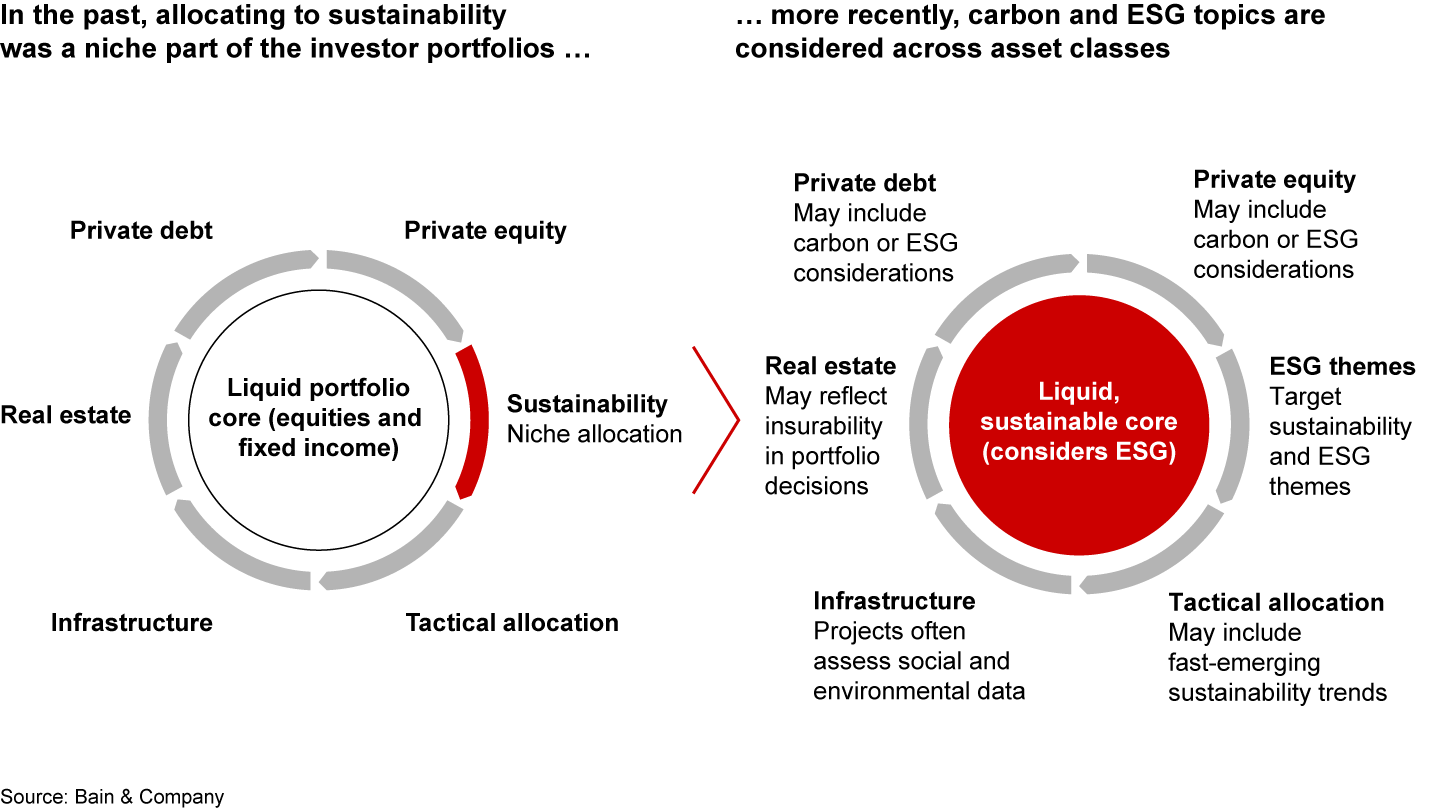
      Carbon, ESG are often embedded into strategic, whole portfolio decisions
      Carbon, ESG are often embedded into strategic, whole portfolio decisions
      Carbon, ESG are often embedded into strategic, whole portfolio decisions

      The second way this plays out is when fund managers, in turn, direct these questions to company executives and board members—in some instances because they genuinely seek a clearer understanding and in others because they wish to satisfy those who allocate assets to them for management.

      Company executives and boards who are queried in this way often suspect they’re being asked box-ticking ESG questions such as, “Do you have a policy or ‘commitment’ for x, y, z?” Leaders can be left with the (perhaps misleading) sense that ESG is entirely distinct from their operational and strategic decisions, or that they are being asked questions that are too far into the future compared with existing business planning cycles.

      However, a recent survey of public market investors Bain conducted with our partner Rivel suggests that it would be wise to treat such questions as potentially relevant to investment decisions and not merely motivated by compliance concerns. Most of the investors surveyed said they do not currently have specific carbon or emissions targets and thresholds in their portfolio decisions. But 19% of utilities investors had emissions targets and 16% of oil & gas investors were considering carbon targets (see Figure 2).

      Going forward, executive teams must watch to see if or when investors in other sectors and asset classes begin embedding carbon or ESG into portfolio decisions and proactively decide what this may mean for strategy, funding, and operations. And, in a recent study Bain and the Institutional Limited Partners Association conducted, 70% of limited partners (LPs) report that their investment policy statements already include some form of ESG consideration.

      Figure 2
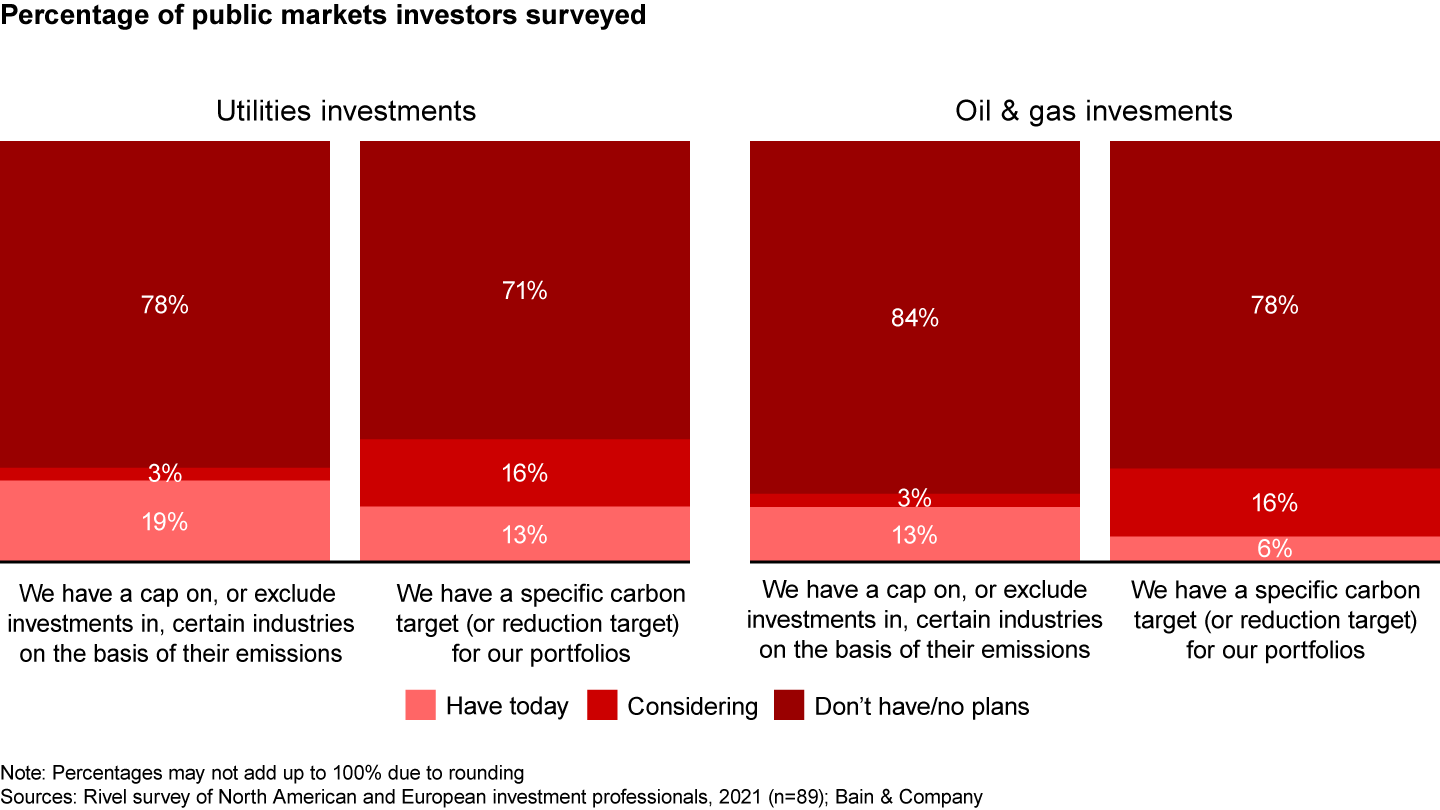
      Investor portfolios may have explicit carbon or ESG plans
      Investor portfolios may have explicit carbon or ESG plans
      Investor portfolios may have explicit carbon or ESG plans

      Some investors target ESG in portfolios

      The breadth of information available for investors to use as they build portfolios, whether classified as “sustainable” or just “investment insight,” will continue to grow. Indeed, the use of less traditional data insights in portfolios was already growing rapidly before ESG became common in portfolios to augment due diligence and/or valuation decisions by private equity investors, with their in-house data teams, and public market investors, both fundamental and quantitative. The two developments together mean that investors of all kinds are increasingly looking at a broader and more diverse set of inputs to inform analyses and decision making. 

      At the same time, executive teams—especially those in global businesses or with significant exposure to Europe—are acutely aware of regulatory shifts that impact both company and investor disclosures. The years 2023 to 2025 will bring enhanced corporate disclosure requirements for 49,000 publicly listed and privately held businesses domiciled in the European Union; investors will eagerly look to these mandated disclosures for several reasons. For portfolios subject to their own sustainable disclosure requirements as outlined in the EU taxonomy, there will be fund-level reporting to do based on these corporate inputs. The compliance imperative aside, investors will scour the trove of new information made available in search of anything that might help inform portfolios. Active investors continually seek, and are incented to find, new insights. Sustainability is one of many topics they assess to learn if there might be unique ways to better understand and differentiate company performance.

      The possibility that investors may uncover something new and informative to alter how they position portfolios should motivate executives and boards as they approach sustainable topics with their investors—perhaps there can be something more than a compliance exercise taking place with ESG (see Figure 3).

      Figure 3
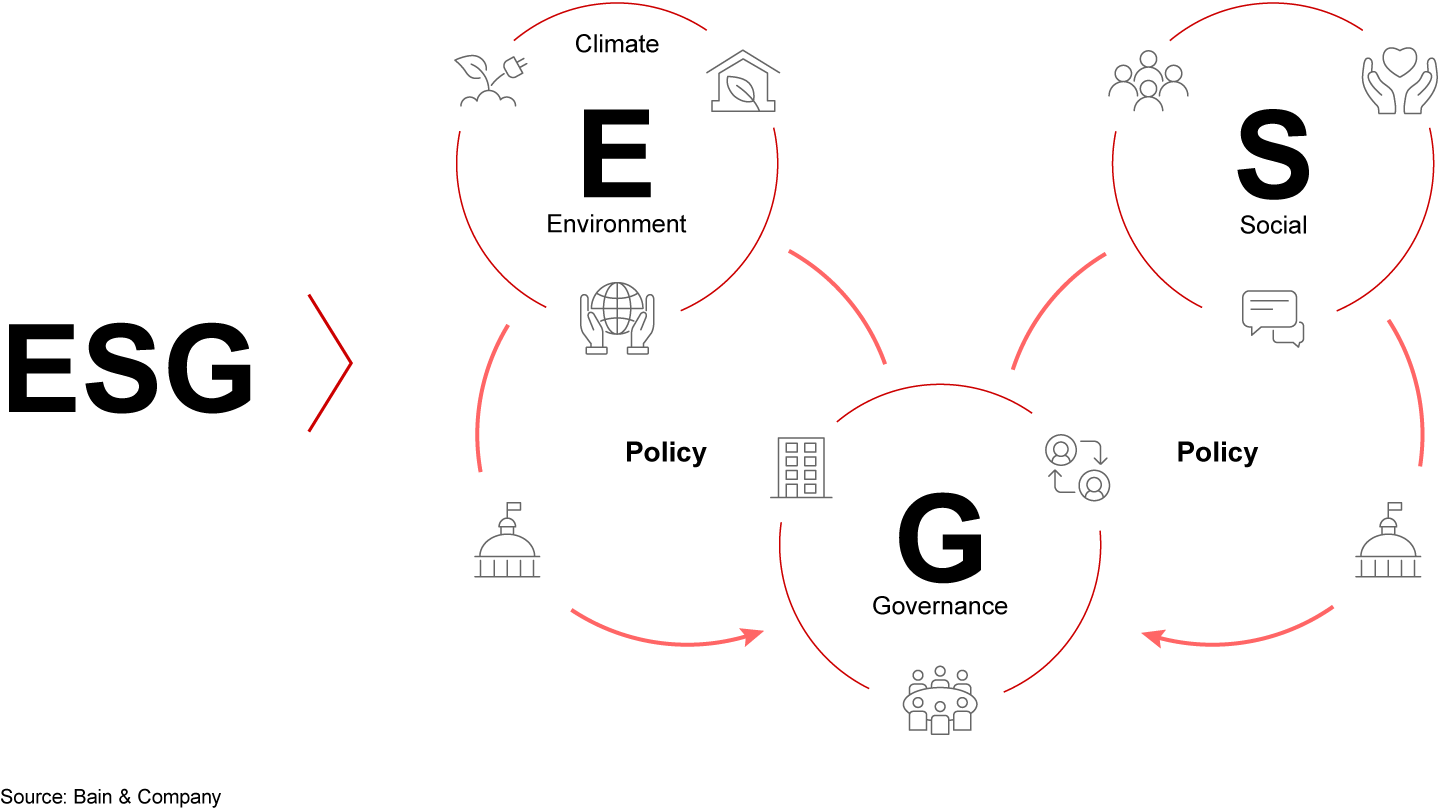
      Investors have the challenge and opportunity to find new, relevant, decision-useful information
      Investors have the challenge and opportunity to find new, relevant, decision-useful information
      Investors have the challenge and opportunity to find new, relevant, decision-useful information

      Don’t look away

      For executives and boards alike, 2023 is already a complex year for which to plan. Given macroeconomic and industry business cycles, not to mention current geopolitical and inflation concerns, it may seem as if environment, climate, and social considerations are fading into the background. But don’t be fooled: They aren’t, regardless of whether they’re called ESG or something else.

      Look closely at these issues instead of looking away. Boards and executives teams who have already made public specific environment, climate, or social commitments, or are considering them, may wish to build analytics into decision making to link these topics to operations and strategy. Wherever you may fall on this spectrum, don’t take the risk of letting investors assess and act on your ESG outcomes before you do.

      著者
      • Headshot of Debra McCoy
        Debra McCoy
        Alumni, Houston
      関連するコンサルティングサービス
      • サステイナビリティ、社会貢献
      サステイナビリティ、社会貢献
      How AI Is Starting to Transform Circular Packaging

      There are 15 AI use cases companies across the value chain can use today to accelerate circularity.

      詳細
      サステイナビリティ、社会貢献
      Exploring AI for Packaging Circularity

      AI is already creating value across the packaging lifecycle, from optimising design and reducing material use to improving sorting and traceability.

      詳細
      サステイナビリティ、社会貢献
      First Movers Coalition for Food: CEO Lessons for the Future of Food Procurement

      How companies can move beyond pilot initiatives to embed resilient, sustainable sourcing at scale.

      詳細
      サステイナビリティ、社会貢献
      Fueling the Future: How Business, Finance, and Policy Can Accelerate the Clean Fuels Market

      Why global clean fuel ambitions are outpacing investment, and what leaders must do to unlock capital and scale viable projects.

      詳細
      サステイナビリティ、社会貢献
      Sustainability: Less Talk and More Action

      Despite elusive targets, the business case is stronger than ever.

      詳細
      First published in 12月 2022
      Tags
      • サステイナビリティ、社会貢献

      クライアント支援事例

      サステイナビリティ、社会貢献 Can Microchips Turbocharge Sustainability Improvement?

      ケーススタディを見る

      サステイナビリティ、社会貢献 Voluntary Carbon Markets: A Bank Moves Early to Seize the Opportunity

      ケーススタディを見る

      サステイナビリティ、社会貢献 A Paper Company Takes Bold Steps to Make Sustainability a Source of Profits

      ケーススタディを見る

      お気軽にご連絡下さい

      私達は、グローバルに活躍する経営者が抱える最重要経営課題に対して、厳しい競争環境の中でも成長し続け、「結果」を出すために支援しています。

      ベインの知見。競争が激化するグローバルビジネス環境で、日々直面するであろう問題について論じている知見を毎月お届けします。

      *プライバシーポリシーの内容を確認し、合意しました。

      プライバシーポリシーをご確認頂き、合意頂けますようお願い致します。
      Bain & Company
      お問い合わせ Sustainability Accessibility Terms of use Privacy Cookie Policy Sitemap Log In

      © 1996-2026 Bain & Company, Inc.

      お問い合わせ

      How can we help you?

      • ビジネスについて
      • プレス報道について
      • 採用について
      全てのオフィス