

論説
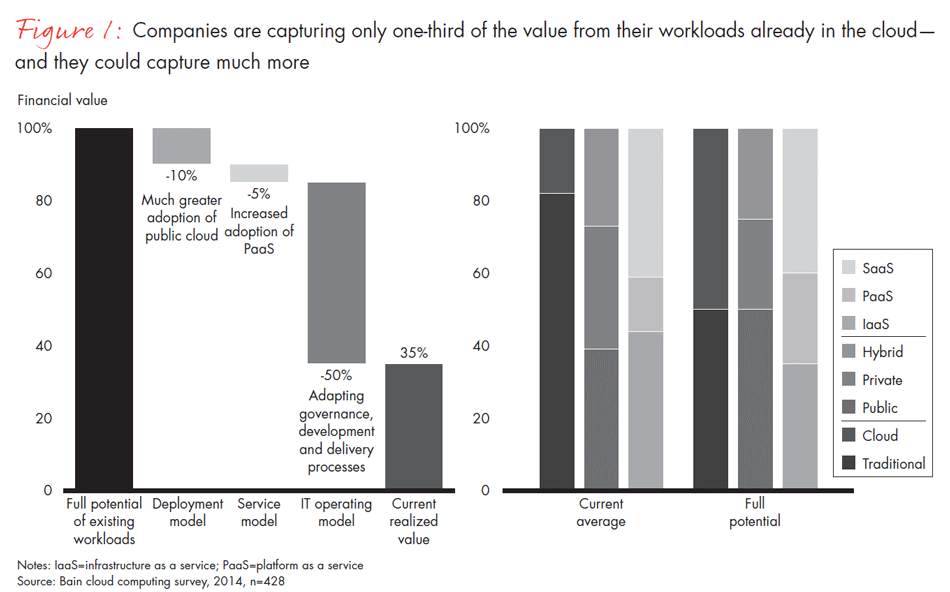
Most business and IT executives are well aware of the benefits of moving their IT workloads to the cloud: faster time to market, more flexible and scalable systems, streamlined application development and reduced data-center costs. Few, however, are using the cloud to its full potential. Our recent survey of more than 400 companies found that firms that are serious about getting cost savings and other benefits aim to migrate at least half of their workloads to the cloud. By comparison, companies deliver an average of only 18% of their workloads from the cloud today, though adoption rates vary by industry. Even with the workloads these companies have already moved to the cloud, they are leaving about two-thirds of the potential financial benefits on the table (see Figure 1).
Disruptive technologies are aptly named: they disrupt processes, organizations and sometimes entire industries. People hesitate in the face of big change, and executives are no different. Many would want to put off a daunting task like shifting half their workload to the cloud. But companies that delay this move will fall further behind in agility and innovation, which may put them at greater security risk, hurt their business performance and make it harder to attract millennial talent who want to work at leading companies.
Understanding the barriers
If executives understand the benefits, what prevents them from investing more deeply in the cloud? Four reasons top the list.
Deployment model: Public, private or hybrid? Many executives believe they will gain a competitive edge by migrating workloads to a private cloud. And for some workloads—especially those with restrictive compliance, security or IP requirements—private clouds are the best option. Still, our analysis finds that private clouds deliver only about one-third of the benefits of the public cloud.
Putting workloads on public or hybrid clouds delivers more value in the form of bigger cost savings, greater flexibility, more scalability and better built-in services. For example, adopting the Salesforce1 development platform has enabled some companies to launch 80% more applications annually and speed time to market by 70%.1 Other research has found that companies that moved development to IaaS and PaaS clouds from Amazon Web Services (AWS) reduced downtime by 72% and improved application availability by 3.9 hours per user per year.2
Until recently, IT executives were reluctant to adopt public clouds run by Amazon, Microsoft and Google. But the double-digit growth of public clouds suggests customers are becoming more comfortable with these solutions as vendors improve security, availability and flexibility, and as subscription fees continue to fall.
Service model: IaaS, PaaS or SaaS? Selecting the wrong service model limits the value that a company can capture from the cloud. Sometimes companies use basic IaaS solutions even though a more complete PaaS could speed up development and improve consistency. To take advantage of these benefits, enterprise architects and development leads need to assess whether the latest PaaS offerings add more value than basic IaaS for their workloads.
Executives frequently overestimate the value of customized software, choosing it over more cost-effective and industry-standard SaaS options. When they use SaaS, they often implement it in ways that undermine value—for example, allowing business units to make siloed decisions that result in dozens of instances of a SaaS app running across a company rather than standardizing one or just a few.
IT leaders can avoid these mistakes by taking a wider view, working closely with stakeholders to rationalize decisions. Most also need to update the ways they manage their application portfolios to ensure that they treat cloud solutions as first-class options along with traditional software.
IT operating model: embracing change. No matter how much work an organization puts on the cloud, it won’t see the full benefits unless it changes how it operates. In fact, our analysis suggests that as much as half the value of the cloud lies in the changes that a company makes in operations.
Cloud providers take on much of the rote work of monitoring and managing workloads and offer self-service features like on-demand provisioning of new capacity. All of that will help, but bigger returns come when business and IT align on “cloud-first” guiding principles for future workloads, vertically integrated teams take project ownership from beginning to end and staff is empowered to access the resources it needs. Incentives should encourage a cloud-first approach.
When moving to the cloud, companies should also standardize their development platforms, leverage automation tools and take advantage of self-service options for stakeholders. They should do more Agile development and tighten the integration between development and infrastructure with DevOps practices.3
Companies that use cloud technology most effectively tend to get three things right, says Steve Berez, leader of Bain's Information Technology practice in the Americas.
Scale and scope: fully vetting the cloud opportunity. Leading adopters have migrated nearly two-thirds of their workloads to the cloud, but the average company has only 18% there—and sees fewer benefits. Too many internal IT teams still think they are the most capable candidates to run data centers. That may have been true five or 10 years ago, but leading service providers such as Amazon, Microsoft, Google, IBM and VMWare have made dramatic improvements in cloud technology. Some infrastructure services will always remain under IT’s direct control for compliance or other reasons, but many companies could get substantial value by shifting more to advanced providers.
Some IT leaders also think that virtualization provides similar benefits by distributing processing or storage across the data-center infrastructure. Virtualizing the workload provides only a fraction of the cost and speed benefits that cloud storage delivers, but it does ease migration to the cloud. We find that well-run IT organizations with 60% to 75% of their traditional server environments virtualized can migrate faster than those that are less reliant on virtualization.
Another misconception is that the cloud has weaker security and scores lower on privacy, cost savings and availability than in-house solutions. The right combinations of deployment models and best practices can help IT organizations overcome these apprehensions. In fact, top-tier cloud providers have the resources to maintain top security personnel and can keep up with the most recent updates far better than most corporate IT organizations. Maintaining your own servers may feel like a more secure decision, but it hasn’t protected the victims of recent high-profile attacks, including Sony and JPMorgan Chase.
Finally, many decision makers focus too much on short-term savings to make the business case for cloud. They should also consider long-term cost avoidance, such as not having to expand and upgrade data centers. Even greater benefits come from improvements like faster deployment times, but these are harder to quantify. Still, these benefits are critical to business metrics like time to market, so executives should take them into account as part of the cloud proposition.
Moving to the cloud
Successful cloud migrations require a complete understanding of traditional workload costs, identification of the right goals—like how much of the business’s work can move to the cloud—and a comprehensive reform of the traditional IT operating model.
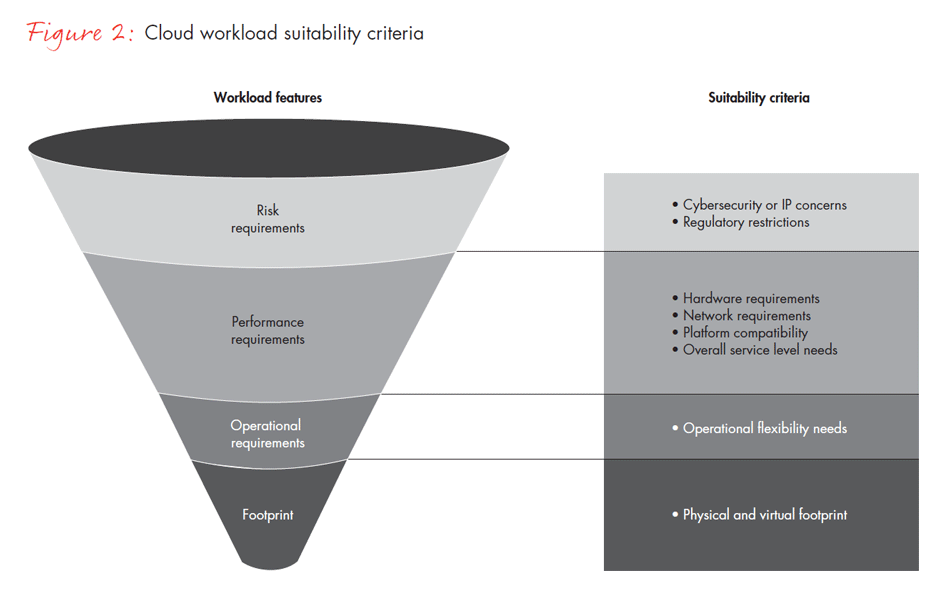
Ensuring the right point-of-arrival. Most companies move piecemeal into the cloud without a comprehensive strategy: A business unit buys a SaaS application or an infrastructure group adopts a private or hybrid cloud solution. Most fail to periodically evaluate their workloads to determine fit for cloud and optimal deployment and service models. A better way is to start with a comprehensive understanding of an organization’s workloads, application portfolios, data centers and other infrastructure, and then use a framework to identify which loads are suitable for the cloud. Companies can identify migration candidates by objectively evaluating workloads using comprehensive criteria such as risk and cybersecurity requirements; performance needs spanning hardware, network and platform features; and operational flexibility (see Figure 2).
Redefining the IT operating model. As executives identify targets and begin moving work to the cloud, they also need to adjust the traditional IT operating model, including priorities and alignment, delivery and operational capabilities, and the supporting processes and technology (see Figure 3).
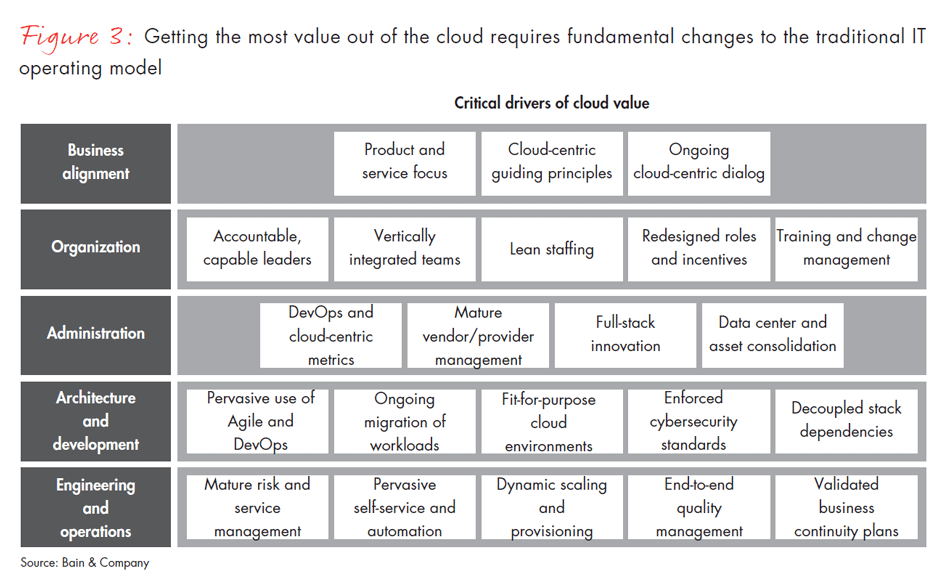
Companies that want to lead should adopt a cloud-first approach for new workloads. Senior leaders can establish this vision, but the IT organization, especially the architecture group, will need to retool governance and incentives to make it stick. Cloud providers like AWS and Microsoft offer training to help IT staff think along these lines, and it helps to hire staff experienced with cloud solutions to educate others on their teams.
Once workloads live in the cloud, development and operations teams can access environments and other resources more seamlessly than they can using traditional—and lengthy—IT provisioning and configuration processes. IT departments may get involved in some customization, but the cloud’s self-service features will significantly change IT’s role.
Traditional development, delivery and operations processes will also change. Most are more efficient in the cloud: Cross-functional collaboration becomes easier, and the cloud enforces a consistent architectural approach with built-in baseline security, monitoring and reporting.
Other advantages of the cloud that change the way IT operates include:
- Rapidly scalable development, test and production environments
- Process automation, continuous integration and deployment
- Access to new platform types and external services
Finally, development teams will take on some of the tasks that infrastructure teams once managed. IT will need to develop new roles to manage the cloud environment, and some employees will need to learn new skills or shift to different areas. IT may need to upgrade its capabilities in ITIL,4 Agile, DevOps and project management to capture the cloud’s full value, and this will require changing existing processes to work well in the cloud.
Taking the plunge. All but a few leaders are moving too slowly to the cloud, and they are missing out on financial benefits. Senior managers should set ambitious goals for cloud adoption, and make sure their leadership team aligns on the effort. The right leaders will be business-savvy executives who bring strong support from senior management and who can collaborate with a wide range of stakeholders across siloes. Many organizations already have some workloads in the cloud, and they should focus first on wringing the most value from these early moves, using them to climb the learning curve and build momentum for the two- to three-year journey ahead. Those who put off these decisions until the next quarter risk falling even further behind.
Steve Berez is a partner with Bain & Company in Boston, where he leads the Americas IT practice. Vishy Padmanabhan is a partner in Bain’s Dallas office. Syed Ali and Paul Callahan are principals with Bain in Houston and Atlanta, respectively.
1 Al Hilwa, Robert P. Mahowald and Randy Perry, “Salesforce1 Platform: Accelerate App Dev with Huge ROI,” IDC, February 2014.
2 Randy Perry and Stephen D. Hendrick, “The Business Value of Amazon Web Services Accelerates Over Time,” IDC, December 2013.
3 Agile is a set of software development principles that encourages closer and more iterative collaboration between developers and software users. DevOps refers to a software development method that focuses on continuous development and a close working relationship between development and IT’s daily operations.
4 ITIL (Information Technology Infrastructure Library) is a set of process rules for aligning IT with the goals of the business.
First published in 4月 2015