

論説

概要
- We project inflation will chop at least three to five percentage points off most telcos’ EBITDA margins over the next two years, unless they take effective countermeasures.
- Leading telcos are enacting a balanced response to inflation that both boosts revenue and reduces costs.
- Three moves can increase the effectiveness of inflation initiatives: getting a complete view of spending, elevating the CFO to C-suite quarterback, and running a private equity-style diligence to spot opportunities to create value.
With costs increasing at the fastest pace in decades, inflation has unsurprisingly risen to the top of the agenda for telecommunications executives.
And for good reason. We project that over the next two years, inflation will chop at least three to five percentage points off most telcos’ EBITDA margins, unless they take effective countermeasures.
The effect on each telco will vary, of course. But inflation will put pressure on most of the budget, particularly personnel costs, energy, external spending on services, leases, and capital expenditures. Collectively, these costs equal around 60% of most telcos’ spending (see Figure 1).
Figure 1
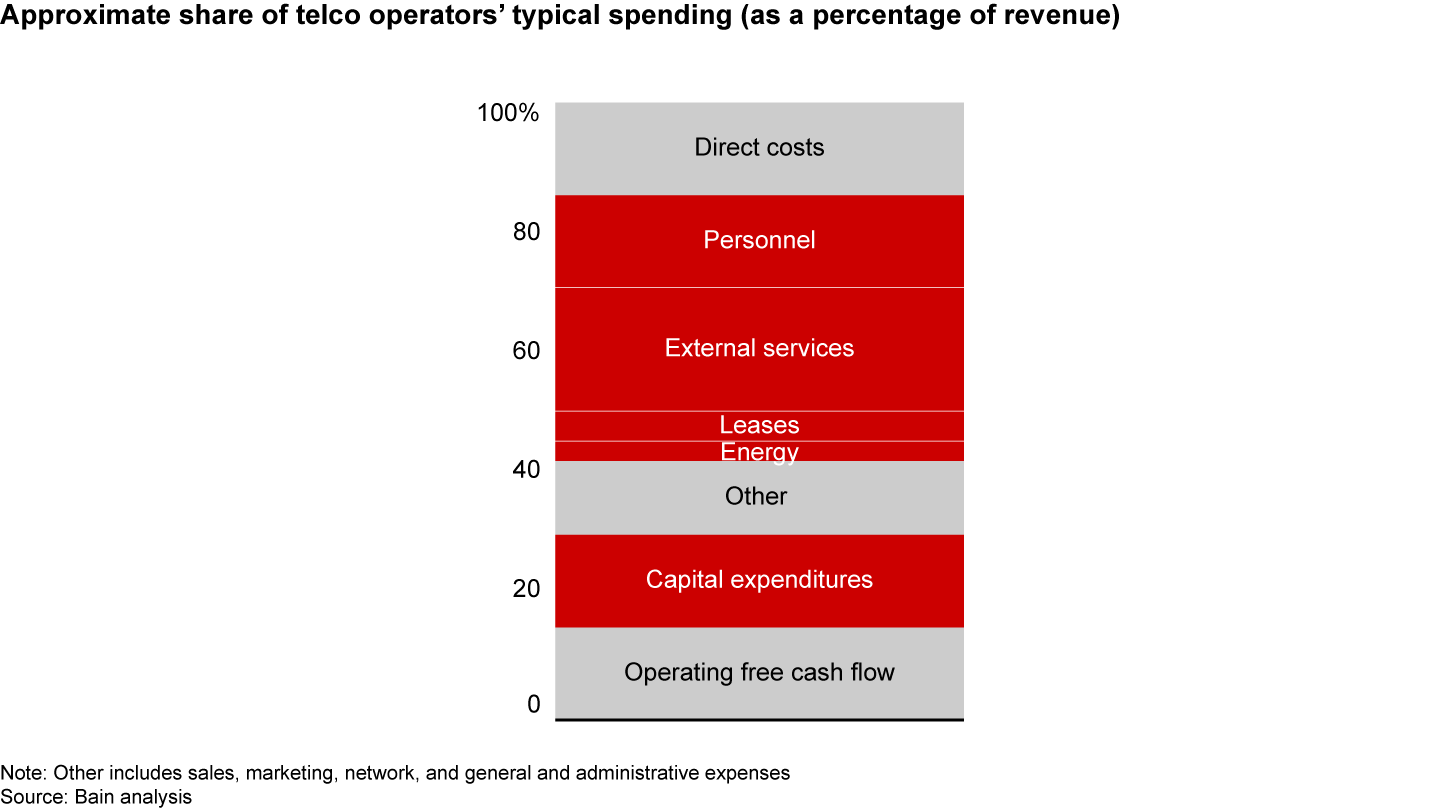

We anticipate inflation will start squeezing telco margins this year. And that’s not even considering a potential recession looming.
Telco leaders recognize that, left unchecked, inflation could hamper the sector’s efforts to increase its average total shareholder returns, which have been among the worst of any sector during the pandemic.
In recent quarterly results presentations, many telco operators have already flagged increasing costs and inflationary pressure as urgent threats. For example, European telcos including Deutsche Telekom, Orange, and Telia warned of rising energy costs (even though they’re mostly hedged for 2022) and inflationary cost pressure on wages and select external spending. In the US, Verizon acknowledged that rising inflation could increase energy-related costs for network operations and transportation as well as labor-related costs. AT&T also noted inflationary challenges, including pressure on wages.
A select few telcos will be able to leverage their pricing power to at least partially offset rising costs. In some European countries, for example, customer contracts that include price increases in line with inflation are the norm. But it will be more difficult to pass higher costs on to customers in most other countries, given the competitive dynamics in these markets.
Leading telcos recognize that this argues for taking a balanced response to inflation, guided by each company’s value proposition with customers. Indeed, that has proven effective in past inflationary periods for companies of all industries. Bain research found that during the last major recession, after the 2008 financial crisis, companies that took decisive steps to both push through price increases and boost productivity, primarily through cost-cutting, achieved higher total shareholder returns.
But telco operators face tensions between margin and topline considerations when responding to inflation, and that’s making it difficult to craft the right response and execute it confidently. In addition to higher operating costs, additional pressure on capital expenditures, and increasing interest rates, telcos become vulnerable to consumers trading down to lower-margin products as prices rise. Despite the pandemic-induced demand for high-quality connectivity continuing, there’s a risk of increased churn in the market as customers reassess their spending and look for alternatives. If price increases are too aggressive or the customer experience suffers from cost-cutting or labor shortages, customer loyalty could erode and contribute to further churn.
Resetting the equilibrium
Despite these enormous challenges and risks, the leading telcos recognize that the current situation has opened a window for them to reset the equilibrium between revenue and costs. They’re already taking steps to improve their position on both sides of the ledger.
Costs
Many telcos are accelerating automation initiatives to help offset rising costs, and some are using inflation as an opening to step up their green energy initiatives as well, amid higher prices for traditional energy sources. Telcos are also using zero-based budgeting techniques to reset their cost base—both which activities get performed and how—for everything from supplier contracts to capital expenditures.
Vodafone budgeted spending €850 million on energy in fiscal 2022. To mitigate surging energy prices, the company is expanding its long-term power purchase agreements, including with UK energy supplier Centrica, to secure power from solar farms. Vodafone projects the average European Union-wide wage inflation this year will be about 3%, which is below consumer price inflation. In response, the telco is looking into moving some operations to lower-cost locations, bringing down network deployment costs through technology-enabled efficiencies, and using pooled procurement across multiple countries to take advantage of its €24 billion purchasing power.
Deutsche Telekom is putting safeguards in place to manage its €1.5 billion in annual energy costs by establishing multiyear power purchase agreements. The company is also addressing the inflationary pressure on its €17.6 billion in personnel expenses by accelerating cost savings and digitization efforts.
Revenue
Here, telcos’ actions include adjusting base prices and promotions to protect margins, implementing price clauses linked to the consumer price index, reinforcing their premium price positioning where possible, and implementing pricing actions that offer “more for more.”
In the Netherlands, KPN in May announced it will increase prices by an average of 3.5%, but noted that this is below the inflation rate. Competitor VodafoneZiggo also announced price increases, citing the growing costs of energy and network equipment.
In the US, AT&T decided in May to increase rates on older calling plans, and Verizon raised prices for consumers and business customers.
Doubling down
On top of all this, telcos are recognizing that delivering a great customer experience has only grown more important in the current environment. Doubling down on this will make it easier for customers to accept price increases and not switch to competitors. As a result, many telcos will continue to focus on making customer journeys as simple, digital, and automated as possible.
In addition, in times of budget upheaval like these, telcos recognize the importance of improving their value proposition for employees and keeping their workforce engaged. Many telcos are responding to employees’ desire for flexibility by increasing work-from-home options, as well as investing in training and skill development to help employees adjust to new ways of working. Such moves can help strengthen employee loyalty at a time of uncertainty around wage increases.
Window of opportunity
Based on our analysis of past inflationary periods and our experience working with companies worldwide across industries, here are three immediate, no-regrets moves that telcos can take to execute their inflation response effectively and take advantage of this window of opportunity to accelerate performance and strengthen the company’s resilience.
Gain better spending visibility. Granular spending visibility is the foundation of any expense management capability, and it’s even more critical during periods of inflation. It enables managers to fully understand where money is spent and who spends it. A good place to start is by placing all spending data, analysis, and dashboards in one digital platform so there’s a single source of truth. To get the full view of spending, leading companies then go a level deeper and develop a more robust understanding of the real enablers of cost in an inflationary environment. This entails dissecting the rate (prices paid) and consumption (quantity or volume), including the underlying drivers, for critical cost categories. This, in combination with a well-defined investment posture, will allow companies to deploy targeted responses to inflation that are grounded in the company’s strategy.
A key part of this exercise is ensuring company leaders agree on which capabilities need to be best in class—built to enable and sustain competitive advantage—and which need to be best in cost. For example, should the telco manage its contact centers to provide a service level roughly on par with the competition and at the lowest possible cost, or should it sacrifice some cost in order to deliver a customer experience that sets the company apart from competitors? Answering foundational questions like this will help the telco set the dial on the scope and nature of cost-reduction measures—or call for investing more in certain areas of high opportunity.
Elevate the CFO to C-suite quarterback. In inflationary periods, leading companies expand the CFO’s role because they recognize that person’s expertise makes them uniquely qualified to help the C-suite navigate the more turbulent times. The good news for many telcos is the CFO is already a powerful figure. Telcos typically have high capital expenditures, and cost has been near the top of the C-suite agenda since the early 2000s, when industry growth was slowing. However, after the shift in recent years to prioritize revenue growth, which heavily dictated telco share prices, the CFO will need to reassert his or her grip on costs and act as an impartial arbiter of spending decisions in order to successfully steer the company through inflation.
Helpful moves include instituting more frequent cost-setting exercises outside of the standard annual review period; ensuring that the organization accurately understands and addresses the key cost drivers; and aligning incentives among the leadership team to prioritize stabilizing margins.
Run a rapid, private equity-style diligence to spot value creation opportunities. Facing pressure to act quickly to counter inflation, it’s easy for company leaders to only make reactive moves to stem the tide. But the most successful companies take a comprehensive view of the situation and go beyond short-term cost management: They look for ways to emerge from inflation even stronger. One effective tool for unlocking value during inflationary periods is to conduct a private equity-style diligence exercise to determine the risks and opportunities in the inflationary environment and stress-test the company’s ongoing initiatives. Leading companies create a small Agile team from across core business functions. Over the course of several weeks, the team should be able to produce a list of inflation-response initiatives ranked by potential value, a set of facts to inform a “go/no go” decision on each initiative, and a roadmap for executing the options.
While most telco operators recognize that inflation provides a window of opportunity to reset the equilibrium between revenue and costs, they’re also clear-eyed that this will likely require an uncomfortable level of change; substantial resources; perhaps unnatural focus, energy, clarity, and intensity; and an integrated, targeted response. Nevertheless, those that move quickly to capture the opportunity have a chance to alter the trajectory of the company and achieve bold results.
First published in 6月 2022