

論説
The cloud has reenergized the software sector. Software as a service (SaaS) has created exciting fast-growth companies with innovative business models and even a few stellar IPOs like that of human resource software provider Workday whose shares rose about 70% above the opening bid for its October 2012 debut. Revenue growth for SaaS companies is predicted to triple between 2011 and 2014. In 2011, they were five times more likely to receive venture capital investments than traditional software companies. Just about every software company watching this shift is realizing it has to play the SaaS game.
Venture behind the headlines, as we do when we talk with software CEOs and industry veterans, though, and questions emerge regarding whether SaaS is good for the industry in the long run. Inflections of this magnitude are rarely kind to incumbents, although the giants sometimes learn from newcomers how to survive and even thrive. For software, which for years has been a profitable and high-growth sector, the central debate is around whether SaaS will reduce or expand revenue and profit opportunities. We hear three questions time and again: How big is this disruption? How will it change the rules of the software game? What can incumbents do to thrive and avoid being eclipsed by upstarts?
The reach of the SaaS wave
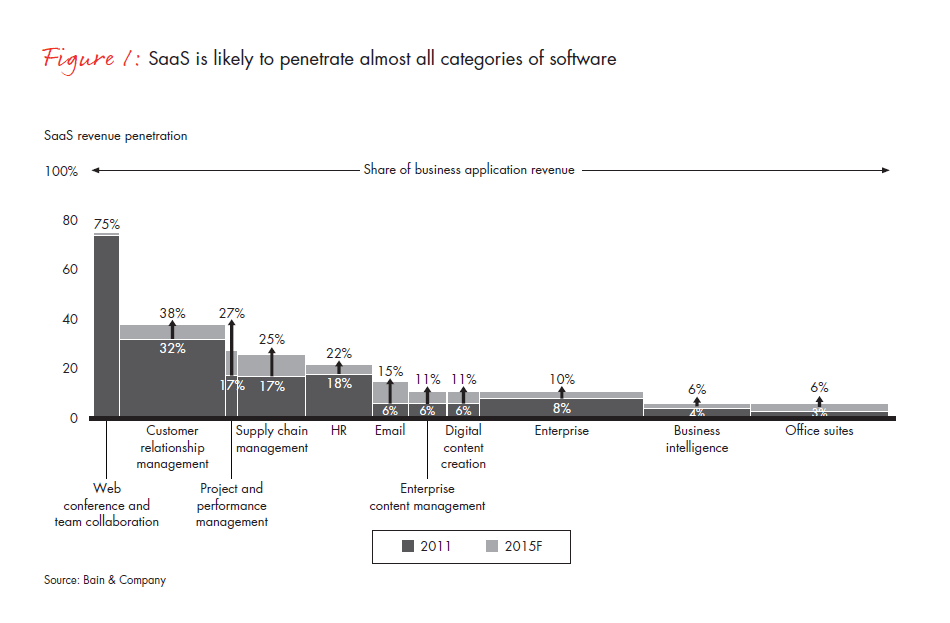
So far, SaaS has taken over only a few categories of software (customer relationship management, online collaboration) though we expect it to penetrate almost all software categories over the next few years (see Figure 1). “Better in the cloud” features, such as collaborative working or ubiquitous access, and those features that reduce IT headaches, such as automatic and painless software upgrades, which are sometimes coupled with a lower cost of ownership, will primarily cause that change.
But while few software markets are likely to convert entirely to service models, even a modest SaaS uptake—say, 10%—can change the pricing model or the dialog between vendors and customers, as with ServiceNow.
Few expected ServiceNow’s SaaS offer to rock IT service management when it started gaining traction in 2007, but its fast and easy adoption led clients to ask bigger vendors like BMC Software, with its category-leading Remedy product, why they didn’t provide a cloud option. ServiceNow’s growth pushed the company past the $100 million revenue mark in March 2011 and on to a successful IPO in June 2012.
The enduring—and new—rules of success
Disruptive technologies tend to rewrite the rules of profitable growth and competitive advantage in a sector. SaaS is no exception. But we expect that three fundamentals of success in software—platform power, scale economics and product stickiness—will continue to apply to software as a service as they have in packaged software. In addition, one new factor—gaining deep customer insights and finding ways to profitably act on them—will be crucial. We believe that after a bumpy start, SaaS is likely to grow the industry’s profit pool over the long term.
Platform power. Successful software products become platforms that define de facto industry standards and prompt third-party contributors to develop new applications that extend the original software’s functionality and value. Platform creators gain a competitive advantage because they can shape the market’s direction and remain an integral part of customer systems for many years. Salesforce.com’s Force.com is one example: The platform draws thousands of third-party developers who create new applications on top of it, further boosting Force.com’s value. We believe this powerful fundamental will not change. Creating dominant platforms gives developers control over core data and transactions. Soft-ware that can maintain that control—whether SaaS or licensed—will remain relevant to the customer.
Scale economics. Promising newcomers, including many SaaS companies, often show tremendous and rapid growth. But developing and selling enterprise software remains a scale business driven primarily by the high cost of sales organizations. While innovative lower-cost sales models will become more common, we don’t anticipate that they will fundamentally alter the development or sales economics in enterprise software. A wave of consolidation has already begun (SAP buying Ariba and SuccessFactors, Oracle acquiring Taleo and RightNow) and is likely to accelerate over the next few years as incumbents acquire start-ups for their innovative products and talent, and pair them with their large sales organizations.
Product stickiness. The aspects of software that make it sticky—tailoring to a company’s needs and an intuitive user interface—are just as relevant in a SaaS world. The ease of adopting SaaS products—one of the strongest selling points of the enterprise—may at first seem to suggest the end of stickiness. We don’t think that will be the case, however, since the friction of transporting data across applications and retraining staff will continue to make it difficult to displace a SaaS product.
Deep customer insights. SaaS introduces a powerful new opportunity to benefit from deep insights into how customers use the product. Because vendors host the service, they can mine usage data and analyze patterns to improve the product incrementally and do so more quickly than they could in the old upgrade cycles. Using these insights to deliver more value may help grow revenues and profits. Some early SaaS leaders, such as Salesforce.com and Intuit, are moving aggressively to build skills in this area.
Incumbent strategies in an evolving landscape
Incumbent software companies face a choice: defend their turf and risk being bypassed or transform their business and embrace the SaaS model. Most are making the smart choice to experiment and evolve, using the following three strategies:
1. Commit to a strategic path and align resources. Software companies exploring the service model must rethink their pricing model (license or subscription), customer base (existing or new) and product offer (core application or adjacent capabilities). We see five migration paths as examples of how software companies weigh these factors as they move to the cloud:
- Flex pricing. Adobe is migrating its Creative Suite design software from an on-premise model to a Creative Cloud brand that depends on monthly subscriptions, which offer an entry price far below the old license of several hundred dollars. Adobe had already offered the monthly option alongside the licensed version, tapping a segment that does not need (and so rarely bought) a long-term license. Corporate buyers say they like this shift from capital expense to operating expense, prompting other licensed software vendors to offer on-demand or subscription pricing.
- Attack adjacencies. A complementary SaaS offer can tap markets adjacent to the core software business. Intuit’s SnapTax offers a simple, hosted product for customers who want a quick and easy way to file uncomplicated tax returns, and for whom Intuit’s traditional and highly successful TurboTax was too elaborate.
- Offer “better in the cloud” functionality. Vendors can use the cloud to improve existing, on-site products. Autodesk’s cloud platform services offer industry-specific (vertical) extensions for some of its traditional licensed products. For example, customers can tap the power of a large connected network to run complex simulations in minutes rather than hours.
- Play it both ways. Sometimes the best approach is to offer two versions: one on-site and the other hosted. Remedy, BMC Software’s IT services management product, has long been a leader in help desk software. But the rise of ServiceNow disrupted that market, prompting BMC to offer a SaaS version as well. Initial concerns that big companies would snub the cloud have dissipated as customers of all sizes have embraced the SaaS version for its fast implementation times and easy upgrades.
- All in. Ariba’s radical transition from a traditional software model to a SaaS provider in 2005 put the company under intense pressure as license revenue dropped dramatically and it endured three consecutive years of operating losses. But the effort paid off: By 2010, subscriptions accounted for more than half of revenues and the company’s total revenues have been growing by more than 20% annually since 2009, prompting SAP to acquire Ariba in 2012 for $4.3 billion. Much of that growth comes from small- and medium-sized business customers, a market that had previously considered procurement packages beyond its means.
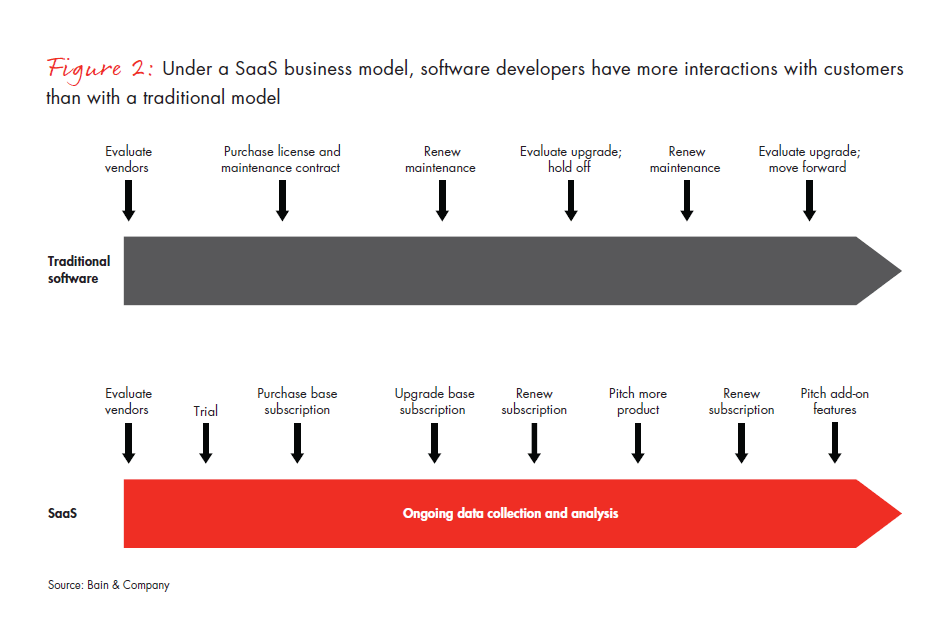
2. Embrace customer insight and intimacy. SaaS’s rapid development cycles entail many more touch points with customers than the traditional model (see Figure 2). Software executives and developers need to rethink their relationship with users: inter-actions become an opportunity not only to renew and enhance the customer relationship but also to improve the service itself. Since developers host the systems that customers use, they now have access to vast amounts of data about the ways that customers use their software. That, in turn, can inform decisions about how to prioritize improvements and highlight opportunities for cross-selling.
Software vendors will also come to understand that long-term customer loyalty is no longer optional but essential. Under the traditional model, vendors could focus their customer relations on the point of sale, occasionally overpromising and then leaving customers alone until the upgrade. With SaaS the renewal process is continuous, and customer loyalty is important every day.
3. Organize for innovation. The differences between selling licensed software and running a software service are greater than most executives may anticipate. Managing two distinct businesses within one organization is a major challenge. Aligning sales incentives can be particularly difficult since commissions are typically based on a large up-front fee and cloud customers make small, recurring payments, often with no up-front cost or commitment. Sales organizations, therefore, need to reevaluate their commission structures, for example, by compensating sales forces based on the expected lifetime value of customers.
Ramping up the rate of software work in companies with legacies of long development cycles is equally challenging. The old model of taking years to develop and debug new releases before unleashing them has given way to “release early, release often.” A new generation of SaaS customers has grown used to rapid responses to their requests for improvements. Amazon Web Services, for example, launched more than 130 system updates between January 2011 and September 2012, setting a pace that shapes CIO expectations for other cloud providers. Microsoft Office, with its new Office365 SaaS version, aims to deliver customer updates at least once a quarter instead of its traditional multi-year upgrade cycles.
The software business of 2020 will look markedly different from the way it does today, and we expect that the leadership in just about every category will be reshuffled. The surest path to success lies in expanding the new SaaS business while maintaining focus and consistency in the legacy business.
Ravi Vijayaraghavan is a partner with Bain & Company in Boston and a senior leader in the firm’s Global Technology practice.
The author would like to acknowledge the contributions of Dianne Ledingham and Mitchell Leiman, partners with Bain & Company in Boston. Simon Heap, a partner with Bain in Silicon Valley, and Chris Brahm, a partner in San Francisco, also contributed.
First published in 6月 2013