

Engineering and R&D Report

概要
- Artificial intelligence, machine learning, and other technologies allow companies to embed novel features in their products and enhance the customer experience.
- Engineering-heavy companies are also developing new sources of value by improving environmental, social, and corporate governance outcomes.
- Top engineering and research organizations build an ecosystem of partners to fuel innovation.
This article is part of Bain's 2023 Engineering and R&D Report.
At global medtech giant Stryker, the leadership team’s quest for new sources of value creation is transforming the business. Once focused mainly on medical products, the company has moved over the past decade into preoperative surgical planning, digital physician advisory, robotic surgery, and wearable devices to track rehabilitation. Digital sensors harvest data at each step in the patient journey to continually improve Stryker’s products and ensure the best medical outcome.
Companies like Stryker are leading a vital shift in the way they wield technology and innovation in engineering and R&D (ER&D) as a source of value creation and competitive advantage. Historically, companies have viewed ER&D as a core function, but their primary focus was on making products better and cheaper. Today, an emerging group of leaders are investing in it as a strategic capability. These companies put ER&D and new technologies at the center of their businesses and wield them in bold new ways to innovate and reinvent business models. Instead of concentrating largely on improving products, they are moving into outcome-based solutions that allow customers to pay based on negotiated results, such as machine uptime.
How does this work on the ground? CTOs and ER&D teams are developing software, hardware, and services to improve customer outcomes and experiences (Figure 1). For example, instead of selling a hip implant, Stryker’s ambition is to ensure successful hip implant surgery and rapid recovery.
Figure 1
To reimagine the business around the concept of customer outcomes and experiences, leadership teams are accelerating their investments in several key areas. First, companies are embedding novel features in their products based on artificial intelligence, machine learning, cloud connectivity, and edge computing, which is a form of computing done on-site or near the source of the data, minimizing the need for remote data processing. Such features can transform unconnected products into smart devices.
A second area of investment to enhance customer experience involves designing products for continual upgrades and new services. Digital technologies allow companies to send upgrades via software or over the air. The aim is to delight customers with new experiences and produce an ongoing stream of revenue as opposed to a one-time product sale.
Companies are also creating new sources of value by improving environmental, social, and corporate governance (ESG) outcomes. Many are investing in new technologies to lower the firm’s carbon footprint and reduce the carbon emissions of their products. Leaders are designing goods for a circular economy by reusing materials, recycling, and remanufacturing products to extend their life. Circular design involves the use of modular components that are easy to replace or upgrade, enabling a longer life span. Remote monitoring technology can help firms better understand the value of a device in the field and its potential for refurbishment.
CTOs leading the race to find new sources of value creation are investing in all of these areas, often in combination. For example, Google Nest tapped artificial intelligence and machine learning to add innovative new features to standard thermostats. The result was a smart thermostat supported by cloud-enabled services that can learn a customer’s schedule and program itself to save energy. The innovation transformed the customer experience and forged a new market segment. Smart thermostats are expected to capture 18% of the thermostat market by 2028.
The risk of technology-based disruption adds urgency to the search for new sources of value creation. Companies in ER&D-heavy industries that do not invest and innovate to improve the customer experience may find themselves rapidly sidelined by nimble rivals.
From product to service
The path to new sources of value creation differs by industry, but many first movers are reimagining their products as a service. Until recently, for example, automakers viewed their core business as producing vehicles. Now, many define their business as providing mobility. These leaders expect services to become a significant share of their business as they expand into new areas of mobility, including self-driving taxis, connectivity, and features that make driving easier, more pleasurable, and more productive.
Volkswagen, for example, sells electric vehicles (EVs), but also provides a charging service on multiple continents with one convenient wireless identification card. To ensure a seamless customer experience, it has teamed up with infrastructure providers to develop a simple and standard process that allows drivers to charge their cars at locations across the US, Europe, and China.
In aerospace, companies that once focused on selling planes increasingly are developing products and digital services that enhance the customer experience prior to the flight, in the air, and after landing. For example, Airbus and German authorities recently launched a research initiative on urban air mobility that will explore electric vehicle takeoff and landing for trips within cities and from one city to another.
Machinery companies are undergoing a similar shift. Instead of selling equipment with traditional service contracts, leaders are offering solutions that generate greater value for their clients. Such contracts may guarantee machine uptime, output rates, or other productivity metrics. Switzerland-based construction power tool company Hilti is expanding from hardware into construction software to improve construction productivity. It recently acquired Silicon Valley construction management software company Fieldwire, which is improving productivity on construction sites by optimizing coordination among owners, general contractors, architects, engineers, and other subcontractors.
Some companies and industries are further down the path than others in developing new sources of value based on enhanced customer experience. One early lesson: Success requires cross-functional collaboration. Leaders start by identifying the customer need. Next, the salesforce designs a proposition and pricing model. That ensures ER&D teams will create the right product.
Outcome-focused engineering
What sounds easy in theory is extremely challenging in practice. Companies that take broader responsibility for outcomes need to deploy digital technologies that can dramatically reduce error rates and variable results. Take the case of self-driving cars or planes. To make autonomous vehicles safe, ER&D organizations must use fundamentally different technologies and develop new capabilities. Outcome-focused engineering requires big data and analytics capabilities, control over multiple value chain steps, and human-centric and personalized product design.
How are leading ER&D organizations supporting the transition to new business models? One important step is building a digital twin, or a virtual model of products out in the field. A digital twin can, for example, alert engineers to problems before they occur, chart energy use, and improve productivity. In designing a product, digital twins can be used to run simulations that help catch errors before the product trial phase, reducing time to market.
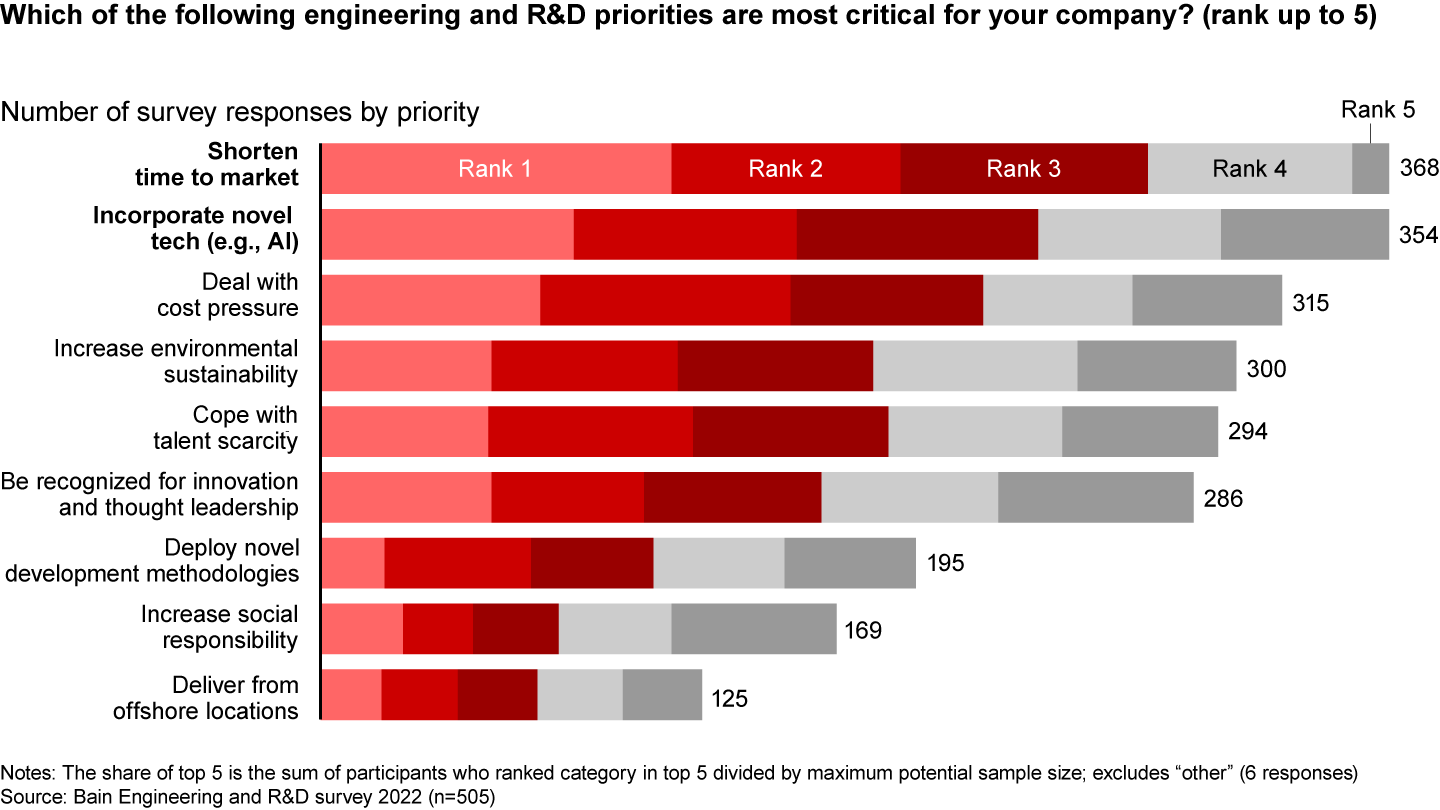
Another vital step is building a talent pipeline for the necessary engineering and IT capabilities, including data science, Internet of Things (IoT), and cybersecurity expertise. Leaders also are expanding the engineering teams’ scope of activity across the product life cycle. Nearly three-quarters of CTOs say shortening time to market is a top priority for engineering departments, while 70% say incorporating novel technologies into products and services is a key priority (see Figure 2).
Figure 2

Organizational change
Successful CTOs have understood that redesigning the ER&D organization is critical to focusing more effectively on customer experience and outcomes. That means expanding the engineering team’s scope of activity, modernizing the operating model, processes, and workflows, and developing an effective human capital strategy and culture (see Figure 3).
Figure 3
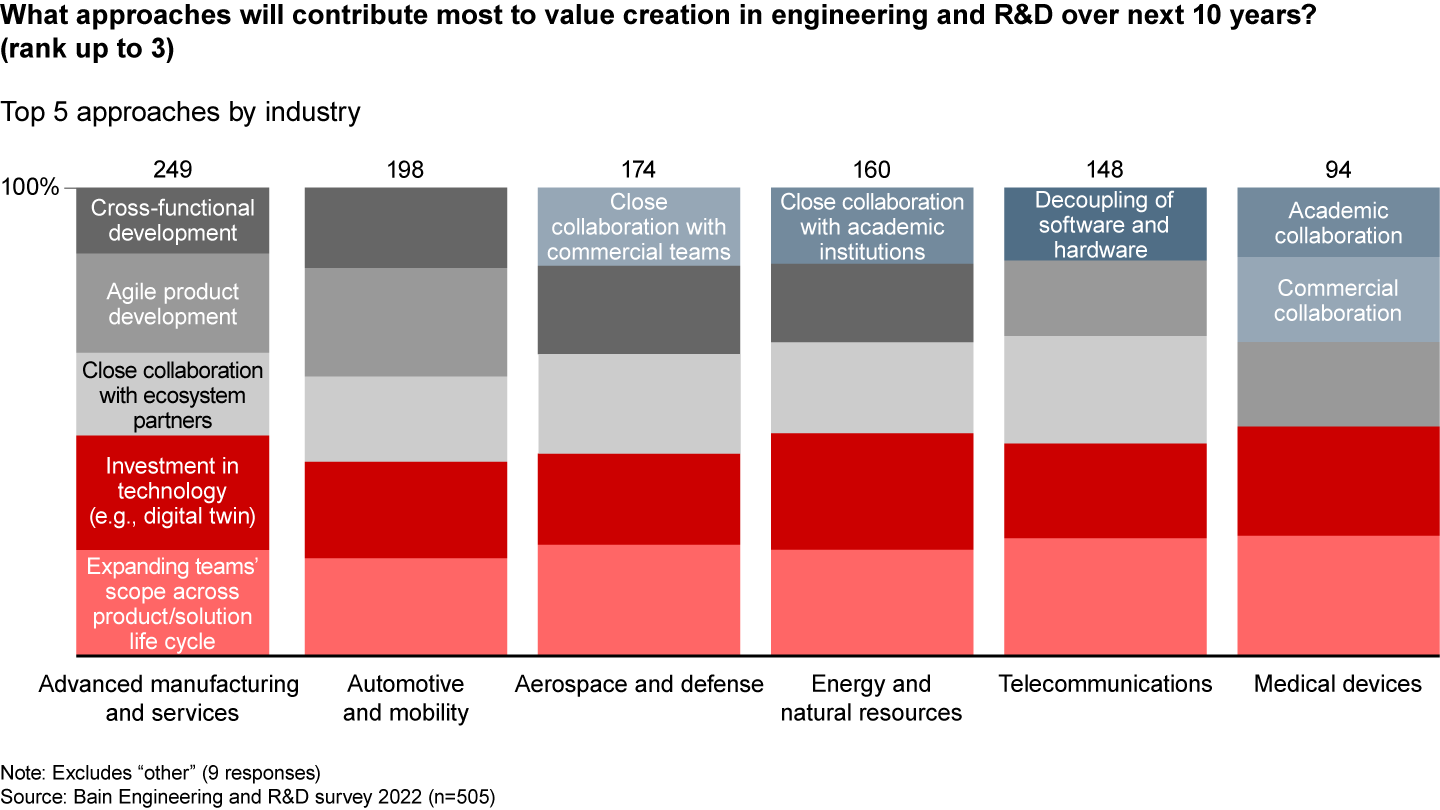

One important organizational change is the need for interdisciplinary teams that provide access to strategic assets such as technology expertise to all departments. For example, a European leader in building technologies has bundled its embedded software and hardware capabilities in a cross-functional team. That team now provides different internal units throughout the organization with a modular set of software and hardware building blocks that they can use to build products.
A second major organizational difference is the shift from cyclical product development toward continuous technology development. In the long run, an Agile approach shortens time to market and reduces unit costs. Software development leaders such as Amazon and Netflix highlight the power of continuous development by using software code to upgrade their products thousands of times a day. Cross-disciplinary teams are key to continuous development as they are more likely to develop efficient solutions. Instead of having different departments create electronic control units for various functions in a car, for instance, one cross-functional team can use its combined expertise to consolidate the customer experience functions in fewer chips.
Leading ER&D organizations also embrace open engineering. They build an ecosystem of partners to fuel innovation and broaden their capabilities. Siemens and Qualcomm Technologies, for instance, joined forces to develop 5G-enabled smart building networks. The goal of the building automation partnership is to improve energy efficiency, reduce the cost of building ownership, and enhance security.
To free up engineering talent for more critical tasks, top CTOs are investing in automation, technology, and artificial intelligence. That approach also increases engineering efficiency, generating cost savings to invest in upskilling and hiring.
In the coming decade, ER&D teams will be critical sources of competitive advantage. They will improve existing products, unearth new sources of value creation, and lay the foundation for entirely new business models. Leaders know that developing new sources of value takes time. Those that start down that path today will be best positioned to compete in a new era.
More from the report
Read our Engineering and R&D Report 2023
First published in 4月 2023