

論説

概要
- Facing mounting challenges to their business and the need to cut costs, traditional retailers are taking a radical stance by shifting to a zero-based approach to managing SG&A expenses.
- Zero-based budgeting provided a major retailer with granular visibility into its spending, along with the cost management discipline to prevent costs from creeping back in over time.
- Another major retailer used zero-based redesign to transform its human resources function and align activities to what really delivers value—saving more than 30% on HR costs while prioritizing strategic costs and eliminating costs in nongrowth areas
These are particularly tricky times for traditional retailers. Web, mobile and even voice shopping options have upended the rules of engagement, intensified competition and boosted customer expectations. Customers now expect to move seamlessly between digital and physical channels. They expect speedy and free delivery. Emboldened by the price transparency afforded by online commerce and the proliferation of dollar stores and hard discounters, they expect lower prices. All this comes at a time when retailers are facing added expenses, in everything from store labor to logistics and delivery, where costs are expected to rise along with fuel prices.
The challenge confronting retailers can feel daunting, if not impossible: How to fund investments to improve the customer experience and expand omnichannel capabilities while also lowering prices to remain competitive? And how to do it while dealing with both top-line pressure and rising costs?
To start, retailers are acknowledging that there is a structural issue at hand. In essence, retailing has fundamentally changed over the past decade, but cost structures and cost management capabilities for selling, general and administrative (SG&A) expenses haven’t kept up—and retailing has largely failed to reap the productivity gains from labor innovation and automation that other industries have enjoyed. Winning companies recognize that traditional belt-tightening will not be enough to fund their future strategies and that cutting costs in the wrong places could backfire. For example, some retailers have instinctively responded to slowing physical store sales by reducing store labor, only to create a doom loop in which fewer store employees leads to a poor customer experience, which leads to even fewer shoppers and thus the need for further reductions in store labor. And many retailers have fallen into a trap familiar across industries: Companies painstakingly trim costs only to find them creeping back in over time.
Lewis Weinger, a partner with Bain's Retail practice, explains how zero-based budgeting helps retailers find savings to reinvest in the company's strategy.
That is why some retailers are taking a more radical stance by shifting to a zero-based approach to managing SG&A expenses, often paired with more rigorous fact-based negotiations to reduce the cost of goods sold (see the Bain Brief “How Grocers Buy Better for Growth”). Zero-basing allows them to establish new SG&A cost structures and build new cost management capabilities that are more relevant for a massively changed retailing environment, and to reallocate spending to strategic areas. It is by no means the right answer for every retailer, but it is yielding dramatic results through two primary methods:
- Zero-based budgeting (ZBB) turbocharges the cost management engine and drives down the cost curve faster. It is a continuous-improvement capability that provides the granular cost visibility needed to challenge the status quo and refocus resources for growth. It is not just a budgeting exercise but a management system and philosophy around cost.
- Zero-based redesign (ZBR) enables retailers to completely rethink the organization and align activities to what really delivers value in this challenging new world. It is a onetime blank-sheet exercise to redesign functions and processes, with the goal of reducing organizational cost and complexity.
Elements of zero-based cost management have received some bad press over the years, and often are viewed as destroyers of growth and culture. Yet the opposite has been true for retailers that exercise flexibility in implementing their programs. These companies have achieved zero-based cost management’s trifecta of EBIT margin growth, revenue growth and employee engagement (see the Bain Brief “Betting on Zero-Based Budgeting’s Trifecta”).
Consider the example of a US-based retailer that wanted to reduce spending in some areas to fund investments in pricing and omnichannel capabilities. As a first step, the company needed to understand how and where costs were allocated in order to identify where there were opportunities to cut. But, as is often the case, the company lacked visibility into its spending. Significant portions of the budget were assigned to catchall accounts such as “other SG&A” and “other third-party services.” Even more expenses were placed into the wrong accounts and required behavioral classification changes. Compounding the situation: Like many retailers, the company was highly distributed, meaning that decision making for many SG&A categories was highly distributed as well.
Zero-based budgeting provided the company with a granular view of its current SG&A spending. Particularly valuable were ZBB dashboards that allowed the retailer to drill down by cost category and filter by cohorts of stores with similar characteristics (see Figure 1).
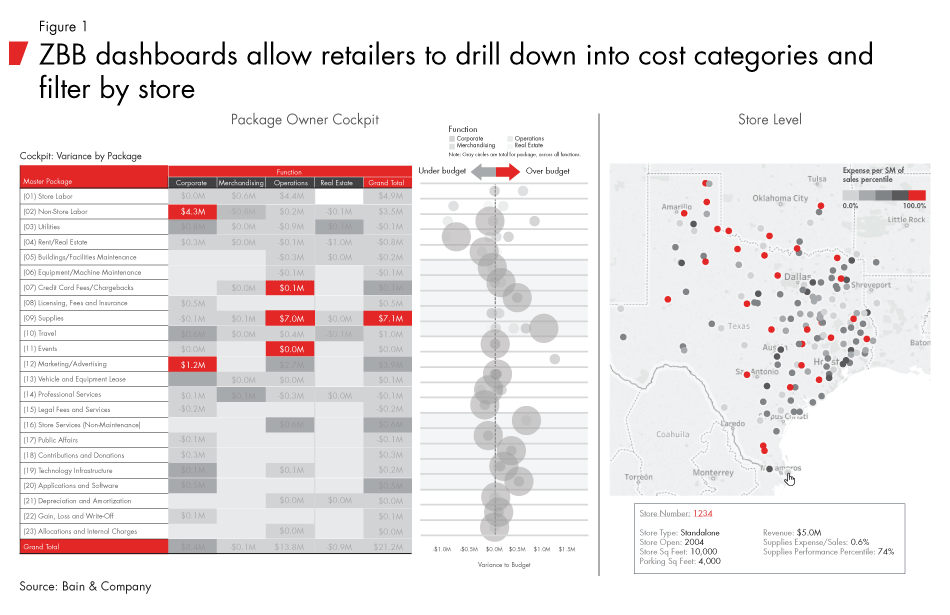
For example, when examining supplies costs, the retailer identified stores that were nearly identical across key characteristics such as sales, sales mix, basket size and location, yet the supplies budget for some of those stores was nearly double that of others in the same cohort. In the past, when this retailer went through a cost-cutting exercise, it would have reduced the supplies budget for every store by 5% to 10%. ZBB enabled it to take a targeted, data-driven approach to cost reduction; some stores’ supplies budgets were cut in half while others remained untouched or even increased.
The retailer saw an additional benefit from the granular internal benchmarking data that ZBB provided: Some costs began to decline even before any budget adjustments. For example, travel spending started to fall as soon as the organization got wind that management could easily see which functions, regions and stores were under- or over-performing compared with peers by cost subcategory.
Historically, this retailer had been successful in using procurement-led efforts to reduce the rate of spending in key categories. Yet, without the disciplined ZBB approach, those savings were often re-spent in increased usage. While the initiative owners declared success, pointing to significant savings, those dollars never seemed to materialize on the bottom line. Yet, the first year after installing ZBB, this retailer reduced its spending on in-store supplies by $50 million, and it instilled the cost management discipline to prevent those costs from creeping back in over time.
In addition to implementing ZBB, retailers that truly want to address structural challenges with their current cost base turn to zero-based redesign for a onetime reset. Unlike traditional cost-cutting, which starts with the current state and looks at how the existing organization and activities can be improved—thus justifying what to cut—ZBR begins with the desired future state, defining which activities are required and justifying what to keep. That means investing to understand the process redesign and simplification needed to implement the business strategy, identify the resources required to deliver those activities and design the optimal organizational structure to support those resources. ZBR results in dramatically simplified processes, with fewer steps, fewer meetings and fewer people attending meetings.
Over the past several years, another US-based retailer revamped its strategy to compete more effectively amid rapid industry disruption. However, it needed to generate significant cost savings to fund the new strategy while reorienting each function within the organization around the new set of priorities. It relied on zero-based redesign.
The company used ZBR to transform its human resources function, reimagining the HR business partner role to focus on providing senior leaders with strategic support on their most important human capital and workforce planning issues. Administrative tasks were peeled away and consolidated. HR silos within different parts of the business were broken down and replaced with HR centers of expertise for activities such as talent acquisition. Highly manual and inefficient HR processes were streamlined through automation, replaced by employee self-service or eliminated.
The approach enabled the company to reduce its HR costs by more than 30%. Savings across HR subfunctions varied dramatically, as the zero-based approach allowed the retailer to prioritize strategic costs—those like technology, central data and analytics, which contribute to revenue and profit growth—while eliminating costs in nongrowth areas.
Process redesign was required to support the changes. The retailer automated applicant screening, for example, and reduced administrative roles in the store. It needed to update its 20-year-old IT systems to enable more self-service options for employees. Meanwhile, a huge cultural change was necessary to pull it all off. Executives embarked on road shows to build sponsorship, sharing testimonials from employees who had benefited from early testing and using case studies to show how things would be more efficient for all in the new model.
In addition to back-office functions like HR, retailers use ZBR in business functions like merchandising, marketing, operations and supply chains.
Five steps for making it work
Based on our experience helping retailers with their ZBB and ZBR efforts, we have identified five steps that guide successful programs.
Step 1: The best companies invest to understand the true costs to compete in today’s retail environment. They take stock of where the funds will come from to pay for those investments, as well as the level of cost reductions needed to deliver the strategy and maintain acceptable profit margins.
Step 2: Knowing the investments they’ll need to make, these companies then assess their cost capabilities and determine whether a zero-based approach to cost management is appropriate (see the sidebar, “Are your cost management capabilities working?”). For example, a zero-based approach might be the right answer if the company lacks the expense visibility needed to make cost trade-off and reduction decisions, or if it has tried to reduce expenses in the past but hasn’t been able to make the savings stick. Also, it could be the solution when a company needs transformative change in its business model and expense structure to fund the strategy and remain competitive, or if it is looking to spark cultural and behavioral change in the organization, motivating all employees to treat each dollar as if it were their own.
Step 3: Companies introduce ZBB as a way to create highly granular cost visibility—to see exactly what is being spent, who is spending it and the underlying drivers of the spending. This insight enables them to change spending levels and spending allocation. These retailers also unlock a treasure trove of internal benchmarks from their store networks, identify best practices and uncover savings opportunities that would never be revealed through traditional approaches to cost-cutting. They may find duplication in expenses across multiple functions, for instance, or allocated but unused technology apps, systems or seat licenses. ZBB doesn’t just offer visibility; it increases expense accountability through both traditional P&L owners and newly added cost-package owners.
Step 4: Some winning retailers begin by picking a single function for a zero-based redesign. They typically start with a function that is further from the customer, such as finance or HR. They dig into this function to justify what to keep, as opposed to starting with the current state and justifying what to cut. They determine how much cost they could free up, using this initial ZBR as a proof point for the rest of the organization. They demonstrate how resources can be redeployed to accelerate growth drivers while simultaneously simplifying the organization and business processes to unlock savings.
Step 5: Finally, they leverage these new cost management capabilities to improve top-line growth. For example, the company can ensure that it directs resources to the highest-priority business units in the most customer-facing ways. If done right, zero-based cost management becomes a company’s last cost effort.
Are your cost management capabilities working?
Here’s a checklist to assess your company’s level of maturity.
- Are all expenses accurately assigned to helpful cost categories based on what drives the spending?
- Are you able to link a cost-reduction effort directly to savings on the P&L or in the general ledger?
- Can business leaders quickly and decisively make expense trade-off decisions during the budgeting process?
- Is there accountability for every expense dollar, or are there miscellaneous areas that go unmonitored?
- Are expense-tracking and budget-building activities linked directly to business performance?
- Are tools and financial incentives for expense management in place?
Lewis Weinger is a Bain & Company partner based in Dallas, Kurt Grichel is a partner in Seattle and Jon Webber is a partner based in Atlanta. All are members of the firm’s Retail practice.
First published in 6月 2018