

論説

概要
- T&L companies in Asia-Pacific are under pressure from rising customer expectations, the shift to B2C and the arrival of new, asset-light competitors.
- The most forward-thinking executives are aligning with changing consumer needs, resetting costs and uncovering new revenue sources.
- Data is a hidden asset at incumbents, but there is no one “big fix” in technology, just an urgent need for more agility.
Consumers are getting used to diverting parcel deliveries to another address when they need to go out unexpectedly. Residents of Singapore may soon take this a step further, by rerouting an active delivery not just to a nearby street but to another Southeast Asian country. The service, planned by Singapore Post, is part of a broad range of strategic responses that are emerging across Asia-Pacific as transportation and logistics companies try to ease the pressure on their business models and meet evolving customer needs.
Times are challenging for the sector globally, particularly for companies with a predigital history that stretches back decades—or in SingPost’s case, 160 years. For established businesses, the opportunities brought by digitalization have often been outweighed by the negatives. Volume growth that ends up hurting margins and cash flow. Rising consumer expectations. Competition from start-ups and asset-light players. The power of major online retailers, both as customer and as rival logistics operator. T&L groups often make it worse by investing too little in technology.
Asia-Pacific has not been immune to these global trends. In Australia, for instance, heavy capital investment in new distribution centers may have improved automation and IT systems, but it has also put pressure on margins by adding to overcapacity, compounding the cash flow hit. Operators in the region must also contend with patchy infrastructure and vastly differing population densities, from the crowded cities of Southeast Asia to the scattered farms of rural New Zealand.
Yet Asia-Pacific remains an industry growth engine, thanks to its robust economies. At the region’s incumbents, meanwhile, the most forward-thinking T&L executives are harnessing the sector’s rapid changes to aid their corporate transformation efforts. In doing so, they are targeting three types of strategic action: aligning with changing consumer needs, resetting costs and uncovering new revenue sources. The reward will depend on the company’s starting point. For some, it might mean surviving while rivals wither; for others, it could be a profitable new chapter (see Figure 1).
Figure 1
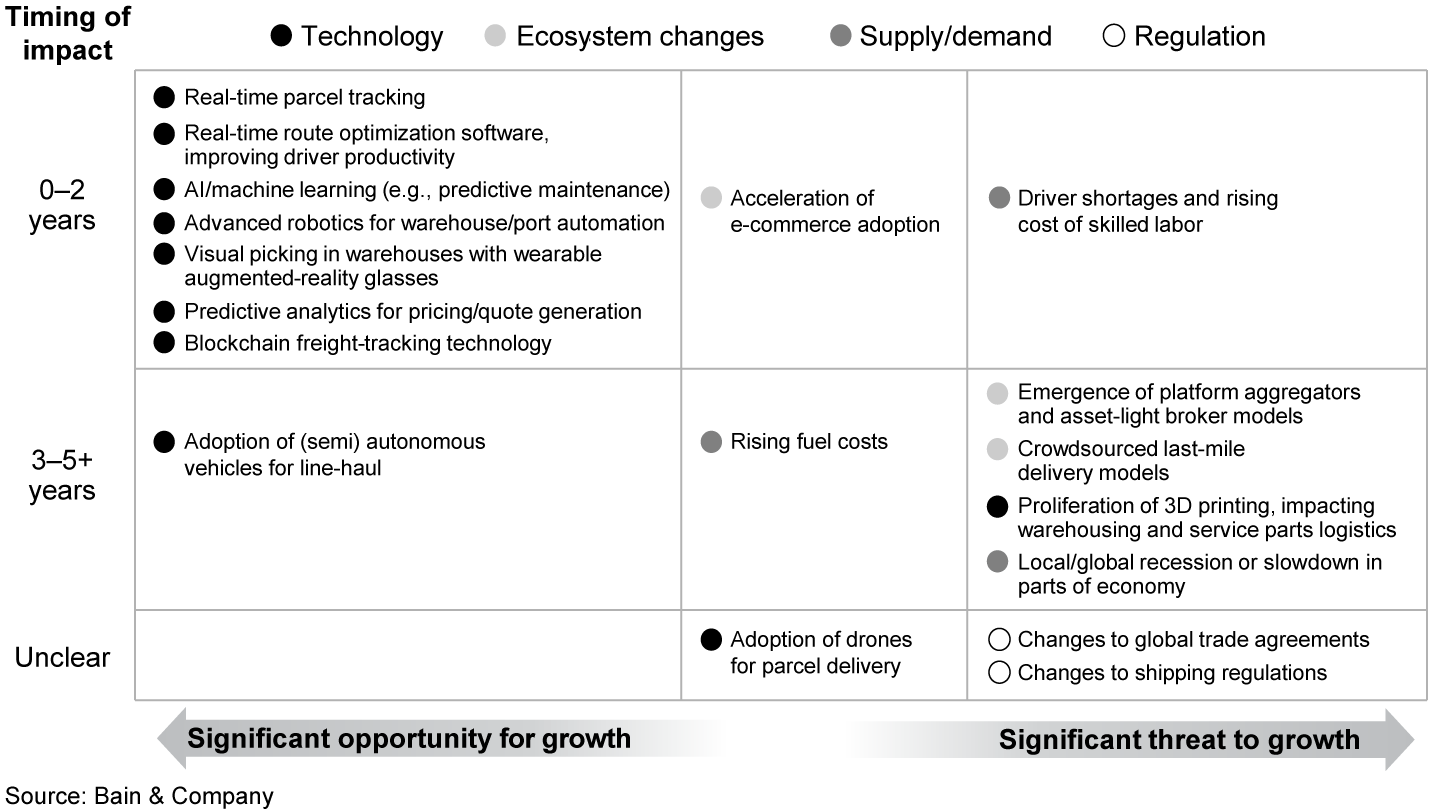

Enhanced services, productivity gains and new business models
SingPost’s willingness to reroute deliveries across borders rather than just postal codes is a strong example of the first strategic priority, which involves enhancing services to meet changing consumer needs and win back pricing power—or, at the very least, maintain it.
In certain C2C and B2C business models, the most demanding customers are willing to pay a premium for higher service levels that simplify their busy lives or offer them more visibility into deliveries. The same is true for some B2B customers that are prepared to pay more for the visibility gains that result from integrating T&L data into their own systems. Less-picky customers may not be willing to spend in quite the same way, but they will still require service improvements to stay loyal.
SingPost’s bid to keep up with its most footloose users relies on a new proprietary logistics software platform, which integrates last-mile delivery services—including courier services and parcel lockers—from other providers in the region, as well as its own. Machine learning and artificial intelligence tools are being introduced to alert customers half an hour before the parcel arrives. SingPost believes this is a significant advance on the vague guidance given in dense cities such as Bangkok and Jakarta. The payback for tangible enhancements such as these? Renewed pricing power.
The second priority is investment in technology and automation to create productivity gains that release funds for projects that can fuel profitable growth. Dynamic routing software is one of the tools that can achieve this. The software can save operators time, fuel and maintenance expenses by removing the need to manually plan routes, reducing the number of runs that trucks need to make, cutting the distances they cover, and adjusting routes to real-time conditions (see Figure 2).
Figure 2
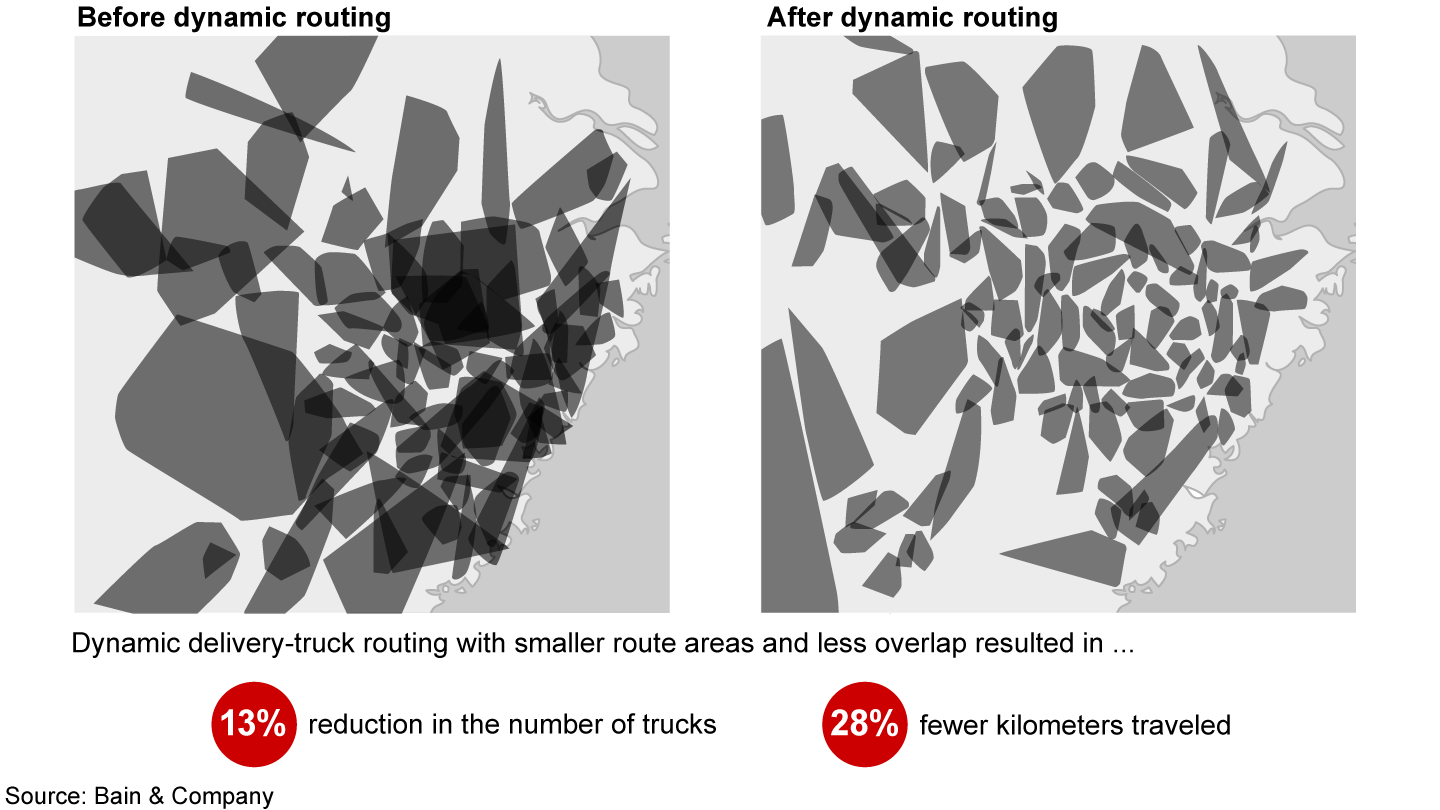

In some parts of the world—notably the US—such software has become ubiquitous. Not so in Asia-Pacific, which, like South America, has been slower to adopt it. That lag means that dynamic routing can help operators in those regions hold their ground as the sector digitalizes; it could even offer a fleeting competitive advantage. One Asia-Pacific transportation and logistics company logged a 13% increase in pickup and delivery productivity soon after piloting it.
Cutting-edge automation of package-handling processes can generate productivity savings of up to 30%, meanwhile, as extensive deployment in the US has shown. It is not just tasks such as scanning and weighing that are done faster by machines. FedEx, for instance, has rolled out self-driving tuggers in the US that are better able to transport oversize items around its hubs. While they might not have the same scale as their US counterparts, Asia-Pacific operators will also benefit from investing more in automation. The key to justifying the capital cost will be a shrewd assessment of the interplay between volume growth and payback period.
The third priority is the creation of new business models to unlock promising markets. This can take the form of diversification into completely new territory, as was the case with New Zealand Post’s four-month pilot scheme to deliver KFC meals to homes in the provincial city of Tauranga. The pilot emulated food delivery start-ups, relying on separately contracted drivers who used their own vehicles rather than postal vans. Even though NZ Post chose not to continue with hot food, the experiment yielded insights into on-demand deliveries. Another of its food partnerships has gone further. The company is working with meal-kit subscription service My Food Bag—a collaboration that required NZ Post to build capacity for Sunday deliveries.
Technology can aid T&L companies as they target promising new markets. Drones, for instance, have the power to transform the industry’s presence in rural areas in which it has been hard to operate profitably. As part of a broader push into logistics, Chinese online retailer JD.com has more than 200 people working on a drone delivery program that has involved test flights to rural shoppers.
Fatigue is a risk as challenges abound
Staying focused on the opportunities as well as the challenges is not easy for any established player in the transportation and logistics sector. The demands from customers are multiplying—and meeting them is often a means just to stay in the game rather than win it.
T&L operators bear some of the blame. Historically, the sector hasn’t prioritized investing in technology, preferring to channel profits into physical assets rather than software. In an era of rapidly rising customer expectations, this is no longer tenable. Lucrative corporate customers such as retailers and industrial groups are perfectly willing to ditch old logistics partners and place their business with newer, more flexible digital platforms that can provide a more customized fit (often by selling aggregated access to those same established operators).
Customers expect shorter delivery times, with more deliveries achieved in full and on time. They want greater pricing transparency and the ability to track operations in real time. Data is also a priority: It must be presented to customers in an easy-to-analyze format. This means that the software interface provided by any logistics partner must be cutting edge, while also integrating phone notifications, GPS tracking and myriad other applications. That is a huge undertaking. And even if a company is prepared to spend heavily to upgrade its IT, there is no certainty that the customer will stay. On the contrary, the uncertainty created by large IT projects can scare customers into the arms of a digital upstart that already has a slick, modern platform.
Another complication is the way logistics has tilted toward a business-to-consumer model. Companies that have traditionally focused more on business-to-business relationships have been sucked into the fierce battlefield that is the last mile to consumers’ homes. The disproportionate growth in residential deliveries has hurt some logistics groups, notably in the US. The trend partly reflects the shifting behavior of retailers such as New Zealand’s The Warehouse, which used to rely on customers trekking to its shedlike stores for furniture and other goods but has now embraced home delivery. T&L operators handling such bulky consignments need to train drivers in installation and customer service, while also coping with the reduced economies of scale available in the more fragmented B2C delivery patterns.
The last mile has also become more competitive as a result of the arrival of new players that are more focused on technology and customer experience than on physical infrastructure (see Figure 3). In Asia-Pacific, these asset-light outfits include Sendle and Instatruck, start-ups that own no vans but offer low-cost deliveries by buying untapped capacity in other courier networks at a discount. While innovative, this model is limited by the physical networks of traditional players. It also gives incumbents a strategic opportunity to fill spare capacity.
Figure 3
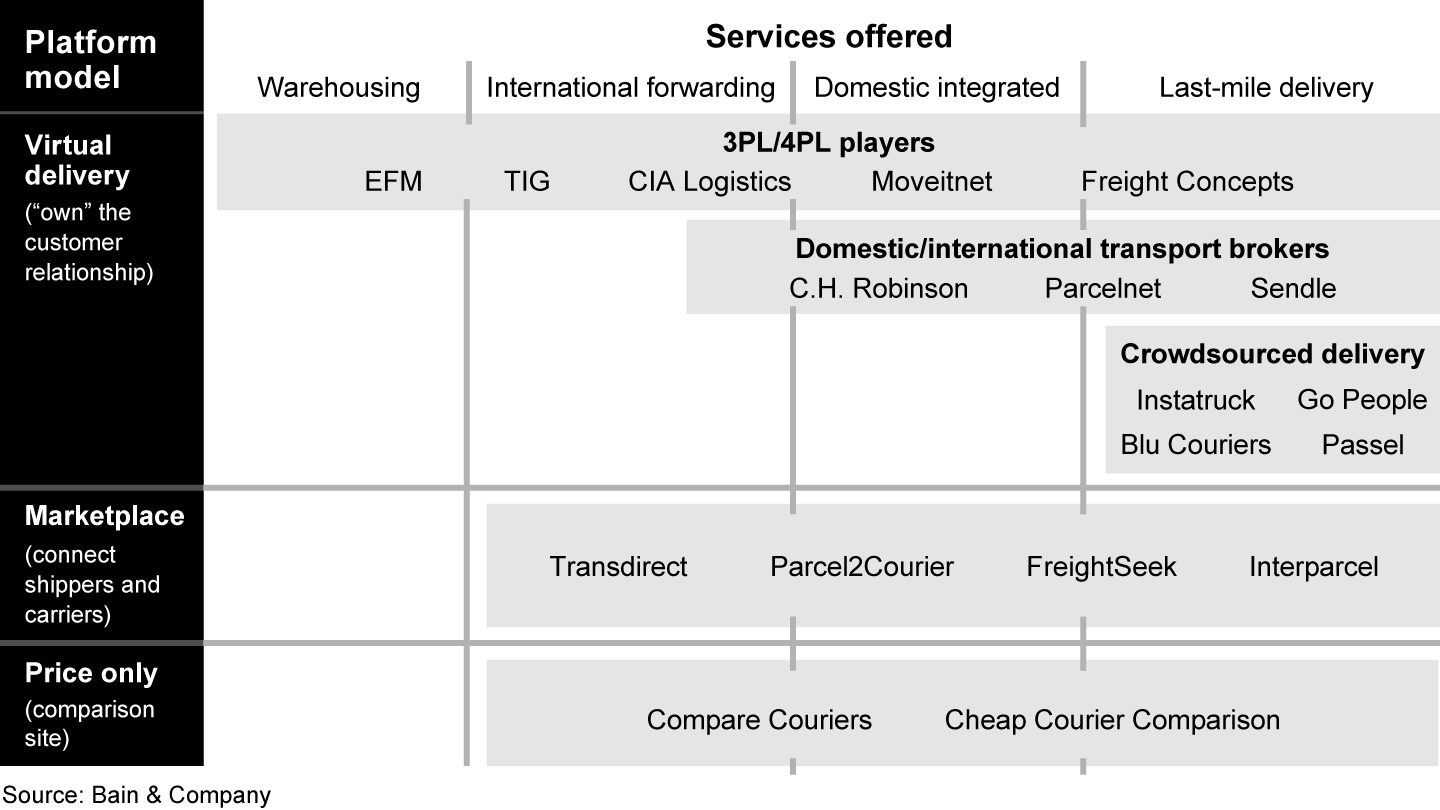

As well as keeping up with the latest software advances, established groups must also contend with the fact that gains from technological improvements are constantly becoming commoditized. Today, technology is optimizing revenue and costs through the value chain—from sales and marketing to warehouse automation and dynamic routing. Executives must harness these advances, but they will not be a source of lasting competitive advantage on their own.
What will distinguish companies from the competition in the long term is not their one-off decision to adopt technology A over B, but rather their ability to make a succession of adoption choices as new technologies emerge and enter the mainstream. At the same time, they will need to keep developing new technologies of their own that can offer a proprietary edge in the market.
Success is still possible over the long haul
To tackle all three strategic areas with impact, it is vital to start the transformation journey early. That will often involve working with what you have, not what you wish you had. Happily, established operators are sitting on a hidden asset that will be invaluable in this battle: data.
Most of the data needed to power a strategic transformation is already captured within the organization. Productivity improvements can start with basic data analytics, coupled with operational discipline. The mere act of feeding sales teams the basic facts about business performance—such as profitability by account and the true cost to serve that customer—can be the catalyst for higher margins.
At the Asia-Pacific transportation and logistics company, senior management found it difficult to hold teams accountable because data weaknesses meant there was always an excuse for why performance was not improving. The data needed to track operational success was mostly available, but the way it was handled varied across depots, and managers had little confidence overall that the figures were correct. The data was also hard to obtain because it was spread across multiple locations and often stored in Excel files.
The company was able to move to a single, reliable version of the operational “truth” by building a dashboard using data visualization tools. The dashboard contained all the key depot-level metrics from across the organization. Senior managers’ oversight of performance evolved in a similar way, with new governance structures and meeting rhythms. The measures helped generate more than $100 million in cost savings.
The digital challenge facing T&L companies can lead to a temptation to focus solely on old waterfall approaches to IT and an obsession with finding one “big fix.” Doing this can slow down the rollout of technology improvements that customers are demanding today, rendering them obsolete when they do appear; budgets can balloon at the same time.
Incumbents need a twin-track approach to technology instead. On the one hand, they need to maintain the robustness of their core platforms with a waterfall approach, but they also need to follow an Agile method for the more innovative, customer-focused systems. In practice, this means that leading companies in the sector are increasingly adopting a phased approach to technology, one based on a constant leapfrogging and revisiting of priorities. They are also happy to build capabilities by partnering with or buying digital players, instead of always trying to develop technology assets in-house.
Another powerful approach is to place selective bets on new technologies that could drastically alter the industry. Australia Post has already made progress with just such an incubation strategy, developing a service called Digital iD, which allows Australians to verify who they are by using their smartphones and facial recognition software that compares their selfie with their passport picture. Another venture it has been nurturing is Fulfilio. Aimed at small to medium-sized businesses that have not always been happy with mainstream postal services, the start-up offers warehousing and order fulfillment within the Australia Post network, competing directly with Amazon.
The fact that the global e-commerce leader is still a relative newcomer to logistics services in Australia—Amazon only opened its first fulfilment center there in December 2017—underlines how much remains to play for in Asia-Pacific. The future is still being shaped across the region’s transportation and logistics industry. By enhancing services, improving productivity and finding new business models, established players can survive—and even thrive.
Marco D’Avino and Gabriel Guedes are members of Bain & Company’s Supply Chain practice. Marco is a partner based in Sydney; Gabriel is a principal in Sydney.
First published in 5月 2019