

レポート

Nguyen Thi Mai Linh was forced to drop out of school but now juggles motherhood and a flourishing online cosmetics business from her home in Hai Phong, Vietnam. After putting her young child to bed at night, Nguyen spends another hour responding to messages from her customers, tracking competitors’ products and prices, and keeping up with beauty trends. She says she is proud that she can now afford to buy baby formula and diapers for her child.
In Surabaya, Indonesia, Fadli is living his dream by selling cookies online. In Bucalan, Philippines, Randy left teaching to become an app-hailing driver so that he could boost his income and devote more time to his wife and daughter. In Johor Bahru, Malaysia, a 25-year-old truck driver named Shahan supports his parents and seven siblings back home in his village—but spends his weekends on bike tours with friends he made from online biking communities. In Khon Kaen, Thailand, 35-year-old Ong wanted to be her own boss—so she became an online reseller of coffee and then started a successful dog-breeding business.
Written in collaboration with
Written in collaboration with

Ready or not, a huge middle class is emerging throughout developing Southeast Asia. Fueled by the rising incomes that result from hard work and ambition, 50 million new consumers will join the ranks of the middle class in Indonesia, Malaysia, the Philippines, Thailand and Vietnam by 2022, contributing to the region’s $300 billion middle-class disposable income. The middle class will expand to include 350 million people and continue on its upward trajectory. It is propelled by greater access to the flourishing digital economy and a view of the broader online world outside their visible community, and by the lasting positive effect that happens when people move out of poverty and watch their community of neighbors, family and friends achieve their dreams—and see the possibilities for themselves. Also contributing to this expansion of the middle class are various ASEAN pacts aimed at regional economic integration.
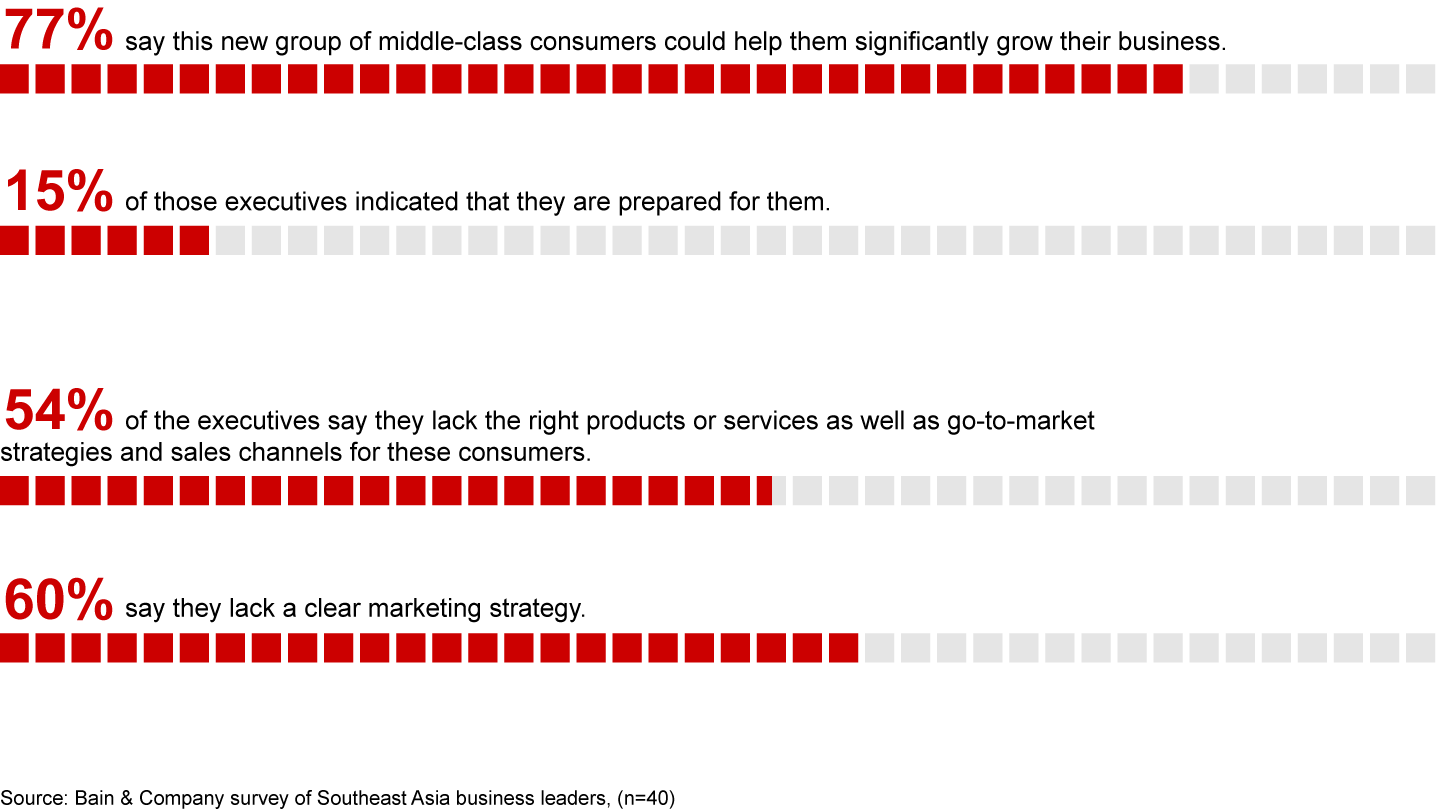
To understand the evolving opportunities and the impact this phenomenon will have on companies, we spoke with 40 business leaders across industries throughout the region. While 77% say this new group of middle-class consumers could help them significantly grow their business, only 15% of those executives indicated that they are fully prepared for them. More than half of the executives say they lack the right products or services, as well as go-to-market strategies and sales channels for these consumers. Fully 60% say they lack a clear marketing strategy (see Figure 1).
Figure 1

How this market is different
These findings led Facebook and Bain to collaborate on an extensive research project to learn about Southeast Asia’s emerging middle class from every possible angle. That included 80 in-home interviews across the region and 160 peer hangouts. Separately, Bain surveyed 12,000 digital consumers across the region. The research provided a deep profile of Southeast Asia’s newest consumer segment, which is quickly evolving with expanded digital access. We learned who they are and the issues they face, as they struggle with—and grow from—the mounting tension between their traditional environment and one that is broadened with new digital access to sources of information, communities and services. Our research enabled us to take a first step toward helping companies determine how best to serve this exploding market of consumers.
Just as consumers in developing Southeast Asia grapple with the tug of war between traditional and modern cultures, companies face a similar challenge. Many have traditionally grown their businesses by focusing on affluent or upper-middle-class consumers in narrow urban corridors. Now, they must learn how to reach and appeal to a new group of consumers with distinctly different profiles, consumption habits and media behaviors.
Among the many changes: Southeast Asia’s middle class is far more dispersed than many business leaders realize. Increasingly, they reach across urban and rural settings. While much of the growth takes place in the capitals of Jakarta, Bangkok, Kuala Lumpur, Manila and Ho Chi Minh City, an equal number of households are joining the middle class from the region’s Tier-2 cities—places like Ambon and Samarinda in Indonesia, Chanthaburi and Lop Buri in Thailand, Imus and Santa Rosa in the Philippines, Can Tho and Thu Dau Mot in Vietnam, and Alor Setar and Kota Kinabalu in Malaysia.
Moreover, many executives still hold notions that this segment comprises unsophisticated consumers who are highly cost-driven, shop primarily in traditional channels and favor inexpensive sachet packages designed for low-income shoppers. They see them as primarily influenced by word of mouth, or by TV and other traditional channels of communication. The reality is that the digital era has brought with it not only a change in consumption behavior but new and evolving influences. These and other misconceptions create challenges for companies hoping to grow along with Southeast Asia’s rising middle class.
A world of new choices
The emerging middle class is embracing the online world and taking full advantage of the greater opportunities that come with digital exposure. As a result, their growing ranks are rapidly changing the game in all industries.
As they increase their digital usage, these consumers widen their worldview beyond the limits of work, neighborhoods or traditional expectations. They now enjoy a huge privilege that previous generations did not: greater power to choose. They can choose the person they want to be, the people they want to be with and the passions they want to follow.
Our interviews across the region helped us identify four common themes.
1. Power to choose identities
Today's emerging middle-class consumers are able to define their own modern identity through the power of digital connectivity, while still maintaining strong ties to their traditional cultural backgrounds. These blended identities allow them to express and shape new points of view.


2. Power to choose communities
Distance does not stand in the way for members of Southeast Asia’s emerging middle class. Our research illustrates how online communities bring people together, uniting those with shared passions, aspirations and challenges. These online communities function as support systems that influence members’ behaviors, attitudes and perspectives, opening up the world beyond their village community, or kampong.


3. Power to choose dreams
The pursuit of personal passions, long considered a luxury in developing Southeast Asia, is now not only possible but is also celebrated. Digital exposure is helping to raise members of the emerging middle class above their socioeconomic status. It spurs brand awareness and the desire to travel. It allows them to project a better image of themselves and to pursue passions far outside of traditional pathways.


4. Power to choose joy
Our findings reveal that members of Southeast Asia’s emerging middle class have become more sophisticated in what they buy, and how they buy it. Exposure to digital marketplaces and social media sites has led them to seek out and purchase whatever brings them joy—whether it is travel, cosmetics, new experiences or branded goods. They use social media to elevate their sense of confidence and their sense of status and to display their achievements.


How to sell to Southeast Asia’s emerging middle class
New choices for consumers means new choices for companies. Our research has helped us identify the fundamental decisions that companies can make to grow along with Southeast Asia’s emerging middle class:
Choose products
Winning brands are outpacing their rivals by simultaneously appealing to middle-class consumers’ desire for new experiences while understanding how these consumers are caught between their heritage and kampong upbringing and the modern world. These companies also take advantage of the increasingly sophisticated pockets of demand for high-end products which are spread out over a huge region. And they rely on technology to help serve this demand. Indeed, their businesses flourish in Southeast Asia because they sell online, as opposed to going the expensive alternative route of stocking offline stores.
This approach has helped spur the success of a host of companies. Indonesia’s GarudaFood is growing by constantly innovating and introducing more premium products—developing new biscuit flavors, for example. It recently launched a highly successful green tea latte product exclusively on Tokopedia. Wardah is an Indonesian cosmetics company that achieved phenomenal growth by focusing on halal beauty products. It initially targeted ambitious, modern hijabis, but has expanded to gain popularity among those who don’t wear the garment. For its efforts, Wardah has captured 30% share of the makeup market in Indonesia.
Choose paths
Southeast Asia’s emerging middle-class consumers are aspirational, “lean-forward” audiences. Successful brands can create a lot of pull by engaging well with digital communities (e.g., diaper websites) and by catching these consumers on the move. Also, it’s possible to target them very granularly for their more differential spending patterns. In Malaysia, FashionValet boosted conversion rates when it used exit intent technology and behavior targeting to appeal to a segment of visitors to the FashionValet Malaysia site. The best brands tend not to rely solely on passive channels—but if they do, they capture consumers during mobile moments. Pond’s accessed more than 12 million women through its location-based campaign that spoke to young women commuters on the dangers of pollution to their skin. The campaign helped contribute to 5% revenue growth for Pond’s.
Choose channels
Brands need to move beyond traditional offline and online channels. Often, that means social commerce plays a role, beyond major e-commerce sites. Thai fashion purveyor Hamburger Studio has achieved 100% annual growth by promoting its products on mobile commerce platforms and offering engaging and visually immersive mobile experiences. Brands also invest in offline setups to create true experiences for targeted consumers. In Thailand, Pomelo came to life as an online fashion site but now has identified 800 locations for potential micro-retail stores in which customers can experience the products before buying.
As Southeast Asia’s middle class grows along with digital capabilities, companies have a unique opportunity to reach a vast new community of consumers just as they are gaining exposure to different brands and developing preferences. The steps that consumer goods companies take today will shape consumers’ choices for the decades ahead.
Florian Hoppe and Aadarsh Baijal are partners with Bain & Company’s Digital practice. They are based in Singapore.
Written in collaboration with
Written in collaboration with

Rooted in what we’ve learned from 2 billion people on our platforms and the 6 million businesses that advertise with us, Facebook IQ provides actionable insights about people, marketing and measurement. We offer studies, tools and resources built to transform how marketers reach people and deliver real results in this crosschannel, multi-device world. Whether you need inspiration for your next big idea, research on how best to reach the people that matter most, or the latest in ad effectiveness, lean on Facebook IQ for insights and strategies.
To learn more, please visit www.facebook.com/iq
First published in 3月 2019