

論説
When we published the Bain Brief “Beyond forecasting: Find your future in an uncertain energy market” in 2013, the industry was wrestling with the effects of new supply shocks—primarily tight oil and shale gas from North America—and was, arguably, approaching key tipping points for solar and wind power in some geographies and under certain regulatory regimes. Our analysis indicated that a price of $60 per barrel of oil in 2030 was plausible. A slightly different scenario has transpired in recent months, but the approach we proposed earlier and our conclusions about long-term strategic planning still apply today.
- We can best capture the dynamics that are shaping the energy ecosystem along three major supply vectors: natural gas, crude oil and renewables. For each of these fuel sources, permutations of supply levels result in eight plausible corner scenarios, which we described in our 2013 brief.
- Interfuel substitutions (substitution between fuel types, such as natural gas for coal) and intra-fuel substitutions (substitution within fuel types, such as shale gas for coal-bed methane) bring about differences in the energy mix across the scenarios. Within each scenario, extrapolation of cost experience curves for each primary fuel source alters the shapes of competing supply curves and clearing prices, which encourage substitution.
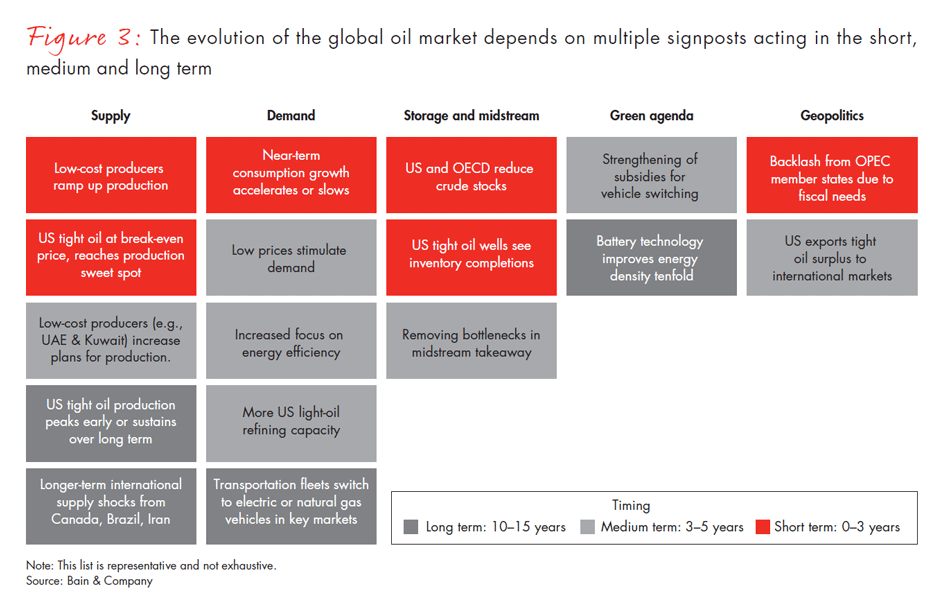
- Executives can track and anticipate the industry’s evolution by identifying signposts, such as increases and decreases in US tight oil production, and leading indicators, like the evolving shape of the tight oil supply curve in North America.
- The benefits of scenario analysis lie not in assigning probabilities to each scenario, but in testing a strategy’s robustness against each scenario. This testing exposes unseen risks and allows for the development of mitigation and contingency plans that can be executed quickly when signposts trigger opportunities or threats.
These conclusions outline a sequence of steps that we recommend for planning in uncertainty (see Figure 1).
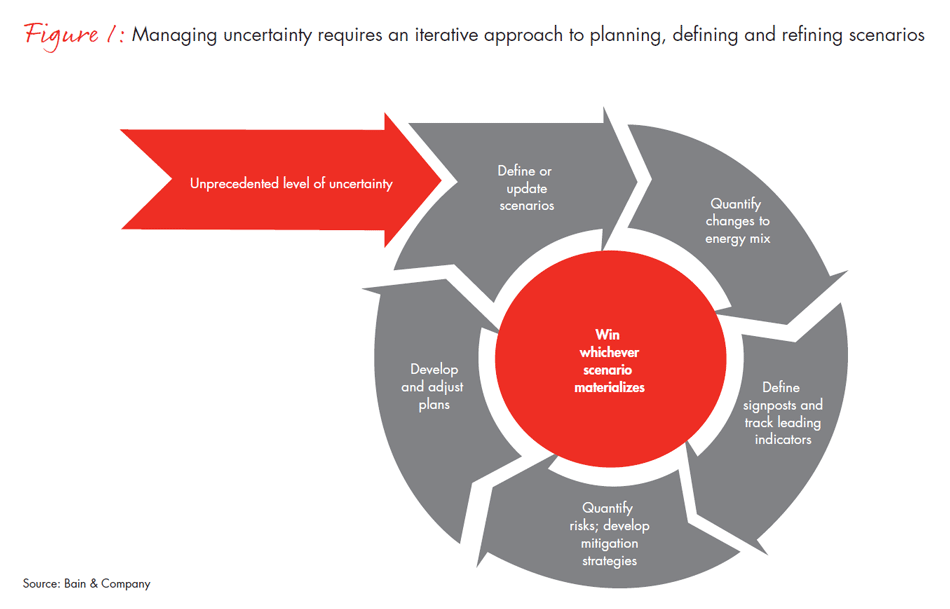
To achieve the best results, planners should explicitly incorporate key insights and learnings in an iterative process. Lessons from the recent crude oil price collapse reinforce this basic approach, but also underline the need for adjustments when dealing with short-term dynamics. To better understand these adjustments, we summarize the factors that led to the price collapse and offer perspectives on likely recovery scenarios.
What led to the price drop in 2014?
From 2009 to 2013, global liquids production grew by 5.2 million barrels per day, according to the Energy Information Administration (EIA) in the US. Roughly 4 million barrels per day of that increase came from the US and Canada, while the rest of the world contributed a net 1.2 million barrels per day. During the same period, global consumption increased by 6.2 million barrels per day. North America’s tight oil boom was offset by anemic production in the rest of the world and consumption outpacing production to mask an impending structural oversupply.
All this changed in 2014. From September 2013 to September 2014, net global production increased by 3 million barrels per day, eclipsing consumption. Sustained production from the US and Canada, along with a resurgence of production from Iraq, Libya and Iran, led this increase. Meanwhile, in summer 2014, the International Energy Agency (IEA) revised downward its 2015 forecast for global demand by about 400,000 barrels per day—essentially forecasting that growth in production is not needed to balance the market in 2015.
Despite this, oil still hovered around $95 per barrel in September 2014, demonstrating the difficulty of predicting short-term market outcomes, even with well-known variables. Last November, as production continued unabated and Saudi Arabia declined to shoulder the lion’s share of any cuts by OPEC, the bottom fell out. Within three weeks of OPEC’s November 27 meeting in Vienna, Brent stood at $60 per barrel.
The oil and gas market is nearly impossible to predict. That's why strategic planners at leading oil and gas companies prepare for multiple potential outcomes rather than optimizing for one assumption, says Jorge Leis, who leads Bain's Oil & Gas practice for the Americas.
Where we go from here
The shape of the recovery hinges on one demand variable and four supply variables.
Consumption growth. China’s slowing growth and Europe’s sluggish economy are likely to hinder consumption in the short to medium term. While the range of forecasts has narrowed considerably, small differences in demand projections can have a large impact on markets and should be taken into account in the near term.
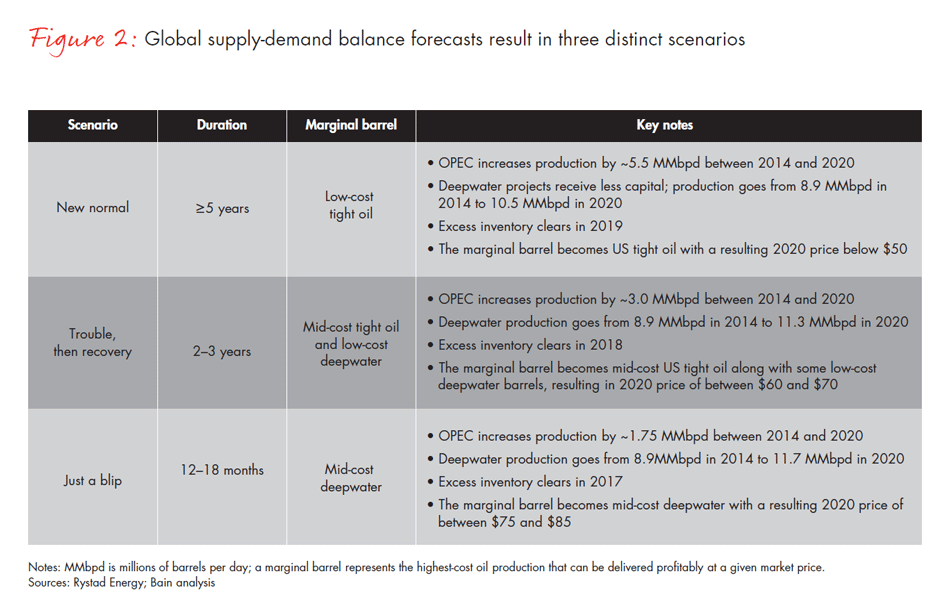
Production from low-cost sources. Bain’s analysis forecasts 2020 OPEC production to be between 26 million and 40 million barrels per day, with the most likely range being between 34 million and 35 million barrels—more than the current production of about 31 million barrels per day. This increase will flatten the supply curve and put economic pressure on high-cost sources of oil, particularly oil from deep water, Canadian oil sands and Venezuelan heavy crude oil. High-cost sources will continue to produce in the short term because marginal costs of production are lower than current market prices, but new, high-cost production could face difficulties finding fresh capital.
Committed capital. High-cost projects, like deepwater rigs, can take years and billions of dollars to complete, so they calculate their break-even projections based on long-range price predictions. Capital continues to flow to many projects that are already under way, even if their fully loaded costs fall below current market prices. These deepwater projects will continue to add supply for the foreseeable future.
Inventory. With OECD crude stocks at their highest levels since record keeping began, the industry has to view inventory as a short-term supply source. In the US, inventory is approaching physical limits that could plummet WTI1 prices to new lows, if breached. Supply and demand scenarios for the near term must consider the depletion of record-high inventories.
US tight oil. Tight oil’s unique characteristics make it one of the few resources that could react quickly to changing conditions.
- Ramps up quickly. New wells take only weeks and millions of dollars, as opposed to years and billions, and can be drilled and held in reserve.
- Shuts off quickly. Depletion curves are very steep, and first-year decline rates of 60% to 70% are the norm.
- Break-even costs vary widely. Tight oil breaks even anywhere from $30 to $80 per barrel. Using assembly-line methods helps bring most production in under $60 per barrel, and the cost drops every year.
Under a scenario in which OPEC produces at new record highs and economics inhibit new capital deployment to the highest-cost supply sources, US tight oil could become the marginal production barrel and price-setting mechanism (see Figure 2).
Managing short- and long-term uncertainty
Predicting the future under such uncertainty is impossible, so planning around a single view of the future is a recipe for value destruction. As we noted in Figure 1, a more strategic approach for planning begins by defining scenarios and then refining the data continually while monitoring signposts that indicate market directions, with important distinctions made at each step, depending on whether the focus is short or long term.
In the long run, changes in energy mix, more than differences in long-term forecasts for total energy demand, drive demand for any given primary fuel. Since changes in the energy mix result from changes in supply dynamics, a supply-side model is most appropriate. However, as we saw in this most recent downturn, changes in short-term demand forecasts can exacerbate supply-demand imbalances, so planners must build demand considerations into their short-term scenarios.
Interfuel substitution is the key mechanism of shifts in the energy mix. Looking to the future, we can take out of the equation substitution barriers, such as midstream constraints or government subsidies, which prevent the physical or true economic flow of primary fuels to their most competitive use. But in the short term, substitution barriers can have profound effects on supply-demand balances and must be considered key signposts.
Signposts indicating the direction of global oil markets can be relevant for the short, medium and long term (see Figure 3). Some of these signposts, such as geopolitical events, can have an immediate impact on supply and demand, but are very difficult to predict. Others, such as interfuel switching for the transportation sector, have long-term impact and are easier to track.
Companies also face different risks in the short term compared with the long term. The recent drop in oil price has created financial distress for many upstream producers and service providers—a situation that should not be considered explicitly in the long term. Cash flow is a variable to be optimized for long-term value creation, but can be a risk to short-term survival. Regardless of the objective, testing a plan against short- and long-term scenarios allows planners to identify risks, build robustness into their strategy and create optionality—and a ready contingency plan—for the future.
Managing the unprecedented uncertainty in global energy markets requires a flexible approach and the ability to alter tactics as market conditions change. Scenario analysis helps companies meet both objectives. Short- and long-term planning are similar, but with important differences, such as the causes of scenarios, signposts, leading indicators, risks, and mitigation tools and strategies. By adopting scenario analysis, companies can maximize long-term value creation while avoiding expensive mistakes in the short term.
Jorge Leis is a partner with Bain & Company based in Houston. He leads the firm’s Oil & Gas practice in the Americas. The author would like to acknowledge the contributions of Mile Milisavljevic, a principal with Bain & Company in Houston.
1. West Texas Intermediate, the benchmark price for light, sweet crude in North America
First published in 5月 2015