

論説

概要
- European equipment makers expect their share of revenue from advanced service contracts to more than double by 2024, Bain research shows.
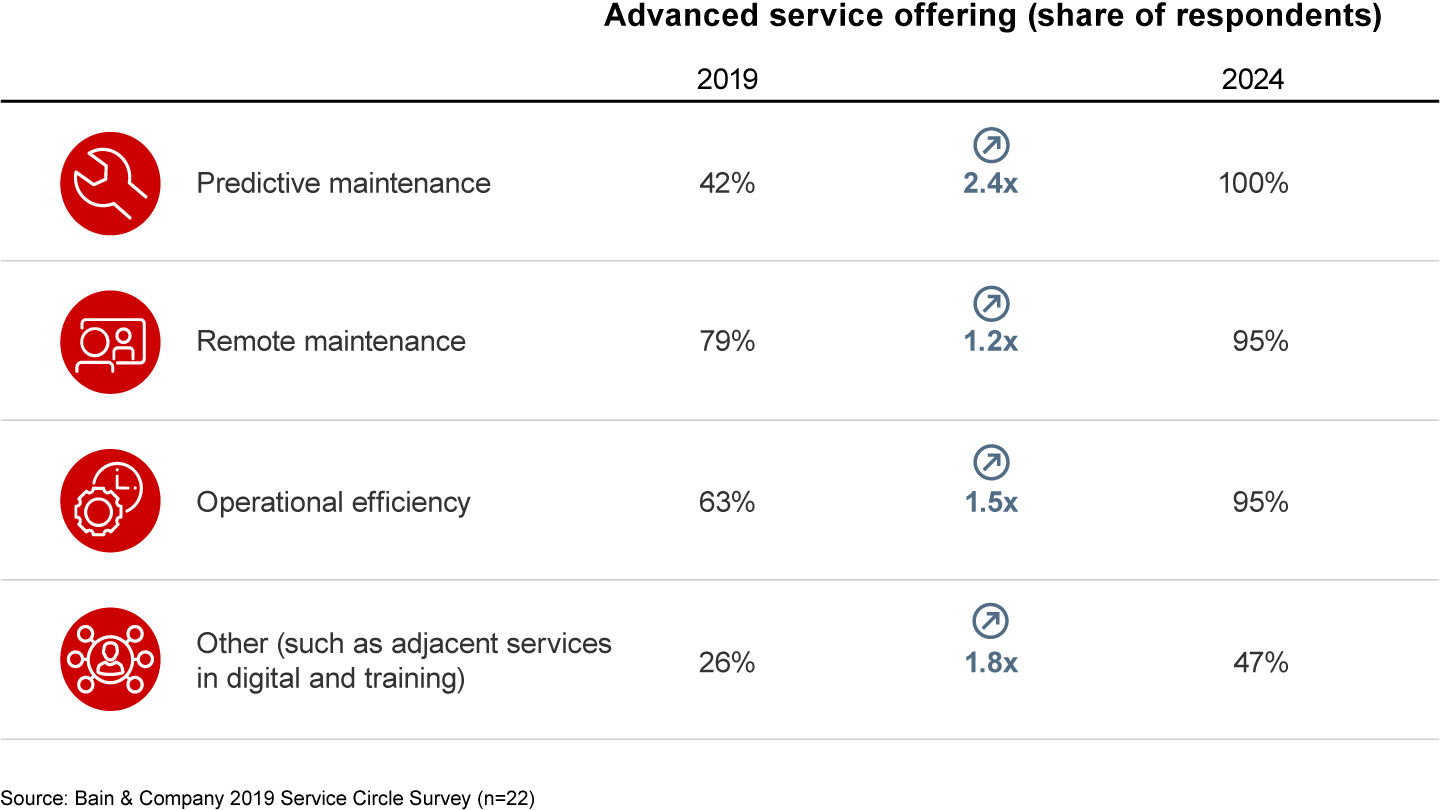
- All European manufacturers we surveyed plan to offer predictive maintenance by 2024.
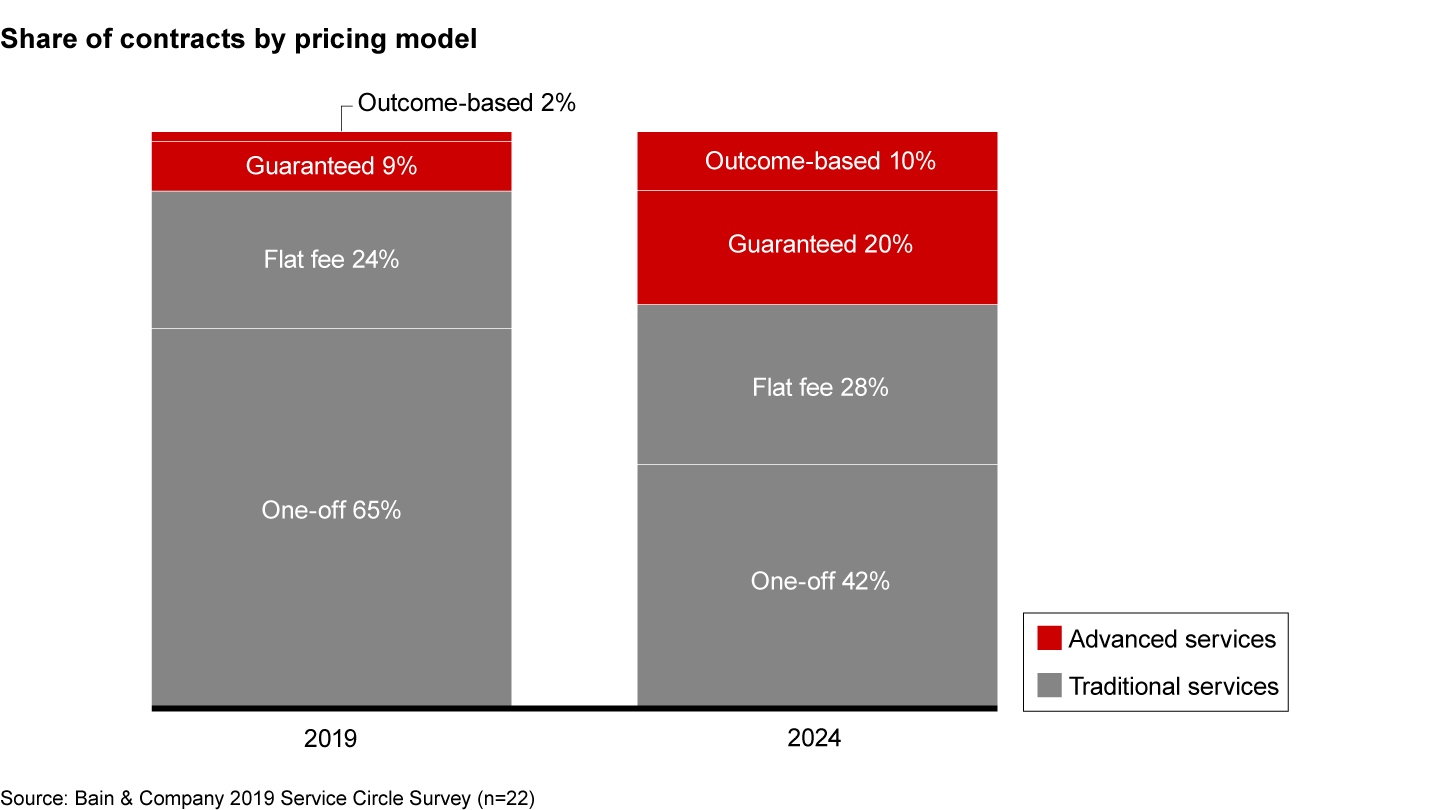
- Equipment makers plan to nearly triple their offering of outcome-based and guaranteed pricing contracts.
How many industrial customers will still want traditional service contracts four years from now? It’s a question many executive teams are starting to ask themselves. Manufacturers now clad their machinery with sensors that provide them with a torrent of performance data. Analytics software can convert the data to insights. Based on those insights, a growing number of manufacturers are starting to replace traditional contracts with offers to guarantee production output, machine uptime or product quality.
Call it the digital disruption of services.
Executives overseeing the service business for any large manufacturer know just how quickly the landscape is changing—and how profound a shift it is. Leading companies are redefining traditional service as strategic care. They offer their clients advanced service contracts that use data and analytics along the entire production process to guarantee performance or output.
This new service model aims to increase customers’ productivity and cuts costs. Using data from a client’s production site, for example, original equipment manufacturers (OEMs) may devise ways to reduce the customer’s overall energy use or boost equipment efficiency, charging a percentage of the savings as their fee.
Bain & Company research shows that leading European OEMs aim to more than double their share of revenue from advanced service models to 47% by 2024 (see Figure 1). Of the manufacturers we surveyed, 100% say they plan to offer predictive maintenance by 2024. Ninety-five percent of OEMs say they will provide remote maintenance, and 95% will offer operational efficiency services (see Figure 2). And as the market shifts, so do customer expectations.
Figure 1
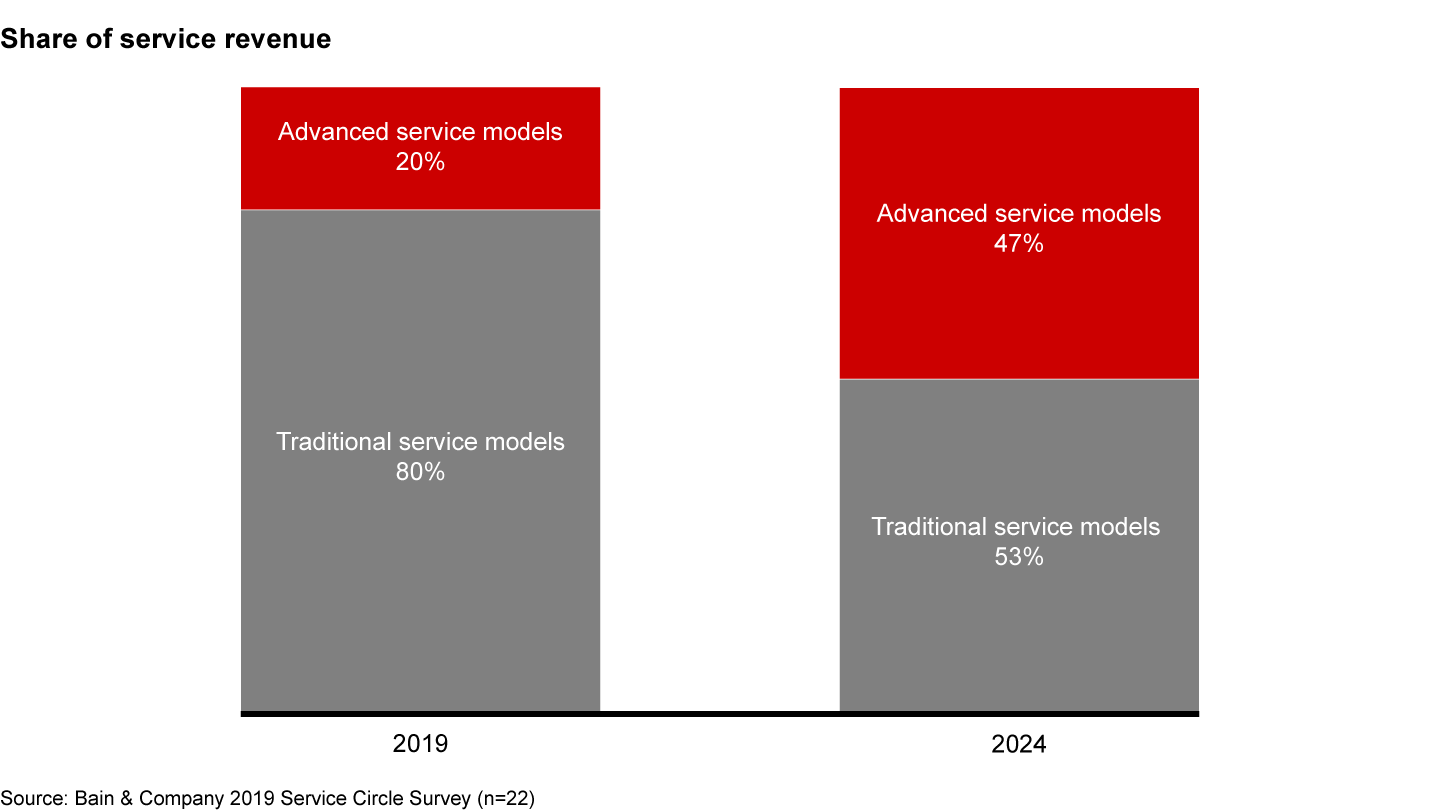

Figure 2

The rapid pace of change poses challenges for equipment makers. Many have invested big sums to gather data from client production sites but lack the analytical capabilities to manage it—and they risk cyberattacks. At the same time, savvy digital competitors including software companies, industrial automation solution providers and systems integrators are developing their own service offerings that threaten to pull customers away from OEMs.
Commercial risk looms large too. Contracts based on performance are difficult to design, value and price—and much more complicated to negotiate. Even if a customer agrees to a contract, the manufacturer’s finance or risk management team often gets in the way of a deal. Finally, it’s easier to pilot a few advanced service contracts than to scale them companywide.
Successful companies address these challenges by doing four things well. They understand what customers value most from machinery in a particular production setting. They also invest in analytics capabilities, develop pricing and contract management skills for a new service model and focus early on scaling performance-based services across the organization.
A new universe of service
Advanced service contracts differ significantly from traditional services. They are broader in scope and may cover a full production line, all the equipment at a given site, multiple plants or even an entire fleet. Importantly, they rely on data and analytics to improve machine function. Equipment makers compile data and insights from their installed base and use the information to build innovative service solutions. For comparison, think about how data and analytics have transformed marketing, allowing consumer goods companies to tailor their campaigns precisely to customer tastes and preferences.
Finally, the service fee is linked to performance as opposed to a one-time fee for each service case or a flat rate for a fixed period of time. Equipment makers that invest in predictive maintenance solutions, for example, can offer to guarantee the uptime or output of their machinery. Instead of fixing equipment when it breaks down for a flat fee, the companies pioneering these next-generation services ask for a percentage of the guaranteed output.
Advanced service contracts can be a win-win scenario for equipment makers and their customers. While improving efficiency and reliability for clients, performance-based contracts increase an OEM’s competitive edge, boost service revenue and grow its share of the service profit pool. And service relationships built on improving customer productivity increase loyalty. Remote monitoring and predictive maintenance are familiar examples, though still relatively new on the market. Other uses include pattern-recognition algorithms that can crawl through thousands of hand-typed reports about machinery breakdowns. Service teams can use the insights they gain to better manage equipment under contract or develop standard upgrades that can be sold throughout the installed base of customers.
No question, performance-based pricing models involve taking and managing risks. Only 11% of companies we surveyed are now using either outcome-based pricing models or guaranteed-pricing contracts. But respondents expect to nearly triple their offering of these models by 2024 (see Figure 3).
Figure 3

Getting started
Manufacturers that have access to clients’ operational data can harness advanced analytics to continually tailor their offerings and fuel service innovation. With the insights they glean, these equipment makers are in a position to simplify clients’ operations and lead the evolution of customers’ assets and processes—a significant competitive advantage.
But offering advanced services requires new capabilities and thinking. Four guidelines can help equipment makers bridge that gap.
Identify what customers value most. The first step in building a strong service offer is understanding what aspects of a machine’s performance matter most to the client in a particular application. That requires knowledge of the client’s operations and processes, and importantly, its pain points. One company’s biggest problem may be machinery that vibrates when in operation, while for another, it’s unsterile surfaces that render products defective. To address customer needs more effectively, manufacturers must see their equipment in motion and identify each client’s trouble spots.
Take the example of a leading manufacturer of industrial robots with an installed base of 250,000. To improve its service offering, the head of service sent teams to observe its 10 most important robotic applications on-site with customers. The company’s semiconductor clients were not shy about their two biggest pain points: inaccurate placement of the silicon wafers and contamination of the wafer surface. Robots that were not absolutely clean and extremely precise produced defective wafers.
That insight prompted the robot maker to develop a service offering that guaranteed accurate wafer placement and provided a dedicated on-site technician to inspect and clean a small park of robots daily. The contract included laser monitoring of the trajectory endpoints with remote surveillance. That process allowed specialists to recalibrate a robot’s movements or change the drive system before it exceeded a certain tolerance, avoiding defects.
The first pilot, codeveloped with the chipmaker, required significant technical and commercial investment. But the robot maker was able to reuse the technology and the framework with other semiconductor customers and point to the pilot as a live demo. After selling a dozen similar service contracts, the company reached breakeven, and it has since sold several thousand.
Invest in analytics capabilities. To make the most of customers’ data, companies must have a digital connection to their equipment and build analytics and software talent. Only 28% of manufacturers have full access to customers’ operational data today. Many lack connectivity toolkits for older machinery and are uncertain about what their data-access agreements with clients really allow.
Once manufacturers secure full access to a customer’s data, the key issue is technology talent. To excel in analytics and software development, each company will need to find the right balance between building internal expertise and relying on partners. As many companies are discovering, combining both can accelerate results.
Steelmaker ArcelorMittal used that approach to quickly harness predictive maintenance solutions and dramatically improve the surface quality of its steel during the galvanizing process. The company’s machine-learning experts collaborated with Datapred, a provider of machine-learning algorithms for prediction, to develop strong, easy-to-deploy industrial solutions. Datapred staff and ArcelorMittal production experts, data scientists, product engineers and quality managers analyzed ArcelorMittal’s manufacturing process to anticipate potential defects. The team developed a solution that produces steel surface quality alerts about 45 minutes ahead of production and highlights potential causes of foreseen defects. The system will allow ArcelorMittal to avoid a significant proportion of the two most common steel surface quality problems.
Develop new pricing and contract management competence. Advanced services based on performance and output will require new pricing structures and contracts. That’s one reason only 11% of the companies we surveyed are using these pricing models today.
In performance-based contracts, OEMs guarantee an agreed level of output or quality based on a predefined set of performance indicators that are then reported in real time. Performance-based contracts have strong appeal for customers, but they involve greater risk for manufacturers. Most companies offering such contracts today use a bonus-malus system, which includes rewards or penalties based on performance, in addition to the cost of service. If the OEM reaches agreed performance thresholds, it participates in the gains; if it does not meet the thresholds, it pays a fee. To be able to offer such contracts, OEMs need access to clients’ operational data and a thorough understanding of the production process. They also need to determine together with clients the key performance indicators they will measure along with the underlying data.
Aerospace and defense companies have used performance-based contracts for decades, but pricing models are now becoming even more sophisticated. For example, OEMs and clients may partner to offer training on complex, high-tech equipment to third-party military pilots. In this paradigm, the OEM commits to providing a certain number of training slots for an air force customer. Together, the OEM and the client can offer any spare aircraft and simulator capacity to other air force units that do not have training infrastructure of their own.
The supplier and client both benefit by delivering training courses to third parties. The OEM improves the utilization of its equipment. The hosting air force unit, which makes its military base available to the OEM for the training, receives credits from the OEM based on the number of courses provided to third parties.
Ultimately, OEMs may end up repackaging their equipment as a service, retaining ownership and charging customers subscription rates for its use. Subscription models offer clear advantages for buyers, who can access expensive equipment without a large upfront capital outlay, while sharing risk with the vendor. Sellers benefit by capturing more of the total value created by the equipment. But the pricing model is challenging to get right. Most companies are waiting to offer equipment-as-a-service contracts until they have more experience with advanced services and greater access to client data.
Scale the offering. Advanced services leaders focus on creating an offer they can use with multiple clients from the beginning. They start with pilots that are tailored to one client’s needs but can be offered on a broad scale with some additional customization. Leaders use that process to create a portfolio of modular solutions for each industry subsector.
One global packaging company has developed a series of advanced services focused on improving packaging efficiency, optimizing costs and ensuring food safety. The results included up to 30% improvement in line performance stability, more than 50% reduction in product defects and more than 40% reduction in waste. Modular digital solutions including data analytics, virtual training and remote support allow the company to quickly tailor contracts to an individual client’s context and avoid reinventing the wheel for each customer.
OEMs running pilots with curious and innovative customers have learned valuable lessons along the way. One of the most important is the need for significant organizational change, including training for salespeople and service technicians. Leadership teams need to create a culture focused on customer process outcomes rather than equipment or products, aligning incentives to support the shift.
Advanced services may still feel like a leap into the unknown for many equipment makers. But in the next decade, performance-based contracts will reshape the service market dramatically. OEMs that sit on the sidelines risk losing proximity to their customers as other, more innovative providers, including digital leaders with deep analytics talent, develop a tantalizing array of performance-based contracts. Sitting down with customers to understand their biggest service needs is the first step in developing advanced services—and keeping pace in a rapidly changing landscape.
Adrien Bron and Pascal Roth are partners in Bain & Company’s Advanced Manufacturing & Services practice. Andrea Pellegrini is an expert vice president and Melanie Oschlies a principal, both in the Advanced Manufacturing & Services practice. Adrien, Pascal and Melanie are based in Bain’s Zurich office. Andrea is located in the Rome office.
The authors wish to thank Datapred for the valuable information it provided.
First published in 4月 2020