

論説

Explore Bain’s latest Customer Loyalty in Banking insights.
Amazon may be taking the plunge into banking, and by any estimation, it’s a game changer for the industry. News reports that it seeks a bank for a cobranded, mobile-friendly checking-account-like product initially targeted to young adults in the US follow earlier moves into financial products. The company has a cobranded credit card offered by Chase, and Amazon Cash allows customers to deposit cash directly to their Amazon accounts from more than 10,000 retail locations throughout the US. In addition, Amazon has loaned more than $1 billion in the past year to small merchants selling online.
Amazon is now talking with big banks, including JPMorgan Chase & Co. This latest move raises urgent questions for retail bank and other financial services executives—and not only in the US:
- Why is Amazon doing this, and what is likely to come next?
- Will Amazon succeed, and how concerned should banks and other financial services firms be?
- What should they do about it?

"Alexa, Move My Bank Account to Amazon"
Amazon may be moving further into the banking sector. How can traditional banks respond?
Why Amazon would bother
The checking and debit account components of a banking relationship are notoriously unprofitable, especially for a fee-free model aimed at younger customers who have little money to keep in the account. Most banks don’t relish serving this part of the market, but Amazon has several good reasons to do so.
Amazon has spotted a segment of customers that it can serve better, and the company can worry about making money later. Start with Amazon’s mission statement: “Our vision is to be Earth's most customer-centric company; to build a place where people can come to find and discover anything they might want to buy online.” It can afford to go after this previously unprofitable segment in part because it will be able to transform the economics of banking; Amazon does not have the burden of an expensive branch and contact center network, which we estimate comprises roughly 40% of a North American retail bank’s costs on average. Instead, Amazon could steer new customers to “just ask Alexa,” its voice assistant on the Echo device. The company can also avoid a lot of the customer acquisition costs borne by most direct banks because it already has digital relationships with so many Americans. Given these two advantages, Amazon’s incremental costs will be almost nil.
Amazon will not legally become a bank. Rather, the bank it partners with would probably hold deposits, while Amazon would design and manage the customer experience and distribution. The arrangement allows Amazon to avoid dealing with bank regulatory compliance and managing the balance sheet. Amazon might generate revenue through fees and royalties from the bank partner, though the more valuable financial benefit will likely be the savings Amazon realizes from direct access to customers’ checking accounts. Amazon could make it easy for customers to pay right from that account instead of with their credit cards, which impose an average 2% interchange fee for most transactions on Amazon or its third-party merchants. Bain & Company estimates that Amazon could avoid more than a quarter of a billion dollars in annual interchange fees in the US alone. This estimate is based on three assumptions: Amazon achieves the bank account penetration our consumer research suggests; 15% of its e-commerce customers pay directly from their Amazon bank account instead of through a credit card; and those customers spend at the same level as Amazon Prime customers.
Beyond that direct cost saving, we could imagine Amazon’s banking services growing to more than 70 million US consumer relationships over the next five years or so—the same as Wells Fargo, the third-largest bank in the US. The estimate assumes that slightly more than half of Amazon’s estimated US customer base chooses a financial relationship with the firm—the same share of people who said in our new global survey that they expect to buy a financial product from a major technology firm over the next five years. Of course, the pace of customer sign-up will hinge on competitive pricing and a distinctive experience so that positive reviews spread quickly.
Once Amazon has established a cobranded basic banking service, we expect the company to move steadily but surely into other financial products, including lending (both purchase financing and debt consolidation), mortgages, property and casualty insurance, wealth management (starting with a simple money market fund to hold larger balances), and term life insurance. Amazon would follow the typical order of needs for its target customers as they age and move through different life and family stages. Underpinning this all, Amazon has a massive data platform and continually refines its ability to personalize offers and communications. Online shopping patterns already tell Amazon what it needs to know about customers’ life events, from getting married to having children to buying a house, which will allow the company to offer relevant financial services products—and information from those products will further increase the depth of the data.
Gerard du Toit, a partner with Bain's Financial Services practice, discusses why Amazon has a competitive edge in trust, distribution and economics and outlines three things traditional banks can do to compete.
What chance of success?
Amazon stands a very good chance of succeeding in banking by disrupting the industry as it has in retailing. Customers indicate ample willingness to buy financial products from technology firms, and Amazon has earned their trust more than most other tech firms. It possesses all the essential ingredients: digital prowess, a large customer base, an organization skilled in improving the customer experience and ample leeway to extend the corporate brand into banking.
Although many retail bankers and observers have pegged the nimble fintech start-ups as the likely disrupters, it has become clear that established technology firms pose a bigger threat. Fintechs may have innovative products, but they struggle to build brand recognition or a distribution model that will attract many customers. Large technology firms already have established brands and access to customers, both of which provide a massive distribution advantage.
We already see this dynamic playing out in Asia. In China, e-commerce giant Alibaba has amassed the world’s largest money market fund, issued $96 billion of loans in five years and grown Ant Financial to a market capitalization roughly equivalent to the ninth-largest bank in the US. Alibaba also started online bank MYbank, which approves loans instantly using automated processes based on consumers’ financial history with Alibaba. Customers globally also sent $1.7 trillion in total payments through Alibaba’s Alipay service last year, roughly five times the global payment volume that flowed through PayPal—another sign of big tech’s edge over fintech. Japan’s main e-commerce giant, Rakuten, has also cultivated financial services and operates the country’s largest Internet bank and third-largest credit card company by transaction value. Financial services now account for nearly 40% of Rakuten’s revenue.
Among the major US technology firms, Amazon is best positioned to succeed in US banking. It has a high frequency of purchase and review interactions with customers; a full commercial relationship, including credit cards on file; integration into consumers’ computers, smartphones, tablets, TVs and home audio devices; excellent service, including a great returns policy; and no major security breaches so far. No other technology firm can claim all of these advantages.
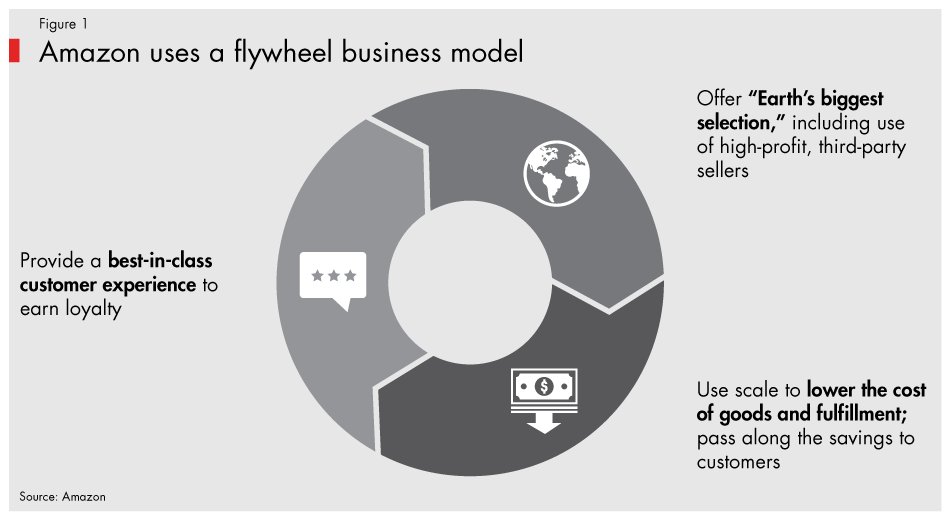
Most people know Amazon for its core e-commerce activities. Here, Amazon offers unparalleled traffic and reach: Some estimates suggest that more than half of US e-commerce searches start on Amazon. Just as impressive is Amazon’s sizable and growing share in markets outside of its core as it expands across countries, product categories and businesses ranging from movie production to cloud computing to plumbing supplies. The successful brand extensions adhere to Amazon’s flywheel model, which maintains momentum on the strength of three pistons (see Figure 1):
- Offer “Earth’s biggest selection” to attract traffic in part by expanding the network of high-profit, third-party sellers.
- Use scale to lower the cost of goods and fulfillment, passing along the savings to customers through lower prices.
- Provide a superior customer experience to earn loyalty.
Can Amazon spin the flywheel in banking? Surely, bankers might think, this won’t be a profitable or attractive business. Yet Amazon has never worried about the profitability of individual products. It focuses on learning about customers’ needs through the copious data collected, gaining their repeat business and thereby expanding share of wallet over time.
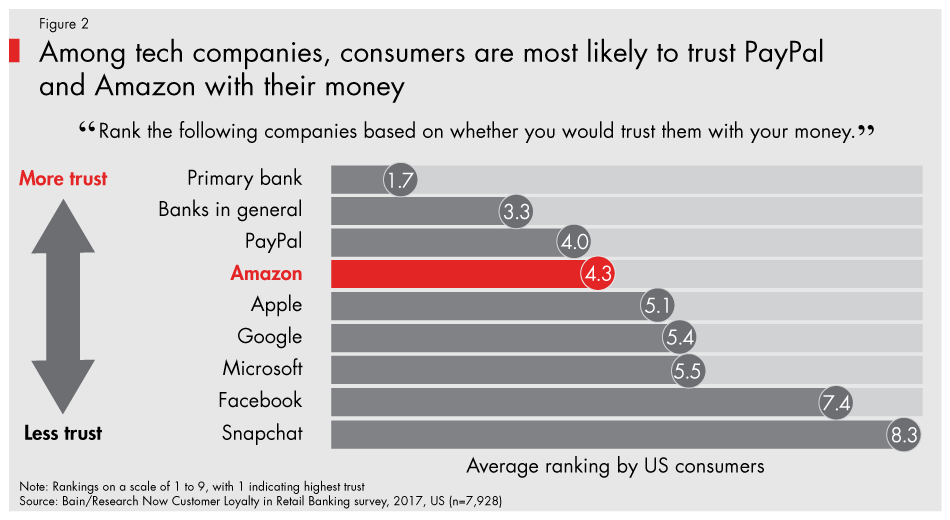
To that end, Amazon has earned people’s trust from the easy and reliable search, purchase, return and service interactions that together create a great experience for customers. As CEO Jeff Bezos has noted, “There are many ways to center a business. You can be competitor focused, you can be product focused, you can be technology focused, you can be business model focused, and there are more. But in my view, obsessive customer focus is by far the most protective….” Indeed, US and UK consumers ranked Amazon nearly as high as banks for trust with their money in Bain’s new survey of more than 133,000 consumers in 22 countries (see Figure 2).
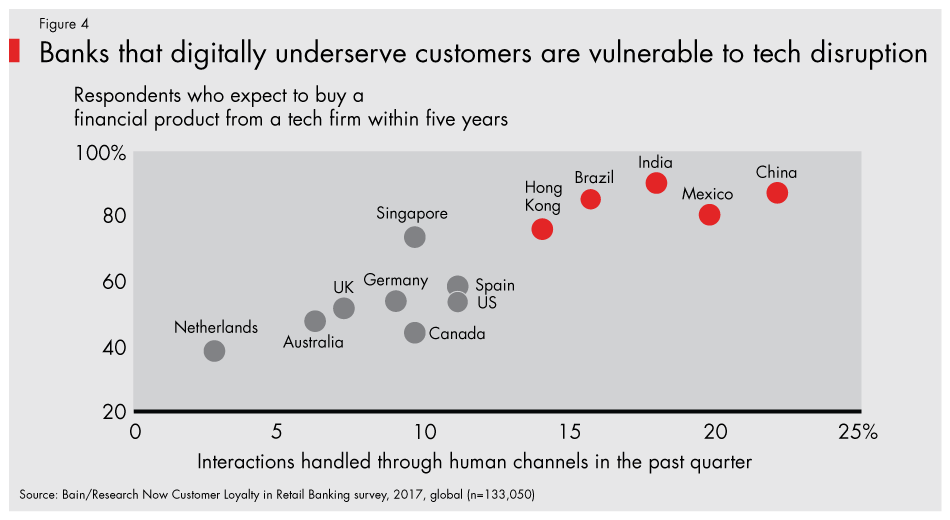
A high level of trust primes people to buy. In the US, more than half of all survey respondents—and nearly three-quarters of those aged 18 to 24—expect to run some of their finances through major tech firms over the next five years (see Figure 3). As Amazon expands its banking reach, the greatest latent demand exists in countries such as India and Mexico, where the banking experience, especially in branches, is time consuming and cumbersome and mobile banking is still nascent (see Figure 4). Both of those countries are key secondary markets for Amazon, and the company can be expected to expand in its other core markets, including the UK, Germany and Japan.
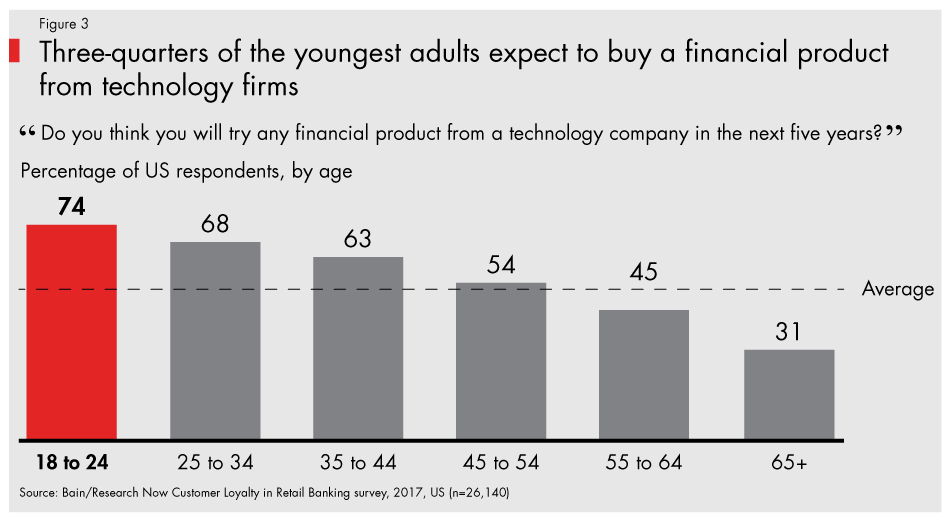
Demand for alternatives to traditional banks will only grow as younger respondents in our survey showed the greatest willingness to try financial offerings from technology firms. With Amazon designing this new bank scheme primarily for interactions through smartphones and tablets, the company’s initial targeting of young adults looks spot-on.
How banks can respond
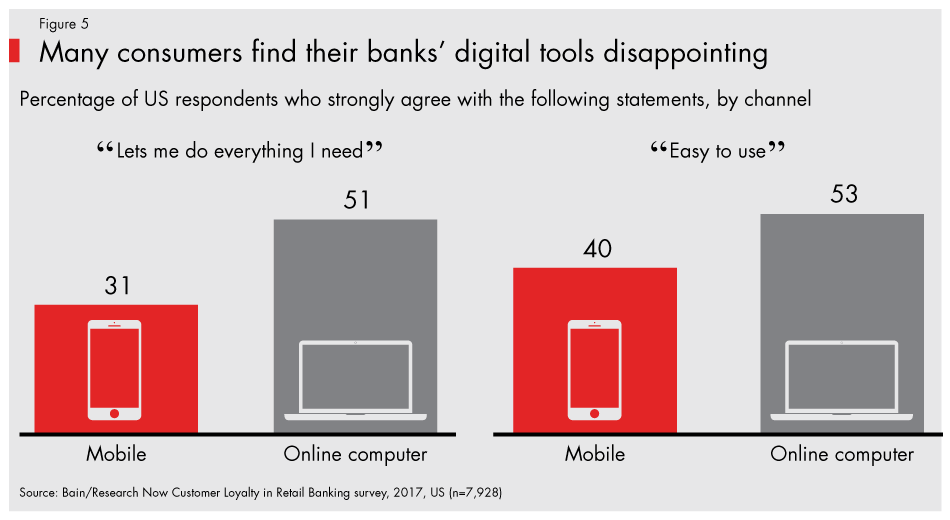
For bank executives and board members, this is a watershed moment. As hard as they have worked to catch up, banks still lag in the performance of their digital channels relative to Amazon and other major tech firms. Consumers young and old, our survey finds, prefer using websites and mobile applications to branches or call centers for their routine banking transactions. Yet banks’ mobile apps and websites fall short: Only about half of US respondents strongly agreed that their primary bank’s website lets them do everything they need or was easy to use (see Figure 5).
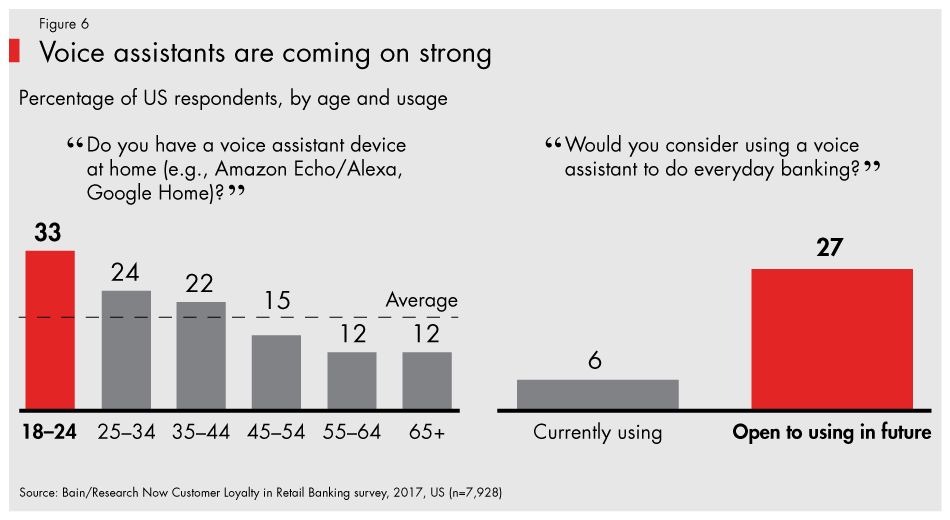
Beyond the basics, banks have barely touched some technologies that have reached a tipping point in consumer markets. Almost one-fifth of US survey respondents said they use voice assistants at home, and Amazon currently dominates the voice-enabled speaker market with Alexa. Moreover, more than one-quarter of respondents would consider using voice-controlled assistants for their everyday banking, and 6% already do (see Figure 6).
Lagging performance on all things digital indicates deeper vulnerabilities in banking organizations. Few banks orient around customers’ needs when designing policies, processes or products. Few banks make decisions fast enough to keep pace with rising customer expectations and disruptive new competitors. (Amazon expects to be in the market faster than it would take most banks to merely decide on a new product, let alone actually launch it.) And few banks have designed a new distribution model to replace high-cost branches beyond simply steering transaction volume to their website.
To raise their competitive game and stave off incursions by big tech firms, retail banks can learn from Amazon in three critical areas. First, banks should get more serious about putting customers first, meeting their needs in innovative ways rather than pushing products. Second, they will have to learn to move much faster, discarding decision making by committee. And third, they can use new distribution channels by partnering with technology firms so that they can improve their capabilities in data science and experience design. Amazon will not be the only game in town. Banks can thrive by cooperating on innovative offerings with Google, Apple, Microsoft, Facebook and others, including local champions in other countries. For inspiration, banks can look to credit card companies and their history of cobranding with airlines, hotels and retailers—and to the recent Google-Walmart collaboration.
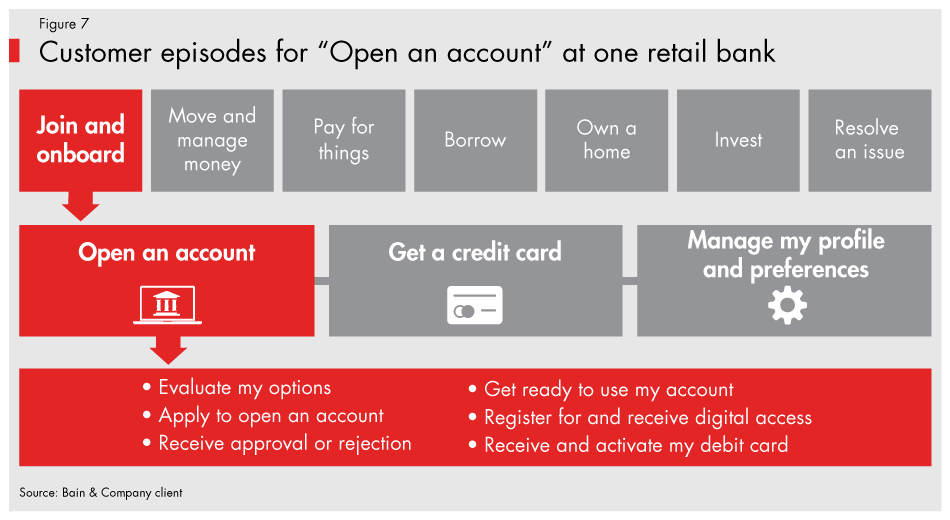
We have seen some banks handle these challenges by organizing in a new way around how customers experience the business. That’s a marked departure from the standard, internally oriented approach to organizing around products, channels and functions. As part of shifting to the customer experience, some pioneering banks have adopted customer episodes—namely, activities that customers perform when they have a task to complete or a need to fulfill—as a key unit of management. Typical episodes include “I want to pay a bill” or “I want to buy a home” or “I want to dispute a fee” (see Figure 7).
The design and management of episodes lends itself to Agile methods. While Agile is hot inside banks right now, it’s deployed mostly in organizational islands devoted to software development. Banks need to adopt Agile ways of working across the enterprise to address all the elements of the episode, whether digital, human, policy, process or back-end technology. At leading banks, the design and management of each episode occurs through small, cross-functional teams that are responsible for owning and improving an individual episode. Teams use Agile methods to quickly arrive at a minimum viable product, gathering feedback from customers and baking it into successive versions of the episode before rolling it out broadly. One bank has managed to take Agile episode management to scale with more than 250 active teams. The bank is realizing substantial gains as a result, especially in speed to market. For instance, one team generated an auto finance mobile prototype in one week, a project that previously would have taken at least six months.
Banks’ comprehensive efforts to build out websites and mobile apps have made for an intense competitive game within the sector. But Amazon’s entry takes the competition into a different league. Consumers’ expectations keep rising as people grow accustomed to simple, convenient digital channels perfected by digital natives such as Amazon. If banks don’t reorient their approach and radically accelerate their rate of progress, they will watch technology firms steadily poach their business. At first, it will be the unprofitable slice that no one wants. Then the rest of the pie. Meanwhile, banks’ economics will erode as too many routine transactions continue to flow through expensive branch networks, while too many bad events keep occurring and cause customers to flood contact centers with disputes and problems. Early warning signals for banks to monitor could include a decline in checking account formation among 18- to 24-year-olds or a rise in customers switching away from direct debits.
Perhaps the greatest challenge to senior bank executives and board members is to recognize that Amazon has a completely different worldview focused on lifetime customer value, while most banks remain slaves to in-period “bad” profits. Banks and other financial services companies that focus on customers over products, on episodes over functions, on fast test-and-learn over business cases and on customer outcomes over internal consensus may stand up to Amazon’s flywheel when it spins into their market.
Gerard du Toit leads Bain & Company’s banking and payments sector in the Americas. Aaron Cheris leads the firm’s Retail practice in the Americas. They are based in Boston and San Francisco, respectively.
Key contacts in Bain & Company’s Financial Services practice
Global
Edmund Lin in Singapore
Americas
Gerard du Toit in Boston
Mike Baxter in New York
Asia-Pacific
Peter Stumbles in Sydney
Europe, Middle East and Africa
Henrik Naujoks in Zurich
Key contacts in Bain & Company’s Retail practice
Americas
Aaron Cheris in San Francisco
Ruy Santiago in São Paulo
Antonio Cerqueiro in São Paulo
Asia-Pacific
Charles Ormiston in Singapore
Europe, Middle East and Africa
Marc-Andre Kamel in Paris
First published in 3月 2018