

論説

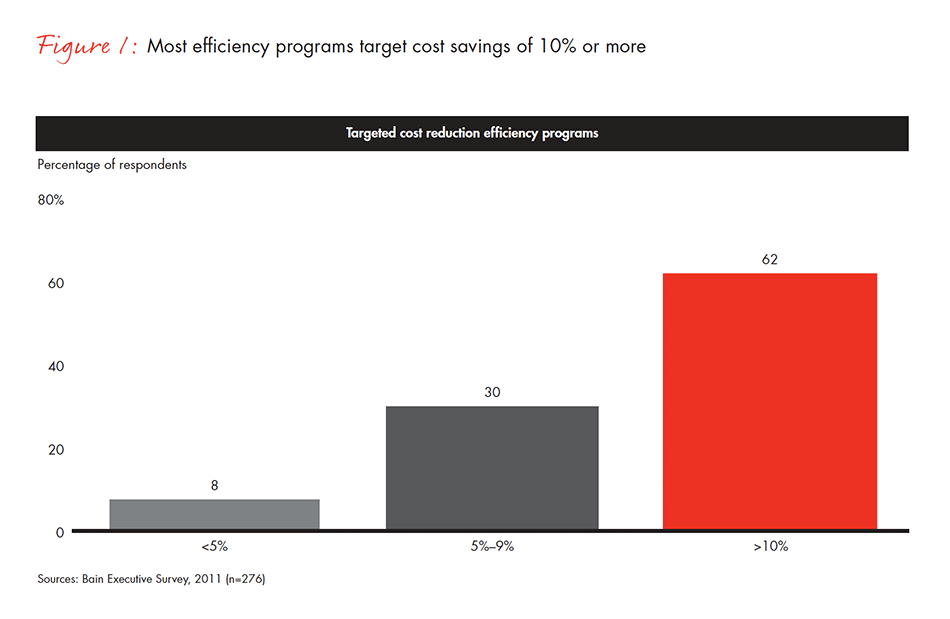
Over the next 12 months, thousands of companies will launch initiatives to make their operations more efficient. They will name a leader and a steering committee, build task forces, assemble project plans, set targets—and make the initiative top priority. In more than 60% of these companies, our research suggests, they will target cost savings of at least 10%—and most of these efforts will start to deliver modest results (see Figure 1).
But the odds are, before long, the initiative will fizzle out. Senior executives will move on to other priorities, task-force members will focus more and more on their day jobs, and the energy surrounding a once-promising efficiency effort will fade. At this point, many leaders confront a universal concern: How do we create an organization that doesn’t rely on one-off initiatives to become more efficient and keep pace with the competition? How do we lock in hard-fought gains and build capabilities for continual improvement?
Companies that have managed to break the cycle of recurring initiatives take a long-term approach. They adopt an efficiency mindset and identify a few key behaviors that trigger organizational change. While many companies worry a corporate culture focused on efficiency will strangle growth or degrade the customer experience, our research shows the opposite result. Companies that embrace an efficiency mindset are four times more likely to say their cost efforts enabled growth rather than hindered it. They also are four and a half times more likely to report improved customer experience. Australian telecom Telstra, for example, launched a corporate-wide efficiency program that removed AUS $3 billion in error and waste from operational processes while delivering dramatic improvements in customer experience.
True, it’s simpler and faster to execute individual efficiency initiatives, such as cost reduction in the distribution network, and a focused effort can produce clear gains. But leadership teams taking that approach have difficulty achieving similar efficiencies across functions and maintaining them over time. Why? The organization doesn’t build the muscles to sustain long-term change.
Short-term initiatives, by definition, are not conducive to behavioral change. Leadership teams often introduce them by saying, “The economy is bad; we have to cut costs” or “We’ve missed our earnings targets so we need to implement a cost-saving initiative.” They describe the effort as a one-time occurrence to be endured before moving on, and they fail to incorporate the progress and learning into their operating model.
So, how do successful companies adopt a new mindset? There is no fixed blueprint for embedding efficiency in an organization’s DNA. In our experience, however, successful companies share a common overarching approach: They make sure their efficiency effort spans five critical areas: strategy, metrics, commitment, behaviors and culture. Tenacity and a sustained investment in these areas create the best chance of success.
Strategy
An efficiency mindset is a powerful tool to unlock growth and make profits more sustainable. Successful companies talk about efficiency as a big part of “who we are,” as opposed to “what we did.” They make it an explicit element of their corporate strategy, focusing on the growth that efficiency can unlock and how it will make their profits more sustainable.
That’s just as true for companies that deliver premium services or have a strong focus on innovation. In fact, these types of companies benefit just as much from an efficiency mindset as companies with a low-cost business model, because efficiency reduces complexity and frees up the funds required to invest in new offerings and innovation.
Ryan Morrissey, a partner in the Organization practice, discusses the long-term approach to efficiency and the five critical areas successful companies focus on.
Metrics
Linking efficiency to strategy is a critical first step. But soon leaders will confront the challenge of changing behaviors throughout the organization—and measuring progress. Successful companies are rigorous about selecting the right metrics to track change—and they avoid using too many. Importantly, they balance measures of cost efficiency with measures of improved effectiveness.
When looking at supply chain performance, for example, inventory turns might seem like an obvious metric to follow, but if it isn’t part of a balanced scorecard, a performance benchmark could be detrimental. Companies seeking to optimize inventory turns may compromise service levels at the expense of customer experience. Pairing measurements of supply chain and customer service provides a more complete picture. Only 50% of the 276 companies we studied balanced cost targets with targets for improved effectiveness.
To make the most of the metrics, companies can create feedback loops linking data to action. Recognizing individuals or teams that move the needle helps encourage change and reinforce commitment. But an excessive reliance on incentives can also backfire. Linking the metrics to compensation, for example, requires careful consideration of which elements of performance the individual or the team really controls. Further, leadership teams that rely too heavily on metrics at the expense of healthy discussion and sound judgment can undermine their own success.
The most effective companies make the metrics visible to all and create forums to stimulate productive discussion about them. They enlist frontline workers to codesign incentives because they are critical to closing the loop and realizing the intended benefits.
Of course, to use metrics effectively, it’s critical to establish a credible baseline performance and set realistic improvement targets—tasks that are best accomplished during the annual planning process. Building the baseline from the top down or relying heavily on the prior year’s metrics is the path of least resistance, but the result often lacks credibility. An approach that starts with a careful review of cost and identifies which elements can be controlled allows leadership teams to isolate the important factors, track progress and provide the right incentives.
A credible baseline makes it easier to set the appropriate efficiency targets but still leaves critical questions, starting with the magnitude of a company’s ambition. Some firms may be seeking to offset inflation while others may want transformational gains. Three key questions can help leadership teams determine a credible baseline performance, no matter what their ambition:
- How will changing market conditions affect our targets?
- How do we accurately build in the gains we should capture moving down the experience curve?
- Is there latent opportunity to improve efficiency that should be built into the targets?
Commitment
Embedding efficiency in an organization requires visible and credible commitment from the top, starting with the CEO and the most senior members of the management team. They reinforce the importance of efficiency in their communications, and they develop a talent model that reflects that commitment, hiring personnel with the right capabilities and elevating team members who deliver. At one global drinks company, top executives demonstrated commitment to continuous improvement by applying a zero-based approach in all budget review meetings.
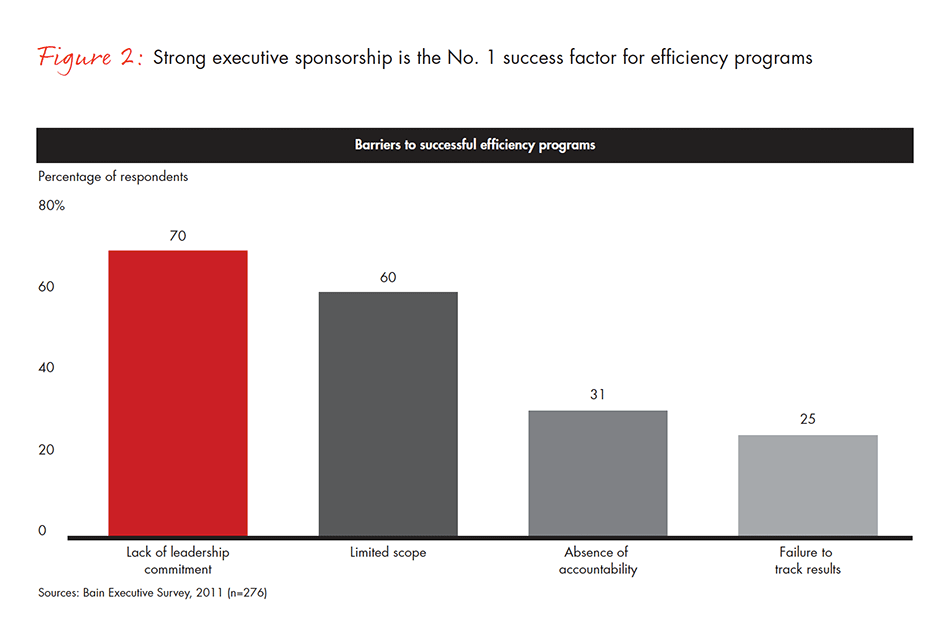
In fact, strong executive sponsorship is the single most important factor for success and the most often cited reason for failure when things go off track (see Figure 2). Successful companies establish a strong sponsorship spine for change. The spine includes the people who must implement change as well as sponsors—those who will be instrumental in sharing the case for change and motivating the right behaviors. Sponsors help anticipate and mitigate risks, encouraging teams to speak up when they encounter barriers.
In our experience, few leadership teams make it a top priority to adopt an efficiency mindset—and engagement fades quickly when new priorities emerge due to lack of commitment along the sponsorship spine. This dynamic not only comprises the effectiveness of a current effort, it undermines the credibility of future efforts. In our experience, inconsistent commitment typically leads to a worse outcome than no effort at all.
Behaviors
It’s the behavioral dimension that companies tend to neglect—especially the challenge of building a pragmatic plan to change the specific new behaviors required, both at the leadership level and at the front line. To motivate large-scale organizational change, mindsets and behaviors—how people think and act every day—need to change.
The first step is identifying moments of truth that really matter—the moments in time when someone makes a choice to do Behavior A or Behavior B. That helps pinpoint the two or three specific behavioral changes that will generate the most value. Successful companies build pragmatic plans to reinforce the right choices. These plans should ensure that people are trained in the right behaviors and that leadership teams follow up and reinforce new behaviors over the long term. Research overwhelmingly shows that reinforcement after the moment is critical for sustaining new behaviors, and ideally the ratio of positive to negative reinforcement should be about 4-to-1. Reinforcement can include feedback from peers and supervisors, financial rewards and recognition from top management.
Change is fundamentally disruptive, but the risks involved in changing organizational behaviors are predictable and manageable. Agile leadership teams identify the most critical risks and address them up front, helping people succeed despite their discomfort, and they reinforce positive behavior—a key to sustaining change.
Culture
Behaviors shape a company’s culture, which in turn can support continuous improvement. A culture that encourages innovation and risk-taking can help an efficiency mindset spread throughout an organization. But in some companies, a more targeted approach led and monitored by top management is essential to kick-starting the process.
An Indian consumer goods company successfully built an efficiency culture by encouraging calculated risk-taking and tolerating failure as part of that process. One team delivered significant savings by working with research and development to experiment with value engineering of packaging.
Rewarding teams that deliver efficiency gains is important, but the type of reward can vary widely. One international airline implementing an efficiency transformation found value in going beyond its profit-sharing plan and established a highly visible program to recognize employees who helped achieve outstanding results.
Three questions can help determine whether your company is missing the efficiency mindset:
- Do you treat cost reduction as an episodic goal, to be endured before moving on?
- Do leaders of your organization struggle to clearly articulate a meaningful set of productivity metrics for their business or function?
- Are your annual planning sessions an exercise in adding or subtracting to last year’s spending plan, or are they structured to fundamentally improve productivity?
Companies that successfully embed efficiency in the DNA of their organization reap great rewards. They manage to break the boom-and-bust cycle of short-term initiatives and gain the competitive edge that comes from a high-performance culture.
First published in 4月 2016