

論説

Most CEOs were grounded in March 2020, right at the moment that their customers and employees needed them most. Their world became virtual—endless Zoom calls to keep their people safe, customers served, and companies solvent. From those early days of the pandemic, it became clear: This crisis will redefine the CEO role, and many CEOs won’t adapt.
But the few that do will be poised to succeed in the future. The muscles CEOs build during the pandemic will help them navigate a more turbulent world, one buffeted by digital disruption, changing customer and employee needs, climate change, deglobalization, and more.
Some CEOs already have made great progress in building these muscles and adapting. Through 175 Zoom-based CEO Forums, we met with 3,000 executives, from 1,000 companies in 35 markets, to discuss how lessons from the pandemic can help them build a more robust organization for the turbulence ahead. Despite different local situations, they shared remarkably similar insights. Through these powerful patterns, we started to form the new CEO agenda and envision the winning postpandemic firm.
The evolution of the pandemic CEO
As the first wave of lockdowns hit, we pivoted our CEO Forums from two-day, in-person meetings to two-hour Zoom calls, with guest appearances from children and pets. We started with one question: How do CEOs manage risk in a more turbulent world?
We segmented risk into three objectives: predictability, the ability to anticipate future scenarios; resilience, the ability to add buffer capacity in critical areas; and adaptability, the ability to respond quickly to changing conditions. All are important, but CEOs agreed that adaptability is fully within their control. It’s mostly self-funded, requiring a leaner, more Agile enterprise. CEOs determined that they must create a more adaptable organization, giving customers the benefits of scale and speed.
As we moved past the frantic initial months of the pandemic, CEOs focused on another question: Which new ways of working should they keep, and which old ways should they stop forever? From our conversations, another pattern emerged. CEOs noted their companies were facing the worst crisis in their history, but they were seeing the best of their people. As we chronicled for the Harvard Business Review, CEOs were both astonished and inspired by new heroes of the business, who brought forward their expertise and acted swiftly when the company needed it most.
CEOs told two different types of hero stories. Some were about employees that knew what needed to be done—and quickly and flawlessly executed their roles. Here, CEOs recognized that in order to run the business better, increase speed, and bolster trust, they needed managers to get out of the way and give more freedom to the teams closest to customers.
In other cases, heroes acted like entrepreneurs. They came up with entirely new solutions and formed small cross-functional teams to execute them. They deployed Agile ways of working, by testing, failing, adapting, and retesting their solutions. CEOs acted like founders, encouraging more experimentation and scaling successes.
Through these stories, CEOs uncovered a guiding principle for the future of their organizations: Listen to the pandemic heroes. Having agreed that CEOs must build the organization their heroes deserve, we asked, “how can you design an organization that competes on the basis of scale and speed?” CEOs said they want to keep the best of the professional management system, which delivers the benefits of scale to customers, but also suffers from soul-destroying complexity. They also want to add the best of what they’re learning from emerging scale insurgents—those companies that use technology and talent in new ways to compete on the basis of being big and fast.
As Adolfo Orive, CEO of Tetra Pak, says, “The challenge is not to prioritize between scale and speed, but to capture both of them at the same time.” This journey to scale insurgency demands the organization keep and discard aspects of its previous systems, while adding new ones. The journey demands that everyone learn and unlearn.
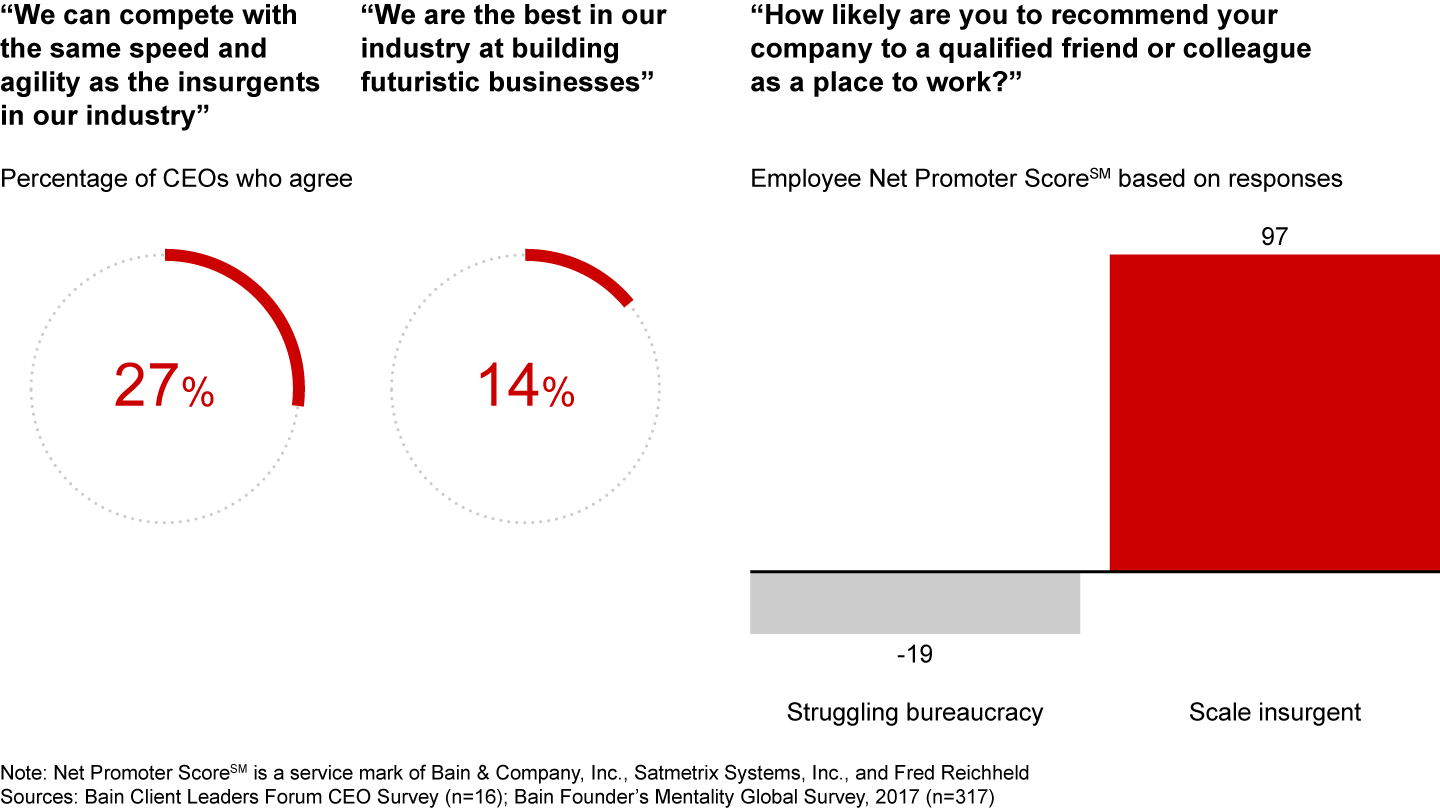
And in a world of more competition for customers and talent, the journey to scale insurgency has never been more important. Only a quarter of incumbent CEOs feel their company can move as quickly as insurgents, and only 14% feel they can build industry-dominating future businesses (see Figure 1). In addition, almost 100% of employees at scale insurgents would recommend their company as a place to work, while employees of bureaucracies are telling others to steer clear.
Figure 1

Finally, in our recent conversations, we asked CEOs, “How do you spend your time and energy?” They shared a somber recognition that the crisis has taken its toll on their organizations. Even as miraculous vaccines are rolling out, companies face a new crisis: the crisis of cultural entropy. Their people are moving away from the massive lift in morale and engagement, the “all-for-one, one-for-all” spirit that we saw at the start of lockdown. The Zoom world leaves much to be desired. Burnout is pervasive. Organizations are divided between white collar employees, who are safe working from home, and frontline workers, who risk their lives to make and deliver products every day.
CEOs are running different companies, with different leaders, and cultures ravaged and enhanced in equal measure by the crisis. They concluded that they must find a new balance in how they lead and create a new deal for talent.
As they’ve learned to adapt to their ever-changing priorities and evolving roles over the past 18 months, leading CEOs have acknowledged they can’t lose ambition as they move away from crisis mode. Returning to normalcy doesn’t mean returning to the company as it was before; their heroes deserve better. This single idea changes everything about the CEO agenda. The CEO of Aviva Singlife, Pearlyn Phau, points out, “In the new normal, we should press harder to achieve breakthroughs in the operating model and not go back to how we used to be. I hope we don’t waste a good crisis.”
Most CEOs feel the same. According to a Bain survey, 92% said they believe this is the right time for radical changes to ways of working in their organization. The crisis is a call to action.
The new CEO agenda
If CEOs must employ these lessons to build the post-Covid-19 company, how does that change the CEO job? Completely. To start adapting their roles and organizations, we’ve identified three common actions for the new CEO agenda.
Action 1: Return to purpose and move beyond the matrix
Leading CEOs will inspire their organizations to become a scale insurgents. Scale insurgents aren’t simply defined by “how” they do something, but also “what” they do. Through our conversations with CEOs, we cocreated the four design principles of scale insurgents.
Answer “why.” Why should customers care that your company exists? Why should employees want to engage with you and your teams? Purpose will be critical after the pandemic. It starts with the insurgent mission. All great companies start at war against their industry to serve the needs of underserved customers. Leading CEOs will rediscover that mission with their people. The journey will matter as much as the destination.
Take lessons from the two types of hero stories. Leading CEOs will commit to running the business better, by empowering local teams more, capturing the benefits of scale, and getting management out of the way. It’s their job to ensure that delivery teams can keep their promises to customers, no matter what it takes. These CEOs will also quickly and purposefully change the business, in order to create the businesses their customers need. They’ll develop business-building routines and nurture those heroes who excel at scaling small ideas into future businesses. It’s the CEO’s job to create systems that enable, rather than block, these development teams starting with HR and finance. In addition, the CEO must pick the right teams for the right jobs and allocate resources quickly across the most important delivery and development goals.
Adopt the lessons of digital natives. Digital insurgents have moved beyond the matrix in their organizational thinking. They talk of three teams. There are the proposition owners, who work directly with customers and deliver core propositions daily. If the organization is a Formula One team, these are the drivers. There are embedded services, which support the proposition owners with the benefits of scale, sharing the same goals and deadlines. Think of the expert teams that provide support in logistics, finance, or customer research. Like a pit crew, they deliver known routines with speed. They don’t stop the car to negotiate the tire strategy; they quickly change the tire. And there’s the company’s operating system. The organization agrees on a few things that are vital to its customers, that must be done flawlessly everywhere and always. Those things become part of the operating system. They don’t debate it. Ever.
Eliminate complexity everywhere. CEOs can start with indirect services, or everything beyond the three teams. Some roles within indirect services are vital. Your customers don’t ask for your regulatory team, for example, but you can’t operate without it. On the other hand, many of organization’s activities aren’t vital and were “turned off” during the pandemic. They should remain that way.
Action 2: Find a new balance, with a stronger focus on learning and talent
Many CEOs discovered a new paradox in their roles during the crisis. On one hand, they feel they’ve been more brutal than ever before. They’ve made quick decisions to shut operations, change distributors, prioritize customers, and cut product lines. They’ve said “no” a lot. They did this to survive.
On the other hand, CEOs now know their people better. They see how their colleagues live. They know their children, spouses, in-laws, cats, dogs, and living rooms. With this knowledge comes a new empathy.
The pandemic forced their blood to run colder when determining the “what,” but far warmer when executing the “how.” They made hard decisions, but implemented them with a new spirit of empathy and generosity. How can they reconcile these two worlds?
Radically changing the organization for a postpandemic world will continue to require tough decisions at every turn. Many CEOs have mentioned that sustaining this nature without the burning platform of the pandemic feels daunting. As they start their journey to scale insurgency, leading CEOs recommend surgically focusing on the organization’s most pressing problem.
If the biggest issue is complexity, with energy vampires hanging from every rafter, sucking the soul out of the company, CEOs can start with creating a compass for the company’s direction. They can use it to set “common instincts for growth,” ensuring everyone approaches problems the same way. This builds a freedom within a framework, providing the guardrails in which heroes can move with speed and achieve extraordinary things, as they did at the height of the crisis.
If the biggest issue is speed, with organizational silos geared toward internal victories rather than external customers, CEOs can invest their energy in their delivery teams, demonstrating to the organization that speed matters. And if the biggest issue is business building, with people who view changing the business as a distracting hobby, or folks who care more about generating disruptive ideas than scaling meaningful businesses, CEOs can focus on nurturing their development teams.
During this time, CEOs are setting the tone for their future organization. They realize employees will view their every action as either an endorsement for new ways of working or a return to the old. CEOs want to remain sympathetic and empathetic, while also clearly signaling the organization’s new direction.
We’ve seen the most effective CEOs do this in several ways. Some create learning and unlearning moments to celebrate both successes and failures. They use hero stories to paint a picture of the organization. Others are finding a new balance between vertical actions, which solve specific issues for specific customers, and horizontal actions, which require level-by-level alignment across the entire organization. They’re thinking customer-first, bringing new focus and speed to their horizontal actions, and even shifting half of their time to build future businesses for their customers.
Many CEOs are also seeking out new talent pools and adopting new lenses to discover talent within the current organization. Pedro Arnt of MercadoLibre foresees winning CEOs will “put the right person at the right role and at the right time.” Emerging from the crisis, there will be many new jobs. CEOs can’t promise everyone a job, but they can promise an audition and coaching to help everyone do their best.
Finally, the best CEOs are stopping things, in order to free up their time and energy. Remember Apollo 13 (or perhaps the Tom Hanks film)? After the accident, the aircraft was frozen in space, with most of its systems shut down to preserve energy—like many companies during the crisis. Now, the issue for CEOs is, “What do we turn back on?” Leading CEOs aren’t starting a transformation with the company as it was before Covid-19. They’re starting a transformation with the company as it is today.
Action 3: Resist a snap back
Thoughtful, resilient CEOs recognize that they’re at the beginning of their change journey, not the end. They were inspired by everything their organizations accomplished during the crisis, but they understand there’s a huge risk ahead. The entrenched behaviors of those senior leaders who desire a return to normalcy could lead the organization to snap back to its old ways, allowing energy vampires to once again settle in every room and Zoom.
“We have to change the mindset of teams,” says the CEO of Swiss International Air Lines, Dieter Vranckx. His sentiment is echoed by other CEOs who realize that mindsets often matter more than capabilities or skill sets. The best CEOs want to constantly remind people of everything that was possible at the peak of the crisis.
To effectively change mindsets and avoid a snap back, CEOs can consider three questions as they think about the journey ahead.
- How do we sustain the journey of behavioral change? Leading CEOs are committed to this journey for the long haul. As Javier Martinez Alvarez, the president of Tenaris’s operations in the Southern Cone, observes, “I find it that it's very easy for the old culture to prevail … I think that the leadership for change is not a one-day job, it's a multiyear thing.”
- How do we rethink the office, instead of carelessly drifting back? When people can’t meet in person, cultural devastation is inevitable. Zoom is critically missing what we call “A3C3”: apprenticeship, appreciation, affiliation, cocreation, creativity, and commitment. And yet, too many companies are mindlessly drifting back to offices, without focusing on the unique benefits of physical interaction. “Our offices need to be these hubs that encourage cocreation and ideation,” says Allison Kirkby, CEO of Telia. “They have to become … places where you want to hang out and to work, to cocreate, but also to socialize. Otherwise, people just won’t come.”
- How do we become business builders? Bruno Lasansky, CEO of Localiza, offers this advice: “If you need to transform the company, you need to invest much more time and energy toward development, toward business building.” CEOs understand the stakes. If they can’t become scale insurgents and rediscover the art of business building, they risk losing their customers and their own people.
Over the past 18 months, CEOs have experienced real tragedies and triumphs. This has been a dramatic dress rehearsal for the more turbulent world after Covid-19. But those who have applied the lessons of the pandemic are better prepared than those who rush back to old ways of working.
Bring on the show.
First published in 10月 2021