

論説

概要
- All multinational consumer goods companies in China, whether successful or struggling, quickly need to up their game to compete in this dynamic market.
- Among the mounting challenges facing foreign companies: the explosive popularity of local insurgent brands, an intensified war for talent and increasing “China speed” when it comes to competition.
- However, it is not too late for multinationals to succeed in China. It will take keeping pace with the market’s rapid changes and a “4D” approach: Design for China, Decide in China, Deliver at China speed and Digitalize the China business.
More Budweiser is consumed in China than in the US.
AB InBev, producer of the iconic American brand, has watched its revenues grow more than 6-fold and its margins 14-fold in China from 2007 to 2017. L’Oréal China has trebled its revenues in the last eight years. Yum China has built up similar success, making the world’s largest market a substantial part of its global revenues before separating the China business in 2017.
However, whether a multinational consumer products company is winning in China, still struggling to get a foothold or is absent in this vast and important market, the game has gotten harder. Big new challenges have emerged that require all multinationals to reinvest their time and energy in China if they hope to succeed. The three biggest challenges for foreign brands are the rapid rise in local insurgent brands, the unprecedented China speed and the war for talent.
Although foreign companies like ABI, L’Oréal and Yum China have been successful in China, domestic brands have steadily gained share over foreign brands during the past six years. Chinese companies are more familiar with local tastes, quicker to adapt to changing trends and have deeper inroads in the lower-tier cities where much of the growth now takes place. Based on the latest shopper report by Bain & Company and Kantar Worldpanel looking at 26 large fast-moving consumer goods categories, local companies accounted for 98% of the market growth in these categories in China in 2017 (see the Bain Report Local Insurgents Shake Up China’s “Two-Speed” Market).
Now, local insurgents have made their entrance to make things even harder for foreign companies. These are young brands, with names like SeeYoung, Three Squirrels, Adolph’s and Marie Dalgar, that are gaining phenomenal momentum—they have become even fiercer competition than established local players against foreign brands. We studied the performance of 46 insurgent brands and found that 30 of them grew twice as fast as their category average in the first half of 2018. These companies are adept at spotting unmet consumer needs, and they speedily bring new products to market.
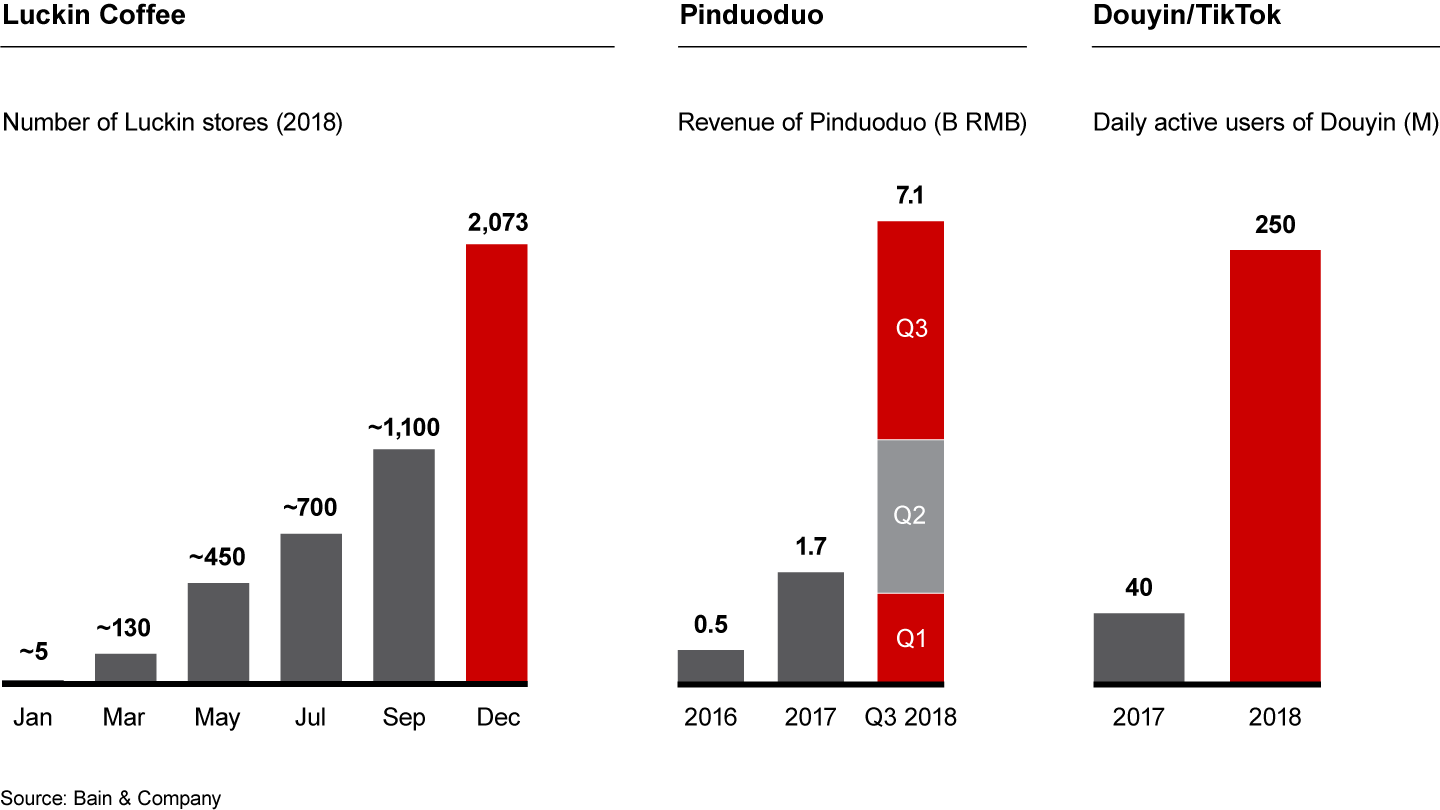
Dramatic examples of China speed are evident not only among new brands but throughout the retail ecosystem. It took Luckin Coffee less than a year to open approximately 2,000 stores; Pinduoduo, the e-commerce group-buying platform, is likely to achieve more than RMB 10 billion in revenues three years after its launch, and it took 18 months for short video social app Douyin/TikTok to attract 250 million daily users (see Figure 1).
Figure 1

And China speed can combine with “China pride” in a dramatic way when Chinese consumers sometimes turn nationalistic, while they remain the smartest and most discerning consumers in the world. There is an abundance of such examples in the recent past.
Last but not least, more foreign companies now find themselves losing out in the war for talent. China’s millennials are turning their backs on careers with multinationals, which they increasingly see as bureaucratic, out of touch and overly reliant on global models that simply do not work in China. A joint study by Bain and LinkedIn found that over the past five years, business leaders in China have moved from multinational to local companies at five times the rate that they move from local companies to multinationals. The typical multinational offers high salaries, with the possibility for global training and rotation. To gain an edge in the competition for talent, Chinese companies are offering more attractive employment packages, with such lures as stock options, differentiated compensation, digital involvement and greater ability to influence decisions.
Keeping pace with China
This troubling scenario does not mean that all foreign brands are doomed to fail in China. What it does mean, however, is that multinationals need to adapt their China strategy to keep pace with a market that is changing—or has changed—too speedily for most to react.
Foreign companies that sustain a strong presence in China are fluid enough to reinvent themselves as quickly and as often as needed. Millions of new Chinese consumers enter the market each year, essentially redefining demand. Winning brands are rigorous in tracking the trends and responding. For example, personalization is increasingly important in China, but consumers will continue to shop as a tribe, with such shared needs as a newly popular focus on health, a thirst for hyperconvenience and a desire to indulge in immersive entertainment. That is the context in which brands need to innovate personalized products and services.
New concepts like social commerce take root easily in the country and thrive. It is a market that has leaped beyond the integration of online and offline retail to introduce ubiquitous shopping across a range of consumer touchpoints. China is home to unmanned shelves with customized SKUs based on profiling of frequent customers—and facial recognition payment.
In such a dynamic environment, the survivors among multinational consumer goods companies will not attempt to replicate the approach that helped them succeed in China until now. They will become strong competitors because they acknowledge that their plan of attack is outdated.
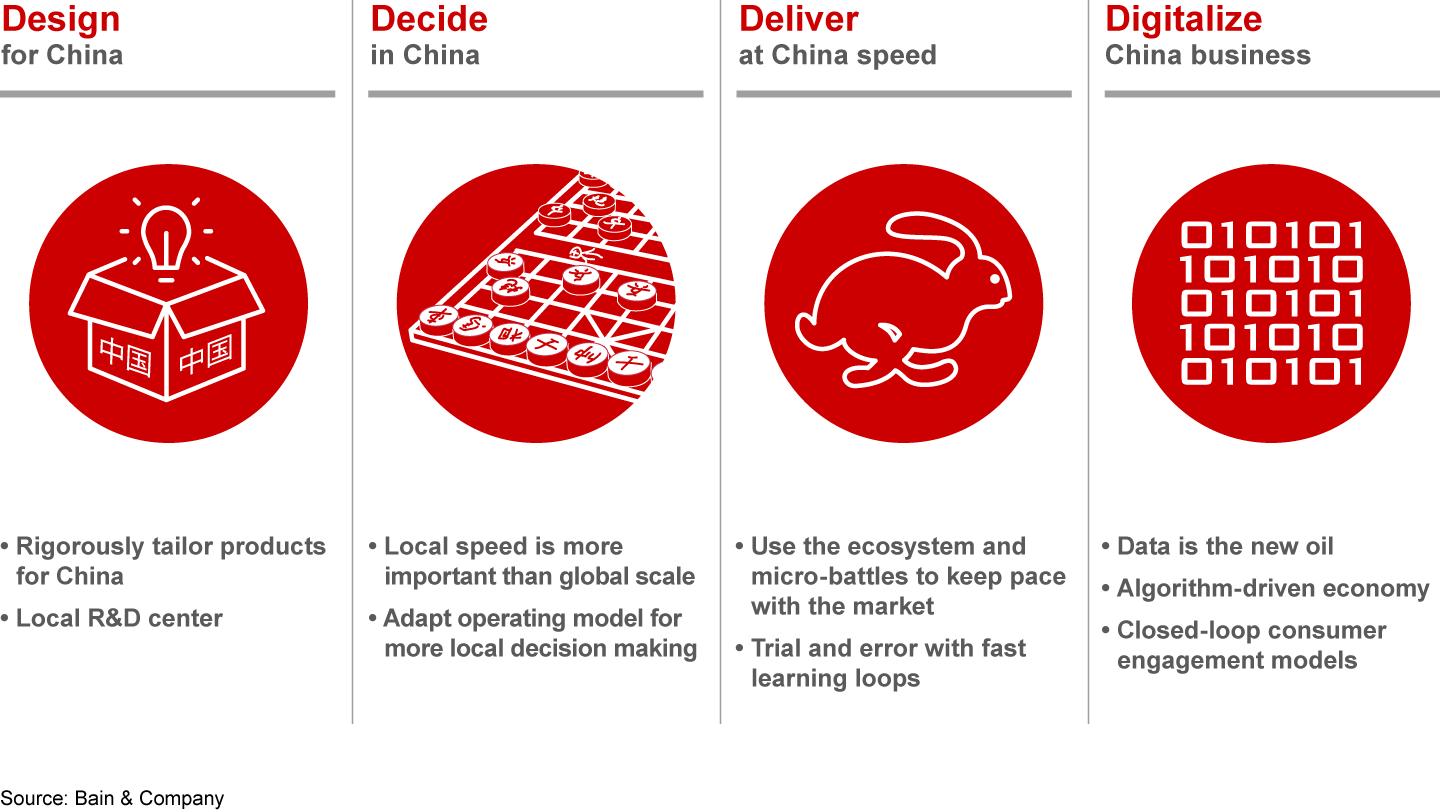
Category leaders can hold onto their position by doubling down on China. They will make China a direct report, emphasizing their commitment by actively devising ways to design for China, decide in China and deliver (execute) in China speed, what we refer to as the “3D approach.” The best companies are accelerating all three of these Ds with digital capabilities—making it a fourth D (see Figure 2).
Figure 2

Let’s look at how the best companies speed execution for China. One way is through micro-battles. They zero in on small, achievable battles that easily can be scaled. In 2018, AB InBev used this approach to become the top imported beer among affluent consumers in China. It created a winning prototype in the trendiest bars across three cities by testing on-trade promotions. After the initial success, the company applied its learning in on-trade channel promotion to its portfolio of other brands in China. The effort is teaching the multinational a valuable lesson: Even for a huge and established company, it is possible to quicken the pace and prevent insurgents from taking over the fast lanes.
Another way that leaders speed the pace of execution is by working with one of China’s powerhouses, Alibaba and Tencent, which can access much of the consumer data in the country through the many participants in their vast ecosystems that encompass social media, gaming, entertainment, banking, you name it. Consider how Unilever acted on Alibaba customer data that showed the need for an affordable antipollution skin cleanser. It developed 48 different product prototypes, market-testing them on Alibaba’s online malls Taobao and Tmall before introducing its Purifi line, starting with a skin cleanser based on the purchasing decisions of tens of thousands of young mothers. The entire process of conception, design and testing took Unilever just six months with Alibaba’s help, down from the usual 18 months to two years for a new product.
Finally, consider the successful path L’Oréal has taken to more than treble its revenues in China over the past eight years. The company designs for China—its L’Oréal China R&D center develops products specifically for the local market. In fact, a vast majority of products in the consumer products division are tailored for China, whether through distinct formulation or packaging. It decides in China: Its China CEO is a member of the Group Executive Committee, and L’Oréal has restructured its organization to enable better consumer centricity and fast adaptation to new digital trends in China. It delivers at China speed. The cosmetics company launched more than 300 new SKUs in China in 2018—roughly the equivalent of one SKU per day.
All of this is achieved with a significant emphasis on digitalizing L’Oréal’s business. By partnering with all leading online platforms on innovation and data-driven insights, and by effectively managing digital channels, the company grew its e-commerce sales to about one-third of its total business in 2018.
Playing catch-up
Those three multinationals are product category leaders in China, but some of the same lessons apply to foreign companies that have historically struggled. If you are trying to get a foothold in China or catch up fast, you need to do all of the above—but act quickly. Develop a “challenger” mindset that fundamentally changes how you think and allows you to move swiftly. The fact is, China’s fluid market brings with it many opportunities. Even for late starters, it can be a second home market.
Lagging companies can get ahead with a bigger commitment to making decisions on the ground instead of at global headquarters, for example. By the time a decision escalates from the local to regional to global headquarters for an approval, a brand is likely to have lost an opportunity to a more nimble insurgent competitor. The answer is to have China directly report to headquarters and build a “team China” at headquarters that will support the China-based team.
It is better to delegate product, marketing, distribution and other decisions affecting the China business to the China team, which should behave like a local company. The fundamental question for multinationals is whether the benefits of global scale can more than compensate for the lack of local speed, both in decision and execution. Evidence so far suggests that the answer is no. When it comes to China, local speed is more important than global scale. There is another big plus to changing an operating model to decide in China and move at China speed: It is a way to attract better talent.
Struggling multinationals will also open themselves up to the opportunities afforded by China’s ecosystems. Those ecosystems provide access and distribution, and a way for brands to build scale through an asset-light approach. It is an attractive alternative to established brands’ crumbling, multiple-tier wholesale distribution model. And the timing could not be better for brands to consider the prospects of joining up. The ecosystems are unclear about how best to partner with big multinational brands, creating an opportunity for those brands to help shape how they can work together.
Even as local companies capture most of the growth in China’s fast-moving consumer goods business, there still is room for multinationals to earn their share. China already is the No. 1 or No. 2 market for some multinationals—but that should be the goal of every consumer products company. With the largest middle class, it still is the best consumer story in the world.
Bruno Lannes and Jason Ding are members of Bain & Company’s Consumer Products practice, based in Shanghai and Beijing, respectively. François Faelli leads Bain’s Global Consumer Products practice and is based in Brussels.

Local Insurgents Shake Up China’s “Two-Speed” Market
Incumbents can compete more effectively by adopting critical ingredients of insurgents’ success.
First published in 4月 2019