

論説

概要
- Venture capital investment in defense has grown five times in value over the past decade, and deal count set a record in 2024.
- Capital inflows are diversifying by both market segment and capital source—signs of strong investor sentiment.
- New entrants’ estimated valuation of $86 billion implies disrupter market share will grow from about 1% today to between 5% and 7% by 2030.
- A market share shift of this magnitude will require breakthrough improvements in cost, greater rewards for risk-taking, and discipline by investors.
Private capital is reshaping defense—slowly but unmistakably. A decade ago, venture capital in the sector was a rounding error. Today, deal counts are at record highs, and investors are backing disruptive new entrants that promise faster, cheaper, and more capable solutions. Of course, disruption in defense is a long game—one that depends on more than just capital. It will hinge on bold reforms, shared risk-taking, and dramatic performance improvement from suppliers old and new.
It’s an unprecedented moment for the industry. But defense technology is not a typical technology growth story. Timelines are long, outcomes are interdependent, and the path from prototype to procurement is not straightforward. Unless suppliers, customers, and investors move in sync, capital will flow in without results flowing back out.
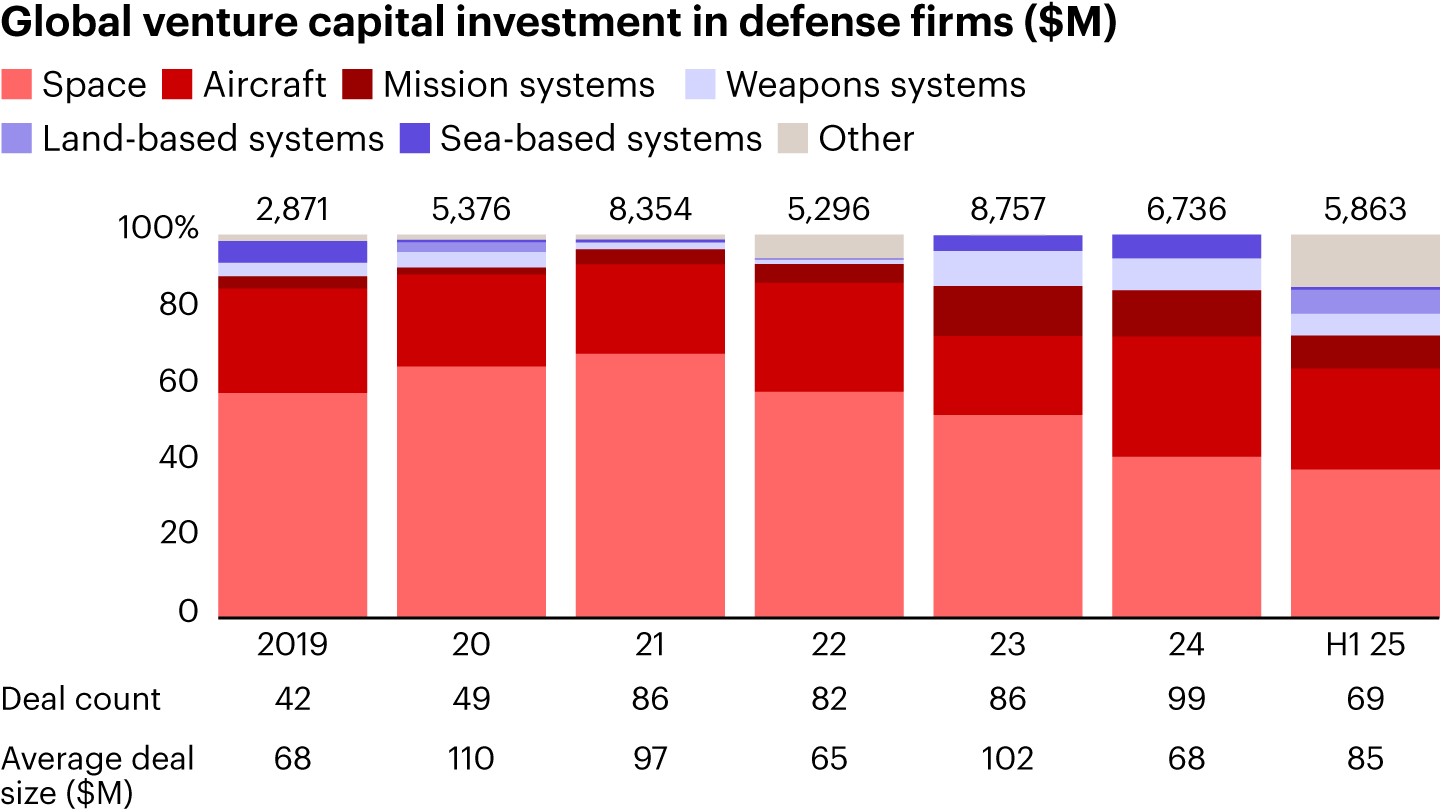
The opportunity is real. A global rise in defense spending and US Department of Defense (DoD) reforms, such as the April 9, 2025, Executive Order on modernizing acquisition practices, creates an opening for change. Over the past decade, venture capital investments of more than $10 million in defense-focused companies have grown five times in value. Deal count has increased eightfold over that same period, reaching a record high of 99 deals over $10 million in 2024. Cumulative invested capital last year totaled $6.7 billion, headlined by a $1.5 billion Series F round in Anduril in August. And fund-raising momentum in 2025 continues at a healthy clip.
These capital inflows are diversifying in terms of market segment and capital source, both signs of positive investor sentiment. The majority of investment from 2018 to 2022 funded companies in the space domain. Now, investors are backing companies across a diverse range of sectors (see Figure 1). Examples include unmanned sea systems (Saronic), autonomous aircraft (Shield AI), and directed energy weapon systems (Epirus).
Figure 1

注 Includes all deal sizes over $10 million; excludes companies based in China, Russia, Iran, North Korea, and Hong Kong; excludes BAE Systems investment of $400 million in 2015 and $290 million in 2016
Sources: Pitchbook; Bain analysisThe investor base has grown significantly and now includes many generalist investors (those who invest across industries or without aerospace and defense as a specific focus area). In 2017, fewer than 100 firms made a venture investment in aerospace and defense. In 2024, more than 300 different firms—both defense-oriented and generalist—invested with funds entering at all check sizes.
Investors are betting on acquisition reform and significant budget reallocation. There have been many attempts in the past to achieve both, yet the pace of change has been slow. As a result, the US defense industrial base is still struggling to achieve desired levels of readiness, affordability, and capacity. Pressure is mounting—from investors, suppliers, and Congress—for faster and more substantial change.
Closing the investment case
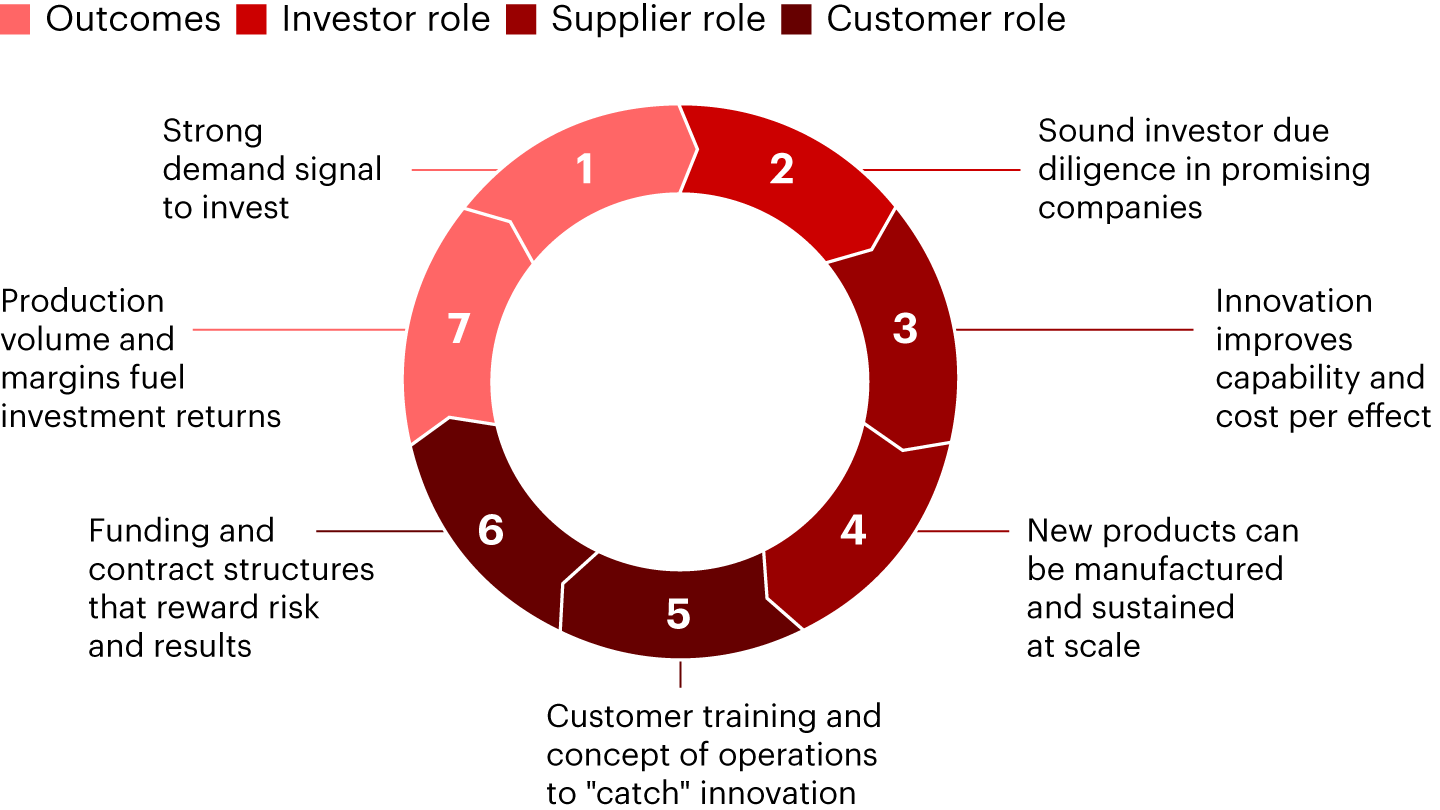
Continued investment growth and improved defense industrial base health depend on many interconnected decisions going right, in parallel (see Figure 2). Any missing link in the chain puts those outcomes at risk. And disappointing returns will discourage further private investment in defense capabilities.
Figure 2

Sustained investment growth requires evidence of returns and a significant shift in market share to suppliers that can deliver step-change improvements in product cost and capability. The total estimated market valuation of VC-backed defense tech firms in our research (excluding SpaceX and accounting for commercial-defense dual-use) is $86 billion (see Figure 3).
Figure 3


注 Only includes firms with a valuation over $25 million through April 30, 2025; excludes estimated share of commercial value; excludes firms in China, Hong Kong, and Russia; excludes SpaceX; includes defense/government value only
Sources: Pitchbook; Bain analysisThis market valuation, based on a five-times revenue multiple consistent with more mature defense technology companies, implies that by 2030, total revenues for new entrants need to be roughly $15 billion to $20 billion. That sum would represent 5% to 7% of the projected $300 billion in addressable 2030 procurement and research, development, test, and evaluation (RDT&E) spending by the DoD, intelligence community, and near-allies. To achieve such a shift, customers, suppliers, and investors will need to change their behaviors.
The risks
Investors are asking a simple question: What would make us regret committing capital? Three major risks—unless addressed head-on by suppliers, customers, and investors—could derail returns and stall the flow of private capital into the sector. The consequences of such an outcome would go beyond finance: The resilience and readiness of the US defense industrial base would erode.
Risk No. 1: Suppliers can’t meet underlying defense needs
US defense needs are not static, nor do they exactly match the needs of allies with different capabilities, geographies, and defense objectives. There is now a clear focus on peer competition. As a result, demand is rising for systems that can perform in contested environments far from bases, with minimal connectivity or support.
New solutions need to incorporate step-change improvements in affordability. However, delivering advanced capabilities under harsh conditions is difficult. Achieving that goal can increase cost, weight, and range. New systems will also require field testing and cycles of learning with end users to achieve operational effectiveness.
For firms that clear those bars, scaling production—on time, on budget, and under scrutiny—is the next hurdle. Disrupters will need to overcome talent shortages, build a trusted supply chain, raise sufficient capital, and ensure supplier resilience—all while ensuring product affordability.
Finally, suppliers must develop viable plans for supplying and sustaining their systems, particularly in distant and contested environments. Systems that can’t easily be maintained, repaired, and upgraded will be inadequate for prolonged operations.
Risk No. 2: Customers don’t shift spending or reward at-risk investment
Private investment in defense technology companies competes with investment in other sectors. Investors may pull back if they fear returns on their defense-market investments will be surpassed by investments in other sectors. Strong returns that encourage further investment require market adoption of novel solutions.
But that shift is far from guaranteed. Defense budget and program decisions are complex and slow-moving—and inflation only adds pressure. To change course, the government will need to break from risk-averse buying habits and prioritize speed, modularity, and cost—which may require changes to incentives.
Defense customers must also be ready to “catch” new technology. Military strategy, doctrine, training, and concepts of operation need major updates to ensure new systems can be used effectively. For example, as the US Army considers buying thousands of unmanned aerial systems, it should ensure it has the manpower, plans, and infrastructure to deploy them effectively in the operational environments where they can be most effective.
Ultimately, defense sector contracts will need to look different in the future. For private investors to close the business case, large independent R&D investments need to be accompanied by higher profit margins, especially when potential volumes are lower (often the case in defense). In commercial markets, these margins are often earned in the sustainment phase of the capital equipment life cycle—the long tail of maintenance, upgrades, and support that follows initial delivery. In defense markets, this model can conflict with “right to repair” provisions. Unless contracting models reward risk-taking, the return profile for investors may fall short—no matter how promising the technology.
Risk No. 3: Investors aren’t disciplined in selecting investments or patient in deploying capital
There are myriad defense technology companies at different stages of maturity. Private capital’s ability to identify and back winners will shape the environment for the entire ecosystem of new entrants. Due diligence is more difficult in defense than in commercial markets. Defense spending outlooks are uncertain, and government decision-making processes are opaque. These factors make thorough due diligence even more critical.
Investors will also need to be patient. Even if near-term demand continues to support valuations, defense investors will face two compounding challenges: long development timelines and unclear exits. Firms with early contract wins may face years of technical maturation before realizing large-scale procurement revenue. The path to a DoD “Program of Record,” or a formal government commitment to buy a product or system, is unpredictable, shaped by shifting customer needs, added requirements, and uncertain budget cycles. Investors should factor in these uncertainties during due diligence and anticipate a longer investment time frame.
What success will look like
Incumbent suppliers, disrupters, and investors each have a critical role to play in improving defense outcomes and rewarding their stakeholders. A few key behaviors will characterize the winners:
- Savvy investors will engage in detailed diligence of underlying technologies and the potential market opportunity. They will conduct proprietary research and seek to understand the customer point of view as well as the strength of a company’s go-to-market approach. The DoD and other government buyers are far from monolithic, and good diligence can decode nuances in the ways that budget and buying decisions are made. Successful investors will also pay close attention to the “end-state” business model a disrupter seeks to achieve. Is there a credible plan for pricing and long-term support—things like maintenance, upgrades, and service after delivery? Can the company maintain its culture and talent as the business matures?
- Successful new entrants will develop technologies with step-change improvements that address critical customer needs. They will use multiple sources of capital, including government and industry partner funding, to complement self-funding. Their product offerings will balance affordability with capability and emphasize support throughout the product life cycle. The best products will be forged from cycles of learning and iteration with end users.
- Winning incumbents will invest more of their cash in R&D, focusing on areas where customers are most likely to reward that investment. They will focus on innovation that can be applied to a broad range of defense capabilities and achieves benefits of scale. Successful incumbents will also raise the bar on program performance—delivering better outcomes on time and on budget. And they will acquire or partner with new entrants when they can add value and speed up the adoption of novel capabilities.
The road ahead is complex—but the opportunity is real. If investors stay disciplined, if suppliers deliver solutions that outperform, and if customers evolve how they buy and sustain new systems, private capital can help reshape the future of defense. The next era won’t be defined by technology alone—it will be built on the willingness to take risks, break patterns, and back what works.
First published in 9月 2025