

論説
Airlines regularly survey flyers, asking how likely respondents would be to recommend each of the carriers they use to friends and colleagues. They also probe the reasons for different ratings. Of course, many passengers give certain airlines poor ratings because they believe those airlines perform significantly worse than competitors in on-time performance—more delays, more cancellations and so on. But in many cases, flight data shows that the gap is far less than customers seem to think. What’s really going on?
A large insurance company was struggling with persistently low Net Promoter® scores (NPS)1 among customers who had recently filed claims. Trying to identify the reasons, the company heard a common theme: Claims agents weren’t demonstrating sufficient empathy. Typical responses included “They made me feel like a criminal” and “I had to prove everything over and over.” Concerned, the insurer launched a series of training initiatives to improve its agents’ listening skills and help them learn to show empathy. But nothing seemed to help—customers were still unhappy. Why were the efforts fruitless?
Virtually every large enterprise devotes significant time and resources to surveying its customers about their attitudes, behaviors and intentions regarding the company’s products or services. Usually it’s the marketing department that sponsors these surveys, and usually the surveys contain endless numbers of questions. There’s a reason for the length, of course: The goal is to pinpoint exactly what customers most like and most dislike.
That’s why the typical hotel questionnaire, for instance, asks about the reception desk, the bell captain, the concierge, the air conditioning, the lighting, the pillows, the bed, the minibar, the turn-down service, the shower and on and on, usually 30 or 40 individual items in all. And what happens? Most customers just toss the card back on the dresser, never filling it out, and the hotel never learns what is on those customers’ minds. As for the minority who do fill out the cards, respondents find themselves limited to the categories established by the hotel’s survey designers. Suppose that what you really value is the hotel’s location and what you really hate is the noise of the garbage trucks out back at six am, and neither of those items appears on the long list of questions? There isn't a survey in the world—at least not one that a reasonable person would answer—that can cover every conceivable reason for a customer’s reactions to a product or service.
The Net Promoter System's℠ process takes a different approach. NPS companies typically ask their customers just two questions: How likely would you be to recommend this company [or product] to friends and colleagues? and What is the primary reason for your rating? Some of these surveys, like the airline one described above, are “top down”—anonymous studies that compare ratings among competitors. Others, like the insurance company’s, are “bottom up,” meaning internal surveys of a company’s own customers, often conducted right after a transaction. (To learn more about the difference, see www.netpromotersystem.com/top-bottom.) In both cases, the questionnaire is short so response rates are usually high. The company learns exactly what’s on customers’ minds, expressed in their own words. The processes generate a steady stream of data that frontline supervisors and employees can use to improve their performance.
Customers can always articulate what’s bothering them or what they most like about a company. But they don’t always know the full story behind their own feelings. Rob Markey, global practice leader of Bain's Customer Strategy and Marketing practice, explains why in this short video.
But a Net Promoter System poses a challenge to its practitioners. Customers can always articulate what’s bothering them or what they most like about a company. But they don’t always know the full story behind their own feelings. So companies can rarely stop with customers’ expressed comments. The insurer, for instance, heard the complaints—lack of empathy—and quickly decided that it should help agents show more empathy. But things didn’t improve.
This is where root cause analysis enters the picture.
The five whys
Root cause analysis in business goes back to the Total Quality movement and ultimately to the Toyota Production System. Toyota—and, later, many other companies—trained production analysts to ask why a defect appeared and to keep asking why until they had identified a root cause. It wasn’t enough to note that a machined part was loose because the hole it fit into was too big. Why had the operator drilled the wrong size hole? Had he chosen the wrong bit, and if so, why? Was the bit stored in the wrong bin? Was it mislabeled? If so, why? The process of asking at least five whys gave companies the ability to attack not just the symptoms of poor quality, such as a loose part, but the underlying root cause—the core reason behind what happened.
It’s much the same with customer feedback. If a customer says that the product’s price is too high, for instance, that’s not the end point; it’s merely the starting point for further investigation. Why does she feel that way? Is it because she doesn’t make use of the full set of benefits the product offers? Is it because the most important benefits are buried in a sea of other, less valuable features? Is it because the company has sold the wrong product to this particular customer? If a company ends its research with the customer’s statement, “the price is too high,” it essentially has only two choices, neither one satisfactory. It can lower the price to make the customer happy, hurting its margin. Or it can keep the price where it is and risk driving the customer away. Asking the five whys leads to a larger set of possible solutions. It also helps a company focus on solutions that will be more likely to influence customers’ subsequent behavior and attitudes.
And while it’s tempting to hand off the job of digging for root causes to specialists at corporate headquarters—after all, they have the experience, skills and time available to do the job well—that’s usually not the best solution. Engaging the teams that are directly responsible for shaping the customer’s experience almost always results in better, more enduring solutions, whether those teams consist of call center agents, web designers, product developers, pricing managers or sales directors. Digging for root causes is a skill to be developed throughout the organization, not reserved just for specialists in a central department.
Look once more at the two real-world examples at the beginning of this article.
The unhappy passengers. A team at one airline that saw a discrepancy between the company’s actual on time performance and customer perceptions began their search for the root cause by studying customers’ responses. Among the many customers upset about travel delays and cancellations, some felt they didn’t receive appropriate compensation. An obvious first response for any airline is, maybe we should offer more compensation and improve our on-time performance. But both solutions would cost millions of dollars. Better on-time performance, for instance, requires spare planes, backup crews, extra mechanics on duty and so on.
Closer analysis, however, yielded different insights. How the airline handled delays seemed more important than the delay itself (see figure). In fact, delayed passengers mostly fell into one of two groups: those who felt that the airline’s communication about the delay had been terrific and those who thought it was terrible.
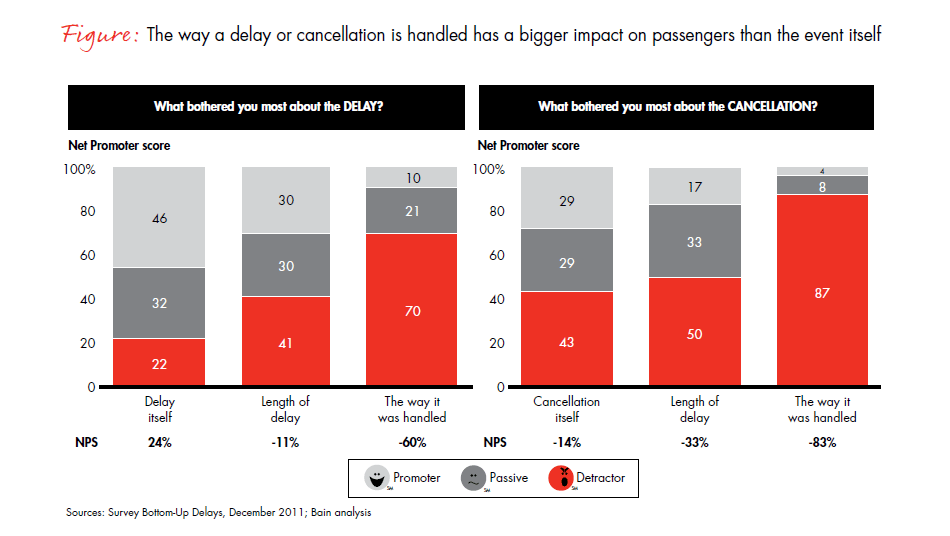
Passengers who thought the airline had communicated well gave it far higher scores than those who did not. In fact, the scores from passengers who experienced long delays but good communication were about the same as scores from passengers who experienced only minor delays, but thought the communication had been lousy.
The team could now investigate each group further. Why did some people believe that communication had been so good? It turned out that someone in authority, usually the pilot, had addressed them clearly and explicitly about what he or she knew and had shown empathy with the passengers’ plight. Asking why that didn’t happen all the time, the airline found that its procedures were poorly defined: No one was quite sure who was supposed to address the passengers. Some pilots took the initiative to do so, others did not. Moreover, pilots had differing levels of communications skills. Some made passengers feel a lot better and others did not.
As for the group that felt communication had been poor, many respondents said they had been given conflicting information, and thus believed that someone had lied to them. Again, the airline’s team asked why. They found that gate agents and other employees were often using different and uncoordinated computer systems, which provided different information.
They also discovered that gate agents were reluctant to give out incomplete information—they didn’t want to be perceived as lying—but as a result they waited for “just five more minutes,” over and over. Unfortunately, their good intentions resulted in prolonged silence that contributed to passenger anger.
Once the “why?” questions were asked and answered, the airline could take corrective actions, including synchronizing information systems, clarifying communications procedures and training pilots in communications skills.
The unhappy callers. The story was similar at the insurance company. Training the claims agents in empathy and listening skills made some difference—but not much. The reason: a set of policies and procedures that undermined even the most empathetic agents. For example, the company required customers to fill out a lot of paperwork. It required them to sign claims requests in front of a notary. And since the company’s systems did not provide each representative with the claimant’s full story, reps were forced to ask for the same information on every call, making customers feel that they were being interrogated. Why were the systems so limited? Well, rapid recall of notes from a prior call would require a system upgrade, and the company had never believed such an upgrade was worth the expense.
These root causes—which implicitly identified a set of potential solutions—didn’t appear until the company asked a series of “why?” questions.
Systematic root cause identification: Four steps
Over time, leading Net Promoter companies have developed procedures that embed root cause analysis deep into their operations and processes. The procedures typically follow a four-step sequence.
- Identifying most likely potential causes from feedback data. Customer responses indicate proximate causes of their satisfaction or dissatisfaction with your products or services. Company employees can add their insights into possible root causes, essentially creating a list of hypotheses about what lies behind the responses. The team can then rank-order the list by likely importance.
- Asking the “why?” questions. Team members then begin pursuing the five whys for the top ranked causes, thus deepening and enriching their list of hypotheses. They assemble operational data that will help them test and validate possible causes. When the airline uncovered the unsynchronized computer systems, for instance, it had good reason to believe that many passengers were indeed receiving conflicting information.
- Proposing actions. At this point the team can assign a value to addressing each root cause. What would fixing this problem cost? What would it be worth? That leads to a list of proposed actions.
- Institutionalizing the feedback. The team then loops back to key individuals in the company, putting a feedback mechanism in place to ensure consistent attention to root causes. The airline, for instance, created a measurement system that gave employees faster feedback on their adherence to best-practice behaviors, along with direct feedback on what customers were saying through the Net Promoter surveys.
The development of this capability—the root cause discipline—is a key part of creating a powerful Net Promoter System. It takes time and resources, but the payoff is substantial. It enables a company not just to hear the voice of the customer, but also to push deep into its internal operations to learn exactly where it is doing things right and where it is doing things wrong. The company thus learns why it creates promoters among some customers and detractors among others, and it can take action to increase the former and decrease the latter. That ability lies at the very heart of the true customer-centric enterprise.
Fred Reichheld and Rob Markey are authors of the bestseller The Ultimate Question 2.0: How Net Promoter Companies Thrive in a Customer-Driven World. Markey is a partner and director in Bain & Company’s New York office and leads the firm’s Global Customer Strategy and Marketing practice. Reichheld is a Fellow at Bain & Company. He is the bestselling author of three other books on loyalty published by Harvard Business Review Press, including The Loyalty Effect, Loyalty Rules! and The Ultimate Question, as well as numerous articles published in Harvard Business Review.
1Net Promoter® and NPS® are registered trademarks of Bain & Company, Inc., Fred Reichheld and Satmetrix Systems, Inc.
First published in 7月 2012