Skip to Content
  • オフィス

    オフィス

    北米・南米
    • Atlanta
    • Austin
    • Bogota
    • Boston
    • Buenos Aires
    • Chicago
    • Dallas
    • Denver
    • Houston
    • Los Angeles
    • Mexico City
    • Minneapolis
    • Monterrey
    • Montreal
    • New York
    • Rio de Janeiro
    • San Francisco
    • Santiago
    • São Paulo
    • Seattle
    • Silicon Valley
    • Toronto
    • Washington, DC
    ヨーロッパ・中東・アフリカ
    • Amsterdam
    • Athens
    • Berlin
    • Brussels
    • Copenhagen
    • Doha
    • Dubai
    • Dusseldorf
    • Frankfurt
    • Helsinki
    • Istanbul
    • Johannesburg
    • Kyiv
    • Lisbon
    • London
    • Madrid
    • Milan
    • Munich
    • Oslo
    • Paris
    • Riyadh
    • Rome
    • Stockholm
    • Vienna
    • Warsaw
    • Zurich
    アジア・オーストラリア
    • Bangkok
    • Beijing
    • Bengaluru
    • Brisbane
    • Ho Chi Minh City
    • Hong Kong
    • Jakarta
    • Kuala Lumpur
    • Manila
    • Melbourne
    • Mumbai
    • New Delhi
    • Perth
    • Shanghai
    • Singapore
    • Sydney
    • Tokyo
    全てのオフィス
  • アルムナイ
  • メディア
  • お問い合わせ
  • 東京オフィス
  • Japan | 日本語

    地域と言語を選択

    グローバル
    • Global (English)
    北米・南米
    • Brazil (Português)
    • Argentina (Español)
    • Canada (Français)
    • Chile (Español)
    • Colombia (Español)
    ヨーロッパ・中東・アフリカ
    • France (Français)
    • DACH Region (Deutsch)
    • Italy (Italiano)
    • Spain (Español)
    • Greece (Elliniká)
    アジア・オーストラリア
    • China (中文版)
    • Korea (한국어)
    • Japan (日本語)
  • Saved items (0)
    Saved items (0)

    You have no saved items.

    後で閲読、共有できるようにするためにブックマークしてください

    Explore Bain Insights
  • 業界別プラクティス
    メインメニュー

    業界別プラクティス

    • 航空宇宙、防衛、政府関連
    • 農業
    • 化学製品
    • インフラ、建設
    • 消費財
    • 金融サービス
    • ヘルスケア
    • 産業機械、設備
    • メディア、エンターテインメント
    • 金属
    • 採掘・鉱業
    • 石油、ガス
    • 紙、パッケージ
    • プライベートエクイティ
    • 公共、社会セクター
    • 小売
    • テクノロジー
    • 通信
    • 交通
    • 観光産業
    • 公益事業、再生可能エネルギー
  • 機能別プラクティス
    メインメニュー

    機能別プラクティス

    • カスタマー・エクスペリエンス
    • サステイナビリティ、 社会貢献
    • Innovation
    • 企業買収、合併 (M&A)
    • オペレーション
    • 組織
    • プライベートエクイティ
    • マーケティング・営業
    • 戦略
    • アドバンスド・アナリティクス
    • Technology
    • フルポテンシャル・トランスフォーメーション
  • Digital
  • 知見/レポート
  • ベイン・アンド・カンパニーについて
    メインメニュー

    ベイン・アンド・カンパニーについて

    • ベインの信条
    • 活動内容
    • 社員とリーダーシップ
    • プレス・メディア情報
    • クライアントの結果
    • 受賞歴
    • パートナーシップを結んでいる団体
    Further: Our global responsibility
    • ダイバーシティ
    • 社会貢献
    • サステイナビリティへの取り組み
    • 世界経済フォーラム(WEF)
    Learn more about Further
  • キャリア
    メインメニュー

    キャリア

    • ベインで働く
      キャリア
      ベインで働く
      • Find Your Place
      • ベインで活躍する機会
      • ベインのチーム体制
      • 学生向けページ
      • インターンシップ
      • 採用イベント
    • ベインでの体験
      キャリア
      ベインでの体験
      • Blog: Inside Bain
      • キャリアストーリー
      • 社員紹介
      • Where We Work
      • 成長を後押しするサポート体制
      • アフィニティ・グループ
      • 福利厚生
    • Impact Stories
    • 採用情報
      キャリア
      採用情報
      • 採用プロセス
      • 面接内容
    FIND JOBS
  • オフィス
    メインメニュー

    オフィス

    • 北米・南米
      オフィス
      北米・南米
      • Atlanta
      • Austin
      • Bogota
      • Boston
      • Buenos Aires
      • Chicago
      • Dallas
      • Denver
      • Houston
      • Los Angeles
      • Mexico City
      • Minneapolis
      • Monterrey
      • Montreal
      • New York
      • Rio de Janeiro
      • San Francisco
      • Santiago
      • São Paulo
      • Seattle
      • Silicon Valley
      • Toronto
      • Washington, DC
    • ヨーロッパ・中東・アフリカ
      オフィス
      ヨーロッパ・中東・アフリカ
      • Amsterdam
      • Athens
      • Berlin
      • Brussels
      • Copenhagen
      • Doha
      • Dubai
      • Dusseldorf
      • Frankfurt
      • Helsinki
      • Istanbul
      • Johannesburg
      • Kyiv
      • Lisbon
      • London
      • Madrid
      • Milan
      • Munich
      • Oslo
      • Paris
      • Riyadh
      • Rome
      • Stockholm
      • Vienna
      • Warsaw
      • Zurich
    • アジア・オーストラリア
      オフィス
      アジア・オーストラリア
      • Bangkok
      • Beijing
      • Bengaluru
      • Brisbane
      • Ho Chi Minh City
      • Hong Kong
      • Jakarta
      • Kuala Lumpur
      • Manila
      • Melbourne
      • Mumbai
      • New Delhi
      • Perth
      • Shanghai
      • Singapore
      • Sydney
      • Tokyo
    全てのオフィス
  • アルムナイ
  • メディア
  • お問い合わせ
  • 東京オフィス
  • Japan | 日本語
    メインメニュー

    地域と言語を選択

    • グローバル
      地域と言語を選択
      グローバル
      • Global (English)
    • 北米・南米
      地域と言語を選択
      北米・南米
      • Brazil (Português)
      • Argentina (Español)
      • Canada (Français)
      • Chile (Español)
      • Colombia (Español)
    • ヨーロッパ・中東・アフリカ
      地域と言語を選択
      ヨーロッパ・中東・アフリカ
      • France (Français)
      • DACH Region (Deutsch)
      • Italy (Italiano)
      • Spain (Español)
      • Greece (Elliniká)
    • アジア・オーストラリア
      地域と言語を選択
      アジア・オーストラリア
      • China (中文版)
      • Korea (한국어)
      • Japan (日本語)
  • Saved items  (0)
    メインメニュー
    Saved items (0)

    You have no saved items.

    後で閲読、共有できるようにするためにブックマークしてください

    Explore Bain Insights
  • 業界別プラクティス
    • 業界別プラクティス

      • 航空宇宙、防衛、政府関連
      • 農業
      • 化学製品
      • インフラ、建設
      • 消費財
      • 金融サービス
      • ヘルスケア
      • 産業機械、設備
      • メディア、エンターテインメント
      • 金属
      • 採掘・鉱業
      • 石油、ガス
      • 紙、パッケージ
      • プライベートエクイティ
      • 公共、社会セクター
      • 小売
      • テクノロジー
      • 通信
      • 交通
      • 観光産業
      • 公益事業、再生可能エネルギー
  • 機能別プラクティス
    • 機能別プラクティス

      • カスタマー・エクスペリエンス
      • サステイナビリティ、 社会貢献
      • Innovation
      • 企業買収、合併 (M&A)
      • オペレーション
      • 組織
      • プライベートエクイティ
      • マーケティング・営業
      • 戦略
      • アドバンスド・アナリティクス
      • Technology
      • フルポテンシャル・トランスフォーメーション
  • Digital
  • 知見/レポート
  • ベイン・アンド・カンパニーについて
    • ベイン・アンド・カンパニーについて

      • ベインの信条
      • 活動内容
      • 社員とリーダーシップ
      • プレス・メディア情報
      • クライアントの結果
      • 受賞歴
      • パートナーシップを結んでいる団体
      Further: Our global responsibility
      • ダイバーシティ
      • 社会貢献
      • サステイナビリティへの取り組み
      • 世界経済フォーラム(WEF)
      Learn more about Further
  • キャリア
    人気検索キーワード
    • デジタル
    • 戦略
    前回の検索
      最近訪れたページ

      Content added to saved items

      Saved items (0)

      Removed from saved items

      Saved items (0)

      レポート

      Electric Vehicles Are Poised to Create a $100B+ Opportunity in India by 2030

      Electric Vehicles Are Poised to Create a $100B+ Opportunity in India by 2030

      Multiple new revenue and profit pools will emerge as electric vehicle growth continues.

      著者:Deepak Jain, Mihir Sampat, Soojin Keum, and Sandhya K.

      • min read
      }

      レポート

      Electric Vehicles Are Poised to Create a $100B+ Opportunity in India by 2030
      en
      概要
      • The Indian electric vehicle (EV) market is expected to see 40%–45% EV adoption for two-wheel (2W) vehicles and 15%–20% for four-wheel (4W) passenger vehicles (PVs) by 2030, with 12 million to 13 million new 2W EVs and 1 million new 4W PVs being sold in India annually by 2030.
      • EV growth will create material new revenue and profit pools, generating $76 billion–$100 billion of cumulative revenue opportunity and $8 billion–$11 billion of profit across the EV value chain.
      • The new EV value chain will be materially different from today’s internal combustion engine (ICE) value chain: At least six new segments are emerging as promising EV-specific opportunities.


      India EV market at an inflection point

      In more mature global automotive markets, widespread EV penetration has depended on a confluence of factors. In the shift from ICE to EV, government support, original equipment manufacturer (OEM) investments, ecosystem build-out, relative vehicle cost competitiveness and performance, and consumer acceptance must marry to create a meaningful inflection point. The Indian automotive market is seeing many of these factors converge and is poised for rapid EV growth thanks to sustained stakeholder investments and efforts over the past few years.

      Government incentives

      Central and state governments are offering meaningful incentives to consumers to adopt EVs and suppliers to propel local manufacturing and ecosystem build-out.

      • Faster Adoption and Manufacturing of (Hybrid and) Electric Vehicles (FAME) offers consumer incentives across vehicle types along with a Phased Manufacturing Plan (PMP) to promote indigenous EV production and assembly. In its most recent iteration, FAME II has provisioned $1.1 billion in demand-led incentives, significantly reducing the capex gap vs. ICE for consumers while driving adoption. There is an additional $200 million provisioned for charging infrastructure setup and operation.
      • Production-linked incentive (PLI) schemes launched by the central government for advanced chemistry cell battery storage to drive local cell manufacturing.
      • Goods and Services Tax (GST) rate cuts and road tax waivers, supplemented by state-level subsidies and direct investments in electrifying fleets and setting up charging infrastructure.
      Download the PDF

      Improved cost competitiveness

      EVs offer significant operating (fuel and maintenance) cost savings over ICE vehicles, but the high up-front purchase cost has been a significant barrier to adoption. The gap in capital costs for EVs in India has materially reduced due to a sustained global decline in battery prices until 2021 (battery prices marginally increased in 2022 due to recent inflationary pressures) and continued government subsidies. For example, a high-speed 2W EV vehicle costs only 15%–20% more than its ICE equivalent in Delhi when you factor in FAME and state subsidies. Standalone capital costs are likely to decrease further, assuming an ongoing drop in battery prices (albeit at a slower rate) and increased localisation and scale of manufacturing for vehicles and components, which will eventually make EV capital costs competitive, even in the absence of material subsidies.

      From a total cost of ownership (TCO) perspective, EVs are already competitive, even at today’s pricing levels. Today’s leading 2W EVs have TCO that is up to 40% lower than comparable ICE models when used more than 40 kilometres a day. While TCO competitiveness is currently lower for electric 4W vehicles, high daily usage cases like ride-hailing and fleets are already seeing TCO advantages, and this is only improving.

      OEM investments in EV

      Cross-segment OEMs have started to take significant steps towards building an EV product slate for the Indian market and setting up the enabling ecosystem (charging and dealership networks, financing) to serve the market, often via partnerships with other players across the ecosystem.

      We have seen the most action on the 2W and three-wheel (3W) product front where, in addition to ambitious EV plans from domestic automotive incumbents like TVS and Bajaj, we have seen the emergence of a whole host of new EV OEMs, such as Ather, Ola, Ampere, Okinawa, and Hero Electric.

      Most major PV and commercial vehicle (CV) OEMs operating in India have also made preliminary market product introductions and have announced full EV product launch slates across the next few years. Domestic champions like Tata Motors and Mahindra are building an extensive EV portfolio for the Indian market, and global players like Hyundai and Mercedes are bringing their global EV platforms into India.

      Emerging EV supply chains and ecosystems

      There has been a slew of recent investments into building out an enabling ecosystem in India to drive mass adoption. This includes localised manufacturing and battery assembly, battery management systems (BMS), software and telematics, and components. There is also an emergence of charging infrastructure, mobility services, and platforms to meet end consumer needs.

      Increased customer readiness/EV awareness

      An increasing number of Indian customers are willing to buy EVs, according to a survey conducted by CarDekho and Omnicom Media Group last year. The survey found that 66% of customers are willing to buy EVs, and 68% showed environmental concern—they believe switching to EVs will help reduce air pollution. Corporate customers, especially in the e-commerce and logistics sectors, are also setting ambitious targets for electrifying their delivery fleets and reducing their overall carbon footprint. For example, both Flipkart and Zomato have pledged a 100% transition to EVs by 2030.

      These factors are leading to an inflection point for EV adoption in India—EV sales have accelerated significantly in the past year (albeit of a small base) and are likely to continue unabated. Our analysis indicates that 35%–40% of all vehicles sold in India by 2030 will be EVs (see Figure 1), up from 2% in 2022. This will equate to approximately 14 million to 16 million new EVs sold each year.

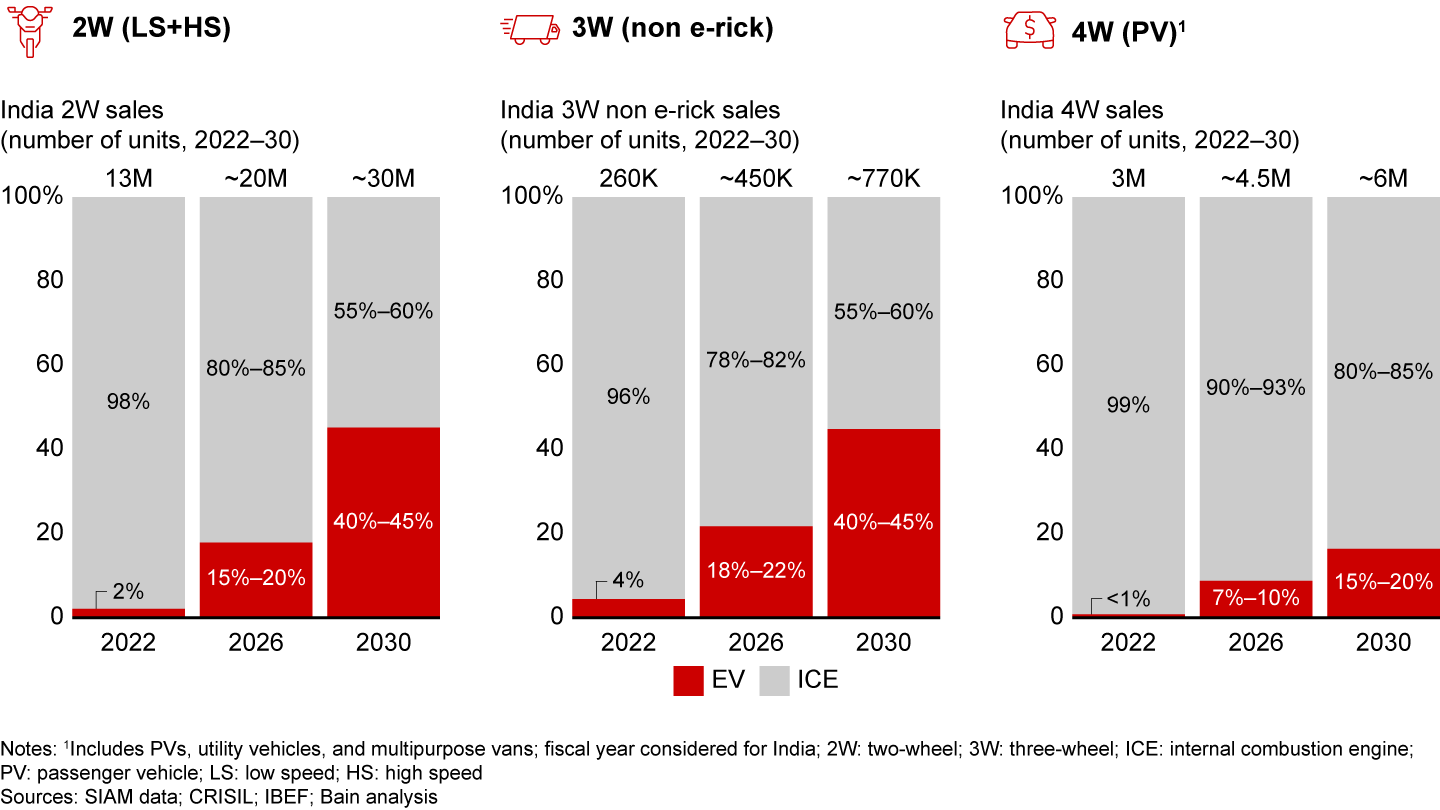
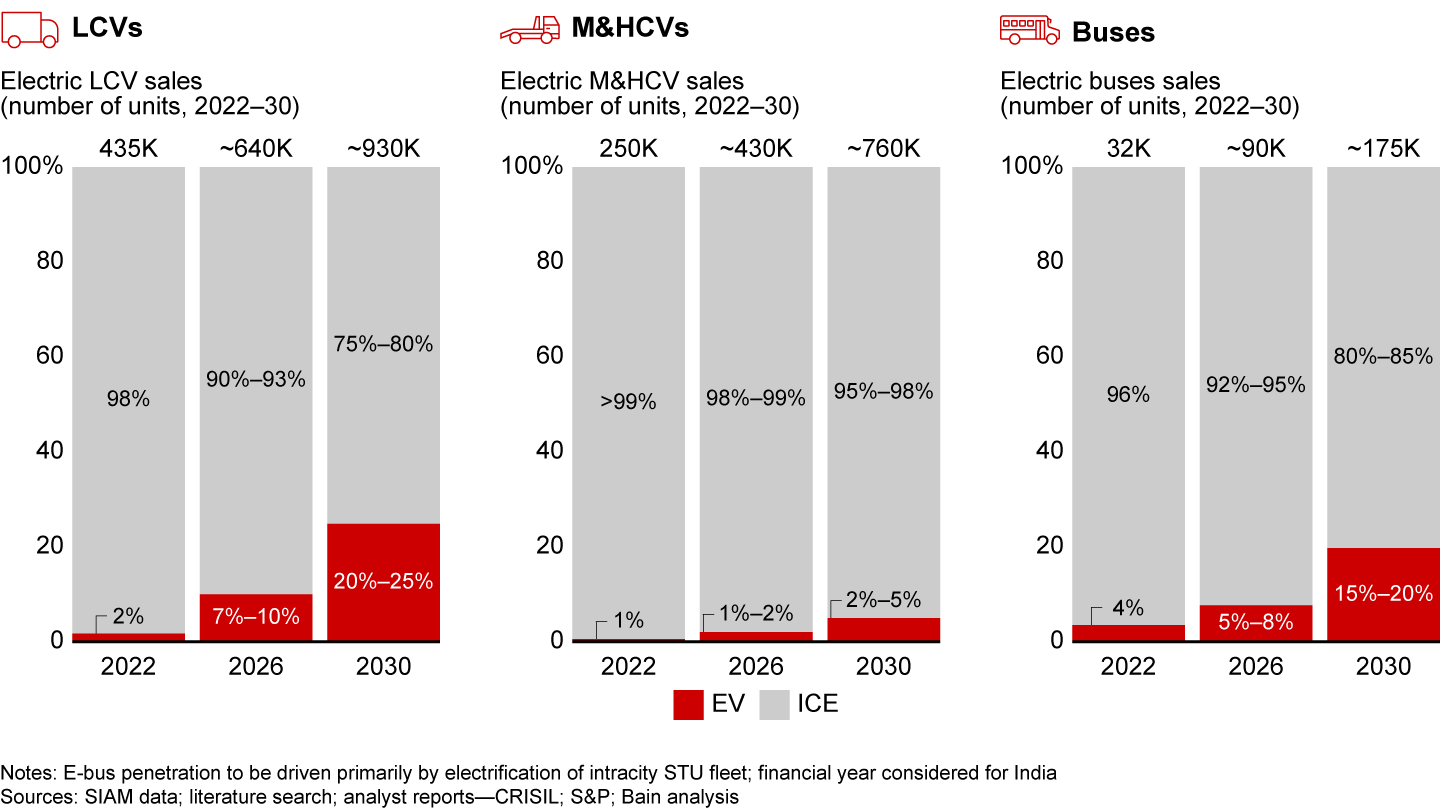
      • The 2W and 3W segments will be the vanguards for EV adoption, achieving 40%–45% penetration by 2030. This is driven by several factors, including highly competitive TCOs, limited need for public charging infrastructure given the adequacy of home charging for daily use, investments in building compelling product offerings with comparable performance to ICE vehicles, and early adoption by delivery and logistics fleets (see Figures 2a, 2b).
      • It’s likely that 4W PVs will remain behind on the adoption curve. Higher requirements for product performance and build-out of public charging infrastructure, plus higher capital cost and TCO gaps, serve as barriers to adoption. Even with these challenges, this segment is still expected to achieve 15%–20% market penetration within that same time frame.
      • Buses will see a penetration curve similar to that of PVs by 2030, driven in large part by State Transport Undertakings (STUs) focused on fleet electrification for intracity transport—already being pushed by multiple state governments.
      Figure 1
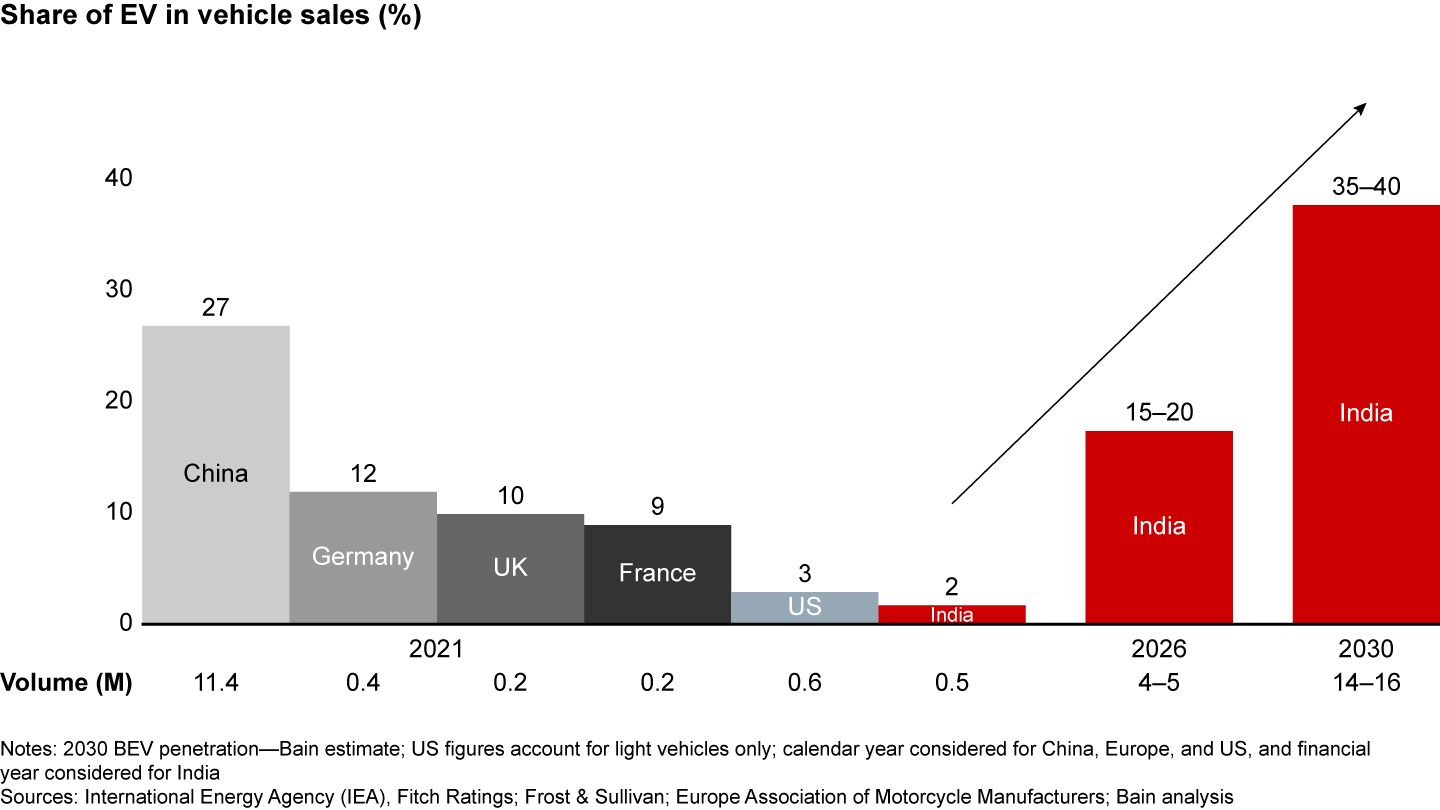
      By 2030, 35%–40% of all vehicles sold in India are expected to be battery electric vehicles (BEVs)
      By 2030, 35%–40% of all vehicles sold in India are expected to be battery electric vehicles (BEVs)
      By 2030, 35%–40% of all vehicles sold in India are expected to be battery electric vehicles (BEVs)
      Figure 2a
      BEV penetration in India for passenger vehicles is expected to reach up to 45% for 2W and 3W and 20% for 4W by fiscal year 2030 (FY30)
      BEV penetration in India for passenger vehicles is expected to reach up to 45% for 2W and 3W and 20% for 4W by fiscal year 2030 (FY30)
      BEV penetration in India for passenger vehicles is expected to reach up to 45% for 2W and 3W and 20% for 4W by fiscal year 2030 (FY30)
      Figure 2b
      For commercial vehicles in India, BEV market penetration will be more modest, with LCVs up to 25% and buses up to 20% by FY30
      For commercial vehicles in India, BEV market penetration will be more modest, with LCVs up to 25% and buses up to 20% by FY30
      For commercial vehicles in India, BEV market penetration will be more modest, with LCVs up to 25% and buses up to 20% by FY30
      Download the PDF
      著者
      • Headshot of Deepak Jain
        Deepak Jain
        Alumni, New Delhi
      • Headshot of Mihir Sampat
        Mihir Sampat
        パートナー, Mumbai
      • Soojin Keum
        Practice Senior Manager, Seoul
      • Sandhya K.
        アソシエイト パートナー, New Delhi
      関連業種
      • 産業財、サービス
      • 自動車
      Electric Vehicles
      Navigating the Shifting Landscape Around EV Adoption

      At the 2025 FT Future of the Car Summit in London, Bain Partner Eric Zayer discusses how leaders are addressing the challenges facing the electric vehicle market.

      詳細
      自動車
      Automotive & Mobility M&A

      As pressure to scale mounts, leaders are consolidating and buying technology.

      詳細
      Electric Vehicles
      Renewable Fuels: Seizing the Generational Opportunity

      Leading companies are separating signal from noise and investing in a strategy reflecting their strengths.

      詳細
      自動車
      Automotive Profitability: How OEM and Supplier Margins Are Faring

      The post-pandemic profit surge has reversed, as OEM margins have fallen more than 50% since 2023.

      詳細
      Electric Vehicles
      When Less Is More: Shifting Gears in Automotive R&D

      To remain competitive, it’s time for traditional OEMs to prune product portfolios and boost R&D efficiency.

      詳細
      First published in 12月 2022
      Tags
      • Electric Vehicles
      • 産業財、サービス
      • 自動車

      クライアント支援事例

      戦略 A Conglomerate Charts a New Global Strategy

      ケーススタディを見る

      コスト・トランスフォーメーション An Auto Parts Company Revs Up Its Competitive Position

      ケーススタディを見る

      業績改善 Carmaker shifts its production model

      ケーススタディを見る

      お気軽にご連絡下さい

      私達は、グローバルに活躍する経営者が抱える最重要経営課題に対して、厳しい競争環境の中でも成長し続け、「結果」を出すために支援しています。

      ベインの知見。競争が激化するグローバルビジネス環境で、日々直面するであろう問題について論じている知見を毎月お届けします。

      *プライバシーポリシーの内容を確認し、合意しました。

      プライバシーポリシーをご確認頂き、合意頂けますようお願い致します。
      Bain & Company
      お問い合わせ Sustainability Accessibility Terms of use Privacy Cookie Policy Sitemap Log In

      © 1996-2026 Bain & Company, Inc.

      お問い合わせ

      How can we help you?

      • ビジネスについて
      • プレス報道について
      • 採用について
      全てのオフィス