
Skip to Content
  • オフィス

    オフィス

    北米・南米
    • Atlanta
    • Austin
    • Bogota
    • Boston
    • Buenos Aires
    • Chicago
    • Dallas
    • Denver
    • Houston
    • Los Angeles
    • Mexico City
    • Minneapolis
    • Monterrey
    • Montreal
    • New York
    • Rio de Janeiro
    • San Francisco
    • Santiago
    • São Paulo
    • Seattle
    • Silicon Valley
    • Toronto
    • Washington, DC
    ヨーロッパ・中東・アフリカ
    • Amsterdam
    • Athens
    • Berlin
    • Brussels
    • Copenhagen
    • Doha
    • Dubai
    • Dusseldorf
    • Frankfurt
    • Helsinki
    • Istanbul
    • Johannesburg
    • Kyiv
    • Lisbon
    • London
    • Madrid
    • Milan
    • Munich
    • Oslo
    • Paris
    • Riyadh
    • Rome
    • Stockholm
    • Vienna
    • Warsaw
    • Zurich
    アジア・オーストラリア
    • Bangkok
    • Beijing
    • Bengaluru
    • Brisbane
    • Ho Chi Minh City
    • Hong Kong
    • Jakarta
    • Kuala Lumpur
    • Manila
    • Melbourne
    • Mumbai
    • New Delhi
    • Perth
    • Shanghai
    • Singapore
    • Sydney
    • Tokyo
    全てのオフィス
  • アルムナイ
  • メディア
  • お問い合わせ
  • 東京オフィス
  • Japan | 日本語

    地域と言語を選択

    グローバル
    • Global (English)
    北米・南米
    • Brazil (Português)
    • Argentina (Español)
    • Canada (Français)
    • Chile (Español)
    • Colombia (Español)
    ヨーロッパ・中東・アフリカ
    • France (Français)
    • DACH Region (Deutsch)
    • Italy (Italiano)
    • Spain (Español)
    • Greece (Elliniká)
    アジア・オーストラリア
    • China (中文版)
    • Korea (한국어)
    • Japan (日本語)
  • Saved items (0)
    Saved items (0)

    You have no saved items.

    後で閲読、共有できるようにするためにブックマークしてください

    Explore Bain Insights
  • 業界別プラクティス
    メインメニュー

    業界別プラクティス

    • 航空宇宙、防衛、政府関連
    • 農業
    • 化学製品
    • インフラ、建設
    • 消費財
    • 金融サービス
    • ヘルスケア
    • 産業機械、設備
    • メディア、エンターテインメント
    • 金属
    • 採掘・鉱業
    • 石油、ガス
    • 紙、パッケージ
    • プライベートエクイティ
    • 公共、社会セクター
    • 小売
    • テクノロジー
    • 通信
    • 交通
    • 観光産業
    • 公益事業、再生可能エネルギー
  • 機能別プラクティス
    メインメニュー

    機能別プラクティス

    • カスタマー・エクスペリエンス
    • サステイナビリティ、 社会貢献
    • Innovation
    • 企業買収、合併 (M&A)
    • オペレーション
    • 組織
    • プライベートエクイティ
    • マーケティング・営業
    • 戦略
    • アドバンスド・アナリティクス
    • Technology
    • フルポテンシャル・トランスフォーメーション
  • Digital
  • 知見/レポート
  • ベイン・アンド・カンパニーについて
    メインメニュー

    ベイン・アンド・カンパニーについて

    • ベインの信条
    • 活動内容
    • 社員とリーダーシップ
    • プレス・メディア情報
    • クライアントの結果
    • 受賞歴
    • パートナーシップを結んでいる団体
    Further: Our global responsibility
    • ダイバーシティ
    • 社会貢献
    • サステイナビリティへの取り組み
    • 世界経済フォーラム(WEF)
    Learn more about Further
  • キャリア
    メインメニュー

    キャリア

    • ベインで働く
      キャリア
      ベインで働く
      • Find Your Place
      • ベインで活躍する機会
      • ベインのチーム体制
      • 学生向けページ
      • インターンシップ
      • 採用イベント
    • ベインでの体験
      キャリア
      ベインでの体験
      • Blog: Inside Bain
      • キャリアストーリー
      • 社員紹介
      • Where We Work
      • 成長を後押しするサポート体制
      • アフィニティ・グループ
      • 福利厚生
    • Impact Stories
    • 採用情報
      キャリア
      採用情報
      • 採用プロセス
      • 面接内容
    FIND JOBS
  • オフィス
    メインメニュー

    オフィス

    • 北米・南米
      オフィス
      北米・南米
      • Atlanta
      • Austin
      • Bogota
      • Boston
      • Buenos Aires
      • Chicago
      • Dallas
      • Denver
      • Houston
      • Los Angeles
      • Mexico City
      • Minneapolis
      • Monterrey
      • Montreal
      • New York
      • Rio de Janeiro
      • San Francisco
      • Santiago
      • São Paulo
      • Seattle
      • Silicon Valley
      • Toronto
      • Washington, DC
    • ヨーロッパ・中東・アフリカ
      オフィス
      ヨーロッパ・中東・アフリカ
      • Amsterdam
      • Athens
      • Berlin
      • Brussels
      • Copenhagen
      • Doha
      • Dubai
      • Dusseldorf
      • Frankfurt
      • Helsinki
      • Istanbul
      • Johannesburg
      • Kyiv
      • Lisbon
      • London
      • Madrid
      • Milan
      • Munich
      • Oslo
      • Paris
      • Riyadh
      • Rome
      • Stockholm
      • Vienna
      • Warsaw
      • Zurich
    • アジア・オーストラリア
      オフィス
      アジア・オーストラリア
      • Bangkok
      • Beijing
      • Bengaluru
      • Brisbane
      • Ho Chi Minh City
      • Hong Kong
      • Jakarta
      • Kuala Lumpur
      • Manila
      • Melbourne
      • Mumbai
      • New Delhi
      • Perth
      • Shanghai
      • Singapore
      • Sydney
      • Tokyo
    全てのオフィス
  • アルムナイ
  • メディア
  • お問い合わせ
  • 東京オフィス
  • Japan | 日本語
    メインメニュー

    地域と言語を選択

    • グローバル
      地域と言語を選択
      グローバル
      • Global (English)
    • 北米・南米
      地域と言語を選択
      北米・南米
      • Brazil (Português)
      • Argentina (Español)
      • Canada (Français)
      • Chile (Español)
      • Colombia (Español)
    • ヨーロッパ・中東・アフリカ
      地域と言語を選択
      ヨーロッパ・中東・アフリカ
      • France (Français)
      • DACH Region (Deutsch)
      • Italy (Italiano)
      • Spain (Español)
      • Greece (Elliniká)
    • アジア・オーストラリア
      地域と言語を選択
      アジア・オーストラリア
      • China (中文版)
      • Korea (한국어)
      • Japan (日本語)
  • Saved items  (0)
    メインメニュー
    Saved items (0)

    You have no saved items.

    後で閲読、共有できるようにするためにブックマークしてください

    Explore Bain Insights
  • 業界別プラクティス
    • 業界別プラクティス

      • 航空宇宙、防衛、政府関連
      • 農業
      • 化学製品
      • インフラ、建設
      • 消費財
      • 金融サービス
      • ヘルスケア
      • 産業機械、設備
      • メディア、エンターテインメント
      • 金属
      • 採掘・鉱業
      • 石油、ガス
      • 紙、パッケージ
      • プライベートエクイティ
      • 公共、社会セクター
      • 小売
      • テクノロジー
      • 通信
      • 交通
      • 観光産業
      • 公益事業、再生可能エネルギー
  • 機能別プラクティス
    • 機能別プラクティス

      • カスタマー・エクスペリエンス
      • サステイナビリティ、 社会貢献
      • Innovation
      • 企業買収、合併 (M&A)
      • オペレーション
      • 組織
      • プライベートエクイティ
      • マーケティング・営業
      • 戦略
      • アドバンスド・アナリティクス
      • Technology
      • フルポテンシャル・トランスフォーメーション
  • Digital
  • 知見/レポート
  • ベイン・アンド・カンパニーについて
    • ベイン・アンド・カンパニーについて

      • ベインの信条
      • 活動内容
      • 社員とリーダーシップ
      • プレス・メディア情報
      • クライアントの結果
      • 受賞歴
      • パートナーシップを結んでいる団体
      Further: Our global responsibility
      • ダイバーシティ
      • 社会貢献
      • サステイナビリティへの取り組み
      • 世界経済フォーラム(WEF)
      Learn more about Further
  • キャリア
    人気検索キーワード
    • デジタル
    • 戦略
    前回の検索
      最近訪れたページ

      Content added to saved items

      Saved items (0)

      Removed from saved items

      Saved items (0)

      Expert Commentary

      Embracing Black Box Machine Learning Models in Business Operations

      Embracing Black Box Machine Learning Models in Business Operations

      How to balance accuracy with interpretability.

      著者:Joshua Mabry

      • min read
      }

      記事

      Embracing Black Box Machine Learning Models in Business Operations
      en

      Machine learning (ML) has caught fire with businesses and the media as breakthroughs in computer vision and natural language processing enable machines to outperform humans at challenging tasks such as cancer diagnosis. At the same time, hardware costs have declined, and implementation has gotten easier, resulting in ML models being used to augment and replace human decision making across all industries.

      To achieve a high level of accuracy, analysts train intricate black box models on large data sets that capture complex underlying relationships. The unfortunate trade-off traditionally has come in model interpretability, but concerns about bias, safety and auditability have sparked a cascade of research in this area. Very recently, robust model interpretation methodologies, such as SHAP (Shapley additive explanation) and LIME (local interpretable model-agnostic explanations), have gained adoption in data science circles and have been incorporated into most commonly used software. One selling point is the ability to explain decisions at the level of a single prediction. This has been a massive advance for imbuing trust into predictive analytics applications and creating explanations that fit with human intuition.

      We recently built an ML pipeline to forecast demand for generic products sold in a national retail chain. This retailer suffered from significant pricing competition among nimble competitors in an emerging market and needed a way to identify products most at risk without waiting to see long-term changes in market share. Sales demand was affected by a large number of complex factors, including weather, marketing activities and substitution effects, and it needed to be predicted for hundreds of stores, each subject to different market conditions. The scale and heterogeneity of the data led us to devise an ML solution based on an ensemble of models rather than taking a more traditional forecasting approach (see Figure 1). In support of this strategy, we saw a significant increase in accuracy, including thousands of additional variables in the model, with the downside being a loss of explainability.

      Figure 1
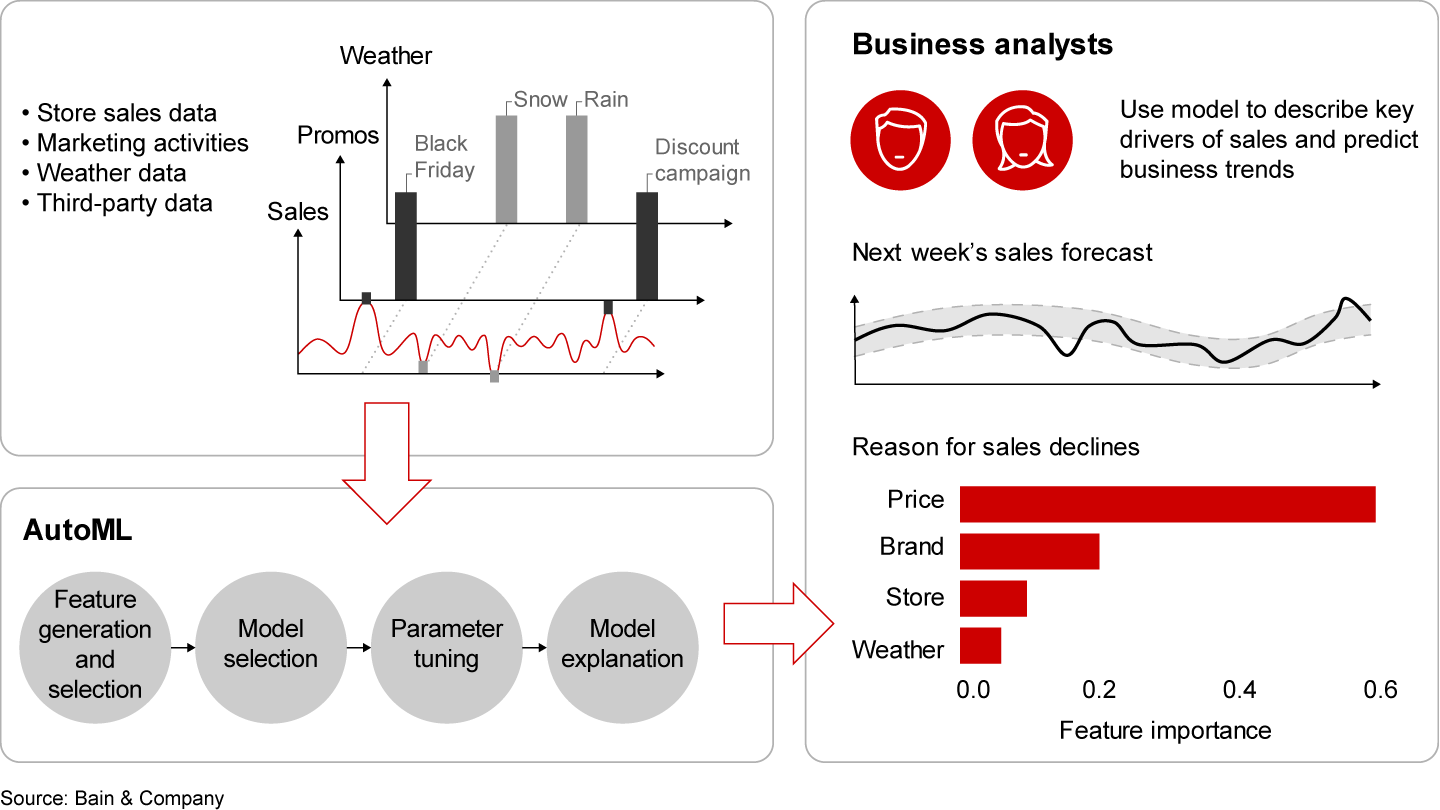
      How one retail chain forecasts demand at scale
      How one retail chain forecasts demand at scale
      How one retail chain forecasts demand at scale

      In this context, we found it useful for the retailer to use business expertise to group the model inputs into natural hierarchies and then compute variable importance for these high-level features. This approach allowed the analysts to focus on the overall effect of catalysts such as price rather than trying to look at the raw output of our explanatory algorithm (SHAP) as provided by many off-the-shelf solutions. Analysts quickly were able to flag predicted declines in sales and the main reasons behind these declines without raising too many false alarms. That yielded both the benefit of black box model accuracy and the explanatory power usually associated with a simpler model.

      We have, however, also seen these methods give less than satisfactory results when the data was small and the models were overfit. Complex black box models can also be more sensitive to correlation among measured variables and to the effects of missing data. As with any model, measured variables are often proxies for unknown or unmeasured variables, which may have a much stronger impact on the outcome.  We highlight the use case above of identifying at-risk retail products because it met our acceptance criteria for a black box model: First, the model accuracy is significantly higher than for simpler models, and second, the cost of a wrong answer is low.

      In general, we advise caution when setting policy based on this type of post hoc analysis and remain strong advocates of a test-and-learn approach, in which these types of insights inform rigorously controlled in-market tests. Keeping the limitations in mind, we are seeing business leaders successfully scale up data-driven transformation using data science and ML methodologies. And what once was viewed as the domain of the specialist is better informing critical decisions throughout the enterprise.

      • Further reading on interpretable and automated machine learning: (click to expand)

        “AutoML.” AutoML Freiburg. https://www.ml4aad.org/automl.

        Cooman, Peter. “Demystifying Black-Box Models with SHAP Value Analysis.” The Civis Journal, May 11, 2018. https://medium.com/civis-analytics/demystifying-black-box-models-with-shap-value-analysis-3e20b536fc80.

        Hall, Patrick, Navdeep Gill, Megan Kurka, and Wen Phan. Machine Learning Interpretability with H2O Driverless AI. Mountain View, CA: H2O.ai, Inc., 2019. http://docs.h2o.ai/driverless-ai/latest-stable/docs/booklets/MLIBooklet.pdf.

        Lu, Meichen. “SHAP for Explainable Machine Learning.” November 10, 2018. https://meichenlu.com/2018-11-10-SHAP-explainable-machine-learning.

        Lundberg, Scott M., and Su-In Lee. “Consistent Feature Attribution for Tree Ensembles.” arXiv, 2017. https://arxiv.org/abs/1706.06060.

        Lundberg, Scott M., and Su-In Lee. “A Unified Approach to Interpreting Model Predictions.” Neural Information Processing Systems (NIPS), 2017. http://papers.nips.cc/paper/7062-a-unified-approach-to-interpreting-model-predictions.pdf.

        Molnar, Christoph. Interpretable Machine Learning: A Guide for Making Black Box Models Explainable. 2019. https://christophm.github.io/interpretable-ml-book/

        Moore, Jason H. “Information about Automated Machine Learning.” AutoML, 2019. https://automl.info/automl.

        Murdoch, W. James, Chandan Singh, Karl Kumbier, Reza Abbasi-Asl, and Bin Yu. “Interpretable Machine Learning: Definitions, Methods, and Applications.” arXiv, 2019. https://arxiv.org/abs/1901.04592.

        Olson, Randal S., Ryan J. Urbanowicz, Peter C. Andrews, Nicole A. Lavender, La Creis Kidd, and Jason H. Moore. “Automating Biomedical Data Science through Tree-Based Pipeline Optimization.” EvoApplications: Applications of Evolutionary Computation, 2016. http://link.springer.com/chapter/10.1007/978-3-319-31204-0_9.

        Ribeiro Marco Tulio, Sameer Singh, and Carlos Guestrin. “‘Why Should I Trust You?’: Explaining the Predictions of Any Classifier.” KDD2016: 22nd ACM SIGKDD International Conference on Knowledge Discovery and Data Mining (2016): 1,135–1,144. https://doi.org/10.1145/2939672.2939778.

      Joshua Mabry is an expert and Fernando Beserra is a specialist with Bain & Company’s Advanced Analytics practice. They are based, respectively, in Silicon Valley and São Paulo.

      The authors thank Bain colleagues Diane Berry and Josef Rieder for their contributions to this commentary.

      Read More

      Advanced Analytics Expert Commentary

      Success with advanced analytics requires both technical know-how and a thoughtful approach. In this series, Bain's experts offer practical advice on some of the most common data issues.

      著者
      • Headshot of Joshua Mabry
        Joshua Mabry
        Alumni, Silicon Valley
      関連するコンサルティングサービス
      • アドバンスド・アナリティクス
      コンサルティングサービス
      • Experimentation at Scale
      アドバンスド・アナリティクスエキスパートのコメント
      Successful A/B Tests in Retail Hinge on These Design Considerations

      Following a small set of guidelines will result in more meaningful and trustworthy results.

      詳細
      アドバンスド・アナリティクスエキスパートのコメント
      Defining the Intelligent Enterprise

      A recap from DeepLearning.AI’s AI Dev 25 × NYC.

      詳細
      アドバンスド・アナリティクス
      Want More Out of Your AI Investments? Think People First

      To unlock AI’s exponential productivity potential, companies must modernize workflow and workforce in tandem.

      詳細
      アドバンスド・アナリティクスエキスパートのコメント
      Making Friends with Collinearity: How Driver Interactions Can Inform Targeted Interventions

      Driver analysis helps inform decisions on which drivers deserve the greatest effort.

      詳細
      Experimentation at Scale
      Predictive Forecasting or Scheduling

      By analyzing current and historical data, companies can better predict future demand or supply, as well as functional and operational metrics.

      詳細
      First published in 8月 2019
      Tags
      • Experimentation at Scale
      • アドバンスド・アナリティクス
      • アドバンスド・アナリティクスエキスパートのコメント

      クライアント支援事例

      An Airline’s Ancillary Revenue Soars Thanks to Test-and-Learn Experimentation

      ケーススタディを見る

      顧客戦略、マーケティング Direct marketing excellence through experimental design

      ケーススタディを見る

      アドバンスド・アナリティクス Analytics guide an entertainment company's growth strategy

      ケーススタディを見る

      お気軽にご連絡下さい

      私達は、グローバルに活躍する経営者が抱える最重要経営課題に対して、厳しい競争環境の中でも成長し続け、「結果」を出すために支援しています。

      ベインの知見。競争が激化するグローバルビジネス環境で、日々直面するであろう問題について論じている知見を毎月お届けします。

      *プライバシーポリシーの内容を確認し、合意しました。

      プライバシーポリシーをご確認頂き、合意頂けますようお願い致します。
      Bain & Company
      お問い合わせ Sustainability Accessibility Terms of use Privacy Cookie Policy Sitemap Log In

      © 1996-2026 Bain & Company, Inc.

      お問い合わせ

      How can we help you?

      • ビジネスについて
      • プレス報道について
      • 採用について
      全てのオフィス