

Global Machinery & Equipment Report

概要
- As in other industries, machinery and equipment makers are changing their operations and supply chains to reduce their greenhouse gas emissions and pursue their net-zero goals.
- But for this sector, the implications go much deeper. Because every industry is changing, a Great Retooling is underway, representing a major opportunity for machinery and equipment makers.
- To make the most of it, executives will need to develop a better understanding of how their customers value sustainability and when they would pay a premium for greener products.
- Many of the opportunities will be found in helping customers improve the sustainability of their own operations, through new technologies, products, and services.
This article is part of Bain's Global Machinery & Equipment Report 2022
How will the drive to improve sustainability affect machinery and equipment companies?
As in other industries, sustainability has risen to the top of the agenda, and machinery and equipment manufacturers find themselves under more pressure by investors, regulators, customers, and even their own employees to improve their sustainability performance—specifically, by reducing carbon emissions and paying greater attention to the circularity of their products. Making the necessary changes will require new investments, some of which can be recovered by charging premiums for greener products and a range of sustainability services to supply chain partners and customers.
But that’s only part of the story for machinery and equipment makers. The broad transformations underway also present an enormous opportunity since the operations of companies across industries will need to become more energy efficient, less wasteful, and tailored to improve the circularity and recyclability of products. A Great Retooling is underway, and the companies that make machinery and equipment are on the front line to provide the tools necessary to effect it.
Leaders demonstrating potential in sustainability
Given the potential and the size of the prize, it may seem surprising that the industry is not yet moving as aggressively as it could to capture the gains inherent in the sustainability trend. While some leaders have set ambitious goals to reduce Scope 1, 2, and 3 emissions and make the most of carbon-reduction opportunities, others are lagging their peers in other sectors (see Figure 1). There may be several reasons for this. The sector is less visible than others such as energy, finance, or retail, and so scrutiny by investors and consumers may be lower. In terms of Scope 3 emissions, machinery and equipment makers may be waiting to see what changes are required by their business customers, so they can make changes in their product and service lines. In any case, over time pressure from customers, shareholders, and regulators will compel machinery and equipment makers to raise their game on carbon reduction and other aspects of sustainability. While it’s still too early to gauge, the war in Ukraine might also dial up machinery companies’ urgency around sustainability initiatives. The rising costs of traditional energy sources and a growing desire for regional energy independence might speed up the transition to renewable energy, but that could get disrupted if the war triggers a global recession—in addition to causing untold human suffering, fear, and panic.
Figure 1
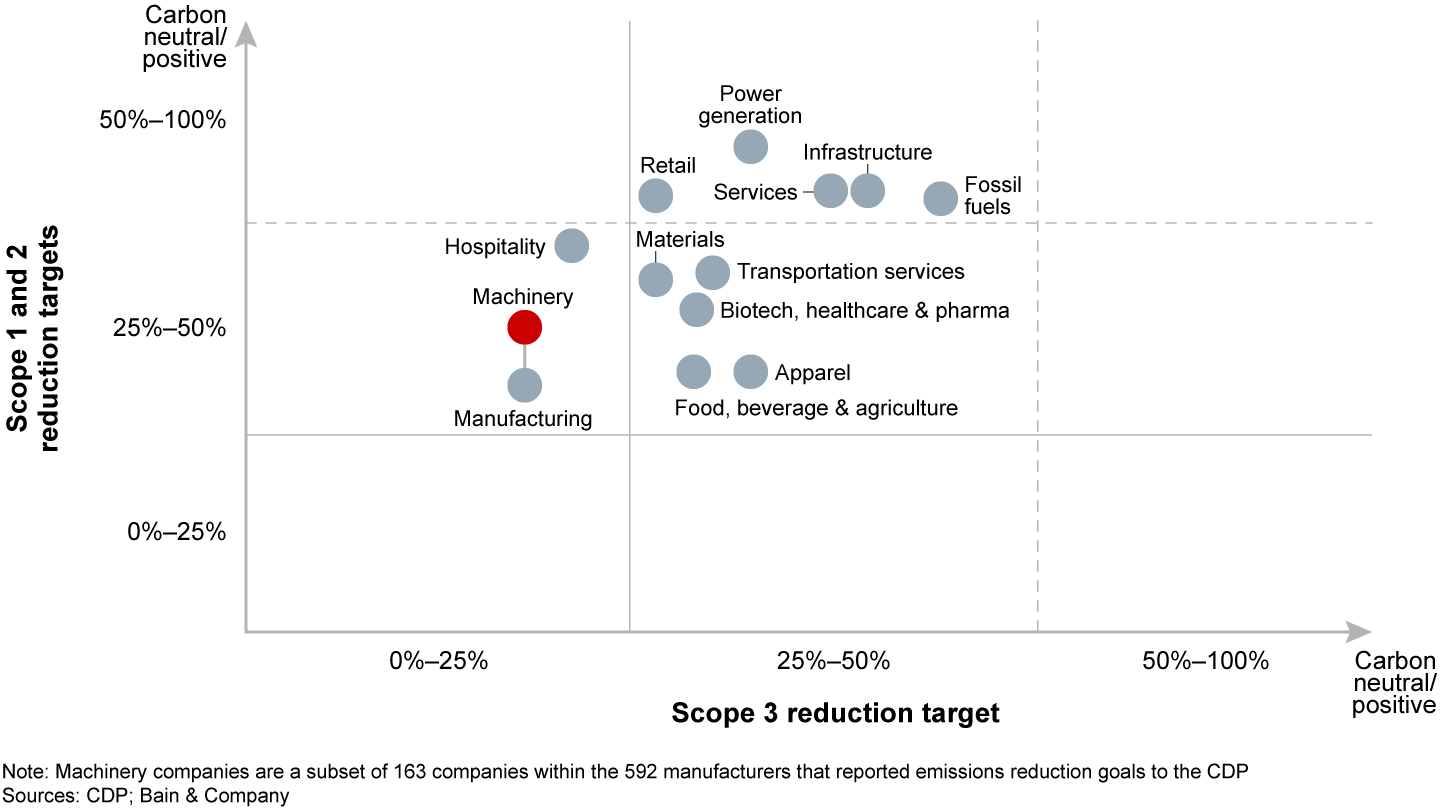

Highlighting the actions of industry leaders can illuminate where change is already possible, and where more work needs to be done.
Reducing Scope 1 and 2 emissions. These are the areas over which companies have the most direct control, the emissions from their own operations (Scope 1) and their energy use (Scope 2). Some machinery and equipment makers are already reporting good progress here. For example, Bosch says it has achieved carbon neutrality across 400 sites since 2020, mostly by improving energy efficiency, sourcing power from renewable sources, and purchasing carbon offsets.
Helping customers reduce emissions. Some companies have focused on Scope 3, supporting their customers in reducing their emissions. Emerson, for example, is providing its valves, instrumentation, and other technologies to support carbon capture utilization and storage (CCUS) processes that reduce carbon dioxide emissions. Emerson’s technologies are deployed in the Abu Dhabi National Oil Company’s Al Reyadah facility, the first commercial carbon capture facility for the iron and steel industry, and the first commercial scale carbon capture plant in the Middle East. Others are looking up the value chain to ensure their suppliers are transparent about their carbon footprint. Daimler, for example, has asked many of its suppliers to commit to providing carbon-neutral components in the future, as the company pursues a net-zero supply chain (see the Bain Brief “Creating Resilience, Sustainability, and Accountability in Supply Chains”).
Improving the circularity of products. Wind turbine manufacturers are acknowledging the risk of decommissioned turbine blades and other materials contributing to landfill volumes by pledging to develop zero-waste manufacturing systems. WindEurope, an industry trade group, has called on the European Commission to ban the landfilling of decommissioned blades. In response, leading turbine makers including Vestas, Siemens Gamesa, and GE-subsidiary LM Wind Power have all pledged to develop recyclable blades in the near or medium term, and zero-waste turbines by 2040. Vestas says that its current turbines are 85% recyclable and that it aims to create a 100% recyclable rotor by 2030.
Targeting new opportunities in decarbonization. The transformation to lower-carbon economies will continue to create outsized opportunities in products and services that help companies reduce their own emissions, everything from wind and solar power generation to battery disassembly and energy assessments. Some industrial companies are expanding their portfolios to include sustainability as a service. Bosch, for example, has launched a climate solutions unit that advises other industrial companies pursuing their own net-zero commitments, focusing on energy efficiency, use of clean power and green electricity, and offsets for remaining CO2 emissions.
Putting sustainability ambitions into action
Commercial initiatives like this start with a shift in perspective: Rather than viewing decarbonization as a burden of compliance, leaders see it as an opportunity for differentiation. Companies start by assessing their current footprint and capabilities to establish a baseline and then set their ambitions, not only in terms of their own reductions but also in the products and services they want to deliver. Capital markets reward leaders who send clear signals about their own emissions and their plans for creating value and growth from new products and services that support customers’ decarbonization journey.
Rather than viewing decarbonization as a burden of compliance, leaders see it as an opportunity for differentiation.
As with any new initiative, choosing the right team leadership and making sure there are measures of accountability are critical. Here, sustainability initiatives often face a unique challenge: the hourglass syndrome. Senior management at the top and new hires below may be enthusiastic about change, but middle management is less convinced. One reason is that these managers are tasked with implementing change and balancing sustainability with competing priorities such as cost and safety. Education can help: While senior managers are confronted with sustainability challenges in their work with external stakeholders, and new talent often arrives with a broad awareness of sustainability issues from their education or roles at other organizations, middle managers may be less familiar with new opportunities, given their focus on current operations. Knowledge sharing across the organization and updating incentives to include measures of sustainability can shrink that gap (see the Bain Brief “Beyond COP26: An Action Plan for CEOs”).
In our work with sustainability leaders in machinery and equipment manufacturing, five areas of focus are emerging as essential for reorienting the business and taking the proposition of low-carbon opportunity from dream to reality.
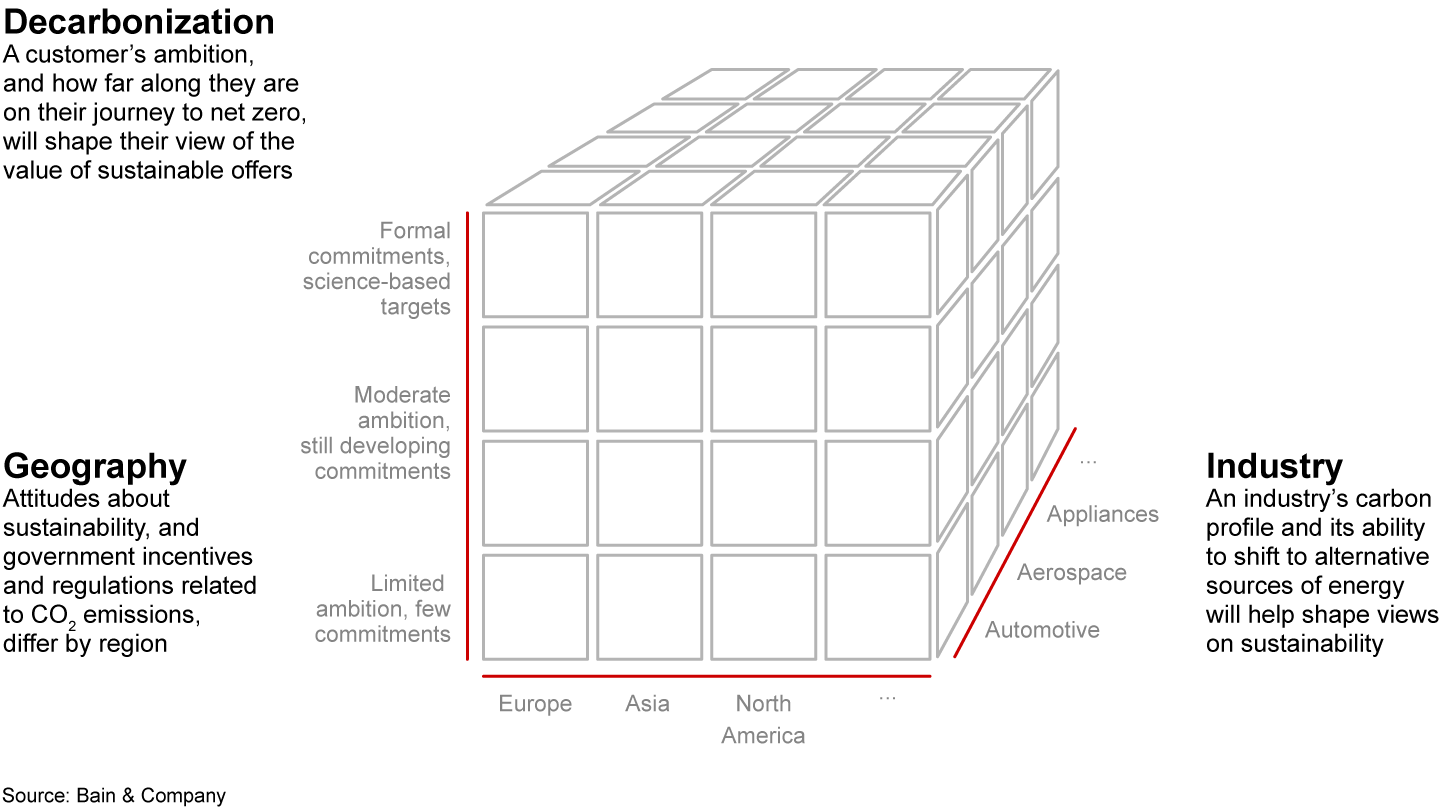
Customer segmentation. Understand which customers derive the greatest value from decarbonization efforts, and segment accordingly to design a differentiated, tailored value proposition. Customers’ commitments and obligations around decarbonization will vary, depending on a wide range of pressures, including consumer preferences, investor scrutiny, and regulatory constraints. This will affect how prominently sellers promote sustainable offers. If a traditional approach to customer segmentation considered factors such as industry and regional preferences, sellers will now have to consider a third metric: decarbonization ambition (see Figure 2).
Figure 2

Identifying the value proposition. Customer segmentation will inform decisions about which customers derive certain benefits from sustainability, either through their own use or by monetizing their investments to their own customers. By integrating this sustainability value proposition with the more traditional customer value proposition, sellers can develop a more comprehensive picture of the real costs and opportunity for customers. Tailoring the offer to different customer segments further strengthens the value proposition. Many companies take shortcuts around this process, but diligence here can deliver insights that translate into a better understanding of customer needs.
Tailored commercial approach. Sales and marketing efforts begin by clearly defining customers’ unmet needs and identifying the tangible benefits to their decarbonization efforts. Sales teams will need training to develop new capabilities regarding decarbonization, and existing commercial tools will need to be enhanced to integrate customer decarbonization targets and ability to track progress. Some companies are creating new senior roles tasked with commercializing and monetizing the company’s sustainability initiatives.
Price optimization. Quantify value delivered to customers to optimize prices for decarbonized products and services to improve margins and market share. In some cases, the trigger for a premium price for a sustainable offering could be consumer preference or regulatory shifts, but the changes may need to happen somewhere else along the value chain. For example, consumers looking for more efficient appliances might be willing to pay more to the retailer. But the greener product might require a different design and manufacture of components several steps upstream from the appliance manufacturer. Companies will need a broader understanding of the entire value chain, to connect customer value with proper investment.
Develop new products and new business models. Perhaps most importantly, identify opportunities to innovate and build low-carbon offers that meet customers’ needs. Engine 2 innovations like these can often be disruptive to the core business, so care will need to be taken to protect existing lines of business while expanding new ones. At the highest level, though, the company’s overarching business model should be strengthened to thrive during the wave of decarbonization and beyond, in a lower-carbon economy.
Companies will need a broader understanding of the entire value chain, to connect customer value with proper investment.
The energy transition and the decarbonization journey to net zero are likely to be areas of focus for businesses around the world for many years to come, perhaps for the rest of most executives’ careers. Nearly every industrial and manufacturing company will need to rethink their operations, a Great Retooling that represents a large and ongoing opportunity for machinery and equipment makers. Companies that grasp the potential quickly and develop products and services that help customers meet their own decarbonization goals are likely to gain first-mover advantage.
More from the report
Read our Global Machinery & Equipment Report 2022
First published in 5月 2022