

論説
Entering the pasta category in the US was a big gamble for Italy's Barilla in 1996. Few consumers would pay more than rock-bottom prices for dried pasta in the 1990s, and as the High Road-Low Road framework we first developed 20 years ago showed, very few brands earned attractive returns in a "value" category.
Barilla won, despite the odds. It invested to establish the brand as authentic Italian pasta, differentiated with 100 percent durum wheat and priced at a nearly 50 percent premium to private-label offerings. And the company quickly moved on from this niche position. It built local mill and plant capacity to grow the business and reduce distribution costs. It plowed profits into advertising and promotions that pulled in consumers, and it worked with strategic customers to ensure favorable shelf positioning. Today, Barilla controls nearly one-third of all pasta sales in the US.
Barilla is an exceptional story, but it isn't an isolated one. When we recently revisited our High Road-Low Road analysis to determine the impact of increasing retail consolidation and pricing pressure on consumer products manufacturers, we found there is new life in value categories. Despite a more competitive and complex environment, brands that follow winning strategies are growing profitably from every starting point.
The High Road-Low Road framework
Two decades ago, after studying hundreds of product categories, we concluded that the consumer products industry is different from virtually every other industry. In most businesses, the single-most important driver of profitability is a company's scale compared with its next largest competitor. But in consumer products, brand profitability is determined not just by relative scale, but also by the "premiumness" of the category in which it competes. We define premiumness as the percentage of a category sold at a premium to value or private label offerings. While higher returns in premium categories may not sound surprising, the fact that a follower in a premium category typically earns higher margins than a leader in a value category adds a twist on profi t targets and reframes portfolio roles. Too often, brand plans accept low margins because they are a follower in the category. That argument is flawed.
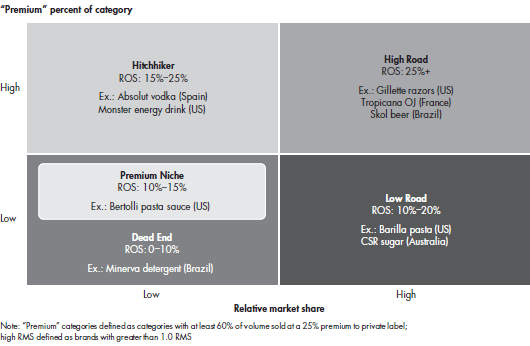
Since we first published our findings in Harvard Business Review ("Your Brand's Best Strategy," May - June 1997), many industry dynamics have changed. In virtually every market in the world, retailers have consolidated and become more sophisticated. In developed countries, private label penetration has continued to rise, and SKUs have proliferated dramatically. The average year sees the introduction of approximately 1,000 new SKUs onto retail shelves. Given this changed environment, we questioned how brand profitability and winning strategies had evolved.
Winning in any quadrant
In our recent analysis, we found that relative market share (RMS) and category premiumness are still the two biggest predictors of brand profitability. There were also new insights. Many Low Road brands are showing improved margins, especially those that are runaway leaders in their categories. And another segment—the Premium Niche—emerged, providing a new option for competing in value categories. So you can win from any starting point—if you customize your strategy with a clear understanding of the category dynamics and your leadership position.
High Road: Innovate and steward category premiumness
Not surprisingly, brands that are leaders in premium categories have the best profit odds; we call this the High Road. But they need to continually protect and increase their premium positions. That requires innovation to upgrade the consumer experience and justify price premiums as well as marketing that strengthens the emotional ties with consumers.
Procter & Gamble's Gillette follows a classic High Road strategy. With each new razor launch, Gillette increases functionality and pricing, while also defending its market-leadership position. Like other High Road winners, Gillette consistently commands prices as much as 200 percent above value offerings, funding its R&D and advertising and contributing to higher margins. Gillette's innovation strategy has supported the brand's growth from the introduction of the safety razor in 1895 through to 2010, with the Fusion ProGlide razor.
In addition to continually upgrading their products, High Road brands often extend their leadership into related, high-potential segments. For example, Tropicana France successfully moved beyond breakfast and traded up consumers with new, higher-priced products like vitamin-fortified juice and blended juice smoothies. In China, beginning in the 1990s, multinational Mead Johnson led in super-premium segments of infant formula and "growing-up milks," catering to parents who wanted only the best for their children. The company used health additives to justify prices more than twice those of the standard segment and generated EBIT operating margins in excess of 20 percent. But its success raises a caution for High Road brands: local players like Yili created a challenger premium segment, with products priced at a 30 percent discount.
Hitchhiker: Draft off the leader, pick the right spot to compete
Followers in premium categories win by leveraging the attractive category dynamics created by the leader. Successful Hitchhikers find a consumer segment or usage occasion that the High Road brand is under-serving and use differentiated innovation and brand building to target that subsegment. They don't rock the boat on category pricing. A price war could erode the premium nature of the category and decrease profitability for all players.
Hansen Beverage followed a winning Hitchhiker strategy when it launched Monster energy drinks in 2002. It focused aggressively on male energy junkies—college students, young truck drivers and avid sports fans. Everything about Monster, from the big black cans to the sponsorship of extreme-sports events to its slogan, "Unleash the Beast," was meant to appeal to this consumer segment. Hansen invested in provocative advertising and introduced new flavors, such as Nitrous Monster Energy Killer-B. And the strategy paid off. Despite competing against Red Bull, whose name was synonymous with the category, Monster energy drinks garnered 26 percent share of the category in 2010 and are the largest contributor to Hansen's 29 percent profit margins.
While Hitchhikers are unlikely to want to attack the market leaders directly, sometimes strong segmentation and rapid innovation can over time lead to a shift in leadership positions. Skol, the Brazilian beer that traditionally occupied third or fourth place, was fi rst to understand the opportunity in canned beer and one-way packaging. The brand saw consumers moving away from returnable bottles and took advantage of the change in consumption habits. Using non-returnables as the basis of differentiation and focusing its advertising on younger consumers, the company overtook its rivals to become—and remain—the market leader, with more than 30 percent share.
Low Road: Focus on scale and cost management
Since we conducted our initial research, we've witnessed an evolution of the Low Road quadrant. In aggregate, there still isn't as much profit potential for Low Road brands as there is for High Road brands. But today, margins for runaway leaders—Low Road brands that are more than double the size of the next largest competitor—are sometimes able to generate returns that rival Hitchhikers. Yet, Low Road brands win with a very different strategy.
Low Road winners drive down non-value-added costs and build scale advantages that stifle competitors. They invest some of those returns back into advertising and promotions, and work closely with strategic customers to pull away from the pack. Many invest to increase the capital intensity of their categories via manufacturing or distribution capabilities. They innovate to stay current and differentiated, but not necessarily to trade up consumers. They aim to grow the category over time, and they explore adjacencies in related categories.
In Indonesia, chocolate maker Petra swiftly and strongly penetrated the lower end of the new and growing chocolate market to become a market leader with double-digit margins. It did this by keeping prices low through a combination of scale, vertical integration and blended ingredients. It's to the point where other local players have to make do with single-digit margins and multinationals have been confined to niches. Meanwhile, the Madrid-based, European packaged-meats company Campofrio Food Group achieved scale by taking a pan-European lens to processed meats, a market traditionally composed of national players. Campofrio uses its regional scale, combined with scale achieved through selective private-label manufacturing, to reinvest in competitive pricing and just enough innovation to keep its premium products differentiated. And remember Barilla? It has followed a winning Low Road strategy in dry pasta and has grown from 0.6 RMS in 2000 to 1.2 RMS 10 years later.
Dead End: Get out, play in a Premium Niche or change the rules of the game
The Dead End has traditionally represented the least profitable quadrant. These are value category players with low relative market share, often facing heavy competition from larger competitors and private-label brands. Given the prospects of anemic return on sales, the right strategy is often to divest Dead End portions of a portfolio and plow resources into more promising opportunities. That was the path taken by Unilever in 2000 when it discontinued Minerva liquid dish detergent in Brazil.
But just as the Low Road quadrant has changed since our original research, we've found new life on the fringes of the Dead End, particularly for brands that can defend a significant premium. These Premium Niche brands earn far greater returns than typical Dead End margins. Bertolli spaghetti sauce has successfully followed a Premium Niche strategy: rise above the category with an offering that consumers will pay more for. The company made the most of its premium name in olive oils when it began selling spaghetti sauces in 2002. Bertolli used its quality image and ingredients to justify prices that were among the highest in the category and 100 percent higher than private-label sauces.
Five years later, Bertolli spaghetti sauce was so well established that Unilever was confident the brand could survive independently from the olive oil business, which it proceeded to divest. But succeeding in a Premium Niche position often requires launching a new offering that resets consumers' expectations. Less than 5 percent of the Dead End brands we studied successfully shifted from the traditional Dead End into a sustainable Premium Niche.
Changing the rules of the game is another option for Dead End brands. That often requires radical transformation—and isn't easy to pull off. Birds Eye changed the nature of competition in frozen vegetables through innovation. It was the leading branded player in a category in which private labels were rapidly gaining ground. Then the company invested in Steamfresh® technology, which allows consumers to steam vegetables in their microwave. The innovation justified higher prices and contributed to a five-point share gain from 2005 to 2009. Suiza Food took an alternate approach; it changed the game by building scale. The company transformed itself from a Dead End player to a Low Road leader by acquiring regional dairy businesses and merging with Dean Foods to become the first and largest national fluid dairy processor in the US. That scale enabled Dean to reduce costs and invest funds in high-growth brands such as Horizon Organic and Silk soy milk.
Using High Road-Low Road to grow your brand
No matter where your brand sits on the High Road-Low Road matrix, you can create a winning strategy. Some starting questions include:
- Are you competing in premium or value categories?
- Have any of your categories shifted over time?
- Where do your brands sit on the High Road-Low Road matrix?
- Is each brand earning the returns expected from its positioning?
- If you compete in a premium category, are you taking the actions required to maintain the category and brand premiumness?
- If you compete in a value category, are you ruthlessly managing costs and evaluating all opportunities to gain scale?
- If you own a Dead End brand, what radical options exist?
Nicolas Bloch is a Bain & Company partner in Brussels. Based in Singapore, Mike Booker leads Bain's Consumer Products and Retail practices in Asia-Pacific. David Harding is a Boston-based partner who leads the firm's Global M&A practice. Eileen Shy is a partner in Bain's New York office and a leader in the Americas Consumer Products practice.
First published in 6月 2011