

論説

Bank profitability has taken a significant hit since the global financial crisis, forcing many banks to focus on cost savings. And they have made good progress in slimming branches, call centers and back-office operations. They have made less headway, though, on realizing the full potential of their relationships with corporate customers. Now they are at an inflection point with the likely rise in interest rates over the next few years.
Higher rates could lift the profitability of corporate banking, yet many banks are missing a chance to make the most of this scenario. Huge opportunities lie in a more rigorous approach to managing corporate client profitability.
Most banks earn a 2% to 3% return on risk-weighted assets (RoRWA) in their corporate portfolio. Higher interest rates will increase the dispersion of RoRWA among banks, with the laggards holding level at best and the leaders potentially doubling their rate of return. If rates rise over the next few years to the point at which a bank lends at 5%, RoRWA could increase sharply, especially in the US and Europe, where rates have been very low.
The catch is that banks must make money in the meantime. They have to figure out which clients are profitable today, which are not, and how to serve the latter group in a different way or move them off the books. Otherwise, banks will be limiting their upside on profitable revenue growth.
Knowing where you make money
In a typical corporate portfolio of a large multinational bank, economic profit derives from roughly 20% of clients. Within that group, perhaps 1% account for most of the value. At the other end of the portfolio, some 30% of clients fall below the threshold for economic profit for the portfolio, with about 1% having the greatest negative effect for the bank as it currently serves them. The remaining 50% or so have moderate value for the bank or just break even (see Figure 1).
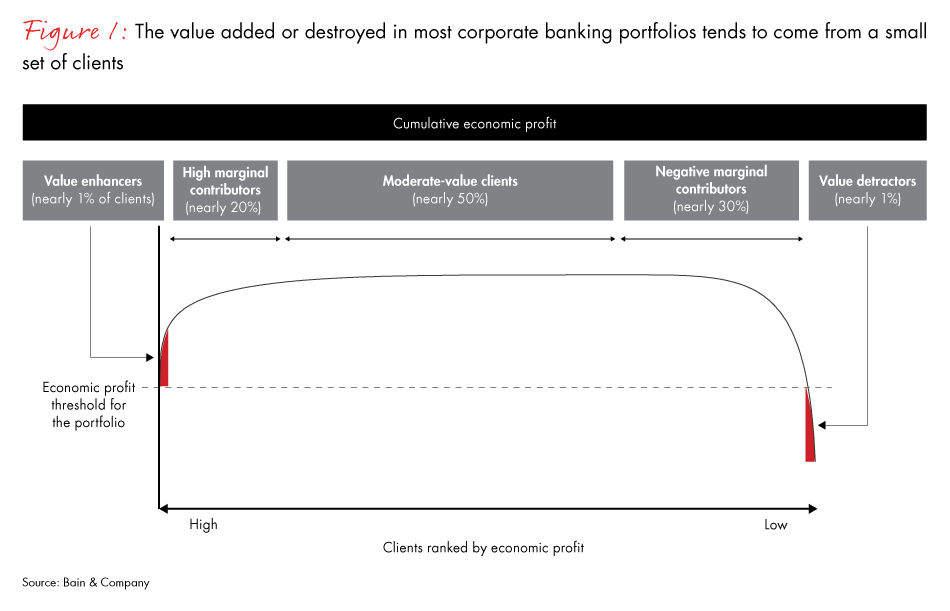
The lowest profitability clients often account for a sizable share of a bank’s risk-weighted assets. Typically, the bank has made large loans at favorable rates and terms, without getting ancillary, higher-margin business—such as transaction banking, risk management or advisory services—in return. The level of profitability will also depend on factors that fluctuate over time, including the cost to serve, the dynamics and cycle of the client’s industry, and market interest rates. Many banks, though, lack a system that can systematically track the ebb and flow of value for each client.
Small shifts in the portfolio can generate a significant effect on overall profitability. In particular, addressing the lowest-profitability 1% of clients first can considerably improve the bottom line. While these clients may be few in number, they tend to be large both in their size and the amount of revenue they generate for the bank; avoiding their business might not be a viable option as the bank needs coverage for its fixed cost base.
IT and cultural challenges
It’s no small matter to get a reliable fix on client profitability. One challenge lies in the complexity of bank IT systems that have been assembled through years of one-off decisions and acquisitions. As a result, while most large banks can attribute revenue or credit risk to specific clients, few have a sophisticated system that can allocate operating costs or market risk to those clients because of the myriad business units, databases and reporting elements involved. Banks often find it difficult even to match a client identifier across multiple data sources or to aggregate subsidiaries in different geographies up to a single corporate parent. Building a reliable infrastructure thus can prove to be a significant competitive advantage.
Besides banks’ unwieldy IT systems, their organizational culture often presents a major obstacle. Historically, when banks earned healthy profits, it was acceptable to manage through revenue alone. The financial crisis spurred a shift to significant cost takeout and a focused effort to shore up the balance sheet and reduce defaults. Today, making a shift to emphasize profitable revenue entails a major cultural change. Some leading banks have reexamined their compensation packages to align the incentives of relationship managers with those of the business. They have rebalanced their scorecards away from revenue growth alone (which motivates relationship managers to close loans at any price) to profitable revenue (which focuses attention on the full potential of the relationship).
Andre Leme, a partner with Bain's Financial Services practice, shares how introducing more data and rigor into corporate customer relationships, and focusing on the profitability of individual clients, can help banks increase their own profitability.
Managing through the client life cycle
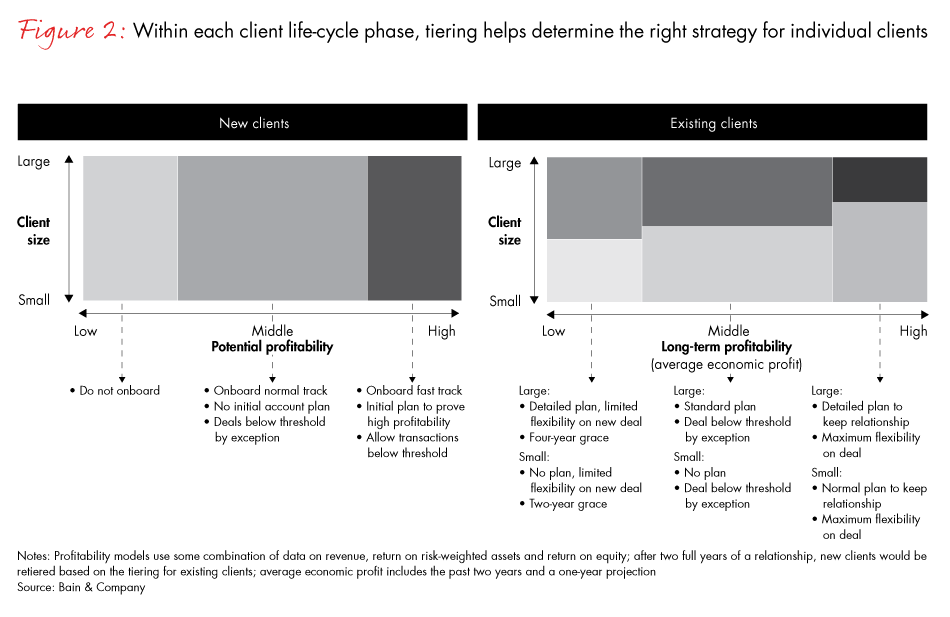
Banks that have been gaining control of their portfolio’s profitability generally have begun by categorizing clients into tiers based on economic profit and company size (see the sidebar, “What leading banks do differently”). The tiers range from highly profitable (or high potential profitability for new clients) through moderately profitable to unprofitable (see Figure 2). Profitability models use some combination of data on revenue, RoRWA and return on equity.
Once the bank has sorted its client base into the tiers, the discipline of profitability should pervade the life cycle of every corporate client (see Figure 3).
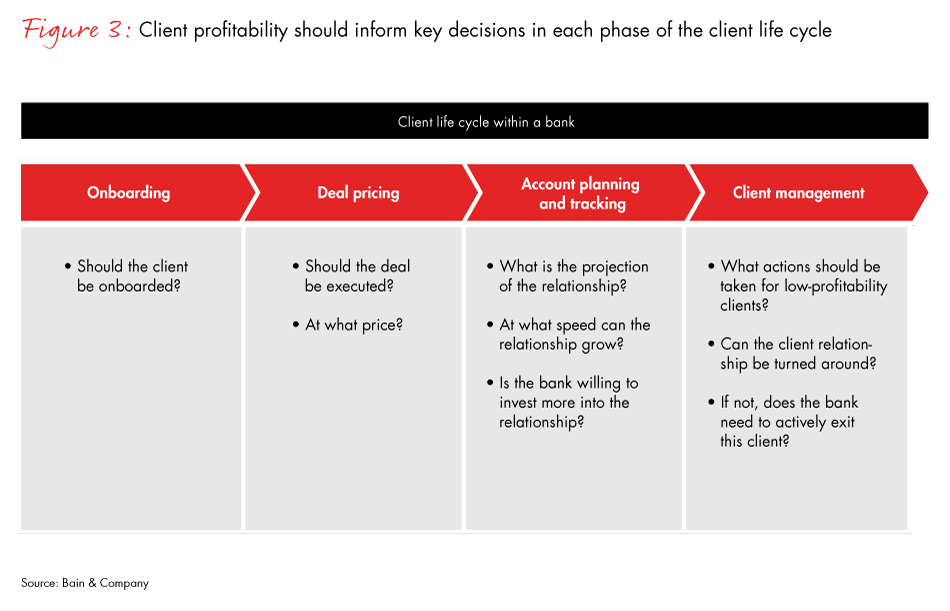
Onboarding. When a bank is deciding whether to bring on a potential new client, calculating expected profitability should be a routine part of the decision. Onboarding has become a more expensive process because of compliance, regulatory and user experience considerations, so it should be undertaken only when a bank can expect to have a sustainable relationship. The onboarding assessment will include indicators such as client size; typical needs for transactions, trading, bank guarantees or contingent loans; and the share of wallet that the bank can reasonably expect.
Deal pricing. When weighing a loan or other product offer, the bank should look beyond the marginal contribution for the specific transaction to whether the deal is accretive or dilutive to the relationship.
One global bank has integrated a pricing tool with its customer relationship management (CRM) system to pull historical data about a client’s past deals and profitability. Certain elements, such as the bank’s desired profit level, are automatically programmed in so that the tool produces a marginal contribution for the client as well as the expected future profitability. This bank also uses rules-based decision making that limits exceptions on individual deals.
While many banks have processes to steer negative-contribution deals to a committee or senior approval, their monitoring of ancillary business consists of manual tracking and inputs. Deal-pricing systems should automatically capture promised ancillary deals in the CRM system and allow tracking all the way through delivery of the deal. That helps limit the ability of individuals to overpromise and underdeliver.
Account planning. Most corporate banks rely on an annual account plan to inform their budgeting and capital planning cycle. But best-practice banks also collect information on historical client revenue and the profitability of the relationship along with estimates of future potential. This profile feeds into a uniform planning process across the bank. Larger clients will require more detail, by subsidiary and product (because different deal teams and business units get involved), with a higher burden of proof on the relationship manager. Account plans for smaller clients can be handled through a more automated process that prepopulates required fields yet still allows judgment calls on the margin.
The account plans inform many client decisions over the following year, such as the pricing of specific deals, coverage level and a broader discussion of other product offers. In the best case, the CRM system can automatically create a projected account plan based on the previous plan. That means staff don’t have to fill in every item from scratch and can update the plan at any point as circumstances change.
Client management. Not all clients will be profitable every year given the nature of ancillary deals and the cyclicality of demand. So leading banks take a two- to four-year view. Of course, taking a longer view does not imply avoiding active portfolio management, including the occasional difficult conversation. The good news: Dependable metrics give a bank confidence that its honest engagement with the client is grounded in solid economics.
An effective practice we have observed at another global bank is how it uses the CRM system as an intermediary between relationship managers and service functions such as the credit or internal capital teams. For example, if the profitability of a client drops below a certain level, the team responsible for overall profitability asks the relationship manager to devise an action plan housed in the CRM. When that manager logs in, an alert will prompt him to create the plan. The team can review it, share it with a senior committee if need be and respond through the CRM. Everyone shares the same information, knows what has been committed and what to track.
•••
It’s never easy to nudge a client to profitability or to cast them loose if the bank cannot serve them profitably. But having solid data to present to the client and an explicit plan to turn things around injects rigor into a historically loose and overly personal process. Such rigor will allow banks to seize opportunities that will only grow larger as interest rates rise.
What leading banks do differently
Best practices for managing client profitability have emerged among leading banks.
Decision-making criteria
- Pricing is based on a combination of the individual deal’s profitability and overall client profitability.
- The bank gives preferential pricing only when there is a clear strategy to improve profitability.
- Other decisions, such as onboarding and service levels, are based on overall client profitability, commercial opportunity (as measured by share of wallet, balance sheet, and profit and loss analysis) and strength of the relationship.
Process and governance
- A clear process exists to review and update the account plan.
- Exceptions are limited for negative-contribution deals, and promised ancillary deals get tracked.
- Incentives for relationship managers link to profitability metrics.
- Finance is responsible for the integrity of data, models and assumptions, while the business units are accountable for the decisions.
Methodology
- The institution uses a centralized global currency and accounting standard rather than individual booking centers with regional standards.
- Cost allocation reflects the true level of effort required to acquire and serve the client.
- The bank explicitly allocates market risks in addition to credit and operational risks.
IT systems and data
- All units in the bank use a consistent source of data. Automated and manual check processes assure data quality and completeness. The system produces timely data that gives managers an accurate picture of the client relationship.
- The management information system has advanced functionalities such as the ability to view client profitability at different levels (by country, by relationship manager and so on) and an intuitive, graphical user interface.
- IT architecture has sufficient flexibility to accommodate future changes.
Jan-Alexander Huber, Iwona Steclik and Thomas Olsen are partners with Bain & Company’s Financial Services practice. They are based, respectively, in Frankfurt, London and Singapore.
First published in 5月 2017