

論説

Utilities are sitting on a wealth of opportunity from data analytics, with more information than ever before flowing from smart meters and other sensors, along with traditional sources of data about their operations. Most utility executives see the potential to mine this data for insights, even if they aren’t quite sure how or where to start. They know these discoveries will eventually generate tremendous value for their organizations, but they tend to think this will be years away, after enormous investments to enhance systems and improve the quality of data.
The good news is, they don’t need to wait. Utilities already have access to data and tools that they can use to begin deploying production analytics and generating insights that create value. They are improving their ability to analyze data and understand their business. For example, some have already sharpened their accuracy in predicting equipment failures and power-outage durations—results that can reduce costs and increase customer satisfaction.
Stephan Zech, a partner with Bain's Utilities practice, discusses how utilities already have the tools to tap into a gold mine of opportunities to create value.
These are just a few of the many ways that utility executives are exploring how to use new sources of data to improve their operations, develop topline opportunities and strengthen relationships with customers. These executives are targeting several key areas for early exploration and success, including:
- Cost reduction. Analytics can help large utilities increase capital productivity and save millions in operations and maintenance expenditures by helping them improve operations (which can reduce call center volumes or help manage vegetation along their power lines), optimize capital deployment (by identifying the most efficient ways to reduce risk) or understand their procurement better (weighing spending against value).
- Reliability. Advanced analytics can also help boost reliability dramatically by preventing outages through more accurate predictions about when to replace failing equipment, or improving outage response through situational awareness (for example, automated dispatch through real-time identification of an issue) and better management of performance.
- Customer engagement. Data analytics can help utilities understand customers and their energy use better—knowledge that utilities can use to design new products and services, such as demand-side management programs that reduce electricity use at peak times. Analytics also allow utilities to provide more accurate information to customers about power outages, grid updates, and repair work by field crews, all of which can raise customer satisfaction.
Sizing up the analytics opportunity
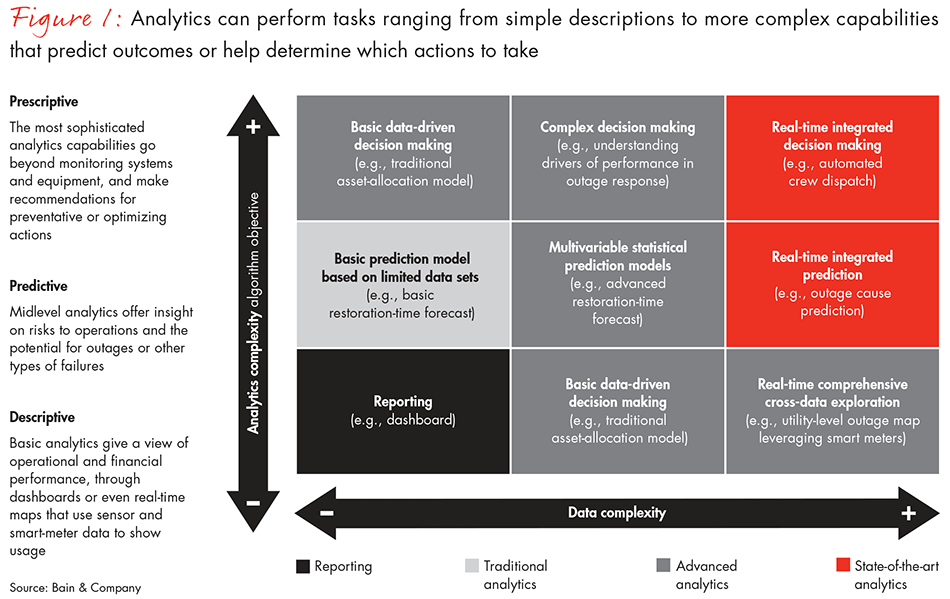
Utilities can get started by viewing the Big Data opportunity in terms of the complexity of the data and the analytics capabilities the organization can bring to bear. It’s helpful to think about three levels of progression—basic descriptive systems, moderately complex predictive systems, and more advanced prescriptive systems—as a way of setting aspirations and developing strategic plans to build up capabilities that will help utilities achieve their data goals (see Figure 1). Utilities won’t have to reach the highest levels of complexity and capability before seeing returns on their efforts. There is plenty of value to be mined in the medium gray areas of the figure.
In addition to the usual difficulties faced in so many industries—hiring and retaining good data-science talent, breaking down siloed functions to accelerate learning from insights, retraining existing staff to use data and insights better—utilities have some unique qualities that can make it particularly challenging to expand analytics capabilities. For example, their current data systems have been set up to facilitate operations, and the data is often low quality and unstructured. Consider the historical data output from an outage-management system, which may be a simple log with text notes indicating when events occurred. Such systems may not capture or retain all the details about causes, duration or resolution, or they may capture them in a format that’s not conducive to assembling a large, mineable data set. A more advanced system would capture all this data in structured form, which companies could compile and compare more easily. However, even with simple logs, utilities can use analytical methods to mine otherwise unstructured data sets and formulate valuable lessons.
As their analytics capabilities evolve, utilities will need to adopt more rigorous standards for capturing, storing and managing data. Cleaning up data is a major challenge, requiring painstaking work to rationalize what is frequently a haphazard collection of systems and restructuring them along common lines so they can share and effectively use the data at hand.
Utilities will also have to get better at adopting and employing advanced modeling techniques to discover insights in the data. Along with this task, utilities are beginning to complement their existing workforces with data-savvy talent that brings advanced analytics, modeling and visualization skills to bear on these efforts.
Quick win: How analytics assist with outage management
Utilities should start by picking a key objective or subject area and developing targeted analytics to build momentum. Such areas may include outage processes, materials management, demand-side management or asset analytics. Focusing on a single area can help in several ways.
- First, it focuses the organization on exploring advanced analytics, but within the framework of a single design issue, with fewer stakeholders than it will need as the programs broaden.
- Second, the initial data engineering represents the heavy lifting that can produce results elsewhere in the organization. Once data sets have been cleaned up and merged, additional and more advanced applications for the data can proceed quicker.
- Finally, a single effort can begin to generate momentum, and the organization can apply the lessons learned to future projects.
One integrated utility decided to focus first on using better analytics to resolve power outages more quickly, a case that applies to all three areas of exploration mentioned above: reducing costs, improving reliability, and promoting customer engagement. The utility knew the average duration of power outages, but wasn’t sure why some outages lasted longer than others or how it could restore power sooner. By mining the data in its outage-management system and adding data sources such as telematics, asset-location data and weather, it produced a finer-grained view of its outage processes and the length of time taken for each step to restore power (see Figure 2). Field supervisors and managers can now filter the view by time of day, type of crew and location to review operations and find ways to increase reliability and reduce costs.
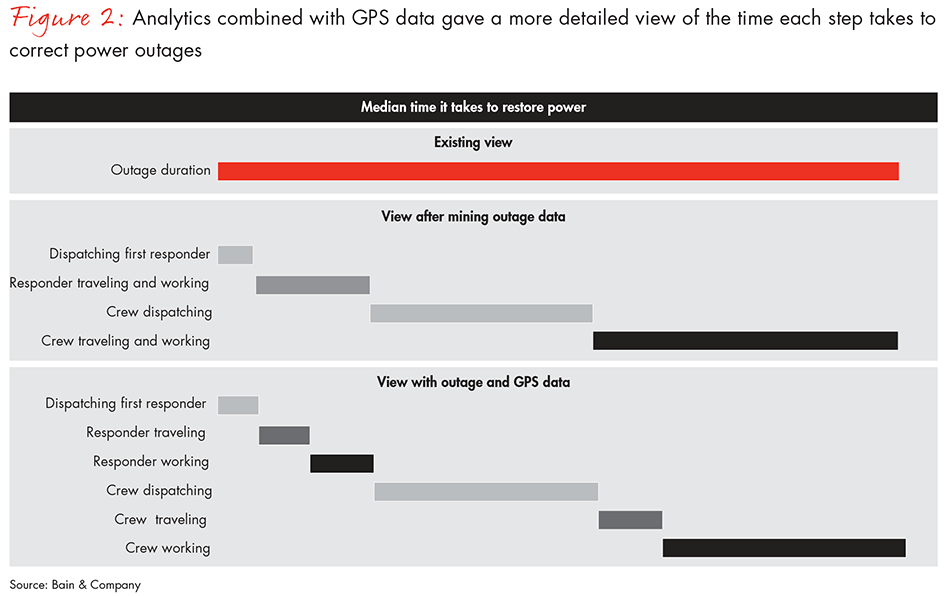
Using advanced analytical techniques, the utility also was able to normalize differences across work locations and determine what processes and business rules affected the duration of each step. This effort helped it prioritize process-improvement initiatives, based on their value potential.
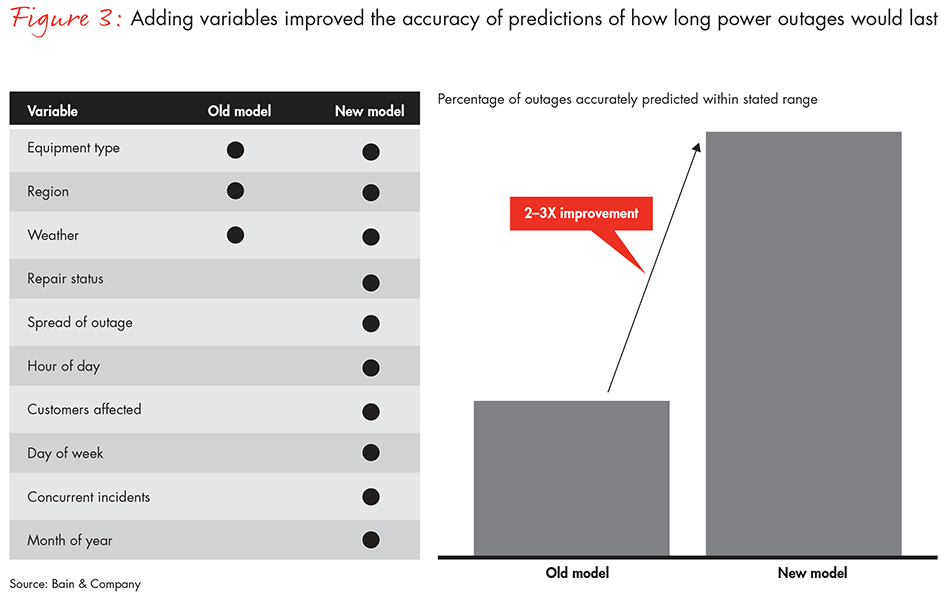
The utility used this data to build predictive models that delivered better forecasts of restoration times and gave customers more accurate information—a critical component of utility customer satisfaction. By adding variables to estimation models and using more advanced statistical methods, the utility doubled the accuracy of its outage-duration forecasts and found new ways to tell customers when power was likely to be restored, further strengthening customer engagement (see Figure 3).
A new relationship with data
Just as the widespread adoption of computerized spreadsheets in the 1990s unlocked new ways to understand and manipulate data, so too does the current explosion in new data tools and analytical techniques promise to elevate utilities’ understanding about their operations and customers. The first important step in unlocking that value is for utility executives to realize the current potential of analytics and experiment with the tools they already have.
Some leading utilities and other industrial companies have begun their journey by creating small centers of excellence within their organizations, tasked with advanced analytics projects. These teams typically combine skills from the business with more advanced data-science capabilities. Once teams are in place, they help raise the bar for analytics in the company, identifying and acting on opportunities with the highest potential value.
Most companies will need to secure quick wins using existing data and off-the-shelf analytical tools. From these initial explorations, they will begin to build up their capabilities and extend their growing expertise to more of their business. Their journey may take years, but the benefits are sizable: millions of dollars in value that would not be possible without advanced analytics.
Christophe Guille is a manager with Bain & Company in San Francisco, and Stephan Zech is a partner in Bain’s Los Angeles office. Both work with Bain’s Global Utilities practice.
First published in 8月 2016