

論説

More than half of executives believe that in five years, their main competitor will be a different company from the one today. This is not only testament to the speed at which upstarts are disrupting markets and industries, it is also an indication of how poorly prepared established companies are to respond to the rapid shifts that are so common in business today.
One group of incumbents does have the ability to keep ahead of the upstarts: the companies that have kept a Founder’s Mentality®. They maintain speed and agility, and have avoided becoming bogged down by bureaucratic processes and organizational complexity.
In their book The Founder’s Mentality: How to Overcome the Predictable Crises of Growth, Chris Zook and James Allen show that about one in nine large companies achieve sustained, profitable growth by harnessing the traits of their founders, even as they grow into large, global businesses.

Inside the Founder's Mentality
Explore how companies that nurture and maintain three key traits are more likely to sustain growth.
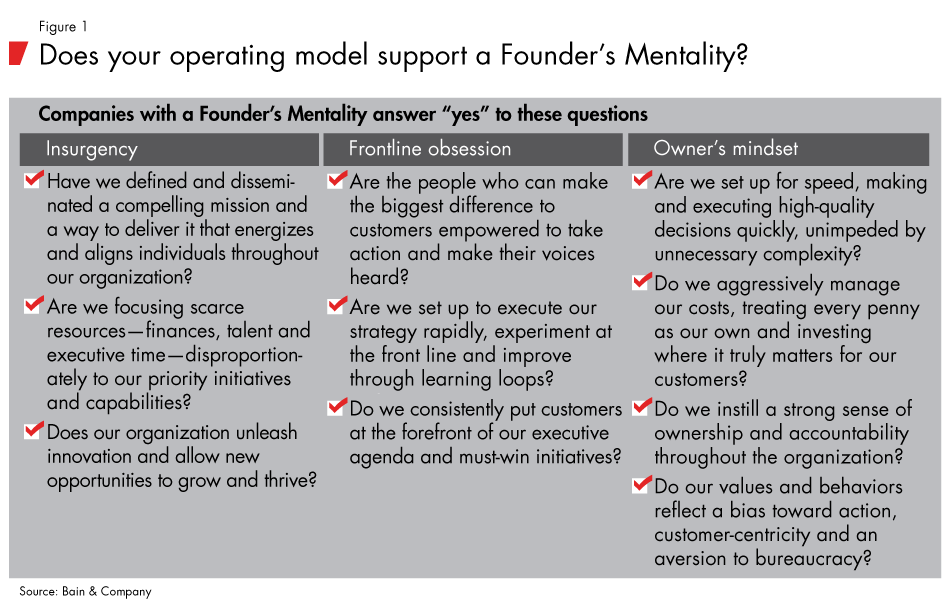
These traits are an insurgent’s sense of mission, an owner’s mindset and an obsession with the front line. They are not only beliefs and attitudes, but behaviors and ways of working that are embedded in the operating models of successful large companies—including the way they hire and manage talent, how they make decisions and how employees work together to serve customers (see Figure 1).
Insurgency. Founder’s Mentality organizations have a clear sense of mission; employees see themselves as insurgents (no matter how large the company) who are “waging war” against their industries on behalf of customers by serving unmet needs.
Frontline obsession. Founder’s Mentality organizations focus attention and resources on the front line, where the company connects with customers and employees can have the greatest impact. This focus helps determine what is essential to do and what is not, and helps identify obstacles to growth.
Owner’s mindset. Owners are impatient, eager to act and averse to bureaucracy that gets in the way. They relentlessly monitor costs to eliminate waste. They do not tolerate processes that slow things down or the layers of organization that disconnect management from the front line.
Companies that lose their Founder’s Mentality are highly likely to face a growth crisis. Only a relative handful of large companies become “scale insurgents” that avoid that fate. Retaining the Founder’s Mentality is not easy, and regaining it once it’s lost is even more difficult. For companies to prevent or pull out of a stall, they often need a radical reinvention of their operating model that will recharge their Founder’s Mentality. Understandably, management may view this as a daunting undertaking, balking at the transformation required, even while recognizing that their operating models are holding back the execution of strategy. Sometimes they just don’t know where to start.
Micro-battles can help companies get unstuck. The Bain Micro-battles SystemSM is a way to make strategy concrete by pursuing discrete, rapid, customer-focused initiatives that can have an immediate and tangible impact. They typically address a specific strategic problem as well as any organizational deficiencies that are blocking strategy execution. A company might launch a micro-battle to figure out how to beat a specific competitor in a certain market, gain share with a particular customer segment or build a new capability. Given their high priority, micro-battles enlist top talent, command frequent and focused executive attention, operate across organizational silos and have a tight time frame to solve their assigned problem. To move quickly and ensure focus, micro-battles operate outside the formal chain of command and are managed using Agile methodology, a proven approach to innovation. (Click here to read more about Agile Innovation.)
As a company first experiments with a few micro-battles, then sees the impact and extends the approach to a larger portfolio of micro-battles, there can be a multiplicative effect that starts to redefine the operating model in practical ways. The ultimate goal of micro-battles is to teach the organization to act like a scale insurgent, allowing the Founder’s Mentality to flourish. While explicitly set up to operate outside of the existing reporting structure, micro-battles are a powerful catalyst for evolving the underlying operating model as each battle tackles major strategy and operating model issues in tandem.
Change depends on two types of teams in the micro-battle system (see Figure 2).
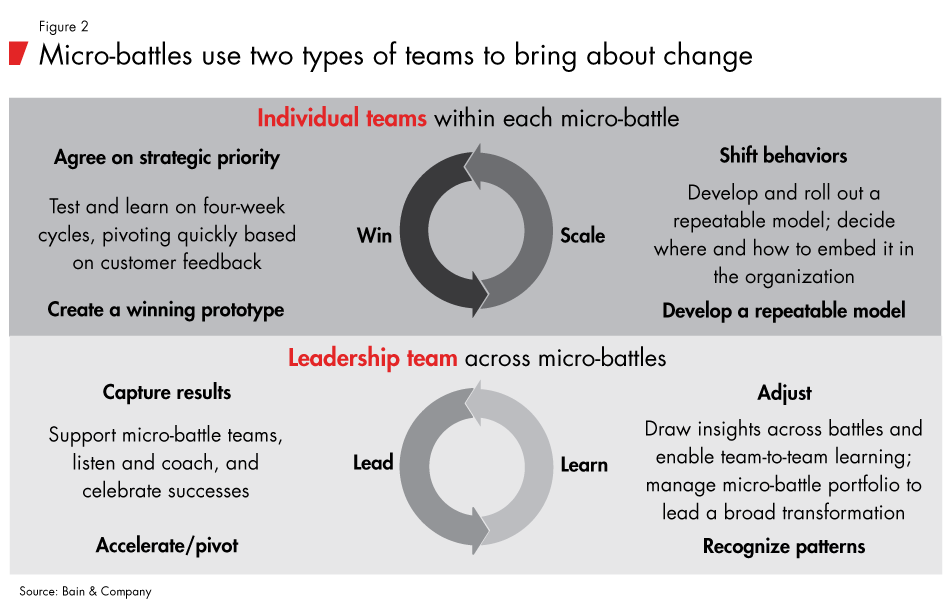
Individual teams, working on specific battles. These teams test and learn on four-week cycles, developing solutions and prototypes that can scale and expand across the organization in a meaningful way (what we call the Win-Scale model).
Executive leadership team, working across battles. This team runs the portfolio of micro-battles, enables each battle to be as effective as possible and watches for patterns that repeat across battles that might point to ways the organization as a whole might improve (the Lead-Learn model).
These teams implicitly and explicitly start to propel an operating model transformation in three ways.
First, each micro-battle serves as a laboratory, in which teams develop and deploy innovative solutions and also exemplify new productive ways of working. This can inspire other parts of the organization to adopt these new Agile values, behaviors and practices. As the insights from each battle are scaled, the new processes and roles required become embedded in the broader operating model.
Second, the leadership team develops new muscles as it supports, coaches and facilitates these micro-battle teams. They adopt effective ways of leading micro-battles, which include focusing resources on top strategic priorities; managing by exception to ensure attention is allocated to what is most important; bringing the voice of the customer into executive forums; and delegating to teams while engaging and listening, so obstacles can rapidly be addressed. These leadership practices, honed on micro-battles, can be applied more broadly, eventually becoming business as usual.
Third, leaders use the flow of information from the portfolio of micro-battles to recognize patterns and identify when significant changes to the operating model are required for multiple micro-battles to succeed. If a common set of organizational obstacles is repeatedly slowing down micro-battles, this may signal the need to adjust structure, roles, processes or behaviors. The portfolio perspective enables leaders to retain a holistic view of organizational design rather than make, one micro-battle at a time, a series of ad hoc changes that may not fit together.
The experience of a major retailer shows how micro-battles can provide quick wins on difficult strategic challenges, while starting to transform the company’s broader operating model. The company was way behind in the shift to omnichannel shopping, a critical capability when competing with online rivals that provides a seamless online and offline customer experience. Omnichannel requires complex processes that enable shoppers to order online and pick up and return in stores, or order in stores and have merchandise shipped to their homes.
The retail chain assembled a cross-functional micro-battle team to focus on pickup in stores. Immediately, the team ran into a problem. Distribution needed in-store personnel to be great at picking merchandise from shelves or storerooms in order to fill online orders. But the company was highly siloed, and store managers controlled everything within the store. Working closely with top leaders, the team broke down barriers and enabled the company to work across functions to create an efficient in-store pickup process.
The micro-battle team’s success showed colleagues that the company could move quickly when it had to, and that the organization need not be shackled by siloed behavior. In a remarkable departure from past strategic initiatives, in-store pickup expanded from pilot programs in a limited number of stores in the summer to a full rollout in time for the holiday season. Following on this triumph, the company was well-positioned to begin experiments with Agile practices now taking place in the supply chain and other operational areas.
The way the micro-battle teams went about their tasks—adopting a more dynamic governance model, tapping cross-functional resources, following a test-and-learn approach, delivering in a short time frame—provided a model for new ways of working at the retail chain. But the micro-battle teams also exposed the ways in which structures, roles and processes had to be redefined in order to support a new capability. They then transmitted the lessons across the company as the initiatives scaled, urgently fixing the organizational elements blocking their strategic initiatives and starting the company on its way to regaining its Founder’s Mentality.
Once a company has begun this journey and sees substantial benefits from its initial micro-battles, it may ramp up to a larger portfolio of strategic micro-battles, and eventually extend the approach further. In time, a significant part of the company could be running through micro-battles and Agile practices.
This advanced stage of the journey requires even more fundamental changes to the operating model as traditional hierarchy evolves into customer-oriented, Agile teams as the dominant way of working. For example, a “new deal for talent” may be required to develop new skills, ensure top talent works on the top initiatives, reward individuals for customer outcomes and make sure they have a path to career advancement even as they move from battle to battle. New approaches are also needed to ensure those in micro-battle mode can access the expertise they need and interface effectively with the rest of the organization.
Any company working to regain its Founder’s Mentality must travel through many phases, but the journey to becoming a scale insurgent starts with the first micro-battle. It is a microcosm of the company you want to be.
Marcia Blenko is an advisory partner in the Boston office of Bain & Company. Leslie Carroll is a partner in Bain’s Toronto office. Andrew Noble is a partner in Bain’s Boston office. Dunigan O’Keeffe is a partner in the firm’s San Francisco office.
Founder’s Mentality® is a registered trademark of Bain & Company, Inc.
Bain Micro-battles SystemSM is a service mark of Bain & Company, Inc.

Founder's Mentality
Fast-growing companies can become global leaders without losing the values that helped them succeed. Bain’s research explores how large incumbents can also reignite their growth by recapturing their Founder’s Mentality®.
First published in 2月 2018