

論説

When a merger or acquisition unexpectedly heads south, the costs are painfully clear. Morale drops. Synergies fail to materialize. Key people—those you planned to keep—start heading for the exits. But what’s really going on? Why is the system suddenly failing?
A likely cause of the trouble is culture clash. In a Bain survey of executives who have managed through mergers, that was the No. 1 reason for a deal’s failure to achieve the promised value. In a culture clash, the companies’ fundamental ways of working are so different and so easily misinterpreted that people feel frustrated and anxious, leading to demoralization and defections. Productivity flags, and no one seems to know how to fix it.
Acquirers have well-developed toolkits for managing the financial and operational aspects of a deal; they track results closely and they hold executives accountable for hitting their targets on schedule. Integrating two disparate cultures, by contrast, typically seems “soft”— both difficult to measure and almost impossible to manage directly. As a result, few organizations apply the same rigor to managing and steering cultural integration that they apply to a conventional, hard-dollar synergy. No one is on point; no one is accountable. Senior leaders can find themselves in the uncomfortable position of watching the problem unfold without knowing what to do about it.
The most experienced acquirers, however, have developed a set of practical, effective tools for facilitating cultural integration. It’s much like what CRM tools did to sales and marketing over the last two decades. As recently as the 1990s, creating leads and turning them into sales was regarded as alchemy—an abstract art that was unpredictable and difficult to manage. Then companies learned to use CRM tools to apply rigorous data collection and KPIs to sales, and to close the loop between antecedents, behaviors and business results. The new cultural integration tools offer companies the same opportunity to close the loop on merging two cultures. Using these tools, leaders can manage and measure the difficult task of persuading people to adapt their beliefs and behaviors, thereby increasing both control over outcomes and the probability that the deals will show positive returns.
Bain Partner Dale Stafford explains the practical, effective tools that the best acquirers use to ensure effective cultural integration.
Here’s what’s involved.
First, set the cultural integration agenda
A company’s culture is all the shared values, beliefs and behaviors that determine how people do things in an organization. Three key elements in combination define the culture:
- The behavioral norms exhibited by everyone from senior leaders to frontline employees
- The critical capabilities and decisions about where and how to compete, as defined by the company’s strategy
- The operating model of the company—the structure, accountabilities, governance mechanisms and ways of working that make up the blueprint for how work gets done
To integrate two cultures, savvy acquirers first define the cultural objective in broad terms. This is invariably a job for the chief executive—and the CEO has to be willing to sustain his or her commitment until the objective is realized. Integrating cultures is like a $200 million synergy opportunity: It merits and requires involvement at the top.
Setting the cultural agenda necessarily involves hard choices. What is the culture you want to see emerge from the combination of the two organizations? An acquirer can assimilate the acquired company, or it can create a blend of cultures. In some cases it can even use the merger to import the acquiree’s culture into its own organization. Your focus and your objectives naturally depend on where the deal’s greatest value lies. If cross-selling product lines is a key to the merger’s success, for example, integrating the salesforce culture will be essential.
Next, diagnose the differences that matter
In many cases, there are significant differences between the acquirer’s culture and that of the acquiree. But it can be difficult to pinpoint where, and how substantial, the differences are. Diagnostics can identify and measure the differences among people, units, geographical regions and functions. They can also help you determine which gaps need to be closed. A company can use a range of tools, including the following:
- Management interviews aimed at revealing managerial styles and priorities
- Video and audio recordings of people in their jobs, allowing side-by-side comparisons of different ways of working
- Decision X-rays and accountability mapping showing who is responsible for each facet of key decisions
- Process flow maps indicating how the work is done—often quite different from one organization to another
- Customer interviews designed to identify disparate customer perceptions of each organization
- Heat maps showing which groups are most important in realizing the acquisition’s value and where the biggest cultural gaps exist
- Employee surveys asking about accepted behaviors, attitudes and priorities
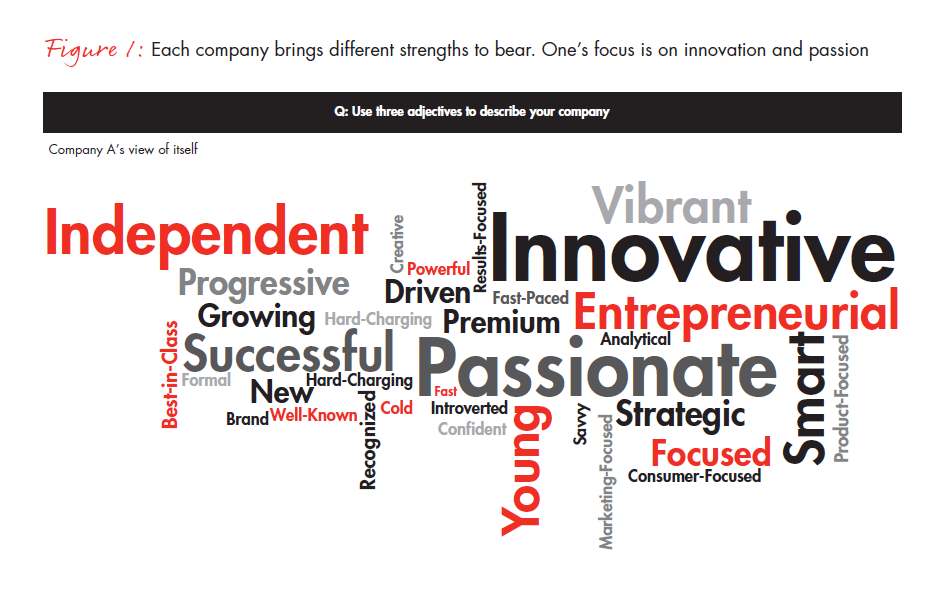
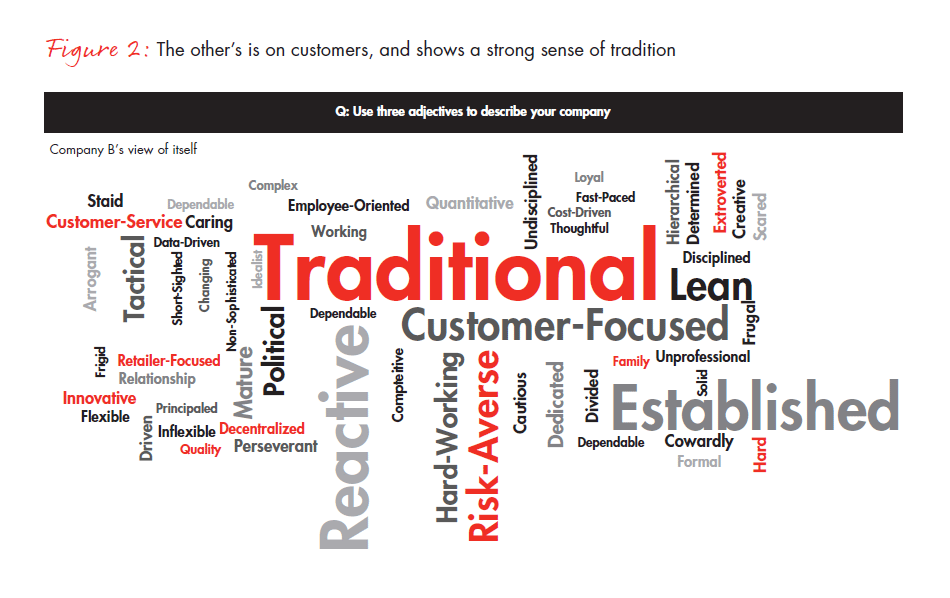
These tools often lead to fruitful discussions. One useful output of employee surveys, for instance, is a “word cloud.” You simply ask people to choose three adjectives to describe both their own company and the other one—a powerful, low-effort way to begin the diagnostic process and to build sponsorship around a broader culture effort. The results, assembled by word cloud software, often reveal significant differences and provide a basis for open dialogue. Look at figures 1 and 2, for example. These two companies—both leaders in a consumer-products industry—have very different self-images and thus encourage very different kinds of behavior. When one acquired the other, it was essential not only to identify those differences but to help people throughout the organization understand them.
Now, define the culture you’re trying to build
Setting the agenda and diagnosing the gaps create the context for action. The senior team then has two jobs. One is to determine the critical gaps to close. The second is to create a detailed picture of the future culture—a picture that moves beyond vision and values statements, and that is concrete enough to be executed by managers.
This is the point where “culture” must be defined not just with themes or adjectives but with specific behaviors, and with the measures and incentives that will be used to encourage those behaviors. Perhaps the acquired company’s managers typically made critical decisions through consensus, and must now adopt a different decision style. Perhaps unit heads were in the habit of squirreling away their top talent, and must now learn to work within an enterprise-wide talent bank. The need to define behaviors extends throughout the organization. When the consumer-products company mentioned earlier acquired its biggest competitor, the deal created an enterprise that could sell each other’s products. But the two company’s sales cultures were quite different. The acquiree’s reps interacted extensively with the distributors they dealt with, helping those distributors understand customer profiles, inventory levels and even their basic financials. The acquirer’s reps had a wholly different style: They had a product line that was highly sought after, and so had a more transactional relationship with distributors. The newly merged company had to ensure that sales reps adopted behaviors appropriate to the products they were selling, and to create reward systems that encouraged those behaviors.
Then comes the difficult work of co-creating the new culture. The most powerful tool for this job is intent workshops. People in the organization get together to build a vision of how they will behave collectively and what they will achieve. For example, imagine the task of integrating two disparate sales organizations. During the diagnostic phase, the new head of sales for the combined company and the regional managers participated in ride-alongs with sales reps from both organizations. They watched how the salespeople interacted and how they made real-time decisions in the field, and they gathered data about the results. In intent workshops, they then help sales managers name the specific sets of behaviors they want to see in the future, along with the processes and incentives that will encourage these behaviors. They discuss how those behaviors will generate value.
Finally, develop a culture-change plan— then sustain and measure progress
Let’s imagine that two hotel chains merge. One has a reputation for stellar customer service; the other has come to be known for indifference. The newly merged hotel company obviously doesn’t want to blend these cultures, even if that were possible. Rather, it wants to create a culture throughout the company that fosters great customer service.
The plan to develop that culture needs to focus on key groups of employees, such as front desk staff. Beginning with a diagnosis of differences, the company can then define the specific behaviors it wants to see. For example, the hotel might decide that, as part of a customer-centric culture, it wants its employees to address customers in suites by name and to personally thank elite-status members of the company’s loyalty program. These might be just 2 of 30 or so critical behaviors that make up the new customer-centric approach.
The company then defines the antecedents and consequences that will foster such behaviors. These might include a robust training program that identifies, describes and trains for these 30 behaviors; a zero-tolerance policy for treating customers poorly; and a promotion and compensation regime that highlights the successes and increases the pay of people who exhibit the new behaviors. To assess the behaviors, the company might create a program allowing customers to give feedback on specific employees (meanwhile ensuring that employees’ name badges are both large and obvious so that customers will actually know the names). And it can make evaluation of front desk employees a significant part of the overall evaluation process for managers.
Conclusion
Cultural integration isn’t something that can wait until a deal is done. Sophisticated acquirers take stock of possible cultural clashes as part of their due diligence well in advance of a merger or acquisition, and they prioritize those cultural issues that might put synergy values at risk. The right tools make this process both feasible and effective. Tools, of course, can’t substitute for leadership. Employees always watch for signals from the top of the organization, because they know that their own managers will be guided by those signals. But if the signs are positive—if the senior team seems truly committed to building a culture that excites employees about the future—then the new tools of cultural integration will help pave the way to deal success.
Dale Stafford is a partner in Bain’s Global Healthcare and Global Mergers & Acquisitions practices. He is based in Washington, D.C. Laura Miles is an Atlanta-based partner and leads Bain’s global M&A practice.
First published in 12月 2013