

論説

In the 23 years since adoption of the North American Free Trade Agreement (Nafta), companies operating in the US, Mexico and Canada have been designing their supply chains for a trade regime of minimal cross-border barriers. But Nafta now looks set for radical change under the Trump administration, after the presidents of the three countries agreed they will renegotiate the pact. For one thing, some trade experts argue that Nafta is obsolete, as it excluded important sectors such as services, finance and largely digital companies. Only about half of Mexican exports to the US, for instance, are traded under Nafta terms.
Renegotiation of Nafta—or at the extreme, withdrawal—has important implications for the supply chain and profitability of US-based companies. However, there is a high level of uncertainty about the ultimate outcome and consequences for companies, in part because the effect could be offset or aggravated by currency-rate adjustments.
In recent months, a few major manufacturers, including Ford and Carrier, canceled plans to build new factories or expand existing operations in Mexico, and affirmed plans to expand in the US, after President-elect Donald Trump singled them out for public criticism. Other firms, including Rexnord and CTS Corp., decided to move ahead with plans to shift some production from the US to Mexico. For most other companies, the uncertain nature of trade policy has left leadership teams reluctant to act.
But waiting for a clear sense of the future is the riskiest option. Successful companies thrive in uncertainty by incorporating change into their strategy process. Leadership teams can limit the negative consequences of Nafta withdrawal and currency moves by adopting an approach that anticipates a range of future scenarios. This approach also applies to companies based in Mexico and Canada, as well as other countries, such as China, with trade agreements that may be vulnerable to US political upheavals.
Senior leaders who have learned to manage in uncertainty focus on the few risks that matter most. They assess each potential scenario and identify the critical trigger points—we call these signposts—that signal a swing from one outcome to another. That approach helps determine a clear portfolio of strategic actions that balance commitment and flexibility. Instead of basing a strategy on conditions at a discrete point in time, leaders engage in a continuous cycle of execute, monitor and adapt, redirecting the company toward the best opportunities over time.
How different industries might fare
Nafta renegotiation will entail a lengthy process, starting with consultations among lawmakers and followed by rounds of multilateral negotiation for each industry. Potential outcomes range from increasing local-content requirements to full withdrawal, which would restore World Trade Organization (WTO) “most favored nation” import tariffs between the US and its trading partners. The eventual consequences of Nafta changes are equally uncertain.
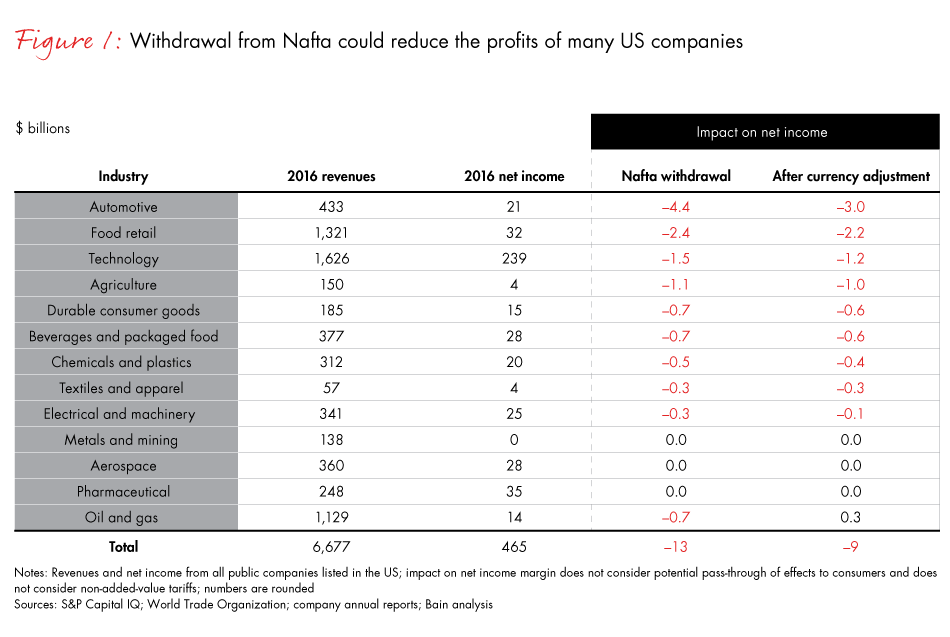
Still, given the likelihood of some changes occurring, companies with exposure would benefit from preparing for a range of possible outcomes. Bain & Company has analyzed the Nafta scenarios. We estimate that Nafta withdrawal could reduce the net income margin of companies in the automotive, agricultural and textile industries by as much as 1 percentage point (assuming no pass-through of higher costs to consumers). Companies in these industries tend to rely heavily on imported parts, components and raw material from Mexico or Canada traded at Nafta terms. For example, California-based berry producer Driscoll’s has invested extensively in Mexican berry operations because of the year-round availability of high-quality fruit, lower labor costs and local know-how.
Industries likely to feel the least harm, with no more than a 0.1-point reduction in the net income margin, are aerospace, metals and mining, pharmaceuticals, and oil and gas, which have very few Nafta-related imports from those countries (see Figure 1).
Tax reform, meanwhile, also is brewing in the US Congress. An early version of tax reform included installing a "border adjustment" to promote exports and eliminate deductions for the cost of imports. Although the current outlook for a border adjustment looks unlikely, with all the uncertainty around tax policy decisions, it's still worth considering a scenario that includes the border adjustment.
Border adjustment, as an isolated policy, would have the greatest negative effect on net income for companies that depend heavily on imports, namely the oil and gas, aerospace, metals and mining, and automotive sectors. At the other end of the spectrum, it would help companies with large exports or domestic production, such as pharmaceutical and technology firms.
Should Nafta withdrawal and the border adjustment both occur, the combined effect would weigh most heavily on oil and gas, automotive and aerospace, while giving the largest boost in profitability to pharmaceutical and technology firms.
Currency adjustments might offset much of the impact of both of these changes, due to a higher demand for the US dollar. When Americans demand fewer imports, they also provide foreigners with fewer US dollars. This reduces their supply, makes them more difficult to get and pushes up the relative value of the dollar. Any export subsidy would allow US producers to lower their prices in foreign markets, raising demand for US exports, which further spurs demand for dollars in order to purchase those exports.
Currency effects could take years to materialize in certain industries, however. That’s because many suppliers sign five-year contracts in dollars, not pesos. No matter when a new trade agreement is signed and currency effects start to kick in, those suppliers could adjust their prices only after the contracts expire.
Three types of action to consider
Companies that develop a strategy for these uncertainties will be able to pivot faster than the competition when Nafta details become clear, minimizing supply chain risk.
Timing is key, no matter which scenario unfolds. When planning actions for each possible outcome, companies should pair each action with a signpost that triggers it. Companies can choose among three types of action:
-
No-regret moves. Some actions will increase a company’s competitive edge no matter what scenario plays out. They include improving cost management or operational effectiveness in procurement, supply chain and inventory management. Nafta renegotiations heighten the urgency to look for new operational efficiencies, as they give companies greater flexibility to face new treaty restrictions. For example, a retailer that becomes more efficient will have the option of not passing on cost increases to consumers, without hurting its profit margins.
-
Options and hedges. Leadership teams that develop strategic options and hedges for a variety of future scenarios navigate better when new developments unfold. These could include expanding procurement options or increasing the volume sourced from competitive local suppliers. For example, back when Nafta was being negotiated, several Mexican companies, such as auto-parts supplier Rassini, seized the opportunity to invest in modernizing their operations so they could expand beyond their local customer base to compete globally.
One option today is automating operations to some degree. If Nafta is repealed, it would be easier to move a partially automated production line back to the US, compared with a highly manual line. The option value lies in the cost of moving, relative to paying higher WTO rates.
-
Big bets. The most challenging balancing act involves large-scale investments that have different payoffs depending on how the future plays out. Any company that keeps its supply chain and manufacturing footprint plans for North America may be making a big bet, and management teams should assess their investments from this perspective. Companies could go even further by expanding US production capacity or switching suppliers from foreign- to US-based companies. Or they could make a contrarian bold bet, like the one contemplated by Ammex, a disposable-glove distributor based in the US that sells to labs, hospitals and other companies around the world. Ammex is looking to invest in e-commerce and double down on Mexico, a key developing market for the firm, while nervous competitors draw back from the country.
If a big bet looks too risky to take immediately, companies can wait for greater clarity and move quickly once signposts point to likely changes ahead.
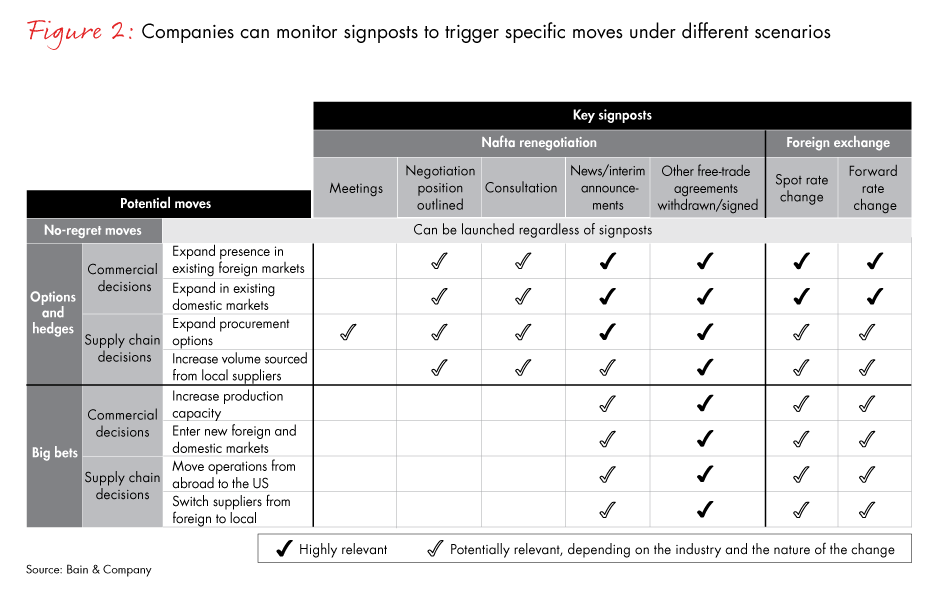
Companies can monitor a wide range of signposts and map them to possible strategic moves with their supply chains (see Figure 2). No-regret moves can be launched regardless of signposts, but a regular check of relevant signposts will precede the implementation of options and hedges or big bets. For instance, if other free-trade agreements are withdrawn or signed, that could prompt some companies to increase the volume of parts or material sourced from competitive local suppliers that have previously been vetted and placed in reserve. Once Nafta negotiations begin, an important signpost would be an announced term sheet that establishes the boundaries of the negotiations—say, an agreement to review regional content rules and include new sectors, but not consider quotas or withdrawal of any sector. Under those boundaries, expanding local supply would shift from being a hedge to a no-regret move for some industries.
It may take a couple of years to know what changes Nafta negotiations will bring and how they will affect supply chain speed, costs and inventories. Developing a strategy for uncertainty provides leadership teams with the tools to anticipate multiple outcomes ahead of the competition, and before the relevant governments make their decisions. By incorporating change into the strategic process, companies can correct course quickly as new trade deals unfold.
Rodrigo Rubio is the head of Bain & Company’s Mexico City office. Thomas Huber and Joe Terino are partners in Bain’s Performance Improvement practice, based, respectively, in Mexico City and Boston. Gabriela Lozada is a manager in the Industrial Goods & Services practice and is based in Mexico City.
First published in 8月 2017