

論説
It's no mystery why customers expect the worst whenever mergers are announced. Bank customers may lose their favorite branch. Frequent travelers dread changes to flight routes and loyalty programs. Cable customers may find their new bill incomprehensible.
When companies merge, they embark on seemingly minor changes that can make a big difference to customers, causing even the most loyal to reevaluate their relationship with the company. Numerous studies have found that more than half of all mergers fail to deliver the intended improvement in shareholder value. Customer defections contribute to that high failure rate.
Integration decisions come with an inherent tradeoff: If you are making changes in your operations, particularly changes that benefit your bottom line at the expense of your customers, you can expect to pay a price in the top line. The trouble is, companies tend to focus on quickly reducing costs and worry mostly about the biggest things that can go wrong, such as major technology disasters, rather than long-term customer attrition.
Despite their low expectations of merged companies, the harsh reality is that customers demand consistent and seamless services across both merged companies from the start. If they don’t get them, they defect. First Union Bank lost 20 percent of its customer base in the first year after purchasing CoreStates Financial in 1997. But customer defections are not a foregone conclusion in mergers. When Westpac in Australia acquired St. George Bank, an institution one-third its size, Westpac's leaders set an audacious goal of not losing a single customer in the process—and they succeeded.
How can companies manage the merger integration process to avoid customer defections? In our experience, companies that do the best job of retaining customers—and attracting new ones—adopt the customer's view of the merger as they make important integration decisions. They typically establish teams tasked with evaluating every step in the integration and every change that is made through the eyes of the customer. They act as the customer's advocate. Adopting the customer's point of view does not change the fundamental activities required in merger integration. Instead, it allows companies to sequence and coordinate customer-facing changes in ways that create a better customer experience.
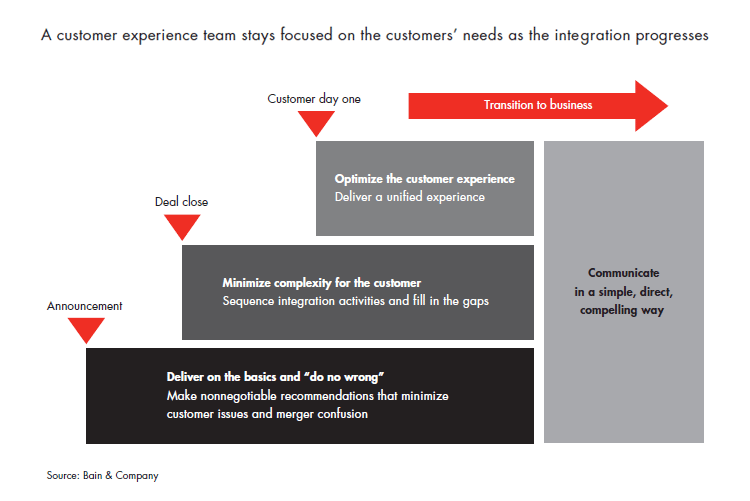
In our work with companies in a range of industries, we identified five key initiatives that can improve customer retention in a merger:
1. Set ambitious goals for customer retention, and adopt specific customer metrics to track performance. Put customer retention in the deal model.
In most mergers, integration focuses exclusively on reducing costs or achieving revenue synergies and all metrics and incentives are linked to delivering those synergies. Instead, metrics and incentives can also be aligned to ensure customer retention, as well as synergies.
One way to measure the value of keeping customers satisfied is the Net Promoter® system, a common approach to assessing customer loyalty that starts by asking customers: “How likely would you be to recommend this company or product to a friend or colleague?” Respondents giving marks of nine or 10 are promoters, the company's most devoted and enthusiastic customers. Those giving a score of seven or eight are passives, and those scoring it from zero to six are detractors. The Net Promoter score (NPS®) is the percentage of promoters minus the percentage of detractors. When one major US bank used this approach to gauge the impact of its merger on customers, it learned that its NPS dropped from 11.5 to zero as customers felt overlooked.
Westpac built customer retention into the business model for its acquisition of St. George Bank. The company set goals for balance sheet synergy, cost synergy and customer retention. Among the steps taken to maintain customer loyalty: personal visits by relationship managers to wealth management customers, letters to retail customers and a significant marketing investment aimed at explaining to St.George customers that they would not be losing anything—that, in fact, they would be gaining the benefits of being part of a bigger bank, such as access to a larger network of free ATMs. The result: St.George's customer base remained stable with no defections following the merger, and its churn rate actually dropped.
2. Embed consideration of the customer experience as an integral part of merger planning.
As with any major change effort, the approach needs to start at the top, with executive sponsorship of the customer perspective and regular review and communication by the steering committee. A cross-functional integration team focused on the customer experience is vitally important. The team maps out and assesses the impact of all integration decisions on customers—with emphasis on the most important interactions affecting the most valuable customers—and provides constructive suggestions for embedding that customer perspective in each integration task force. Customer experience teams can ask a functional team to include customer impact as part of the team charter, in the same way a company would identify IT dependencies or other cross-functional points.
When two major airlines recently merged, one of the first steps was to develop such a cross-functional customer experience team to work with each of the functional integration teams, from network planning to airport operations. The goal was to identify the customer-facing issues that required immediate attention, among which was the need to quickly align beverage and Internet policy in airport lounges and to provide reciprocity for complementary domestic upgrades and premium economy seating. If bungled, those issues would alienate their most valuable customers, so the airlines elevated their resolution to high-priority status. With other customer-facing issues, such as same-day ticket change policies and baggage fees, the integration team had more time and could make the necessary adjustments during the first six months of integration.
Members of the customer experience team had ambassadors from each of the functional integration teams to help each function manage the customer experience and the tradeoffs. They involved senior decision makers with the most influence over the customer experience at touch-points such as airport operations, e-commerce and loyalty programs. The team also worked closely with the airlines' corporate communications staffs to manage messages surrounding the merger and keep customers informed through Facebook, Twitter and other social media channels.
3. Identify and accelerate actions to improve the customer experience or increase the value of your offering to them.
The customer experience team maps out the customer experience from end to end, identifying how customers will be affected at each point and looking for opportunities to delight or at the risks of disappointing them.
One year after announcing the Commerzbank–Dresdner Bank merger, Germany's biggest banking deal in a decade, the companies realized that migrating two IT systems would take a year longer than anticipated. Rather than postpone the merger, they moved forward, accelerating activities that would keep customers loyal. Commerzbank and Dresdner Bank established a team to systematically identify customer pain points, a step rarely taken by banks involved in mergers. Then the banks invested in processes that would maintain or improve the customer experience and reduce the chances of disappointing customers.
For example, the company established a goal that a Dresdner Bank customer could conduct every transaction in a Commerzbank branch and vice versa. But without an integrated IT system, it would need to build temporary solutions that allowed customers in any location to complete basic tasks, such as obtaining their account balances or making transfers. So the company invested in a central hotline to enable branch employees to quickly access customer information, bypassing the legacy IT systems.
The company also analyzed the pain points using customer segmentation. It thus determined that high-value private-banking customers might be disappointed if they visited a legacy branch of the other company and did not have full access to their own account information. During the lengthy IT integration, employees would not be able to print out a stock-trading statement for non-legacy customers at the branch. To deal with that gap in service, the banks proactively mailed out stock-trading statements to private-banking customers. The move resulted in 30 percent fewer requests for stock reports, effectively reducing by 30 percent the risk of disappointing high-value customers. In both cases, the company made a decision that cost money but would pay off in terms of customer loyalty.
When UK telecom providers Telewest and NTL announced their £3.4 billion merger in 2005, the deal made headlines if only because of the well-known disparity in the merging companies' reputations for customer service. In the 2005 UK Residential Broadband Internet Service Providers Satisfaction Study by JD Power and Associates, NTL ranked at the bottom among the UK’s top six ISPs. Telewest came out on top. The merging companies used the process of aligning pricing and product portfolios as an opportunity to develop a model for consistent customer service—upgrading to Telewest's best practices in such areas as quickly resolving customer complaints. One year later, the company acquired Virgin Mobile from Sir Richard Branson and rechristened itself as Virgin Media.
4. Communicate and listen.
Customers left in the dark assume the worst. Give them a vision for the integration and the expected time line even before you make any decisions. For example, on the first day that two airlines joined their customer operations, they announced combined priority airport services and integrated self-service capacity, but explained that a single reservation system would take more than six months to be introduced. Once you've made a decision, be thoughtful about how and when you communicate.
One lesson companies have learned about successful mergers is to actively manage customer- facing communications by bundling good news with the bad. In the case of the merged airlines, the customer experience integration team set a goal of delivering an average of "neutral" change in each month. They looked at all changes and rated the potential customer perception of each as good, bad or neutral. The company then strategically timed announcements, bundling bad news with good. The bundling approach helped customers absorb the news. A key part of the customer experience team's job is to figure out what to package together and when to announce.
Winning companies maintain an open two-way dialog with customers, seeking their input and listening to it. One effective way to do this is to create a closed-loop system for learning why customers are promoters, passives or detractors, and deliver the feedback directly to employees who can learn from and act on that feedback. It's also important to follow up directly with customers when appropriate.
5. Empower employees—provide them with the tools and information they need to respond to customers caught up in the change.
Mergers invariably create stress for employees, who naturally worry about the fate of their jobs. But companies also rely on the workforce—particularly their frontline employees—to deliver an exceptional experience during a time of change. That may require a new level of frontline empowerment, which can be uncomfortable for some companies accustomed to more command-and-control management. Merging companies may have different approaches to empowering employees, but satisfied employees make for satisfied customers. In our experience, customer service problems handled well in times of stress contribute to customer loyalty.
Mergers aren't easy, and they raise real risks that customers may jump ship. But the merger integration process brings with it a natural opportunity to reevaluate—and even improve—the overall customer experience. By setting ambitious retention goals, making the customer experience an integral part of merger planning, finding new ways to improve the customer experience, communicating and listening with customers, and empowering employees to provide better service, companies can turn mergers into a sign of better things to come for their customers.
Laura Miles, a Bain & Company partner based in Atlanta, leads the firm's Mergers & Acquisitions practice in the Americas. Ted Rouse, a partner based in Chicago, leads the firm's Global Mergers & Acquisitions practice.
First published in 11月 2011