

M&A Report

概要
We’ve identified five M&A themes to watch for in the year ahead:
- Cash-rich companies making strategic, bold moves.
- A continued prevalence of small to midsize deals.
- A balance of scale and scope deals.
- Valuations coming under further pressure.
- Companies reshaping portfolios through separations and divestitures.
This article is part of Bain's 2023 M&A Report.
In 2023, savvy executives will keep their feet on their M&A accelerators, even as competitors slam on the brakes in the face of turbulence.
Experienced dealmakers are familiar with the cyclical nature of the M&A market. Deal values and deal multiples decline as sellers hold back and acquirers lose conviction. As uncertainty impacts both the base business of acquirers and targets, it becomes harder to make decisions about deals. It’s no wonder why many executives lose their appetites for the deal process during turbulent times.
Yet history tells us that winners don’t pause M&A during downturns, rather they take advantage of opportunities to reshape their industries. Companies that move quickly when others hesitate are rewarded.
Bain research on M&A in times of turbulence validates how M&A was part of the winning response in previous down cycles. We examined the acquisition activity of 2,845 companies from around the world during the global financial crisis and economic downturn of 2008–2009. We found that in the long run, companies that executed at least one deal per year during the economic downturn earned 120 basis points more in total shareholder returns than companies that were inactive in M&A. Moreover, as we explore in the chapter “M&A in Times of Turbulence: Lessons from the Last Recession,” many industry-defining deals were made throughout the last downturn.
Nearly two-thirds of respondents report that acquisitions completed in the previous three years have met or exceeded expectations.
Deal practitioners are prepared to take advantage of this moment. We surveyed around 300 M&A executives globally about their outlook and priorities for dealmaking in 2023. Respondents anticipate closing a similar number of deals, if not more, in the year ahead, encouraged by more attractive asset availability and decreased competition. They express confidence in the ability for M&A to create value. Nearly two-thirds of respondents report that acquisitions completed in the previous three years have met or exceeded expectations.
Based on our observations from earlier down cycles, we have identified five themes to keep an eye on in 2023: cash-rich companies making strategic, bold moves; continued prevalence of small to midsize deals; a balance of scale and scope deals; further pressure on valuations; and portfolio reshaping through separation and divestitures.
コンサルティングサービス: M&A Strategy
Cash-rich companies making strategic, bold moves
In 2008–2009, numerous industry-defining deals positioned acquirers for faster, more profitable growth out of the downturn. In the current cycle, too, companies with a strong market position, cash on hand, and debt capacity will have the upper hand to execute transactions. These companies should be confirming their strategic M&A roadmaps, revisiting deal models, and laying the groundwork to move fast on desirable targets (large and small). Nearly every sector has a few cash-rich market leaders. Energy, industrials, and technology stand out as sectors in which the top players have solid balance sheets to make bold moves. Strong performing companies with an experienced track record of M&A will be the best positioned to do the largest transformational deals.
Continued prevalence of small to midsize deals
Thousands of deals valued at less than $500 million make up the bulk of M&A activity each year. We expect this to continue. Companies look to M&A to address strategic needs to expand markets, build new engines for growth, and fill capability gaps. Smaller to midsize deals will be easier than megadeals to complete given relatively lower risk, less reliance on financing, and less regulatory scrutiny. Dealmakers in many industries may shy away from pursuing deals that could wind up in regulatory crosshairs as extended pre-close periods incur many direct and indirect costs. Sectors with struggling assets, such as banking in Europe and telcos in developing economies, may find more tolerance among regulators for large consolidation deals.
Dealmakers may shy away from pursuing deals that could wind up in regulatory crosshairs.
A balance of scale and scope deals
A high interest rate environment and weak economy put a premium on assets with cash flow and a line of sight to rapid synergies, supporting a near-term shift to scale deals. For example, in healthcare, moves such as Johnson & Johnson’s $16.6 billion acquisition of Abiomed in November 2022 signal a return to category leadership. At the same time, our M&A Practitioners' 2023 Outlook Survey indicates that appetite will continue for deals to build and grow new businesses. These “Engine 2” deals offer speed to market and efficiency that organic moves can’t match—see the chapter “When Buying (vs. Building) Is the Right Move for Engine 2.” Energy companies are likely to be a prime example of this approach as they use cash to consolidate in existing markets while shifting to renewables via scope deals—see the chapter “M&A in Energy and Natural Resources: Beating the Odds in Energy Transition Deals.” Similarly in retail, while we expect to see retailers pursue scale deals, such as the $25 billion Kroger-Albertsons deal announced in October 2022, they are also likely to use scope M&A to establish “beyond trading” Engine 2 businesses—see the chapter “Retail’s New M&A Balancing Act.”
Further pressure on valuations
Uncertainty regarding cost and availability of capital, as well as the overall macroeconomic outlook, will likely cause dealmakers to be more conservative in valuations. History suggests that valuations typically find a floor at around 9 times to 10 times enterprise value to EBITDA, another 2 to 3 turns lower than the 2022 median. Yet strategic buyers hoping for a steal should be prepared for increased competition from financial buyers as the year unfolds. Private equity firms are resilient in fragile economic environments and will continue to have record amounts of dry powder, an appetite for deals, and a willingness to pay for desired assets.
Strategic buyers hoping for a steal should be prepared for increased competition from financial buyers.
Portfolio reshaping through separation and divestitures
Down cycles and uncertainty force companies to reevaluate their portfolios under new scenarios. While we expect boards to consider divestitures more seriously, it takes a lot of conviction to do one in a downturn. Corporate executives often drag their feet on selling underperforming assets “at a loss.” Yet this fear is often misplaced: at some point, no amount of multiple expansion can offset declining performance in the business itself, especially one that is no longer receiving attention or investment. We expect to see the most divestiture activity in sectors in transition, where divestitures can help fund new investments. For example, the shift to renewable energy from fossil fuels and internal combustion engines could spur more divestment activity in the energy and automobile industries—see the chapter “M&A in Automotive and Mobility: Finding Alternative Routes to the Future.” Moreover, a quick sale unlocks not only capital but also leadership focus. For this reason, we expect the relatively high level of divestiture activity in consumer products to continue.
What does this mean for the M&A practitioner?
In a challenging macroeconomic environment and deal market down cycle, M&A executives should customize their toolkits to accelerate decision making, gain conviction in potential deals, and preserve value through integration (see Figure 1).
Figure 1
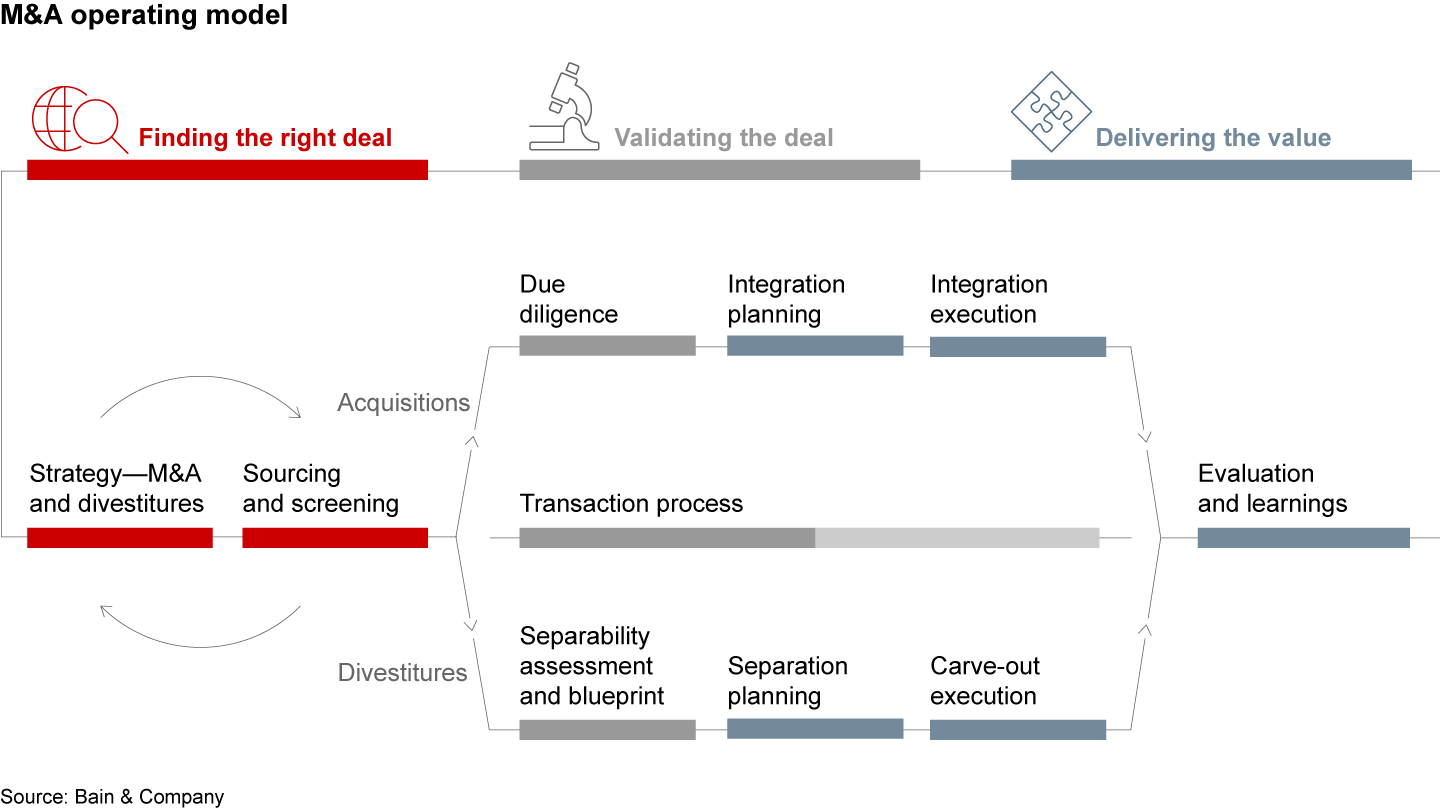

That means confirming portfolio strategies and refreshing M&A roadmaps to enable nimble decision making. Now is the time to revise scenario planning to account for cost and availability of capital, geopolitical disruptions, and other uncertainties. The best companies devote energy to scrutinize their competitors, determining which of them has both the cash and motivation to make bold moves. Winners also identify where and how they can use M&A to accelerate or scale innovation or build an Engine 2. And they expand the pipeline with a broader view of prospective targets. That gives them a faster response time when those targets come to market and prepares them with viable alternatives if their top choices don’t work out.
They gain conviction quickly through rapid and strategic diligence and valuation. Market volatility means buyers need to be confident that their target will be resilient in several future scenarios, for example. And increasing interest rates mean buyers need to determine how to accelerate synergies. Moreover, at a time when speed counts more than ever, nearly 40% of surveyed M&A practitioners tell us that a volatile market is making the deal process take longer. All of this implies that companies need to come armed with proprietary insights from due diligence that is faster, deeper, and better focused than the approach taken in a more stable environment. Among the necessary moves: getting more detailed on the sources of value in the marketplace, revenue, costs, talent, and technology—and laying integration plans during the diligence, not afterward (see the chapter “Tougher Times: Putting the Diligence Back in Due Diligence”).
Nearly 40% of surveyed M&A practitioners tell us that a volatile market is making the deal process take longer.
It’s also now more critical to preserve and amplify value through integration. Our M&A Practitioners’ 2023 Outlook Survey found that while culture is an early focus area for 80% of integrations, 75% of acquirers still struggle with cultural issues that require serious interventions. The answer is to focus on the specific issues most likely to disrupt the integration rather than the broader cultural landscape that could take years to address. We call these specific issues "cultural fault lines," which, similar to fault lines between tectonic plates, cause foreseeable, frequent, and disruptive frictions when and where they conflict. There are three common types of cultural fault lines in merger integrations: differences in purpose, decision making, and engagement (see the chapter “How to Avoid the Fault Lines Sending Tremors through Cultural Integration in M&A”).
Some companies may consider bigger portfolio moves such as a spin-off. Such companies should develop a well-crafted separation thesis that helps them to focus and provides a roadmap to value creation. Bain’s recent Spinoff Performance Study (2021) revealed that top-quartile separations performed exceptionally well, with 75% higher combined market caps two years after the separation. The other three-quarters of separations either failed to create value or destroyed value two years down the road (see the HBR.org article “Research: Few Corporate Spinoffs Deliver Value”). The existence of a clear and robust separation thesis was the single biggest difference between top- and bottom-quartile performers.
The following chapters in this report explore the insights that executives can learn from the best dealmakers and how M&A activity within industries and select regions reflects evolving sector strategies.
Read our 2023 M&A Report
Overview
Hot Topics
Industry Views
Regional Perspectives
First published in 1月 2023