

Retail Holiday Newsletter

概要
- Despite supply chain and labor headwinds, exceptional year-over-year growth in consumer demand and rising prices support our forecast for robust holiday sales growth.
- Amazon appears poised for another winning season, thanks to its efficient gift-buying experience and ability to weather product shortages and delays.
- But category specialists, especially fast-growing marketplace models, are also winning customers’ hearts—and wallets—with inspiring shopping experiences.
- To give Amazon a run for its money and deliver holiday cheer, marketplaces and traditional retailers alike can focus on mitigating shoppers’ current pain points while planning ahead for next holiday season.
Checking in on the forecast
Two weeks into the holiday shopping season, signs continue to support our projection for a second year of exceptional sales growth. Consumer confidence rose 4 points in October, topping 2020 holiday levels by more than 20 points. Meanwhile, US retail sales were up 12% year over year in the third quarter. While inflation partially explains this uptick—the Consumer Price Index increased 5.3% compared with the third quarter of 2020—it’s clear consumer demand is holding strong.
Retailers’ main challenge will be keeping up. Supply chain disruptions show no signs of easing. Container rates have skyrocketed to nearly 12 times pre-pandemic levels; port delays have increased from 14 hours in June 2020 to nearly 13 days this September; and wait times for chip deliveries have lengthened from an average between 9 and 12 weeks to 22 weeks as of October.
Labor shortages also persist. Of the top 100 retailers, 20 have publicly announced plans to hire a cumulative 600,000 employees this season. But unemployment is at its lowest rate since March 2020, and retail labor vacancies remained near historic highs in September.
To mitigate some of these issues, major retailers are seeking to build early momentum and smooth the consumer demand curve. Amazon, Target, Walmart, Best Buy, and Kohl’s all launched early Black Friday deals in October.
Although store-based sales have outgrown online sales for the past two quarters, e-commerce growth is primed for a holiday comeback. We project nonstore sales will grow 9% over last year, while stores will still grow a healthy 6%. And US consumers are turning to their devices: 77% plan to do at least some of their holiday shopping online, with 23% planning to shop online exclusively, according to a Bain survey conducted in partnership with ROI Rocket.
Within e-commerce, sales are increasingly shifting toward online marketplaces, platforms where third parties can list and sell their products. Amazon, the largest US marketplace and historic holiday heavyweight, will likely capture a significant chunk of online growth this season. But other players—particularly specialty marketplaces—are preparing to make a strong showing, too.
Marketplaces gain steam heading into the holidays
Third-party marketplaces have heavily contributed to recent US e-commerce growth, outpacing first-party online sales over the past several years (see Figure 1). The pandemic has accelerated this trend. In 2020, marketplace gross merchandise value (GMV) made up more than one-third of total US e-commerce sales and grew more than 1.5 times as fast as first-party sales.
Figure 1
Retailers with third-party marketplaces at their core fall into two primary models.
- Multicategory marketplaces: retailers such as Amazon, eBay, and Wish.com, with broad assortments across a wide range of categories.
- Category-specialist marketplaces: retailers such as Etsy, in handmade and vintage products, and GOAT or StockX, in sneakers and sportswear, with deep assortments and personalized experiences across a focused set of categories.
In addition to marketplace-centric players, traditional retailers are increasingly using marketplaces to complement their existing e-commerce offerings. Today, 21 of the top 100 US retailers have added bolt-on marketplaces—up from only 9 in 2016.
The marketplace model unlocks benefits for consumers and retailers alike. For consumers, marketplaces offer a convenient one-stop shop for a broad range of products from thousands, even millions, of sellers. For marketplace operators, this translates into higher conversion rates—the percentage of page visits that end in a purchase—with no inventory risk and minimal incremental overhead.
However, the marketplace model does come with some risks. It limits retailers’ control over pricing and the customer experience, particularly when it comes to helping customers easily find the best products for them. And consumers, often unaware they are buying from a third party, can directly associate negative experiences with the hosting retailer’s brand. But given the clear upside potential and increasingly lower technological barriers to entry, marketplaces are likely to continue seeing accelerated growth—especially amid product shortages this holiday season.
Furthermore, it seems consumers already have marketplaces in mind for holiday shopping: Bain research shows 71% of consumers who recently shopped at marketplaces intend to do so again this season, with most planning to shop for both themselves and others.
Amazon: A multicategory marketplace that thrives on holidays
Amazon is the exemplar of scale multicategory marketplaces in the US. Its marketplace business has outgrown its first-party sales for several years, with third-party sales now making up about 60% of its 2020 GMV, based on an analysis conducted with Pyxis.
The Internet giant also continues to lead the winner-take-most race in e-commerce. It grabbed 44% share of US online sales in the first half of 2021 (see Figure 2). While its GMV growth slowed from historical rates in the third quarter, we estimate that Amazon could still gain up to 1 percentage point of share in the second half of the year as it dashes for yet another holiday win.
Figure 2
Delivering on key holiday needs
A staggering 89% of US online shoppers say they plan to buy from Amazon this season, and most expect to spend the same—if not more—than last year (see Figure 3). For customers who already know what they want to buy and are seeking efficiency, Amazon remains top of mind.
Figure 3
According to our survey, Amazon shoppers are planning to spend more because they feel confident the retailer will have the items they’re looking for delivered in time for the holidays. While Amazon’s third-party marketplace has long supported its extensive product selection, this source of additional inventory will be especially critical this year. The retailer has also continued investments in its fulfillment operations, expanding its already robust delivery capabilities just in time for a particularly hectic shipping season.
The Internet titan is expected to use its own fleet to deliver three out of four packages in 2021. Its facilities are now within a 60-minute drive of about 77% of the US population—up from 71% in 2020, and inching closer to Walmart’s 99%. And the retailer’s “Fulfilled by Amazon” service extends its logistics strength to third-party sellers: An estimated 69% of third-party products sold through Amazon in the US were fulfilled by the retailer last year, up from 63% in 2017.
While Amazon won’t be immune to labor shortages, which could impact its logistics network, this level of control over fulfillment may help the retailer meet holiday shoppers’ expectations of delivery reliability and speed. Ensuring consumers get their gifts on time has a high likelihood of generating lasting loyalty, as 47% of shoppers are concerned about delivery delays this holiday. The online retailer’s investments are also translating directly to savings, as analysts estimate Amazon will pay up to 50% less per package compared with retailers using traditional carriers.
But the Internet behemoth isn’t the only one working toward speedier fulfillment. In aggregate, retailers have improved their “click to door” delivery times this year, even if most still lag Amazon’s pre-pandemic average, based on analysis we’ve performed in partnership with NielsenIQ (see Figure 4). General merchandise retailers like Walmart and Target—Amazon’s most direct competitors—are chipping away at the Internet retailer’s advantage. To maintain its edge in the long term, Amazon will need to maintain its aggressive investment posture.
Figure 4
Innovating to boost loyalty
Beyond meeting expectations of product availability and reliable delivery times, Amazon continues to find new ways to spread joy, especially for its most loyal customers. Consumer Intelligence Research Partners estimates US Prime memberships reached 147 million in the first quarter of 2021, a 25% increase from last year. Our survey indicates lower-income customers, a segment Amazon has historically struggled to win over, contributed disproportionally to this growth. And Prime members who signed up during the pandemic are enthusiastic, with about 70% reporting that they intend to renew their memberships.
This holiday, Amazon is offering several new Prime benefits:
- Exclusive inventory access. This September, the retailer piloted granting Prime-only access to the PlayStation 5 restock. Units moved so fast the item never made it on sale to non-Prime members. For customers seeking coveted holiday items, Prime-exclusivity could help limit competition with other shoppers.
- Mobile gifting. Delivery delays notwithstanding, a new Prime-only feature will help ensure gifts arrive on time this holiday—at least virtually. In October, Amazon announced that in-app shoppers can now send gifts via email or text. Recipients can choose to provide a delivery address for the item or exchange it for store credit, without alerting the gift-giver.
Beyond Prime, Amazon continues to build customer loyalty with new subscription offerings. Amazon’s new “Alexa Together” service, launching just in time for the holidays, aims to bring additional comfort to caregivers. The $20-per-month service will give aging family members, who may be living independently, remote assistance services and 24/7 access to Urgent Response.
Bringing holiday cheer in gifting categories with third-party sales
Our research with Pyxis shows that five categories contributed to most of Amazon’s holiday growth last year: toys, apparel, entertainment, home, and electronics (see Figure 5). And its marketplace business accounted for around 60% to 70% of GMV in all categories except entertainment, where third-party sales made up about 25% of sales. Given the continued growth of the Internet giant’s marketplace this year, as well as potential stockouts of key gift items in first-party inventory, third-party sales are likely to play an even bigger role this season.
Figure 5
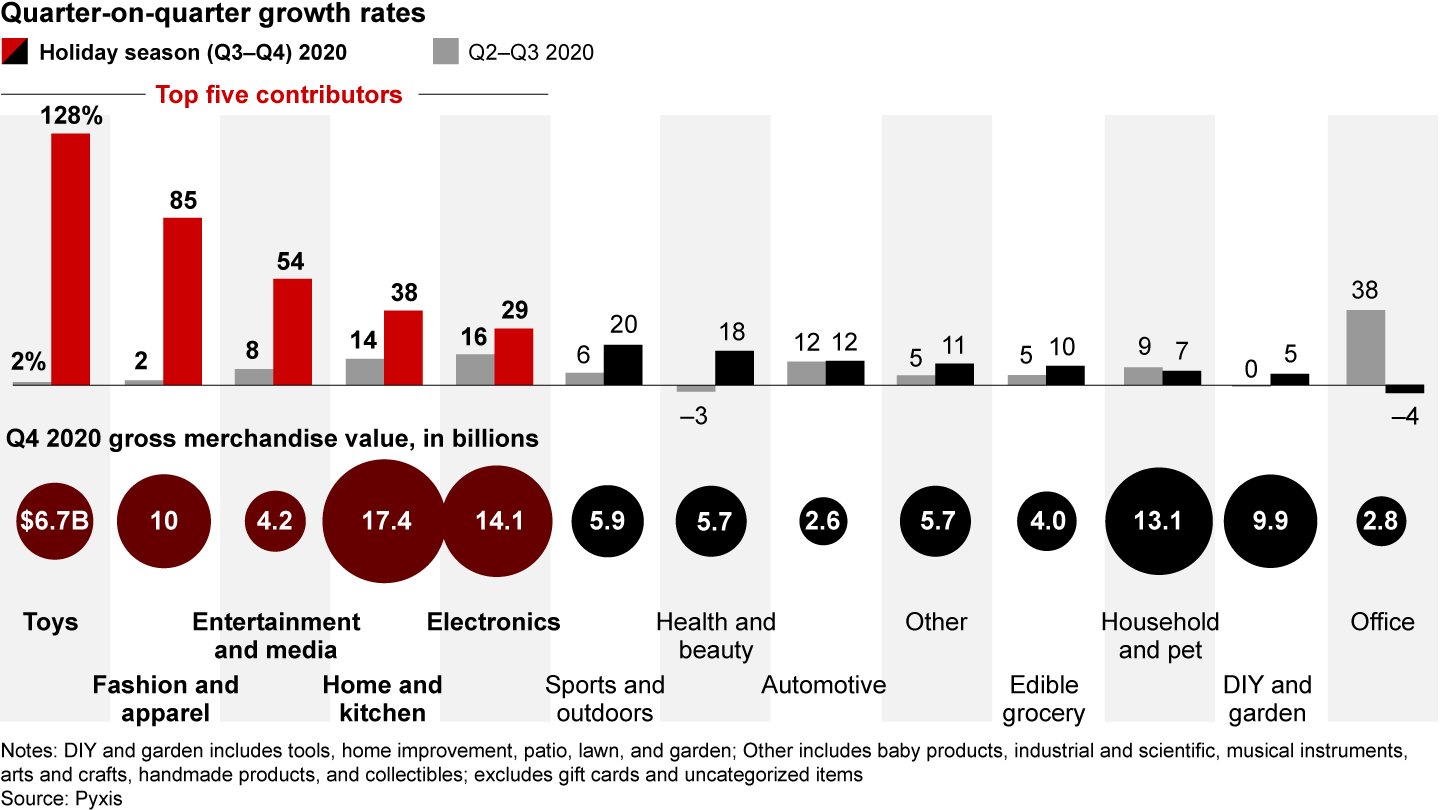

Amazon is, yet again, throwing its weight behind these gifting categories with a variety of first-party-focused initiatives. The retailer unveiled its 2021 Holiday Gift Guides in October, featuring curated selections in home, toys, and fashion, among others, along with its annual print holiday catalog for toys. The retailer is also betting big on the smart-home market, unveiling several new owned-brand products in its annual fall event, from smart thermostats to home robots to security devices. Ultimately, these strategies will also promote growth in its marketplace business. While gift guides, promotions, and exclusive products initially drive customer traffic to Amazon’s platform, third-party merchandise supports the breadth of assortment that Amazon customers know and love.
Category specialists have an opportunity to shine this holiday
While it remains a formidable competitor, Amazon is not invincible. Research we’ve conducted with ROI Rocket suggests that the retailer has lost ground in customer advocacy within several key categories. Although Amazon’s Net Promoter Score℠—a measure of a customer’s likelihood to recommend a store or brand—still ranks highly across nine core categories, its relative ranking has declined in seven of those categories since 2017 (see Figure 6). Meanwhile, category specialists, such as Sephora, Torrid, and Chewy, have claimed top spots.
Figure 6
Among category specialists, category-specific marketplaces are doing especially well. Players such as Drizly, StockX, and Ruby Lane all outgrew their respective categories in 2020. Category-specific marketplaces are gaining traction with younger consumers in particular: Our survey shows 28% of Gen Z online shoppers reported making a purchase from specialist marketplaces in the past three months.
What are these players doing to win the hearts—and dollars—of consumers? While Amazon shines when shoppers already know what they want, category-specific marketplaces can excel when consumers want inspiration for the perfect holiday gift. They are poised for a strong holiday in their respective categories because they offer product selection and experiences that Amazon does not.
Unique assortment. The marketplace model enables specialists to build a differentiated product selection within their categories, ranging from vintage or secondhand items to selections from smaller brands and sellers to custom-made products. Etsy, for example, offers one-of-a-kind, customizable products through its focus on artisan sellers. Over the past three holiday seasons, the company has outgrown overall e-commerce sales, with triple-digit year-over-year growth in the fourth quarter of 2020. Similarly, peer-to-peer marketplaces such as Depop, a recent Etsy acquisition, and Poshmark are proliferating as they entice customers with vintage and other hard-to-find fashion items.
Product discovery. By focusing on specific segments, category-specialist marketplaces offer a more personalized shopping experience that favors product discovery—ideal for consumers who are shopping for their loved ones. Curated, bite-sized selections offer a powerful antidote to Amazon’s endless aisle. High-end sneaker specialist GOAT uses “drops”—limited-time-only collections of merchandise—to highlight new offerings from its more than 350 brand partners. The company doubled its sneaker sales from the first half of 2020 to the first half of 2021.
Similarly, furniture specialist Wayfair helps shoppers find the right products through its artificial intelligence-enabled visual search feature. Consumers can upload photos of items they love and browse similar styles from the retailer’s first- and third-party assortments.
Trust and authentication. While third-party marketplaces have the benefit of expanded assortment, they also come with the risk of counterfeit or unsafe products. Platforms like GOAT and StockX have developed robust authentication processes to build trust and reassure customers that their products are genuine, a critical factor for gift givers. Poshmark has also continued investing in this domain, with its recent acquisition of a machine-learning sneaker-authentication platform.
Socially conscious shopping. Our survey shows that “supporting small businesses” is the top reason consumers shop Etsy, and the marketplace leads the pack in customer sentiment on broader social responsibility topics—an area in which Amazon stumbles (see Figure 7). In apparel, Madewell uses its Labels We Love marketplace to highlight brands with a meaningful purpose, including Black-owned businesses, sustainably produced items, and a rotating selection of independent artisans featured in its Hometown Heroes program.
Figure 7
As further testament to a successful model, multicategory marketplaces are borrowing from the category-specialist playbook. For instance, eBay launched its authentication guarantee last October, enabling the retailer to more effectively compete with fast-growing niche players like GOAT and StockX. The new “meet me on Amazon” campaign offers gift guides that spotlight small businesses and artisan sellers, helping shoppers learn more about the entrepreneurs on the other side of their packages.
A winning formula for growth—this season and beyond
The success of category-specialist marketplaces indicates there is still room to not only survive but thrive in an Amazon-dominant world. Retailers—marketplaces or otherwise—have opportunities to gain share by nailing the basics of the customer experience. Instead of trying to compete head-to-head with Amazon’s broad assortment, top retailers will build distinctive product selections, enable inspiring product discovery journeys, and invest in building trust and loyalty programs that captivate their most valuable customers.
Delivering a successful strategy this season will require navigating a minefield of supply chain and labor challenges. But mitigating pain points for stressed-out shoppers can go a long way.
- Keep speed and availability promises. Leading retailers will align marketing dollars to product availability, be transparent and realistic on fulfillment by item and channel, and point customers to the right backup options and substitutions. As eager consumers flock to stores, winning retailers will tune algorithms to avoid advertising inaccurate in-store product availability.
- Help shoppers get gifts on time. Customer experience leaders will avoid overpromising on fulfillment times, provide expected delivery dates before checkout, and keep shoppers up-to-date on their order status. Creative virtual gifting—something festive for recipients to “unwrap” without delivery constraints—may help retailers avoid disappointing shoppers.
- Double down on customer service hiring. Filling customer service roles remains a worthy priority. Hiring for remote roles may also help retailers circumvent labor shortages in some areas.
- Prepare to make up for holiday mishaps. Despite best efforts, many retailers will have some missteps on product availability or fulfillment. Winning retailers will think ahead on strategies to rebuild customer loyalty following such moments of frustration. Promptly providing store credit, rewards, or discounts before customers ask for a resolution can turn disappointment to delight. And don’t forget to look ahead to the new year, when promotions and targeted loyalty offerings can extend the holiday cheer.
- Start planning for the 2022 holiday season—and beyond. With many of this season’s challenges likely to endure and new disruptions always on the horizon, winning retailers will begin taking stock of how to future-proof their businesses. They will start with an unvarnished view of their current customer pain points and work to remedy them while doubling down on existing strengths. And they will continue to expect the unexpected. Retailers that adopt Agile processes, run effective in-store and online pilots, and quickly pivot to meet customer needs will continue to see gains, both in financial performance and customer advocacy.
Looking forward: Future release dates and topics
Here’s a preview of our upcoming newsletters:
- Issue 4 (December): Mid-season check-in and the future role of stores
- Issue 5 (January): Post-holiday recap and resolutions for 2022
We look forward to sharing holiday headlines with you and hearing your feedback throughout the holiday season.
About our research partners
NielsenIQ is a leader in providing a comprehensive, forward-looking view of consumer behavior, globally. Fueled by rich analytic capabilities, NielsenIQ’s consumer data platform enables bold, confident decision-making for the world’s leading consumer goods companies and retailers. NielsenIQ, an Advent International portfolio company, has operations in nearly 100 markets. For more information, visit NielsenIQ.com.
ROI Rocket is a leading provider of full-service research, fulfillment, and digital and direct marketing support to a broad client base of consultants, investors, publicly and privately held corporations, agencies, and market research firms. ROI is a Bain customer advocacy benchmark partner in Grocery and 10 other retail categories. For details, visit www.roirocket.com or contact Noah Seton (Noah.Seton@ROIRocket.com).

Pyxis combines alternative data, AI-driven analytics, and institutional investor-led insights to reveal where, how, and why consumers buy, how they pay, how much they spend, how their needs and demands are changing, and much more.
The authors would like to acknowledge Emily Harris, Licia Figueiredo, Jackson Shain, Emma Hand, and Isabel Romeu for their contributions to this newsletter.
Net Promoter Score℠ is a service mark of Bain & Company, Inc., Satmetrix Systems, Inc., and Fred Reichheld.
First published in 11月 2021