

論説

概要
- As companies become more digital, they deploy more technology to grow the business.
- To fund these essential new investments, IT leaders should work continuously to pare back the technology costs associated with existing run costs.
- They can think of cost transformations along three planes: reduce costs with short-term actions, replace technology with more efficient options, and rethink architecture and operating models to make long-term sustainable change.
As companies deploy new technologies, including automation, AI, cloud hosting, service platforms, and others to make their businesses more digital and efficient, all businesses are becoming technology businesses. In a post-Covid environment, natural forces are accelerating this dynamic and the need to digitize and virtualize.
This expansion from physical into digital means that many functions and activities that were traditionally labor based are now technology based. Although the tech budget may grow, total costs should decrease—for example, a bank investing more in digital banking while reducing its costs for physical branches.
For a business needing to manage its costs prudently, this may create a misguided reaction: Because technology spending is growing much faster than the overall cost base, surely more focus and effort must be required to triage and reduce it. But that would be the wrong conclusion, since spending on technology increases efficiency and speeds growth.
With the demand for technology continuing to grow as new capabilities become available, companies have to find ways to manage spending on technology that runs the business, while investing more in technology that grows and improves the business. The best performers will invest proportionally more in technology over time, but only in the right places, so that the business can run at maximum efficiency while growing as fast as possible.
So, how should companies determine how much they are spending on technology and whether it’s the right amount?
As tech spending increases, it has proliferated across the functions of the business. Across sectors, more than half of spending on information technology comes from other back-end functions or the lines of business themselves. Companies need to take a more sophisticated approach to building an accurate view of spending (see the Bain Brief “A Better View of Technology Spending Improves Business Outcomes”). Traditional benchmarks, such as IT spending as a percentage of expense or revenue, may be irrelevant and misleading because they are based on the outdated idea that proportionally lower spending on technology leads to better business outcomes.
The critical challenge then becomes: Once companies understand their technology spending, how can they best control and manage it in order to invest more in growth?
Three horizons to reduce base costs
Cost transformation is no longer an event or a limited program of several months. Because the need for technology investment continues to grow, the corresponding need to reduce run costs must also be continuous. Fortunately, the law of experience curves, the growing capabilities of technology to automate processes, and the adoption of Agile and development, security, and operations (DevSecOps) methodologies all combine to make processes and development more cost-effective. Technology requires new investment, but it also reduces the spending for ongoing operations.
Because cost transformation must be ongoing, executives can think of actions as happening in three waves (see Figure 1).
- Reduce. Short-term reductions that remove costs without substantially changing the business.
- Replace. Medium-term replacements, that swap out technology costs for lower-priced alternatives.
- Rethink: Long-term changes that reimagine the business, often changing processes, technology architectures, and sometimes operating and business models.
Figure 1
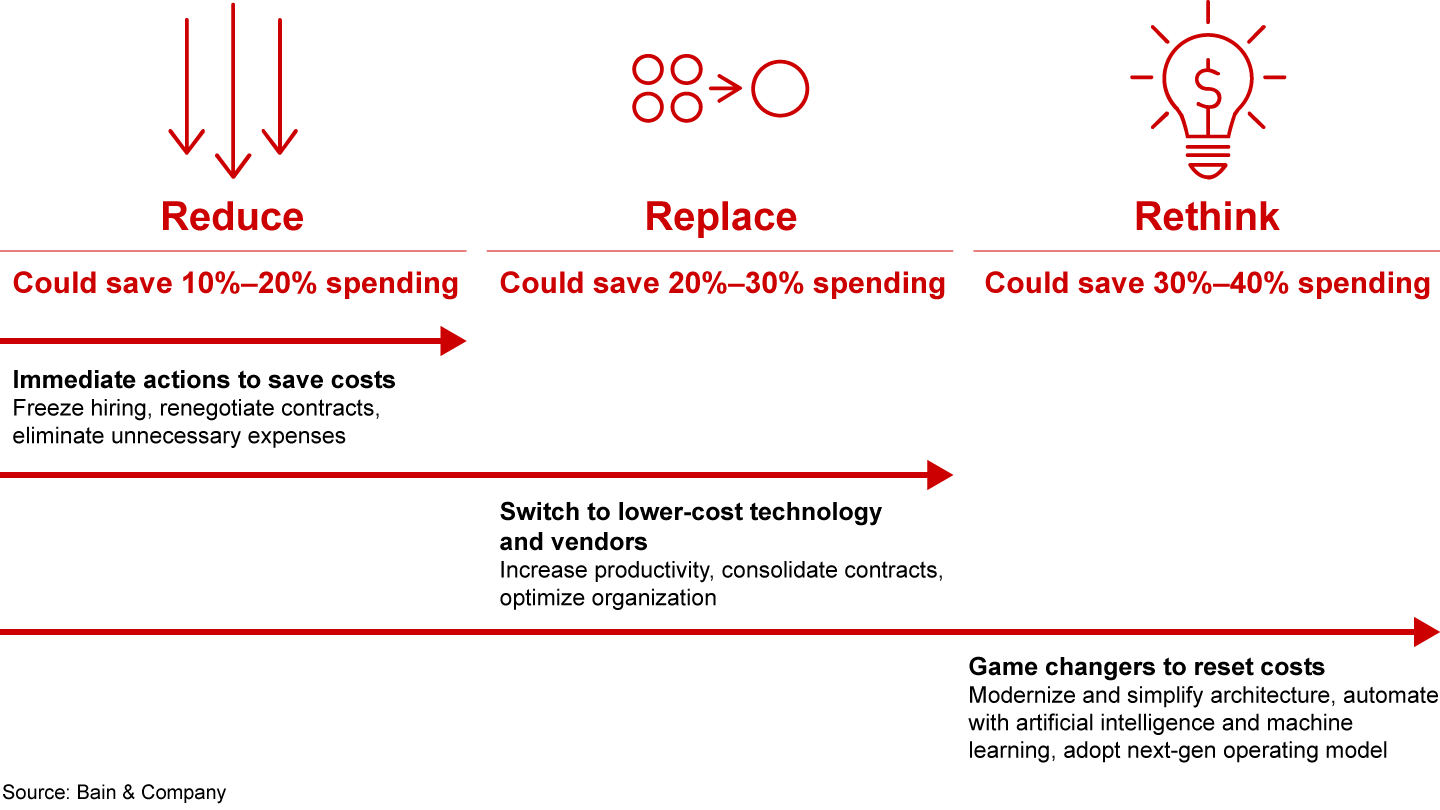

Reduce. Short-term actions can help recapture 10% to 20% of costs, some of that in the first few months. Many of these are business decisions (hiring freezes, pausing nonstrategic projects, tightening spending), while others are technology decisions (squeezing higher utilization rates from servers and storage). Cost is often measured as quantity x price. In the case of technology spending, the business usually has more control over quantity, by managing consumption and demand for IT services, while the technology team has more control over the price—whether through higher utilization rates or renegotiating with vendors and suppliers.
Key to any reduction program is managing demand, without which companies are likely to reduce their capabilities in ways that can impair results. An insurer fell into this trap when it gave its IT shared-services budget an across-the-board 10% cut without adjusting demand for technology. Senior leaders didn’t have visibility into how that led to a slowdown of its cloud strategy and to accumulation of technical debt.
An alternative approach worked out better for a vehicle manufacturer that reduced its IT budget by 15.5%, setting aside 4% of that savings for replacement technology that would further reduce cost and complexity. Technology teams worked with the business to identify projects and service levels that added little value, and by reducing or eliminating them they reduced the overall demand for IT support—along with other costs as well. This approach worked even more effectively during the Covid-19 pandemic, when the manufacturer rolled out work-from-home functionality while reducing other telecom and technology costs, clearing the field for strategic new projects that will accelerate its recovery and generate new growth.
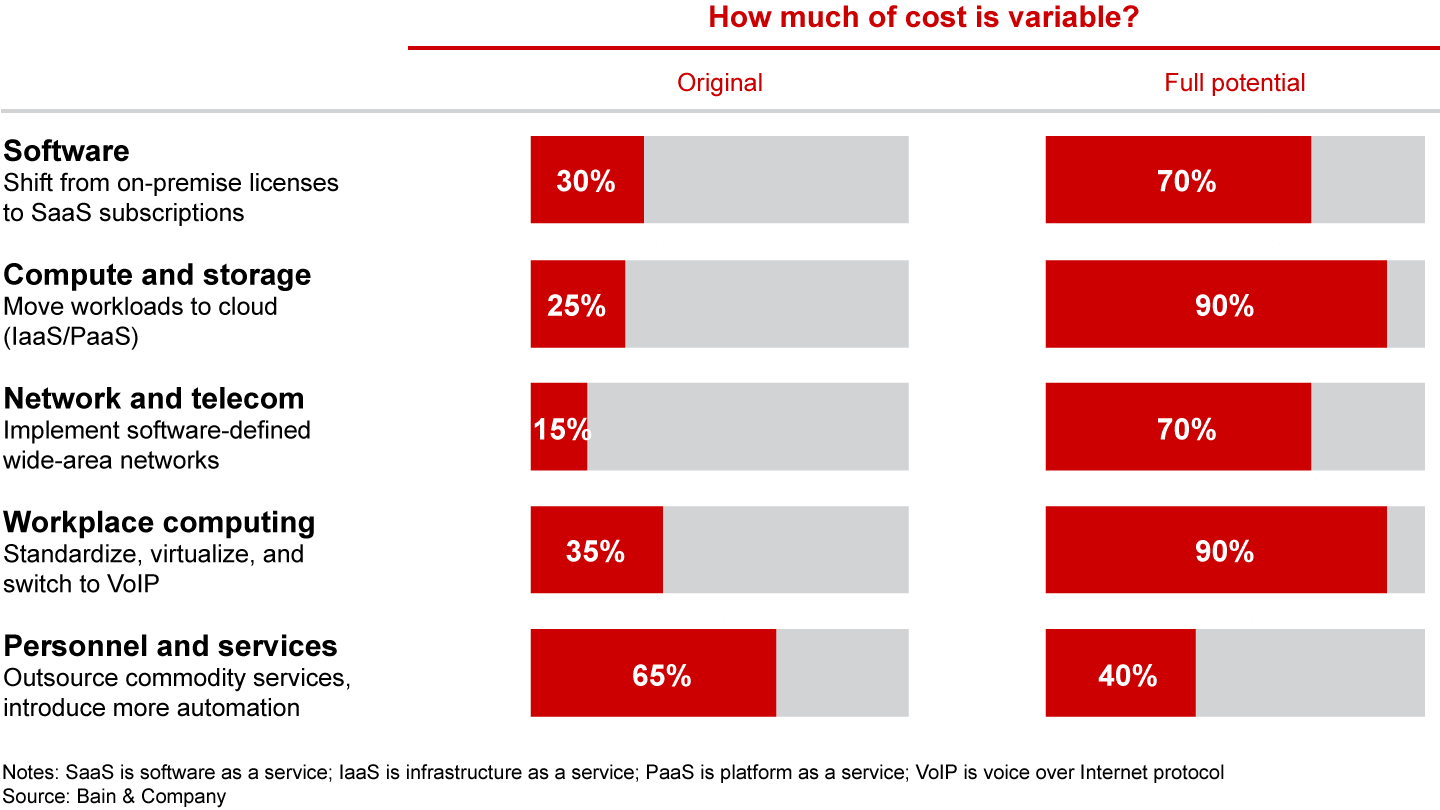
Replace. Companies can wring another 20% to 30% out of costs by replacing costly technology infrastructure with less expensive alternatives. Many of these opportunities increase the variability of costs, which aligns spending more closely with actual demand (see Figure 2). Examples include replacing on-premise software with SaaS applications, outsourcing more work, seeking out hosting services with more manageable, variable, on-demand hosting solutions (including IaaS and PaaS), and refining the operating model to include more Agile development and automation. Changing these models can incur short-term costs (as well as the introduction and management of some new risks), but companies need to balance these against the opportunity to reduce longer-term costs. For example, adopting some SaaS applications can allow companies to adapt their operating models in ways that reduce their labor costs.
Figure 2

Rethink. The most significant and sustainable cost savings, 30% to 40%, come from fundamentally rethinking and reengineering technology (architecture, services, processes, and even the operating model itself), or by simplifying the business and the associated IT (for example, existing geographies or divesting product and business lines). Modernizing or investing in next-generation architecture, moving more workloads to as-a-service and pay-per-usage platforms, and pushing automation to its full potential are all ways to contract the cost base to make room for growth. Some companies are getting to the next level of productivity by accelerating a DevSecOps operating model across the entire technology function and by enabling more remote work with better communication and collaboration tools. Only by applying at least one or two of these big changes can companies hope to see a significant, lasting reduction in cost.
Right now, for example, some companies are taking the opportunity to rethink and modernize parts of their technology architecture given changes in business requirements and demand due to Covid-19. One major airline is modernizing its technology to reduce costs and improve performance in the post-Covid environment.
Banks and retailers have been navigating a similar shift over the past decade, reducing their need for physical space (branches and brick-and-mortar stores) to free up capital that can then be invested in digital customer experiences. Midsize banks have generally been able to shift their operating model to accommodate the change. For some larger banks, with sprawling legacy IT systems, it has proved more efficient to spin out digital subsidiaries, green-shoot banks that can start with a clean technology slate.
Even within the bounds of a legacy architecture, companies can take meaningful steps to rethink and reengineer the cost of the services they provide. Many have taken a “cost out” approach to cloud migration, identifying high-cost workloads and processes that can be extracted and modularized from legacy systems, then migrated to the cloud and run as a service. Others are realizing significant cost improvement by reengineering technology services to take advantage of opportunities to automate, and to simplify policy and procedure requirements and interpretations within the process itself. One bank found that it could reduce costs for data source ingestion and conformance (that is, gathering data and organizing it so that it can be easy to use) by 60% by removing outdated or no-longer-required policy requirements from the process, measures that will enable it to reengineer its services without major technology investments or architecture modernization.
Diligence, design, and delivery
Successful transformations begin by investing the time to scan the organization, analyze cost drivers, and identify opportunities for cost optimization. Companies will have different criteria for prioritizing these opportunities, but in most cases they will want to tackle a few easy wins first to build momentum. In either case, the leaders of the cost transformation need to pressure-test the business’ commitment to change, to ensure consensus as they begin to move forward.
With priorities in hand, design and delivery begins. Agile sprints are the best way to manage cross-functional collaboration that gathers user feedback and incorporates it to improve the next version. Project leads set the ambition for baseline costs, and then Agile teams work with the technology organization to develop initiatives that reduce costs. New solutions get tested and refined as the tech organization carries them out.
Across initiatives, leaders will want to define a new normal in cost, reflecting a changed mindset about baseline costs and ensuring that the work remains an ongoing effort. Executing the first initiatives, often in the Reduce category, can help gain traction and gather important feedback for the rollout of more significant Replace and Rethink initiatives. And, of course, teams will need to ensure accountability for hitting targets.
The recovery from the Covid pandemic is likely to put new pressures on many organizations as they continue to ramp up operations to meet reviving demand. Many companies took advantage of a decline in activity to invest in new technologies that could help increase their resilience, speed their recovery, and place them in leading positions in the next wave of growth. Now, by gaining better control of their spending on the costs to keep their businesses running, companies can extend their abilities to invest in technology that moves their businesses ahead.
First published in 7月 2021