

論説

Companies around the world are facing growth challenges. This is especially true for companies in industrial goods and services (IG&S), whose fortunes tend to be tightly bound to GDP, which has made growth challenging in the wake of the global financial crisis. Yet, across subindustries, we find that one out of nine companies achieves sustained growth in both revenue and profit. When asked about what drives success or failure, only 15% of executives surveyed blame external market conditions. Instead, the vast majority cite internal factors, particularly organizational and business complexity. If unaddressed, these internal factors lead to stall-out: sales slow, competitors attack and companies eventually fail or are acquired.
To overcome these internal hurdles and reignite growth, companies need to regain the Founder’s Mentality®—the attitudes and behaviors associated with highly ambitious founding management teams that can revitalize businesses. There are three basic elements to the Founder’s Mentality: an insurgent mission to take on the rest of the industry and fulfill unmet customer needs; an owner’s mindset that instills a deep sense of responsibility for how resources are deployed throughout the organization; and a frontline obsession and relentless focus on customer-led growth. To illustrate these principles, we will share the examples of two companies that turned around their performance by adopting a Founder’s Mentality.
How organizational and business complexity slow growth
In our experience, the two most common reasons why IG&S companies lose the Founder’s Mentality are organizational and business complexity. Both sources of complexity can set off a vicious cycle that strangles growth. And, in many cases, organizational and business complexity wind up reinforcing each other (see Figure 1).
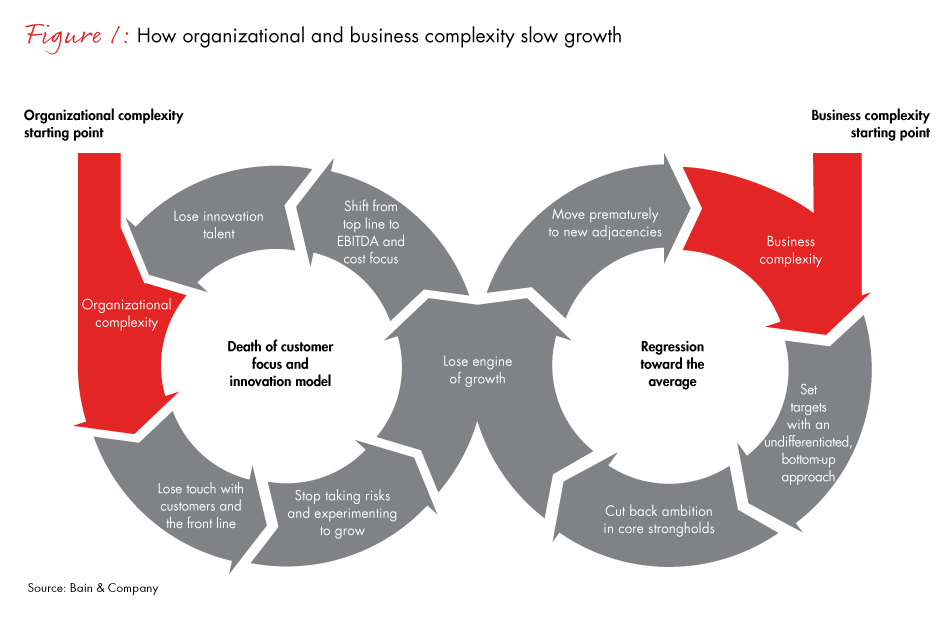
Organizational complexity. Organizational complexity slows growth by reducing customer focus and killing innovation. As organizations design increasingly elaborate matrices, add superfluous layers and multiply reporting “nodes,” senior management gradually becomes disconnected from the customer and the front line. Instead of taking calculated risks and chasing growth, employees spend their time avoiding blame and managing internal processes and politics. Inevitably, growth stalls. In response, management shifts its attention to increasingly large functional cost-improvement programs to protect earnings. These efforts typically yield marginal returns, leading to more cost initiatives that divert energy from growth. Eventually, innovation talent leaves in desperation, making the growth challenge worse.
Business complexity. Business complexity leads to an averaging out of ambitions that ultimately depresses results. As business portfolios grow more heterogeneous and complex, internal budgeting and target-setting processes tend to become “democratic”—and not in a good way. Instead of managing the most promising businesses to full potential, executives set targets and allocate resources evenly across the company. As a result, stronghold businesses set the bar comfortably low for themselves, while lagging businesses end up chasing unattainable goals.
The laggards inevitably fall short and wind up consuming inordinate amounts of management attention, stealing energy and resources from businesses with the highest potential. Growth slows, and to compensate, companies tend to move prematurely into adjacencies, further fueling complexity and exacerbating the management and growth challenge.
Breaking through complexity to restore growth
Although complexity can dramatically hinder growth and ultimately lead to stall-out, it is also common and predictable, and can therefore be overcome. To turn around the growth crises that beset so many large enterprises, companies need to rediscover their Founder’s Mentality, attacking complexity and restoring the customer focus to rekindle growth. Companies can do this by taking three transformative steps:
-
Rediscover an insurgent mission. Founders believe that the company is on an insurgent mission, waging war with its industry on behalf of its customers. The mission can focus on a customer segment that is not being served or a better way of meeting customer needs than competitors.
-
Instill an owner’s mindset. In a Founder’s Mentality culture, everyone thinks like an owner. Like owners, they abhor bureaucracy that wastes time and energy, and they treat the company’s money as their own, ruthlessly attacking costs.
-
Build a frontline obsession. Founders grow their companies by focusing obsessively on what is happening on the front line. They are eager to learn anything that will help land another customer or boost sales. In a company with the Founder’s Mentality, the whole organization is focused on the customer, and everyone supports the front line to serve customers better.
Two recent examples of large IG&S companies illustrate how it is possible to overcome complexity and restore growth through the Founder’s Mentality.
Turnaround at a global chemical company
A major chemicals company had underperformed its industry on growth for five years in a row, despite holding market-leading positions in several regions. The company seemed to lack focus, speed, accountability and collaboration—all because of organizational complexity.
With sales stalling, the company resorted to repeated cost-cutting programs. As a result, business unit general managers spent 80% of their time on operations and cost measures, rather than meeting with customers. Sales teams were underresourced and undermanaged—farming existing accounts rather than hunting for new ones. Meanwhile, support functions remained complex and overstaffed, and operated in silos. The issues were exacerbated further as triple- or even quadruple-hatting strained management time. Misaligned objectives hampered collaboration by reinforcing silo behavior. For example, people in the operations and supply chain functions were motivated to limit volume growth, because higher plant or inventory costs might cut into bonus payouts.
The chemical company adopted the Founder’s Mentality principles to attack complexity, reinforce customer focus and kick-start growth. Within a year, it went from underperforming its peers to growing at twice the industry average. One of the most powerful changes was delegating operational management of the sites to expert managers, enabling business unit leaders to spend 80% of their time on frontline and customer activities. The company further bolstered performance by cutting complexity in support functions and reinvesting freed-up resources in sales, adding hunting and business-development capabilities and introducing a sales back office to increase customer-facing time.
To move quickly, the company launched precisely targeted “micro-battles” to pursue innovation and business development projects. These were fast-paced, tightly focused efforts that delivered tangible benefits—a sharp contrast to the large functional programs the company had used in the past. For example, the company mobilized resources to penetrate a new key account in a high-priority growth geography and quickly developed a technology enhancement requested by a major customer—both leading to increased sales. These micro-battles helped to energize employees by proving that the organization was capable of delivering fast results and was no longer bogged down by complexity.
The company also adapted its governance to help accelerate growth. Micro-battles were tracked rigorously through Monday meetings. The traditional business reviews received a massive overhaul, changing from a meaningless report on past events to forward-looking discussions on specific ways to accelerate growth.
Top management also served as role models for Founder’s Mentality behaviors. For example, instead of starting every meeting with a financial review, leaders now start with a discussion of frontline developments with the most important customers. The CEO and senior management have committed to visiting a quota of top customers each month, and have dedicated time to meet with frontline employees. Finally, the company has simplified and aligned incentives to support growth and collaboration, such as increasing potential rewards linked to growth, and aligned incentives across departments.
Turnaround at a global industrial company
Sales at a highly regarded industrial conglomerate had been flat for several years because of business complexity. The company operated a large portfolio of businesses in different industries and with widely varying performance levels. Management faced challenges to manage performance and steer the organization effectively, since each business set its own targets in a bottom- up fashion to meet company averages. Weak performers hijacked executive time and attention, whereas the more promising units coasted, setting and meeting modest goals and missing opportunities for growth. Sales stalled, while costs and complexity continued to grow. Securities analysts who followed the company were starting to lose faith, and pressure was mounting on the CEO.
To turn around performance, the company first de-averaged the way it looked at its portfolio to see how individual businesses were performing. This enabled the company to calibrate targets and resources more productively. Each business received a clear mandate and appropriate resources based on its true potential. Management set ambitious targets for core strongholds, but also allocated resources disproportionally toward them to support this growth.
Next, the company reduced complexity to free up additional resources. It did so by divesting noncore and underperforming businesses that were taking up too much management attention, and by decreasing unnecessary organizational complexity and the associated cost. The liberated resources were redeployed to fund new growth initiatives. In particular, the company successfully placed a big bet on a multiyear plan to become the global leader in a promising emerging technology by preemptively building scale and experience to achieve the lowest-cost position in that industry.
The results were swift and impressive. Within a year, sales growth went from flat to double-digit, and within two years, the company’s share price doubled.
Reinforcing your Founder’s Mentality
Complexity kills growth, plain and simple. Certainly, as companies grow large, enter new businesses and geographies, and try to leverage scale economies, complexity has a tendency to creep in and erode growth, often with serious consequences. The Founder’s Mentality provides a path to overcome complexity and restore growth by reigniting the insurgent mission, instilling an owner’s mindset and renewing the frontline obsession.
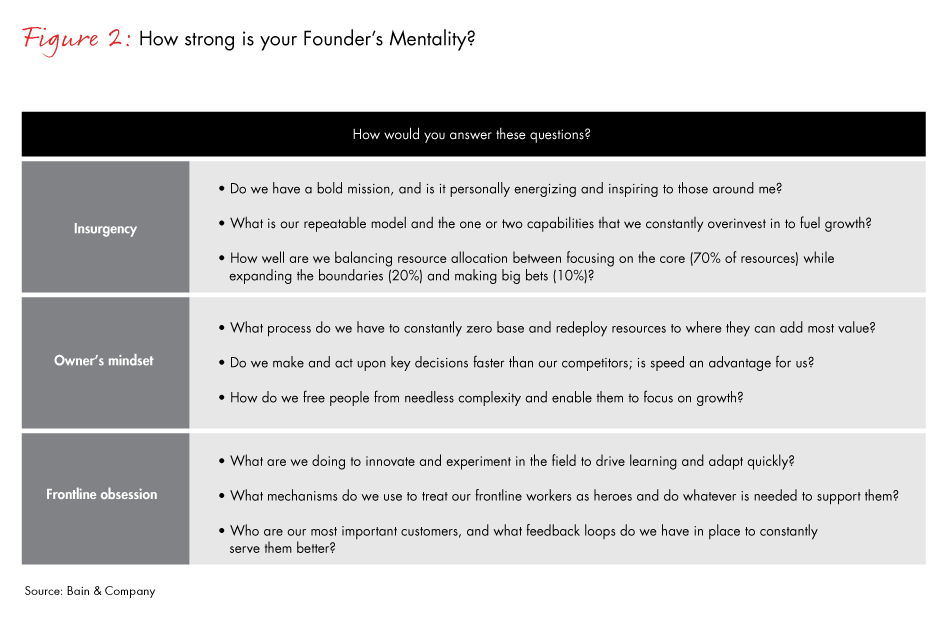
The illustrations shared in this article are just two examples of journeys that companies can take to restore the Founder’s Mentality. The specific journey relevant for your business will depend on your starting point. To understand your starting point, you should ask yourself the nine questions below (see Figure 2).
Piet de Paepe is a Bain & Company partner and an expert in the Industrial Goods & Services practice. Jason McLinn is a Bain partner in the Industrial Goods & Services, Chemicals and Oil & Gas practices. Bram Vanassche is a Bain partner affiliated with the Industrial Goods & Services and Performance Improvement practices. Laurent Migom is a Bain principal in the Industrial Goods & Services practice. Piet, Bram, and Laurent are based in Bain’s Brussels office. Jason is based in Bain’s Chicago office.
Founder’s Mentality® is a registered trademark of Bain & Company, Inc.
First published in 6月 2017