

論説

As we approach the holidays, sales are at the higher end of expectations and retail pundits are focused on the explosive growth of online and mobile commerce. These results and opportunities are real, but the accompanying “death of the store” narrative grossly underestimates the value of stores in an omnichannel strategy that empowers customers to shop however and whenever they choose.
Holiday sales are humming along
Based on the US Census Bureau’s recent release of retail sales data for November, Bain estimates that total retail sales—both in stores and online—grew by 4.9% year over year. In particular, furniture and home furnishings stores, food and beverage stores, and clothing and clothing accessories stores (driven by the cold winter) all had noticeably higher year-over-year growth rates compared with 2015. Although this data is preliminary and will be adjusted, it indicates that holiday sales growth this year will likely end up at the higher end of our forecast of 3.5% to 3.9%.
Additionally, consumers are feeling better about their personal finances and the economy: According to the Michigan Consumer Sentiment Index, consumer sentiment in December reached 98%, a 4.5% month-over-month increase. Also, the unemployment rate dropped to 4.6% in November, the lowest rate since 2007.
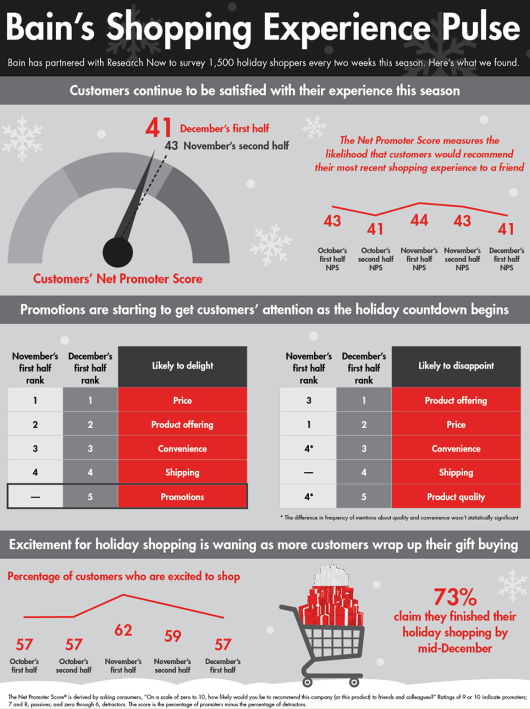
Recent sales confirm what we are hearing from the 1,500 consumers we are surveying biweekly in partnership with Research Now for Bain’s Shopping Experience Pulse. Our goal is to better understand what shoppers are experiencing and feeling over the holiday season. Here are some of our recent findings:
- Shoppers’ satisfaction with Amazon.com has increased. Amazon’s Net Promoter Score® went up from 47 to 50 from the second half of November to the first half of December.1 Despite the increase, the score is still lower than Amazon’s peak Net Promoter Score of 56 from our first survey back in October. The change in customer satisfaction over the past two and a half months has not been driven by the kind of disappointing experiences that would create detractors. Instead we’re seeing a shift from happy promoters to satisfied passives, which suggests that customers feel their Amazon experience is less differentiated than it was at the start of the season.
- Shoppers’ satisfaction with physical stores is holding steady, but their satisfaction with those stores’ websites has dropped. Meanwhile, physical stores saw their Net Promoter Score stay relatively flat on average, with a slight dip from 38 to 36 from the second half of November to the first half of December. At the same time, the average Net Promoter Score for physical stores’ websites dropped from 44 to 40.
- Purchases on promotions peaked in the second half of November. The proportion of shopping carts, both physical and digital, filled with at least some sale items increased from 71% in the first half of October to 77% in the first half of December—down from a peak of 82% during the second half of November (which included Black Friday). Furthermore, customers who benefited from a promotion during their last purchase had, on average, a Net Promoter Score that was 5 points higher across retailers and channels than those who did not.
- Most shoppers report they’ve completed their holiday shopping. Of the shoppers we surveyed, 73% claimed they had completed their holiday shopping by mid-December, up from 58% just two weeks earlier.
As the holiday season winds down, the store-closing season winds up
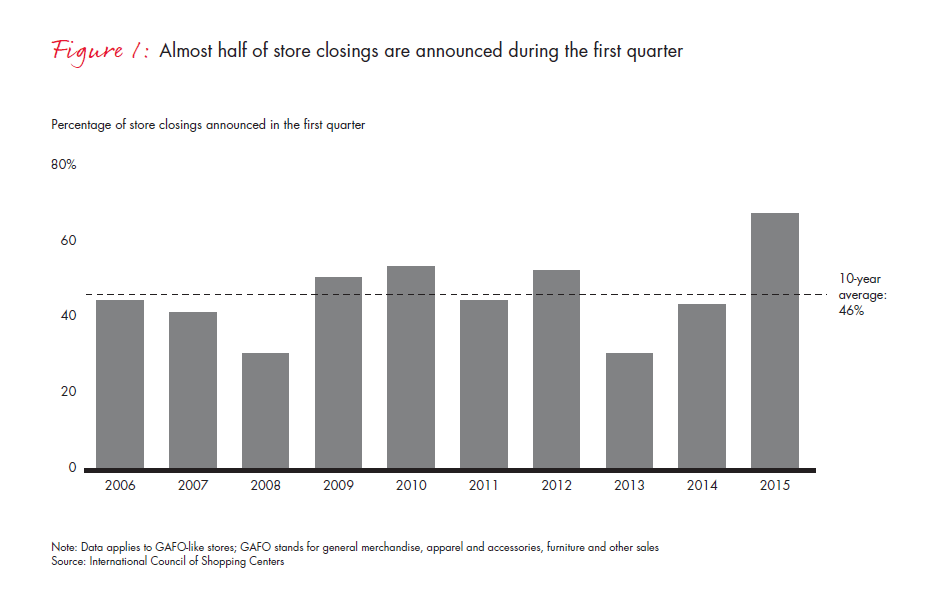
Soon after the last shopping sprint, the holiday decorations will come down, and announcements of store closures will begin. Nearly half of each year’s store closings take place in the first quarter (see Figure 1). Although the “death of the store” narrative will grab headlines, the truth isn’t so simple. Yes, e-commerce is growing rapidly and traffic in stores is slowing. But that doesn’t mean stores are doomed to fail. It just means that the conventional approach to designing and operating stores is becoming obsolete.
A tale of two retailers
There are different ways to deal with the growth of e-commerce. Here we describe the evolution of two fictional general merchandise retailers that we’re calling “Siloed Sales” and “Omnichannel Emporium.” Ten years ago, each company had sales of about $50 billion with 1,000 stores and a small e-commerce business. Total sales in their industry were relatively flat, but e-commerce sales were growing at about 15%.
Siloed Sales decided to jump on the e-commerce bandwagon. It created a fiercely independent e-commerce business, which it called its “digital business,” and set itself the audacious goal of outperforming Amazon. Because the information technology department at Siloed Sales was weak, the digital business invested heavily to create new cloud-based systems. The company upgraded its website, developed award-winning mobile apps and spent $1 billion to build four additional highly automated fulfillment centers (see Figure 2). To increase traffic and accelerate sales growth, the digital business tripled its breadth of assortment. As digital sales continued to grow, Siloed Sales shifted as many resources as possible to its digital business. By 2016, e-commerce orders had grown to more than 40% of total sales—making the digital business the star of Siloed Sales’s portfolio.
Meanwhile, the stores business at Siloed Sales deteriorated. It seemed as though every dollar of digital sales came straight out of the physical stores. In total, store sales dropped by nearly 6% annually—very little in some stores, much more in others. Siloed Sales closed 400 stores and aggressively reduced costs in the others. It slashed the number of employees in stores and shifted away from full-time workers to part-timers to reduce hourly costs and move toward a more variable expense structure. The transition was painful and demoralizing, but everyone at the company knew it was necessary. Customers, however, were less understanding. They complained about the lack of help, time-consuming buy-online-pick-up-in-store experiences and the inability to return items they bought online to the stores. They also complained about the three to five days it often took to receive online orders, pointing out that Amazon could always get things to them in two days and often on the same day.
After 10 years, Siloed Sales had 600 stores, almost half of them worn out and struggling, and a digital business that was beginning to slow. Repeated rounds of layoffs made it difficult to attract and retain top talent, and customer Net Promoter Scores were falling.
Omnichannel Emporium took a different approach. It believed that the company had only one business: selling merchandise to customers however they wanted to buy it. Instead of trying to compete head-to-head with Amazon by radically broadening its total assortment, the company decided to focus on both increasing its unique products (e.g., exclusive items and private-label goods) and providing a superior shopping experience. It stepped up innovation to combine the best of the digital and physical worlds at each step of that experience. Omnichannel Emporium did have e-commerce experts, but its digital and physical operations were seamlessly integrated, and the entire organization adopted Agile frameworks and mindsets. The company decided that instead of spending $1 billion on building more fulfillment centers, it would use the money to add digital technologies and omnichannel shipping capabilities in its stores. It didn’t matter if foot traffic dropped off: The total merchandise volume flowing through stores would remain roughly the same.
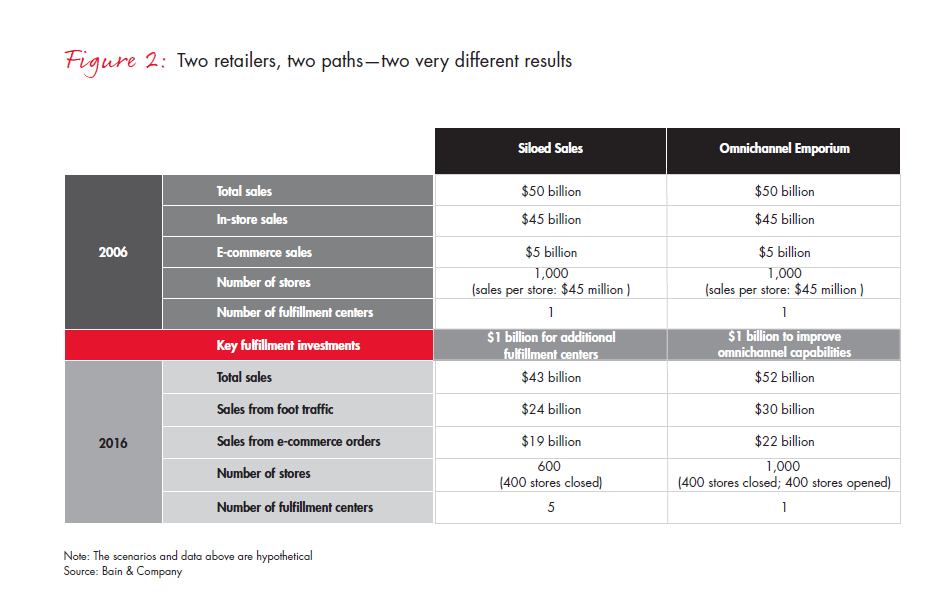
Omnichannel Emporium built a website and mobile app that worked seamlessly with the store shopping experience. It used digital technologies to improve in-store visual merchandising, help customers connect with in-store associates (or chatbots or remote experts, if they preferred), speed checkout times and customize offers. It regularly invested in store picking-and-packing technologies to improve their effectiveness and efficiency. Nearly 40% of online orders were picked up in stores, saving shipping costs and driving incremental sales as customers bought additional items when they came to pick up their online orders. The company also found that it could ship from stores to customers for next-day delivery at little to no additional cost, which quickly became a clear competitive advantage. Omnichannel Emporium also kept its full-time employees and trained them to deliver new omnichannel customer experiences.
Omnichannel Emporium did have to close stores in bad locations and dilapidated malls. But the company developed a smaller high-tech “store of the future,” which it used to penetrate good locations that had previously seemed too expensive or too small. Omnichannel Emporium decided to open at least one new store (which it called an "omnichannel hub") in a good location for every store it closed in a bad location. As competitors closed stores, and Omnichannel Emporium’s brand strengthened, procuring good real estate became cheaper and easier.
After 10 years, Omnichannel Emporium still had 1,000 stores, 95% of them healthy. Customer Net Promoter Scores were strong, and so were financial results. Top talent was eager to join a company that respected its workers and gave them the opportunity to broaden their skills.
Of course, we realize that we’re depicting extremes, simplifying assumptions and raising what may be a sensitive topic for many retailers. But our two examples are legitimate choices. The key questions: Which of them should most retailers choose, and how do they make that approach succeed?
As you consider your options, think about these facts:
- E-commerce will not take over the world.
- There is a broad-based shift toward omnichannel retailing.
- Traditional accounting doesn’t capture the full value of stores.
- Minimizing wages may not maximize profits.
Sophie Horrocks, a partner with Bain's Retail practice, discusses how retailers can blend digital and in-store channels to drive brand awareness and generate sales.
E-commerce will not take over the world
E-commerce growth rates have already begun to slow. There are two reasons: First, not everyone wants to buy everything online. Second, the economics of e-commerce aren’t as attractive as most people think.
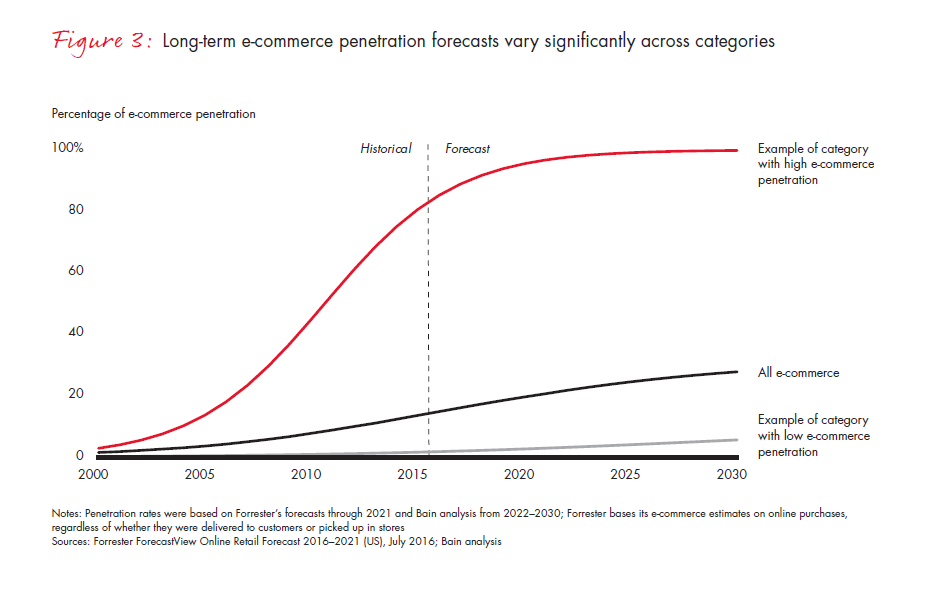
E-commerce is increasingly difficult to define. Typically, it means that an order is placed online (from a computer, tablet or mobile device) even if it's picked up or later exchanged for other merchandise, in a store. We used that conventional definition and Forrester’s data on the top-30 product categories (which account for 97% of total e-commerce sales) to forecast e-commerce penetration trends through 2030 (see Figure 3). Our analysis suggests a familiar growth pattern: E-commerce as a percentage of total retail sales seems to be following a classic S-shaped curve. If historical trends continue, e-commerce’s share of retail will rise to about 28% of total sales in 2030, albeit with big variations by category.
The rise of e-commerce also does not spell the death of the mall. Yes, some malls have closed, and others are teetering. But many are doing quite well, particularly superregional malls, which typically have a broader selection of upscale stores. On average, the 620 superregional malls in the US today have net operating income per square foot of $8.33—up from just $5.50 four years ago—and are 50% more profitable on a square-foot basis than the 599 regional malls. Moreover, they have an occupancy rate of 93%. Malls that have great anchor tenants and are focused on providing a great experience for customers will continue to thrive.
Also, even though many customers like the convenience of having everything delivered to their homes, the economics don’t always work well for retailers. With accurate activity-based accounting, most retailers find that their autonomous e-commerce businesses actually struggle to make a profit. For instance, Amazon’s e-commerce business has barely broken even over the past three years. Meanwhile, operating margins for brick-and-click department, discount and specialty stores typically run between 5% and 11%.
There is a broad-based shift toward omnichannel retailing
Even as retailers with physical stores grow their e-commerce operations, e-commerce pure plays are adding stores or negotiating space in other retailers’ stores. Examples are plentiful, among them Everlane, Harry’s, Rent the Runway, Bonobos, Warby Parker, Glossier, Gilt, Purple Carrot and Amazon. Amazon is rumored to be rolling out 2,000 stores over the next few years, although the company recently denied this. What’s important is that Amazon is not simply copying today’s store formats; instead it’s reinventing the store. Consider Amazon Go, a pilot store offering “no lines, no checkout—just grab and go!” The secret is advanced technology, including microphones, cameras, scales and sensors that detect the items shoppers are choosing and carrying with them out of the store. The company has spent four years developing the concept, and it plans to go public with its first store early next year. Although that first iteration is likely to face challenging unit economics, Amazon has a long track record of testing and learning to get to a model that works.
Why are online retailers adding stores while physical retailers are expanding e-commerce? Because strategies that combine the best of both the digital and physical worlds will be more attractive to a broader range of customers ... and more profitable. Omnichannel retailers—those that offer a seamless blend of both at each step of the customer experience—enjoy significant advantages over retailers that try to pursue either one alone or both independently. For omnichannel retailers, websites and mobile apps are not just a means of ordering: They are front doors to their stores. And stores are not just showrooms: They offer inspiration and community, and they function as test labs, help desks, purchase points, pickup and return locations, and shipping centers.
Traditional accounting doesn’t capture the full value of stores
Accounting departments do their best to tell each organizational unit how it’s performing. But allocating costs and describing the long-term effects of fixed, variable and semivariable costs are very difficult and often misleading—especially in an omnichannel environment. Physical locations impact brand awareness, consideration and sales both in stores and online, meaning their value is becoming harder to quantify (see Figure 4). For example, Bain finds that physical stores can increase online sales by 15% to 30% in their catchment areas.
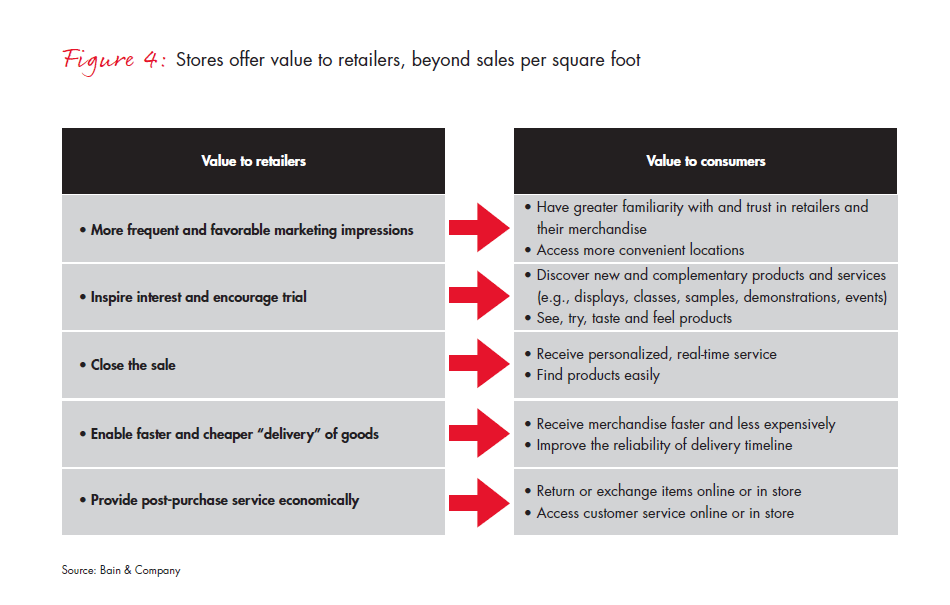
Instead of making decisions about the future of stores based on traditional accounting methods, we recommend modeling the economics of the company-wide system under several viable scenarios. For example, what happens over the next three years if we close 40% of our stores and build two new fulfillment centers? What happens if we close some stores, open others and sell two of our fulfillment centers?
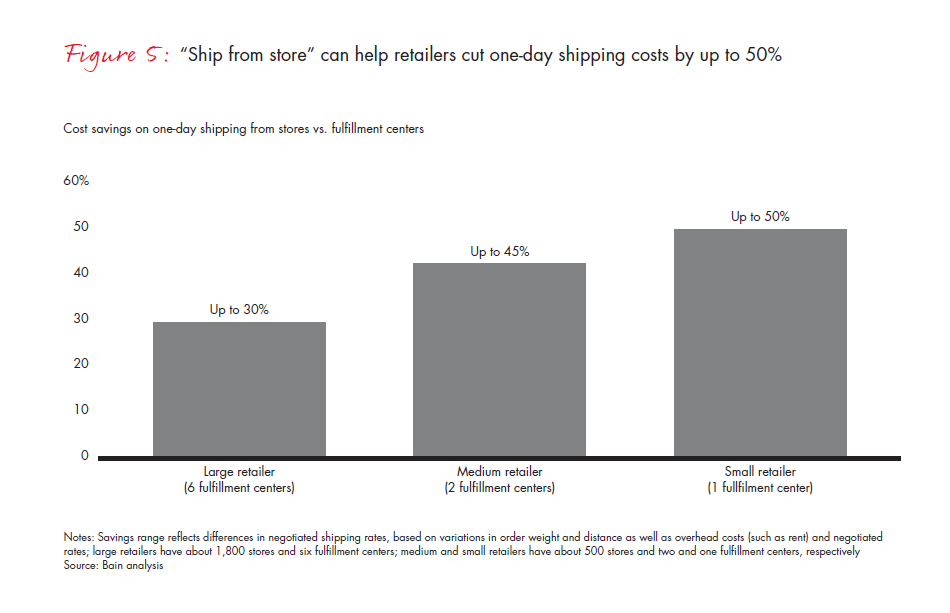
On the fulfillment side, Bain has analyzed the economics of ship-from-store to evaluate the potential benefits compared with fulfillment centers. We modeled about 75 scenarios of retail store and fulfillment center footprints, shipping days and package weights. We found that shipping from stores was usually the better option, especially for retailers with fewer fulfillment centers. And, as consumers continue to expect faster shipping or tighter delivery windows, stores will play an even more valuable fulfillment role. Most retailers (especially smaller ones) are likely to see a significant cost advantage on one-day shipping by shipping directly from stores (see Figure 5). In addition, technology improvements, including robotics that will do more of the picking and packing in stores and driverless cars that will be available for last-mile delivery, also will benefit the relative economics of ship-from-store over the long term.
Minimizing wages may not maximize profits
In challenging times, it seems obvious to cut costs from the single largest cost item: store labor. Yet retailers like Costco, QuikTrip and Trader Joe’s are defying conventional wisdom. Research carried out at MIT suggests that by simplifying work processes, reducing the complexity of merchandise assortments, cross-training employees in multiple skills and leaving enough time for people to innovate and personalize customer service, retailers can actually invest more in people and accelerate the growth of sales and profits.
A recent New York Times article highlights this. By 2014, only 16% of Walmart’s stores were meeting their customer service goals. Since significantly revamping its labor practices in 2015—upping wages 16%, opening 200 training facilities and creating a clear path to promotion—the number of stores hitting their goals rebounded to 75% this year.
Another example is Toys “R” Us. During the 2015 holiday season, Toys “R” Us struggled with its fulfillment operations in part because seasonal employees didn’t always show up to work. This year, as the company ramped up its omnichannel operations—particularly ship-from-store—it took a different approach to seasonal labor. Warehouse employees received a pay bump of about 20% depending on their job and shift, and the company offered bonuses.
Many other retailers, among them Ikea, Starbucks and Wegmans, are adopting similar strategies. They are designing radically different stores and empowering employees to make a difference. In the process, they’re changing the role their stores play and improving their chances of success.
Lessons learned and the future of stores
Our stylized examples of Siloed Sales and Omnichannel Emporium may not reflect your particular situation. But we hope they encourage discussion on opportunities:
- to invest in omnichannel capabilities and technology.
- to measure the full value of your stores.
- to develop your store staff to enable the omnichannel customer experience.
We are not underestimating the magnitude of the changes traditional retailers are facing. Still, it would be sad to see a world in which today’s store-focused retailers let their best assets die, while Amazon and other online retailers win by building the physical stores of tomorrow.
Looking forward: New Year’s resolutions
We hope you have a fulfilling and relaxing break over the holidays.
We’ll be back in the new year with our final issue of the 2016–2017 holiday season, "Bain’s Post-Holiday Outlook: New Year’s Resolutions," in January.
Please let us know if you have any questions or would like to arrange a follow-up discussion on the issues addressed in this newsletter or any other retail topics.
About Our Research Partners
Research Now
Research Now Group, Inc., is a global leader in digital data collection to power analytics and insights. It enables data-driven decision making for its 3,700 market research, consulting, media and corporate clients by providing access to millions of business professionals and consumers. The company has provided proprietary, research-only online panel sample since 2001 and currently operates in over 40 countries from more than 20 offices around the globe with locations in the Americas, Europe, the Middle East and Asia-Pacific. For more information, visit www.researchnow.com.
1The Net Promoter Score® is derived by asking consumers, “On a scale of zero to 10, how likely would you be to recommend this company (or this product) to friends and colleagues?” Ratings of 9 or 10 indicate promoters; 7 and 8, passives; and zero through 6, detractors. The score is simply the percentage of promoters minus the percentage of detractors. Net Promoter®, Net Promoter System®, Net Promoter Score® and NPS® are registered trademarks of Bain & Company, Inc., Fred Reichheld and Satmetrix Systems, Inc.
First published in 12月 2016