

論説

概要
- As ad loads and cost per impression increase, tailored marketing is critical. Yet 40% of consumers say ads feel irrelevant.
- Top retailers are using AI-powered personalization, and early trials have shown a 10% to 25% increase in return on ad spend for targeted campaigns.
- AI enables hyper-personalized marketing at scale with on-demand content generation; more holistic customer profiles; and real-time, one-to-one decision engines.
- Success necessitates a “learn fast, scale faster” mindset and a customer-centric strategy for brand alignment.
Today’s consumers are bombarded with ads and messages across every channel, making it harder than ever for brands to cut through the noise. As ad loads climb and attention spans shrink, retailers face a high-stakes conundrum: How can they stand out to shoppers with relevant marketing, improve the customer experience, and still make every dollar count?
The solution: Personalization. Tailored, timely outreach and engagement can give retailers an edge by demonstrating an understanding of shoppers’ needs. In a recent Bain survey, over half of shoppers said that generative AI-powered personalized recommendations will be valuable when shopping online.
In an omnichannel world, effective personalization creates a seamless, tailored experience across channels and at every stage of the customer journey, from sparking the first moment of inspiration to perfecting service to building loyalty. It’s about engaging customers where they are, with the right experience, at the right time, and through the right channel—whether it be through personalized search, mobile push notifications, targeted emails, or in-store suggestions. Imagine if retailers could not only deliver millions of unique marketing ads but also use them to deepen their understanding of each shopper’s underlying needs, motivations, and preferences to make each subsequent interaction more tailored than the last (see below).
That once lofty vision is now within reach, thanks to generative AI. Leading retailers such as Walmart and Amazon are rolling out AI-powered personalization features, including customer-specific, unique homepages and shopping assistant tools, to name a few. By creating standout customer experiences and reflecting their unique brand proposition at every touchpoint, leading retailers are deepening customer relationships, boosting conversions, and reducing acquisition costs in a competitive market.
More than a buzzword: A strategic imperative
A recent Bain survey revealed that around 45% of shoppers don’t mind sponsored ads if they are relevant. In fact, around 40% say these ads can be helpful when shopping.
But let’s be real: “Personalization” and “one-to-one” have been marketing buzzwords for years, and many retailers are still missing the mark. In the same survey, about 40% of consumers say the ads they see today just don’t resonate. You’ve probably been there: seeing endless ads for dining room tables for weeks after buying one, or having to re-filter for your size every time you search for a clothing item, despite being logged in on the retailer’s site. Missteps like these don’t just burn through marketing budgets, they dilute the brand, annoy customers, and lower conversion rates.
When done right, personalization represents the retailer’s best self. It fosters connections that feel authentic and valuable. As such, winning retailers know that AI-powered personalization isn’t just another plug-and-play technology. It empowers a strategic shift—the ability to align every message and interaction with the retailer’s identity, voice, and unique value proposition.
The right approach to personalization varies by the retailer’s strategy and differentiators. For example, a luxury store might use AI to enhance high-touch in-store services, while a discount retailer could use the technology to highlight unbeatable promotions. The best messages resonate with customers’ needs, whether it’s the thrill of exclusive style or the satisfaction of smart value. When retailers get this right, they make shoppers feel seen, valued, and engaged, which builds loyalty and sets a new bar for customer experience.

Generative AI’s Potential to Improve Customer Experience
Bain's research identifies five design principles for deploying generative AI in the customer journey.
How AI is revolutionizing personalization
Today’s leaders in personalization are combining traditional AI with generative AI, which not only recognizes patterns in unstructured data but also analyzes complex data in real time to create content, such as text, images, and recommendations. It’s a dynamic alternative to traditional A/B testing, enabling scalable, adaptable personalization that gets smarter with each interaction.
With AI, retailers can create more granular (and accurate) customer segments with comprehensive data inputs, generate vast amounts of content quickly, test multiple hypotheses simultaneously, and use the responses to determine customer preferences on a one-to-one basis, informing future ways to engage. The benefits are real: Retailers experimenting with AI-powered targeted campaigns are seeing a 10% to 25% increase in return on ad spend.
AI is transforming personalization in three game-changing ways:
1. On-demand creative generation, at scale. Generative AI is empowering marketing teams to develop variations of emails, graphics, and ads at unprecedented scale and speed. In our experience, generative AI can slash content-creation time from weeks to hours. AI tools like Adobe Firefly, OpenAI’s DALL-E, and generative AI-enabled platforms like Figma and Canva, among others, are making this capability more accessible than ever. In training these tools on their guidelines, marketing teams can produce on-brand content with far less effort. This helps them meet the growing demand for personalized assets while also freeing up time to focus on strategy.
2. A 360-degree view of the customer. Generative AI is revolutionizing data synthesis, scaling the breadth, speed, and quality of processes like metadata tagging. L’Oréal, for example, saved 120,000 hours of manual work and boosted search engine optimization (SEO) by using SiteCore’s generative AI to automate tagging for 200,000 titles across 36 brands and more than 500 websites.
Generative AI can also enrich customer profiles by uncovering preferences and intent from real-time behaviors such as browsing, purchase history, and social media activity. And, unlike traditional automation, which tags structured data, generative AI unlocks unstructured data—analyzing images or detecting sentiment in customer call transcripts. It can recognize feelings and behaviors such as “frustrated by assembly process” based on a buyer’s customer service call or “preference for sustainable products” based on engagement with an Instagram ad.
3. Real-time decision engines. Generative AI doesn’t just analyze data; it makes it actionable. With reinforcement learning-based decision engines, retailers can test ad variations to identify the most engaging combinations of creative, messages, offers, as well as contextual parameters such as frequency, day of week, time of day, for each customer.
Take that frustrated customer, for example. Armed with real-time data, the model can learn the most appealing offer—perhaps one for complimentary white-glove service for their next purchase—and turn an aggravating experience into one in which they feel heard.
Reinforcement learning enables large-scale experimentation at the one-to-one level, assigning “rewards” based on performance metrics—such as incremental profit or conversions—for each customer. With this real-time feedback, the model continuously refines its strategy to optimize toward true one-to-one personalization. In some cases, retailers’ customer engagement platforms can automatically deliver the agent’s next recommended ad, or even journey, to the customer without human intervention. The result? Retailers deliver increasingly effective, personalized ads and experiences while boosting customer satisfaction and margins.
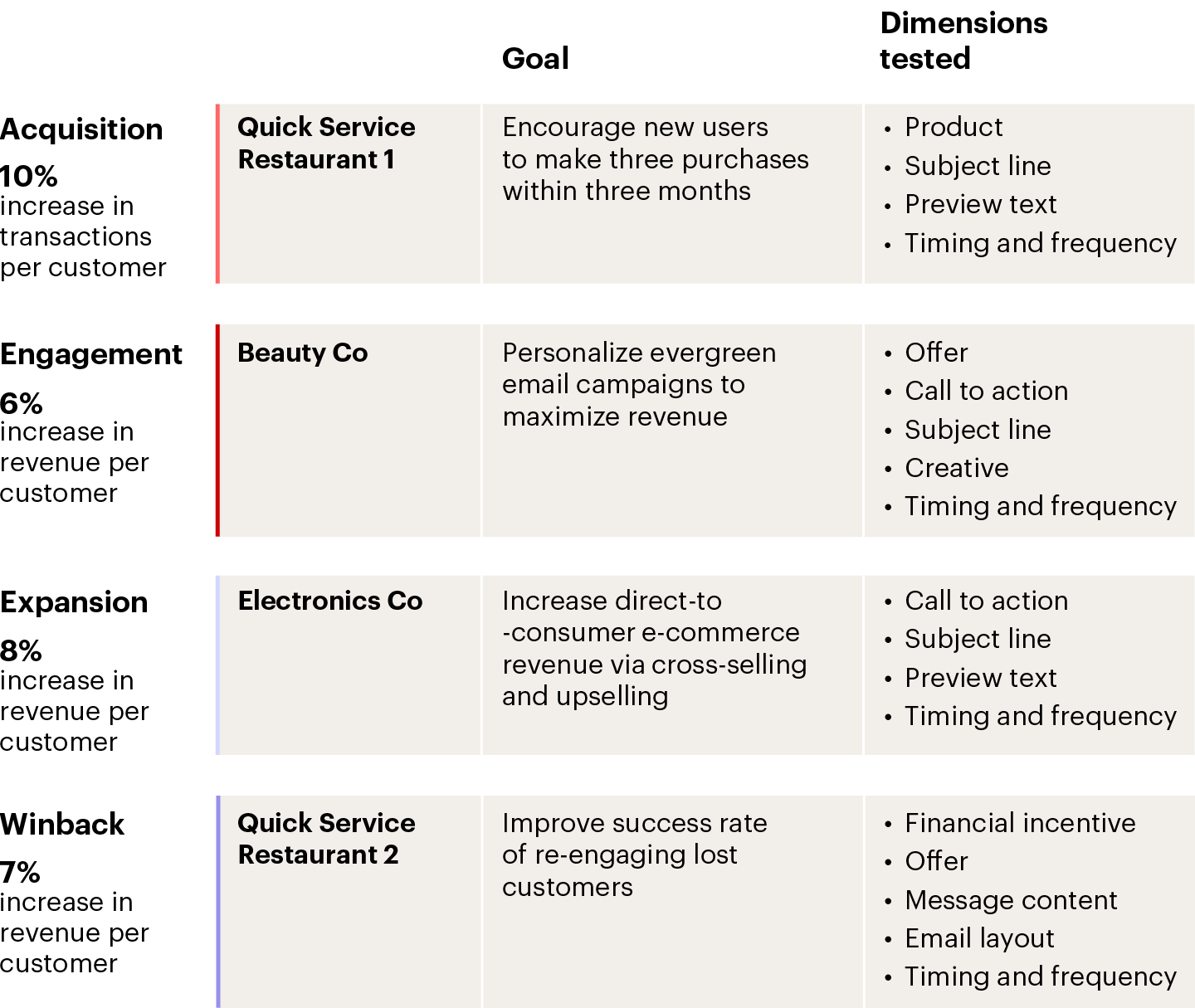
The transition from traditional A/B testing to AI-powered, reinforcement learning-based personalization is paying off. We partnered with OfferFit, an AI Decisioning Engine, and found that across retail sectors, personalization campaigns can yield sizable increases in revenue and transactions per customer, in line with our shared client results (see Figure 1).
Figure 1

Learn fast, scale faster
It’s easy for marketing teams to get swept up in the AI buzz. Many fixate on setting up the right marketing technology (martech) stack before deciding what they want to achieve. And when teams start building, they often default to low-impact use cases, such as making existing tasks more efficient, instead of seizing the opportunity to transform customer experiences in novel ways.
In contrast, successful companies not only start with strategy but also realize that unlocking the true power of AI comes from their people. These leaders foster the right mindset, culture, and ways of working organization-wide.
The first step is pinpointing high-potential use cases and embracing a “learn fast, scale faster” mindset. This approach encourages early experimentation, with calculated risks and real-time strategy refinement. It also necessitates cross-functional Agile teams with marketers fluent in tech and data scientists attuned to customer needs. Early trials help these teams quickly uncover what resonates with customers in an effort to develop seamless, personalized solutions across the customer journey. With close collaboration, they can adjust as needed, proactively responding to evolving customer needs and maximizing the value of every interaction.
With this foundation, marketers can move beyond incremental improvements to reimagine the customer experience. This transformation demands a culture that democratizes AI, giving everyone—not just engineers and data scientists—access to AI tools and insights. Senior leaders play a crucial role, championing a ground-up and top-down shift. This paradigm empowers marketers to spend less time creating and monitoring campaigns and more time interpreting AI-generated campaign insights to shape bold, targeted strategies for the future.
As with most big changes, it will take time and energy to cascade the cultural shift throughout the organization. But this people-first approach instills adaptability and innovation, allowing leaders to scale AI meaningfully and purposefully.
In parallel, leading retailers also invest in the data and technical foundations necessary to scale AI. The journey isn’t easy: Solutions can be expensive and infrastructure-intensive, requiring accurate, up-to-date data to avoid mistimed messaging and ensure privacy compliance. Top-performing retailers are already building modern tech stacks that synchronize zero-, first-, and third-party data to create the holistic, real-time customer views that power personalization at scale.
Five questions for the journey ahead
Retail chief marketing officers (CMOs)—no strangers to innovation—face the challenge of integrating AI thoughtfully. To ensure personalization strategies are customer-centric and set up for success, marketing teams can reflect on a few questions:
- Where is the biggest opportunity to create unique, personalized experiences for our customers? Which opportunities will provide the most value, and where can AI play a role?
- How can we use personalization to create better long-term customer experiences? And how can we demonstrate the mutually beneficial value of sharing data?
- Where do our core customers want more personalization, and where might they resist it? How do we ensure data privacy?
- What are the use cases we want to start experimenting with first? How can we develop proof points and test quickly—without massive tech and data investments?
- How are our leaders integrating AI into their strategies and using AI to reimagine the way we work?
Using AI to create relevant, personalized marketing is no longer a competitive edge but table stakes—and it will be critical to building loyalty and market leadership that lasts.

Retail and Gen AI: Now Scale Those Terrific Early Returns
Prioritizing families of use cases can accelerate both savings and revenue gains.
About our research partners
OfferFit’s AI Decisioning Engine autonomously experiments and empirically discovers the optimal actions one-to-one for each customer. OfferFit’s AI Decisioning agents use reinforcement learning to personalize communication to identified customers and to maximize any business key performance indicator (KPI). OfferFit works with top brands in telecom, energy, retail, travel, streaming video, and financial services, among others.
Sensor Tower is a leading source of mobile app, retail media, audience, and digital advertising (formerly Pathmatics) insights for brands and app publishers globally. With visibility into usage, engagement, and paid acquisition strategies across web, social, and mobile, its award-winning platform empowers organizations to stay ahead of changing market dynamics, understand competitors, and make informed strategic decisions.
The authors would like to acknowledge Sasha Foo, Maddy Crisera, and Diya Chadha for their contributions.
First published in 3月 2025