

記事

概要
- Under continued financial pressure, regional universities must identify innovative ways to gain more control of their budgets.
- Traditional efforts to reduce costs tend to be the default way to meet budget, but universities should also assess their assets and capabilities to identify new, diverse ways to generate revenue.
- Based on our experience in the Gulf Cooperation Council and analysis of global universities, we believe that diversification can generate at least 10% of a school’s revenue.
- Given the value at stake, universities should adhere to a methodical, systematic approach to generate, evaluate and execute the right ideas in a style that fits with the culture and environment.
Public universities in Gulf Cooperation Council (GCC) nations are at a strategic turning point; they are also experiencing significant budget disruptions.
On the funding side, public support for education is under pressure: Total public funding on a per student basis is declining in Saudi Arabia and the United Arab Emirates (UAE). Furthermore, funding is moving away from lump sum awards and becoming more outcome based. Finally, specific programs, such as postgraduate studies, are increasingly self-funded. On the tuition side, universities are beginning to be unable to increase fees for students without sacrificing occupancy levels.
As bleak as these difficulties may seem, they provide many opportunities for GCC public universities to question their existing approaches and find new strategic directions. Particularly, there is excellent potential for local players seeking to establish control over their own budgets through endowment funds or revenue diversification. Also, institutions looking for greater autonomy and flexibility in funding, with lower emphasis on public sources, and those wishing to optimize their financial resource allocations to fuel strategic growth can challenge the status quo.
To achieve these goals, universities will have to rethink their entire strategic, operating, organizational and financial models. This article focuses specifically on rethinking financial models to deliver early gains to GCC universities.
Financial models typically cover tuition fees, funding, endowment returns and revenue diversification. Based on our experience and in light of the significantly undertapped potential in the region, revenue diversification can provide the earliest gains.
In order to do so, regional universities should study the financial models of leading global universities that typically achieve greater than 10% diversification of their operating revenue from sources other than traditional tuition and research activities.
Revenue diversification is a critical component of overall revenue mix, and it requires a holistic approach based on five key revenue diversification levers: continued education, research and innovation, services, asset utilization, and partners (see Figure 1).
Figure 1
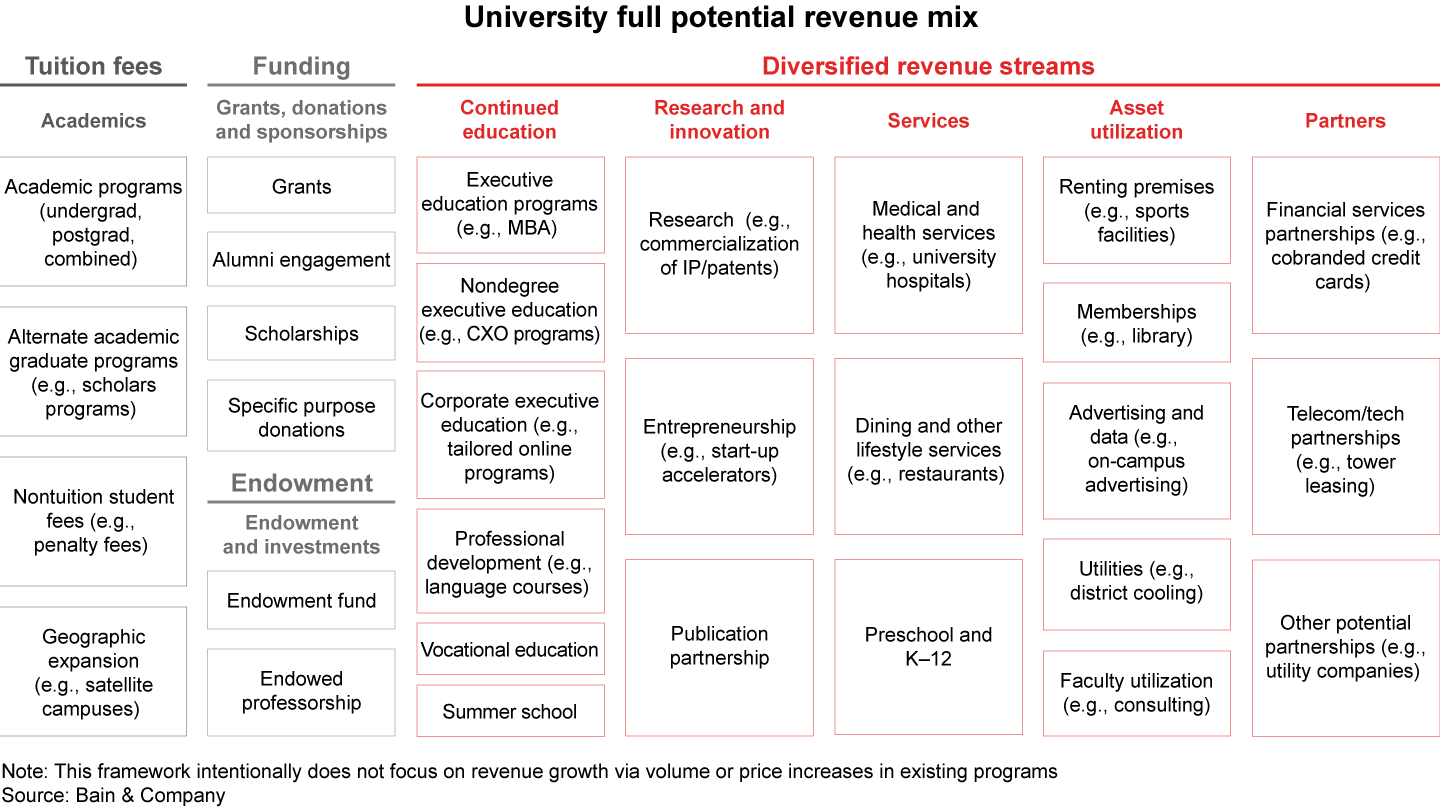

What follows are some specific examples of how leading global universities have successfully applied revenue diversification initiatives.
- Continued education: A leading US university has set up an active professional education team focused on building partnerships with corporate and government training divisions. Over the past five years, the university has collaborated with more than 50 companies in which executives share their imperatives and faculty works with them to tailor a suitable program.
- Research and innovation: The University of Michigan established its Business Engagement Center (BEC) in 2007 as a pathway for faculty to work with business leaders on mutually beneficial projects in a wide range of fields. The BEC now maintains ongoing relationships with more than 1,200 companies. Since its inception, the BEC has contributed to a 53% increase in corporate philanthropy and a 163% increase in corporate research expenditures.
- Services: Dartmouth College runs seasonal athletic training and sports camps. The coaches keep a portion of the revenue, while the rest goes to Dartmouth.
- Asset utilization: The University of Chicago not only rents its premises but also assists in the event planning. The university has business relationships with event management companies (including wedding planners and corporate event organizers) that help the university source clients.
- Partnerships: The University of Pennsylvania introduced a cobranded credit card to its alumni in 1997 through Bank of America, the benefits of which include cash back on various purchases, no annual fee and a low annual percentage rate for the first 12 months. The University of Pennsylvania collects additional revenue through a revenue-sharing agreement in which the bank contributes a percentage of funds to the university with every account opened and with every purchase made using the cobranded card.
In our experience, GCC universities are already aware of, or are deploying, some of these levers. The schools typically pursue them in an ad hoc fashion, however, and lack a consistent strategy. As a result, the chances of success are limited, and they often fall victim to a host of regional pitfalls. For instance:
- Universities do not even pursue high-value opportunities, usually due to subpar idea prioritization and a weak assessment of full potential.
- Opportunities are unable to scale up, leading to a limited impact on the total revenue pool.
- Opportunities fail to capture their full value, mostly due to limited resource focus and management attention.
- The opportunities that schools do pursue are misaligned with the institution’s strategy and vision, so they either fail at implementation or are too different from core activities to sustain.
To be successful, GCC universities need to approach revenue diversification as a holistic and structured exercise. Diversification is a phased process that depends on the university’s starting point, including its strengths and its objectives. As a result, this process requires tailoring to be fitted to the unique university profile.
We have worked with a leading university in the GCC to tailor its approach to revenue diversification. The university was previously less than 1% revenue diversified; we identified the potential for 10% revenue diversification and prepared a quick-win initiative representing 3% to 4% revenue diversification that is now being implemented.
To enable this, we followed a prioritization approach split into three phases: baseline definition, gradual prioritization and strategy formulation. Each phase is concentrated around a core set of questions and with a specific objective in mind (see Figure 2).
Figure 2
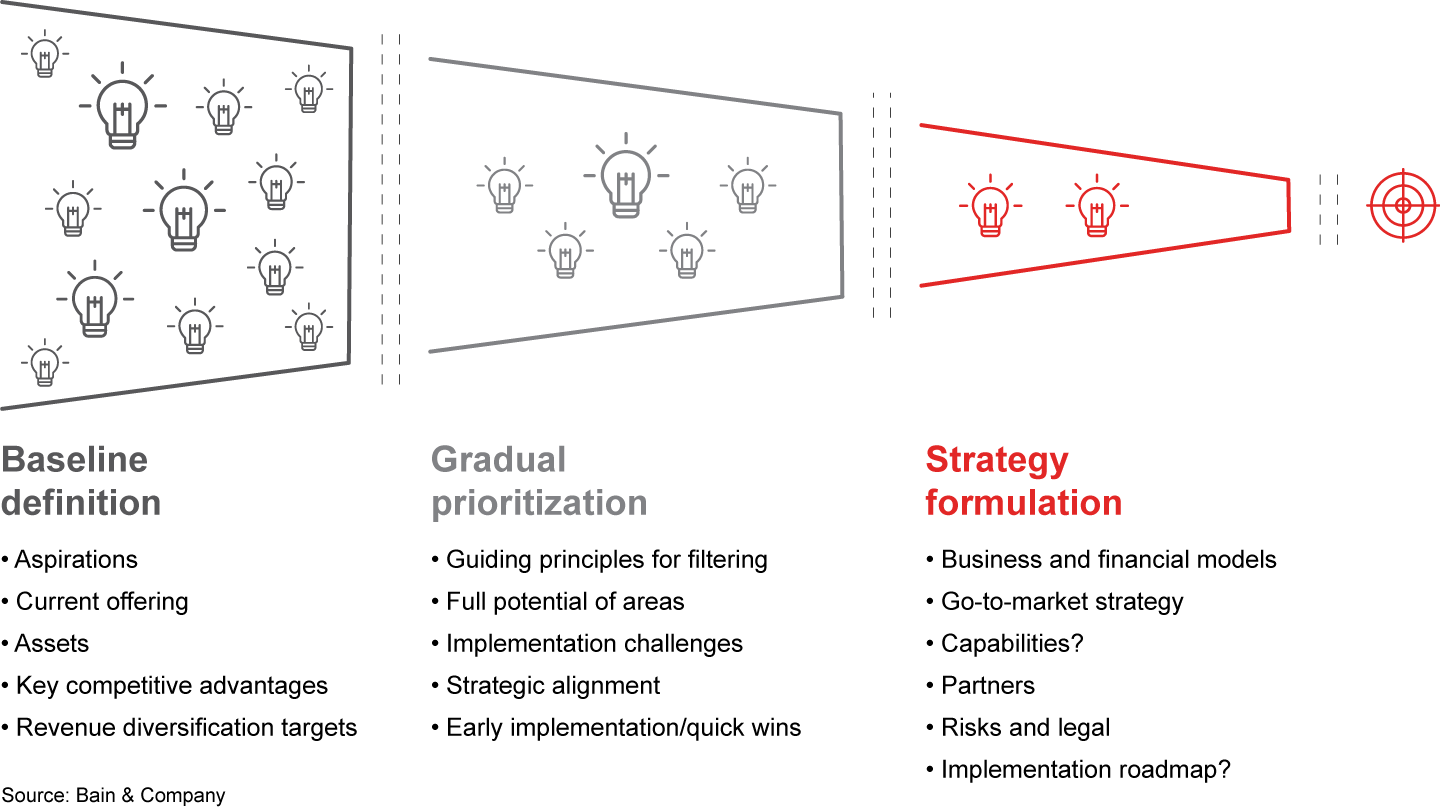

- Phase No. 1: Define the baseline of the university to understand in which areas revenue diversification should be pursued and what the overall ambition is.
- Phase No. 2: Gradually prioritize the most value-added areas to address based on the full potential of each idea pursued, how they compare with the implementation challenge and their alignment with the broader strategy.
- Phase No. 3: Formulate a dedicated strategy to win—for example, operating model adjustments, new capabilities required, critical initiatives to fast-track implementation and an actionable implementation roadmap.
Once the strategy is formulated, its success most often lies in the robustness of the governance model. In that regard, we advise GCC universities to follow four guiding principles.
First, the role of the center and accountability of stakeholders must be clearly defined. This includes a dedicated mandate for revenue diversification and a forum for discussion. Second, investment policies and criteria must be stated in order to classify prospective investments for comparison and ensure that financial commitments are compliant with the university and aligned with its strategy. Third, decision rights should be specifically allocated so that it’s understood which stakeholders are engaged at different decision points. Finally, the end-to-end process should be codified with clearly formalized milestones to track progress at each stage.
Diversifying revenue is an ongoing process that can yield early as well as long-term benefits to GCC universities. Based on our global and regional experience, we recommend five key success factors to secure when planning revenue diversification.
- Set an aggressive ambition. Get internal agreement on the revenue diversification target and the time frame to achieve it.
- There is no silver bullet. It is unlikely that one single program will deliver the majority of the value. Adopt a portfolio approach—namely, a mix of initiatives with different degrees of risk and revenue potential.
- Build early momentum. While managing an overall roadmap and portfolio, select a few opportunities that can deliver results quickly and use these successes to justify the concept across the organization.
- Institutionalize revenue diversification. Governance and stakeholder engagement are critical to ensure that full potential is realized. Effective change needs to be institution-wide to reach scale and enable implementation
- Engage and promote entrepreneurship. Best ideas can come from anywhere, so develop the right incentive mechanisms that foster creativity and entrepreneurial thinking.
Karim Shariff is a partner with Bain & Company, and Jürg Kronenberg is a Bain principal. Both work in Bain’s Middle East offices. The authors would like to thank Maxime Toth for his support.
First published in 10月 2018