

M&A Report

At a Glance
- Revenue synergies are becoming critical for deals in today’s high-valuation environment. But unlike cost synergies, revenue synergies are difficult to size and to realize.
- Overestimating revenue synergies was the most cited reason for deal failure among the 281 executives we surveyed, yet only half of those executives said that they bake revenue synergies into their deal models.
- Successful acquirers develop a proprietary, data-driven view on revenue synergy value creation during diligence, giving them more confidence in valuation and bid strategy.
- The best acquirers also fully utilize the pre-close period to prepare the product roadmap and adjust the sales model so that they realize results from day one. They then track those results and evolve their revenue synergies playbook with each deal.
This article is part of Bain's 2022 M&A Report.
Revenue synergies in M&A have been traditionally treated as something of an art by dealmakers. Compared with the relatively industrial approach common to cost synergies, acquirers often develop a bird’s-eye view on revenue synergies and stop well short of using them to underwrite the deal. Yet, in today’s M&A market, record-high valuations have forced acquirers into a more rigorous approach to estimating and committing to top-line growth. Acquirers must be more scientific: They must clearly determine in advance how and how much the deal will jointly boost revenue. Companies that commit to underwriting revenue synergies in the deal model are the most likely to meet or exceed their targets, according to a recent Bain executive survey.
The trouble is that revenue synergies are difficult to size and to realize. In fact, overestimating revenue synergies was the most-cited reason for unsuccessful deals in Bain’s recent survey of 281 executives.
This isn’t surprising. Maximizing revenue synergies requires a high degree of focus, execution, and commitment. Even cross-selling existing products to existing customers can be stymied by lack of data visibility (especially pre-close), poor coordination, and mismatched motivations across target and acquirer. The base business takes priority in the face of potential deal-related disruptions. Successful acquirers ensure that their newly combined salesforce is well positioned to register a few early wins, spurring conviction and positive momentum in the field.
Meanwhile, transformative revenue synergies, such as new customer value propositions, combined product offerings, and updated go-to-market approaches, can be more difficult and take longer to realize. These more ambitious sources of value require extensive behavior change across the value chain, from product development to sales, as well as across business units. And it can take up to three to five years to see the full results, according to Bain benchmarks. No wonder our survey respondents cited failure to effectively integrate the product portfolio and achieve the full go-to-market transformation as the two biggest obstacles to capturing revenue synergies (see Figure 1). All of this may help explain why only half of surveyed executives told us that they typically bake revenue synergies into their deal models.
Figure 1


Successful acquirers flip the script. These companies develop a proprietary, data-driven view on revenue synergy value creation during diligence, giving them more confidence in valuation and bid strategy. They fully utilize the pre-close period to prepare the product roadmap and adjust the sales model so that they realize results from day one. They then track those results and evolve their revenue synergies playbook with each deal.
Successful acquirers develop a proprietary, data-driven view on revenue synergy value creation during diligence, giving them more confidence in valuation and bid strategy.
We’ll look at the four key steps to turning revenue synergies into a competitive advantage.
Step 1: Begin yesterday. Don’t wait until the dust has settled to evaluate and plan revenue synergies. Sophisticated acquirers build an outside-in perspective on possible targets (and potential new products) years ahead of live deals. When performing diligence on specific targets, these companies use rigorous and creative research to detail the customer map and evaluate customer needs. Advanced analytics enable deep examination of historic customer buying behavior and modeling of future potential. Primary customer research and a review of win-loss track records from the seller can inform potential product bundles and the combined product roadmap. Such analysis can confirm (or deny) the deal thesis and provide dealmakers with more confidence in valuation.
The best acquirers rely heavily on a clean room to conduct data-driven sales planning between sign and close. They share unblinded data within the clean room and use that data to go deeper on customer segmentation and account-level planning. As day one approaches, they selectively add individuals to the clean room to validate the findings.
A medtech company with a long track record of revenue growth prioritizes an early and tactical approach to revenue synergy planning. During a recent acquisition, the company’s diligence detailed not only the product and customer overlap but also the channel strategy and salesforce model required to maximize growth. It found that the company’s channel strategy must shift from a mixed model to more direct salesforces, with as much as 90% direct in key geographies. And it decided that with a potential 30% customer overlap, it needed to realign sales responsibilities to avoid customer confusion. Therefore, immediately upon deal announcement, a clean team began designing the future-state go-to-market model, including regional channel strategy, salesforce assignments, and a shared customer approach. Such detailed diligence and integration planning enabled reps to begin selling in new territories and across the full portfolio about 90 days post-close, the fastest launch in the business unit’s history.

Five Big Things to Know about M&A in 2022
Retaining talent, capturing revenue synergies, boosting ESG, and making the most of alternative deal models are top of mind for buyers.
Step 2: Center on the combined value proposition for the customer. When pursuing growth-oriented deals, a customer-centric approach to M&A uncovers value creation opportunities that would otherwise go overlooked or deferred. The best acquirers test existing and new combined product offerings during diligence. They use the pre-close period to build a detailed customer segmentation. As deal close approaches, they look for opportunities to convey how the anticipated combined value proposition will benefit customers from day one. Winners also consider how to bundle existing offers and effectively position for cross-selling upon close. Finally, they build a long-term roadmap for product integration and joint value proposition, using it to focus the integration on key decisions that will support an improved product and service offering for customers.
This approach helped one global technology company more than double its targeted revenue synergies when it acquired a target with a highly complementary product portfolio and go-to-market model. The acquirer executed deep customer and competitor diligence to test customer needs and the potential market for an integrated product offering that would supersede any available value proposition. Convinced that they had identified a home-run opportunity, the acquirer prioritized the joint offering in integration planning and decision making across engineering, sales, and ops.
The best acquirers rely heavily on a clean room to conduct data-driven sales planning between sign and close.
Step 3: Enable the sales team to hit the ground running from day one. The best companies work to generate revenue synergies momentum from day one and plan for what they can kick-start in the first 90 days. They don’t wait for the longer-term product and sales transformation to get started; they begin capturing upside with existing products and the current sales teams and structure. A day-one revenue Sales Play System℠ provides the focus and execution support to make this happen (see Figure 2).
Figure 2
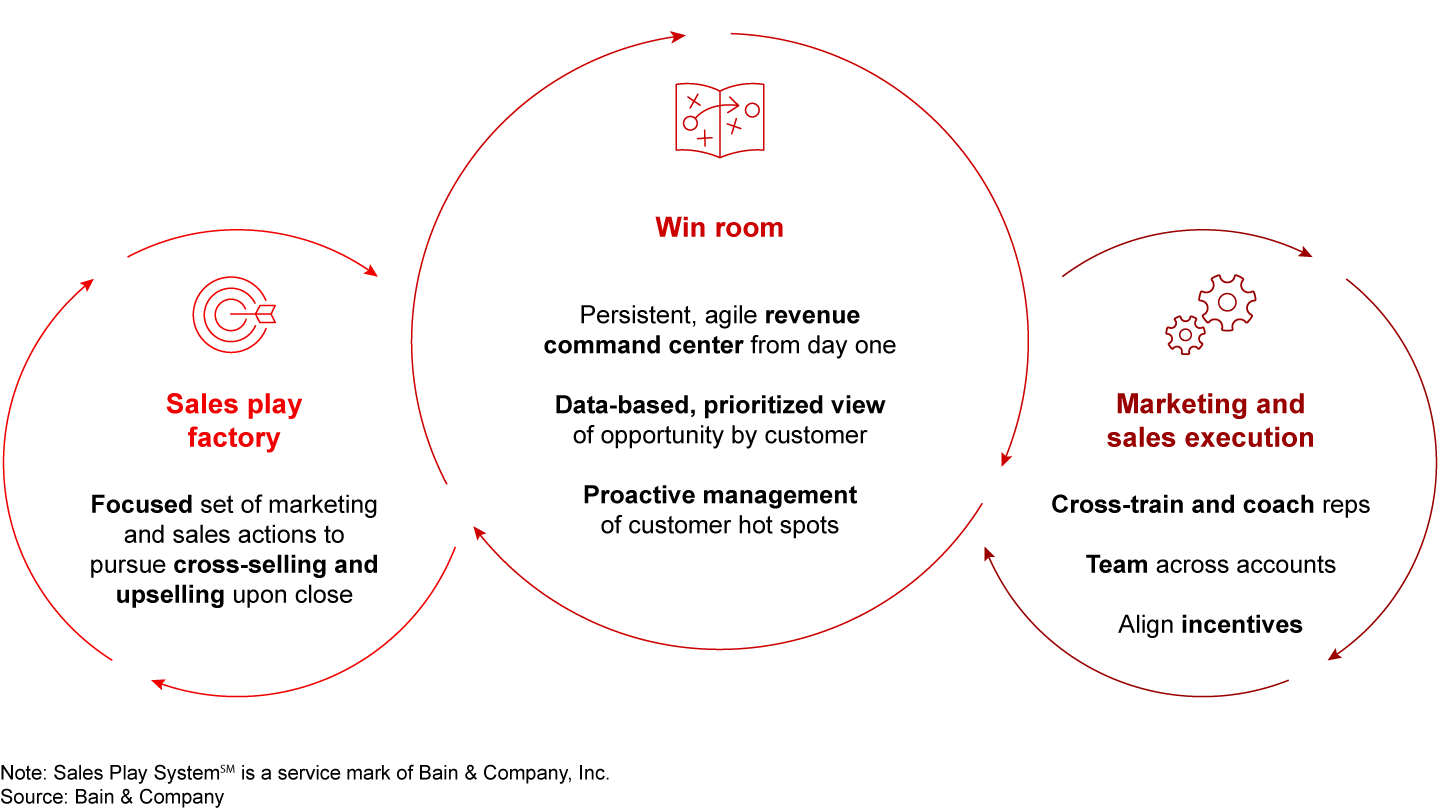

The first step is to prioritize plays for upselling and cross-selling. An acquirer can’t expect the salesforce to take an entirely new product catalog to its full set of accounts. Instead, it’s important to zero in on the target use cases, value messaging, and sales collateral that are a natural fit and can be sold today. (For more on this Sales Play System, see the HBR.org article “The Sales Playbook of Successful B2B Teams.”)
Sika, a construction chemicals company, applied focused sales plays to achieve ambitious revenue synergies. The company knew from a long track record in M&A that trying to sell everything to everyone doesn’t work. In the construction industry, different trades have different product needs for different applications, and they are served by a hybrid network of local distributors and manufacturers. By acquiring Parex, a mortars company, Sika expanded its building finishing offering and gained a strong foothold in the ultra-local distribution channel in China through Parex’s established relationships with thousands of professional distributors. Immediately after closing the deal, Sika systematically prioritized and introduced flagship stock-keeping units in these distribution channels, generating quick revenue synergies from a laser focus on what to cross-sell and to whom. As sales reps delivered early wins, frontline confidence and excitement about the Sika-Parex combination grew. The salesforce leaned in on the first sales plays. The first wave of synergies accelerated, and the China team moved to more advanced sales plays while transferring the approach to other high-growth markets.
As deal close approaches, look for opportunities to convey how the anticipated combined value proposition will benefit customers from day one.
Second, it’s necessary to set up a “win room”—that is, a revenue command center to prioritize and manage sales plays, track results, and identify the next opportunities on an agile basis. The best companies use the win room to proactively address revenue dis-synergies, too, identifying overlapping customers or products and developing specific plans to resolve those hot spots.
Third, winning acquirers invest heavily in sales execution. They support the sales team by cross-training and coaching reps, providing clear rules of engagement, and aligning incentives.
They mobilize each rep with a simple and tactical plan that includes a list of prioritized clients, products, and sales plays for the first 12 weeks. They also use clarity and compensation to resolve hot spots around shared customers or overlapping products.
Seismic, a fast-growing PE-owned software company, recently acquired Lessonly, a scope acquisition with meaningful revenue synergy opportunity. To maximize synergies and accelerate realization into year one, Seismic followed this proven playbook. First, the company developed a series of cross-selling plays that were tailored to the needs of each customer segment, outlining what product bundles to offer, focused messaging, competitive positioning, and the winning sales cycle to close the deal. Seismic then enabled 100% of the combined salesforce on these sales plays in the first week after close through a two-day, go-to-market training session to motivate sales reps regarding the opportunity at hand. Lastly, they set up a focused win room to help navigate large and complex cross-selling opportunities in real time. As a result, the sales reps were able to build a cross-selling pipeline immediately and have meaningfully exceeded year-one revenue synergy value.
Step 4: Learn from every deal. These three steps give companies a scientific way to identify and capture revenue synergies from their deals. Yet there is one more step that helps ensure that companies make the most of this approach—namely, tracking synergies to develop a proprietary angle on the next deal.
Winning companies use each deal to learn which sources of revenue synergies ultimately materialize and which fail to deliver so that they can determine the critical activities for success and the right key performance indicators to track. They refine a repeatable revenue synergies capability that helps the M&A team focus on the right data, improves diligence on subsequent deals, and sets them up to win more deals—and with greater confidence that they can achieve revenue synergies to justify deal valuations each time.
Get Started with Sales Play System®
Crack the code on sustained, profitable growth with Sales Play System. Start by taking our Maturity X-Ray, to get a quick, accurate read on your current sales performance.
Read our 2022 M&A Report
Overview
Hot Topics
Industry Views
Regional Perspectives
First published in 2月 2022