

論説

概要
- Despite the well-publicized stock market successes of technology icons, most initial public offerings (IPOs) have burned their new investors. Bain & Company analysis shows that two-thirds of IPOs that stayed public during a five-year span have underperformed their established peers, with a weighted annual average total shareholder return (TSR) of 0.4%, far lower than the 8.4% of their respective indexes.
- The elite companies that manage to outperform on TSR after their IPOs do several things differently. They view the IPO as a beginning and a means to longer-term value creation rather than any kind of end in itself. That means they prepare for value creation well ahead of even deciding to pursue an IPO.
- These winners understand how post-IPO investors have fundamentally different objectives and incentives than earlier investors, and they adjust their operations accordingly.
- Outperformers that gear up for support cast a wider net than simply seeking transactional help; they get strategic support to help build long-term value. Executives who have prepared for life beyond the IPO position their companies to earn investors’ trust.
After the storied stock market successes of technology icons such as Amazon, Facebook and Google, investors have endured a cold soaking of late with the share price reversals of LendingClub, Uber, Twitter and Slack. Have initial public offerings (IPOs) lost their mojo?
It turns out that IPO magic has long been more hype than substance. Market sage Benjamin Graham wrote in 1949: “In every case, investors have burned themselves on IPOs, have stayed away for at least two years, but have always returned for another scalding. For as long as stock markets have existed, investors have gone through this manic-depressive cycle.” In recent years, investors who hold a stock past the first-day pop often are disappointed.
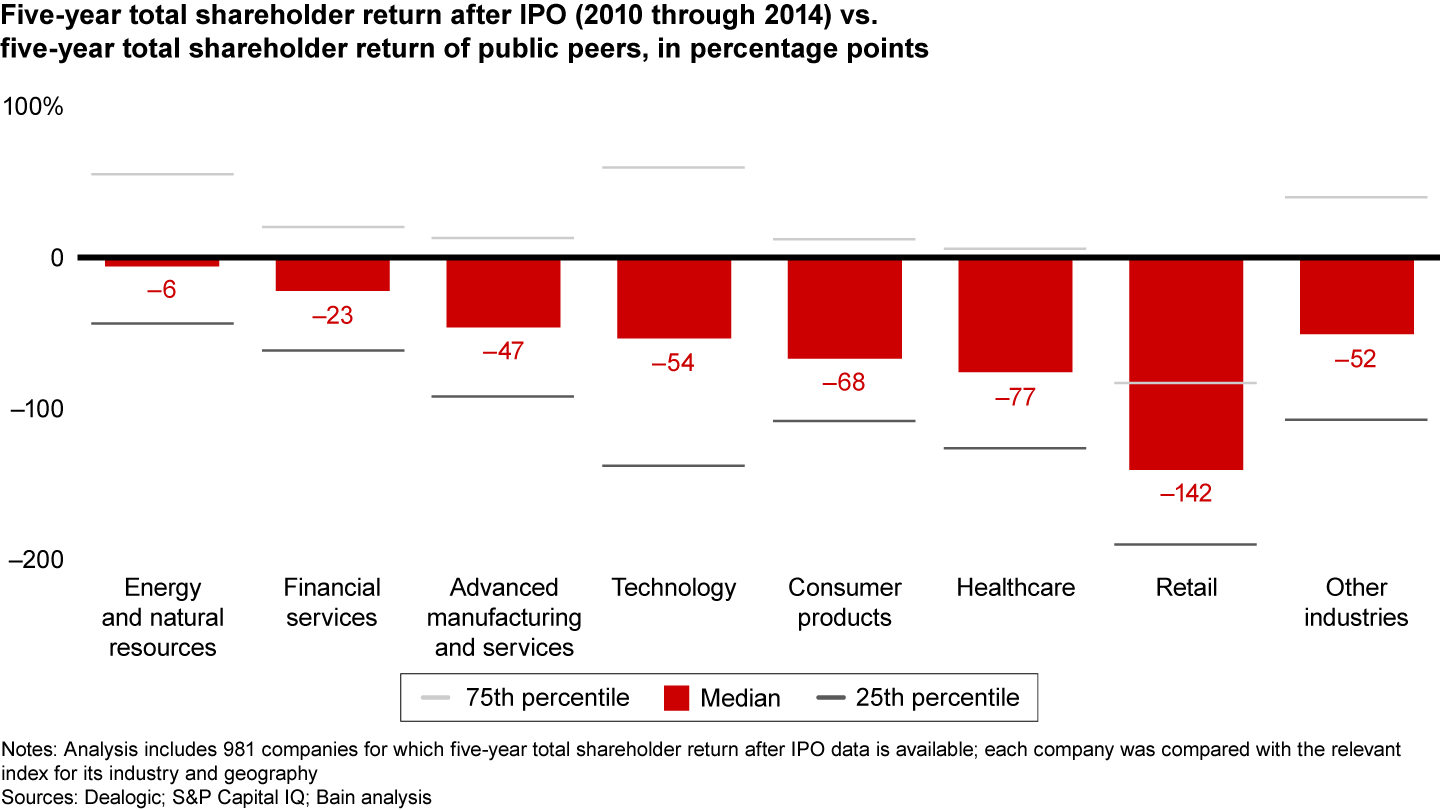
Their disappointment has a firm grounding in reality, though not for the reasons typically cited. New Bain & Company analysis shows that two-thirds of global IPOs that stayed public from 2010 through 2014 underperformed their established, publicly listed peers, with a weighted annual average 0.4% total shareholder return (TSR) vs. 8.4% for their respective indexes by geography and industry (see Figure 1). The underperformance spans regions, industries (see Figures 2 and 3) and prior ownership, including private equity (see the sidebar, “IPOs by the numbers”).
Figure 1
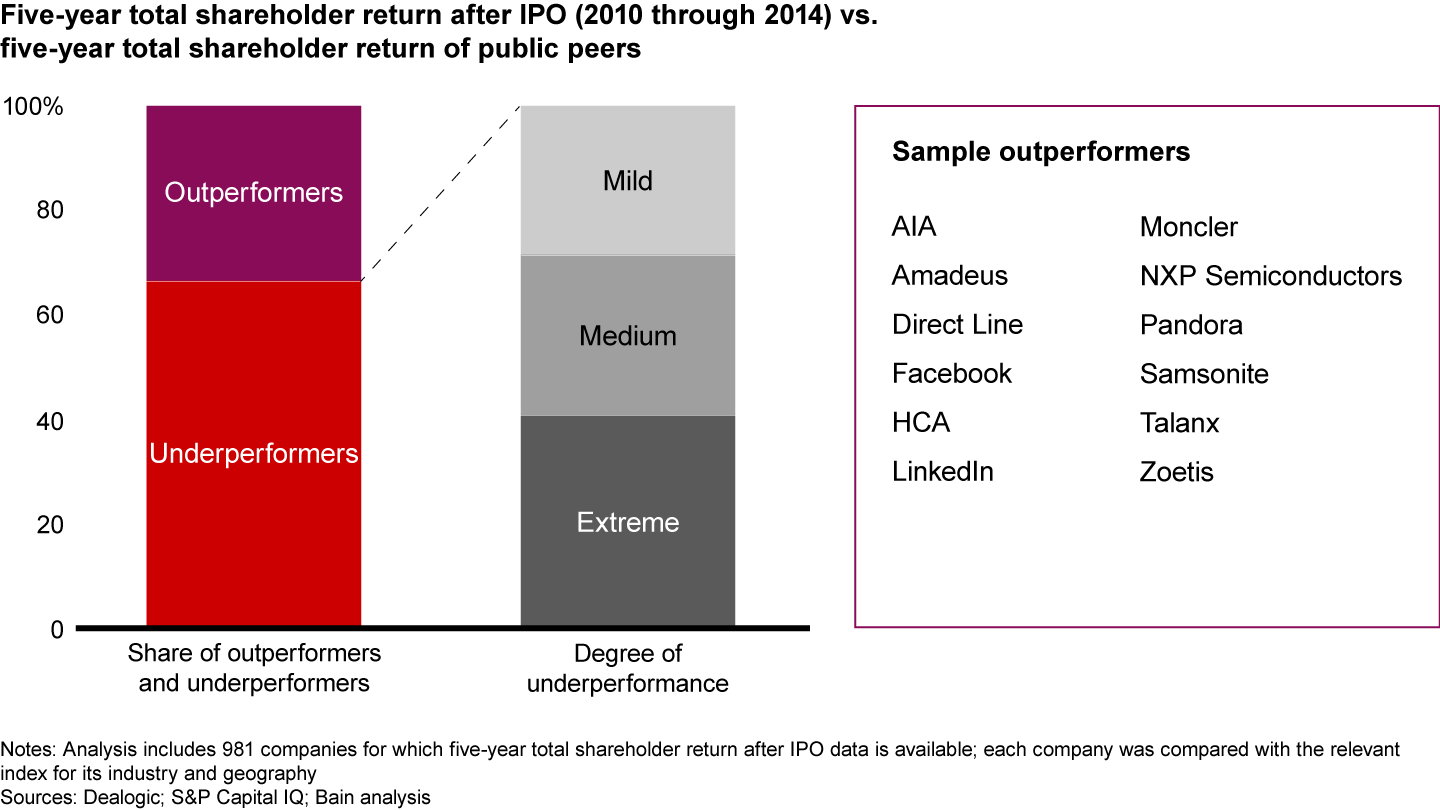

Figure 2
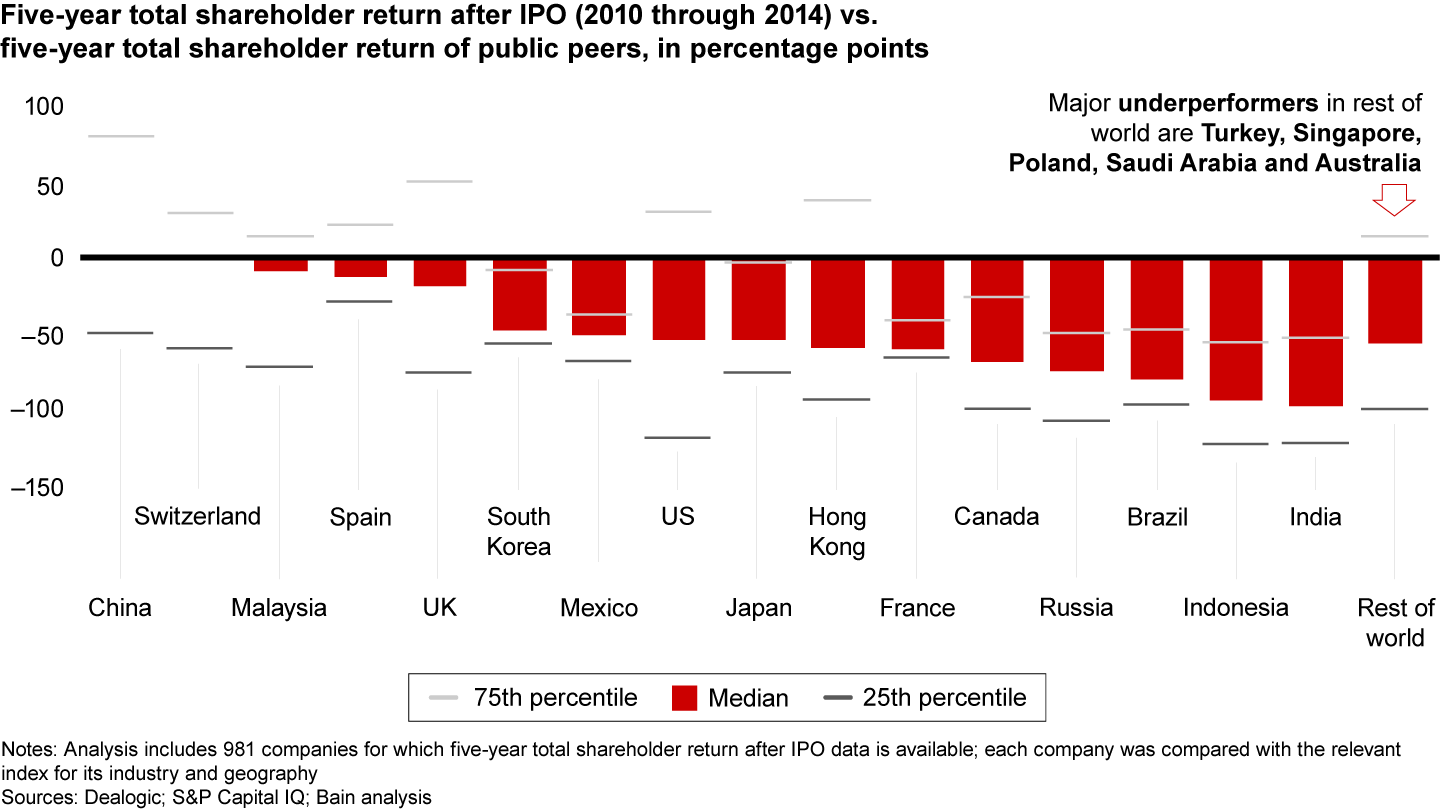

Figure 3

In fact, money has been flowing in the other direction. Over the past 20 years, private market capital globally has grown at more than double the rate of public capital, and there’s no slowdown in sight. In the US, the number of annual IPOs also has fallen over the past four decades, according to data compiled by finance professor Jay Ritter. And the number of public companies in the US has dropped from 8,090 in 1996 to 4,397 in 2018, according to the World Bank.
Meanwhile, since the start of the current economic cycle in 2009, investors have allocated a staggering $7.1 trillion globally to private equity because of its relatively strong performance, and the debt markets have been eager to finance transactions.
Yet IPOs remain relevant for companies that need substantial capital in order to fulfill growth ambitions. An IPO helps a company gain recognition and credibility, which is relevant for building an ecosystem of partners in the company’s market. Also, companies can use new shares as an acquisition currency when trying to consolidate within their industry.
For example, French cosmetics company L‘Occitane decided to publicly list in Hong Kong, partly because Asia had become the fastest-growing market for luxury goods. Further, going public presents an opportunity to attract key talent through employee stock options plans.
Post-IPO performance, then, is critical for the companies, for their investors (including the private equity funds that retain partial ownership) and more broadly for the economies in which they operate.
How can companies going public ensure that they join the elite one-third that outperform their public peers in TSR, a group that ranges from Spanish travel software company Amadeus to US animal health company Zoetis?
Superior performance requires not only a mastery of IPO mechanics but also a sound, detailed post-IPO growth strategy. It entails a practical plan embraced broadly within the organization that lays out where growth will come from, how the company will execute with operating rigor, what systems are in place to track progress, and who is accountable for keeping the plan on track and keeping the faith with investors.
One such IPO success was Pinnacle Foods, a US maker of food staples. Private equity firm Blackstone bought Pinnacle in 2007 then took it public in 2013. Pinnacle’s stable cash flows attracted unusual demand among investors. But the IPO plan included other components as well. Under Blackstone, Pinnacle set a productivity initiative that generated annual productivity savings of 3% to 4% in procurement, manufacturing and logistics. The company used “foundation brands” as cash cows to fund the growth of “leadership brands.”
The next five years saw the stock price increase steadily as its well-known brands rode the tailwinds in the frozen foods and snacks categories. In 2018, when Conagra decided to buy Pinnacle as the perfect complement to its existing food portfolio, Pinnacle had realized a fivefold increase in value.
Our analysis of IPOs teased out three common themes that outperformers grasped as essential to their long-run relationship with investors and over which mediocre and poor performers stumbled.
Proper perspective: This is just the start
First, the outperformers put the IPO into proper perspective—namely, as a beginning and a means to an end rather than any kind of end in itself. Too many firms underestimate the demands of being a public company. That leads them to skimp on resources for a complex undertaking or focus on near-term needs rather than the long-term vision that will enable the company to thrive in the years ahead. Some underperformers may also suffer from poor financial controls. About 20% of companies that filed for IPOs in 2019 disclosed serious issues with internal controls over accounting and financial reporting, an analysis by Audit Analytics reported.
By contrast, winning companies view the IPO as a springboard to longer-term value creation by using the proceeds in ways that maximize long-term value. They have already defined the vision for revenue growth, cash flow and, yes, profitability, along with a path to achieve those goals and alignment among the senior leaders about the vision. They take time to determine a winning post-IPO strategy, including where to play (which products, geographies and customer segments to focus on) and how to win (what pricing, execution methods and model for delivering value to customers).
Perhaps the toughest challenge is to mobilize the entire organization for life in the public eye. People accustomed to more of a start-up or early-stage environment without the pressure of quarterly reporting now have to tighten up their acts. Some of their goals will differ from the earlier incarnation of the company.
Senior leaders will need to identify and promote the desired behaviors that will deliver what customers want along with economics that please investors. The strategic plan must name the owners accountable for streams of growth, for operating rigor, and for systems to formulate key indicators and to track progress. In addition, the plan should commit to deploying the most capable employees to those streams of growth in order to raise the odds of creating the greatest value.
One leading European IT services company used the IPO process to develop a detailed plan for determining where to play and to clarify how to win within select customer segments and products. The plan included detailed responsibilities and milestones required for successfully delivering in the public market. Moreover, it energized and mobilized senior leaders and employees toward the agreed goal.
Pre- and post-investors: Two species, two sets of incentives
Many of the newly public companies that outperform their established peers have gleaned how pre- and post-IPO investors have fundamentally different objectives and incentives. Private company investors look for liquidity, want as high a valuation as possible and frequently push executives to tell as rosy a story as possible in order to maximize the proceeds at the IPO. Eager companies comply but often don’t have the wherewithal to reach such lofty ambitions. Investors after the IPO have other priorities and look, in particular, for a practical scenario with some blend of growth and profits that the company can achieve.
The trouble is that investment banks rarely offer helpful guidance on how to bring the equity story to life. Newly public companies may have a rudimentary or ill-equipped investor relations function that does not communicate effectively.
Worse, in some cases, there is no direct link between the story and the path to value creation, a phenomenon that plagued companies at the heart of the 2000 dotcom bust, such as pets.com, Webvan and Flooz. Investors’ trust in management is critical yet fragile, which partly accounts for the recent WeWork and Uber share price reversals.
Consider the history of NXP Semiconductors. When NXP split from Philips in 2006, it was suffering from heavy losses, a lack of strategic direction, high costs and organizational complexity. Now that it could stand alone, senior management began a restructuring program to streamline the organization in order to boost productivity and speed. The business also executed a major operational turnaround, resulting in a sharp reduction in the cost base. These moves set up an IPO in 2010, which helped pay down debt. The compelling story for investors included a strategy shift to focus on less capital-intensive manufacturing, complex segments where it had an advantage in research and development and high-growth markets, all while shedding some noncore businesses.
Post-IPO, NXP continued restructuring. Timing helped, as 2010 was the first year of recovery for IPOs more broadly. Outsized earnings growth combined with burgeoning segments for future growth appealed to investors, and the share price grew sevenfold over the five-year period in our analysis.
Outside help: It takes a village
Any IPO candidate needs technical capabilities to prepare for the launch. But companies that eventually outperform don’t rely solely on transactional help, such as the services provided by investment banks and the various boutique advisory firms that are motivated to maximize IPO proceeds. They also emphasize strategic support that will help build long-term value creation.
They engage the appropriate investors for the IPO with a coherent story about the business model and target market. For instance, they would bring long-term-oriented growth investors predominantly on board vs. short-term-oriented tactical hedge funds. They get the timing right and reserve alternate windows of time as a backup, plus they have a plan B if the IPO route fails.
Valuing newly public companies is always tricky given the lack of a track record in most cases as well as uncertainty about how management will adjust to the intense scrutiny of quarterly earnings calls and real-time feedback on their performance in the form of share prices. Executives who have prepared for life beyond the IPO will welcome that direct feedback. They position themselves to earn investors’ trust. Ample preparation by the senior team spread throughout the entire organization raises the odds of sustained growth and superior TSRs for years to come.
Hubert Shen is a partner with Bain & Company’s Mergers & Acquisitions and Private Equity practices. Henrik Poppe leads the Corporate Finance practice in Europe, the Middle East and Africa. Mike Kühnel is a partner with Bain’s Financial Services and Corporate Strategy practices. They are based, respectively, in Los Angeles, Oslo and Frankfurt.
First published in 2月 2020