

論説

概要
- When Agile teams work in harmony with support and control functions, they create extraordinary results.
- Successful models are emerging for how support and control functions can support Agile teams, become more Agile themselves and redesign their processes to improve organizational agility overall.
Companies thrive because of their support and control functions, not in spite of them. The accountants who meticulously ensure the numbers are right, the lawyers who sniff out the dangers in bad contracts, the safety officers and the human resources pros who safeguard integrity and brand equity. Support and control functions like HR, finance, risk, legal, and tax build a business environment in which it is safe to experiment and innovate. But because these groups are paid to avoid problems, they can be skeptical when Agile Management ideas are introduced. They worry that business processes may turn sloppy and reckless. Agile teams are often equally uncomfortable, concerned that support and control staff will erect unnecessary roadblocks and create delays.
Agile teams and support and control functions can work in harmony, however, and when they do, they create extraordinary results. Consider the development, production and distribution of vaccines for the Covid-19 virus. Created and approved in under 12 months, these vaccines broke all speed records. Credit goes to the researchers and scientists who found the breakthrough approaches, of course. But support and control functions at the manufacturing companies certainly played a vital role, too, navigating accelerated regulatory approval, staffing, contracts, and more.
Two factors determine how long it takes an Agile team to release an innovation: the time for the team to do its work and the time waiting for things like budget approvals, legal advice, and staffing. How quickly that support arrives depends on many things: planning calendars, decision-approval processes, budgeting and funding cycles, software release schedules, legal or regulatory constraints, people allocation and more. If these stretch out, a company’s overall speed of innovation can remain stubbornly flat, even as it creates more and more Agile teams.
When Agile teams and supporting groups trust one another and collaborate effectively, they can speed things up by making smart trade-offs between risk and reward and reducing idle time. Low-risk activities may not require the same level of review, and understanding the greatest risks and key constraints is helpful for Agile teams, too.
Support and control experts can function as trusted advisers to innovation teams, and there are several ways to get there. Leading companies are already reimagining how these functions operate. We see three common opportunities.
- Provide resources and support to Agile innovation teams. Support and control functions partner with and provide support to Agile teams in the organization to speed innovation.
- Experiment with Agile methods. Seeking to become more Agile themselves, some support and control functions are running Agile teams within their own department to help meet their strategic priorities.
- Redesign support and control processes to improve organizational agility. Support and control staff redesign core processes—budgeting, planning, talent management, and others—to reduce the time Agile teams have to wait while also maintaining the required checks and balances.
Provide resources and support to Agile innovation teams
Agile teams work at a rapid pace that is ill-suited to the waterfall of approvals common in support and control departments (see Figure 1). These teams cannot pause and wait two to four weeks for legal or budgetary approval. But they need that help as much as any group. Reducing this waiting time significantly benefits the teams, and the overall pace of innovation in the company. Support and control functions must address Agile team requirements as quickly as possible, not simply handle requests on a “first in, first out” basis.
Figure 1
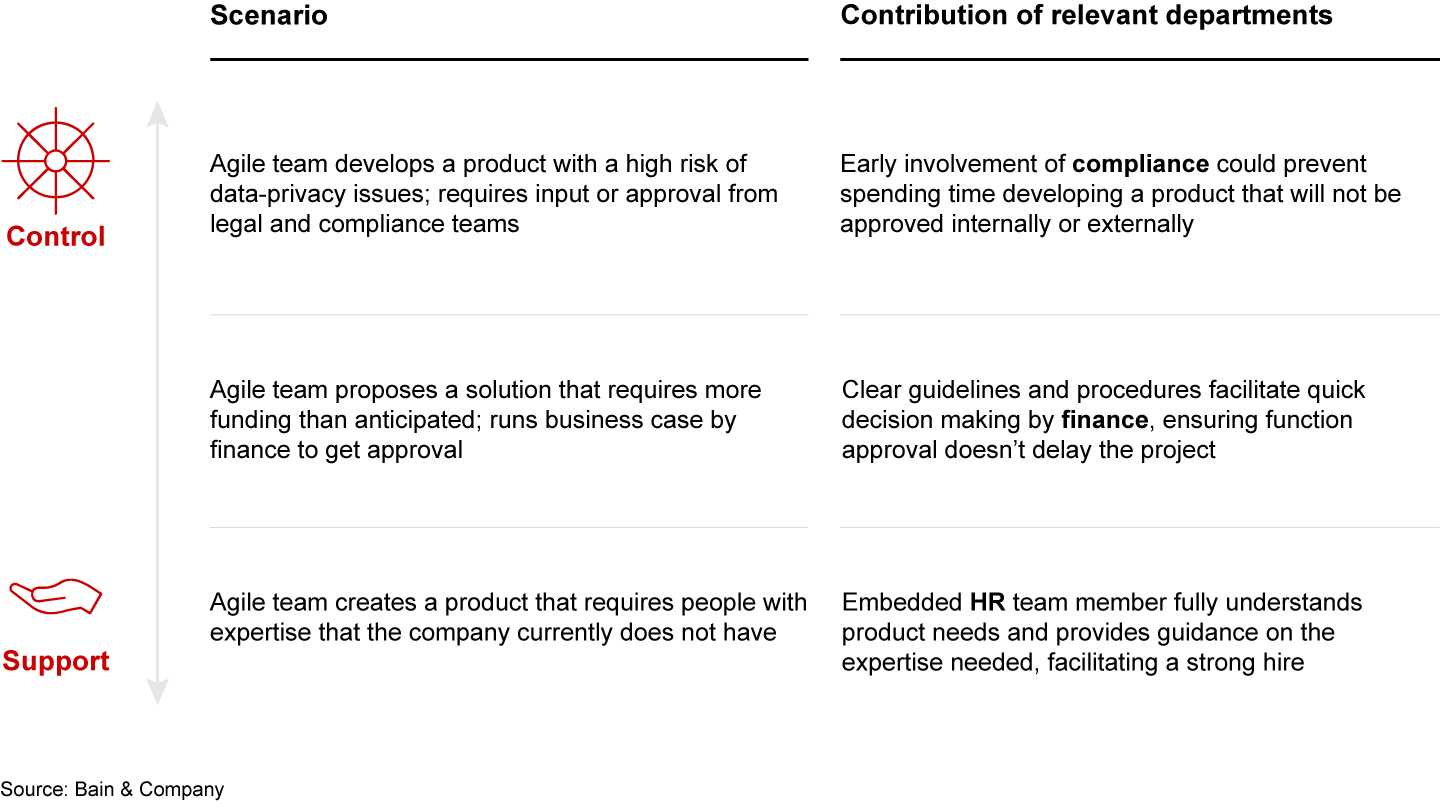

Support and control functions can engage with Agile teams in a few different ways.
In the first model, resources may be assigned full-time to Agile teams if demand is heavy. This usually works well in a high-profile project for which it is difficult to predict what resources will be needed and when. Involving support and control from the beginning makes managing that uncertainty easier. If demand is moderate, one or two experts may support a group of Agile teams.
In the second model, support and control resources serve as subject matter experts. They jump in at specific points in the project when the team needs their input and help. In this set up, the support and control groups keep track of the project by attending certain sprint reviews and meetings that the product owner or scrum master identify as key, but they are not embedded or dedicated to that team. Some set up “help desks” within these functions so that they can respond quickly to requests. Think of these as the priority desks that serve an airline’s most valuable customers. The staff is large enough to ensure valuable customers are not kept waiting and to break through typical red tape. Their level of expertise is high.
In both models, availability and responsiveness is key. Managers of Agile teams in research and development or client services often say that it is difficult to engage the support and control groups when they need them. These team leaders need to get on the radar of the right people at the right time. Because of how they operate, Agile teams need support more urgently and less predictably than traditionally managed groups. Communication can be especially challenging when support functions are located in different places from operating departments, as they often are in large enterprises.
Once assigned, Agile team resources need protection. To minimize the impact on other parts of the business, support and control functions may set up a rotational program that ensures coverage of the Agile team with minimal disruption for others. That function needs to decide whether their people will support a single Agile team or several. And it’s important to design strong career paths for people working on Agile teams.
Experiment with Agile methods
The best support and control functions constantly innovate and recognize that the teammates they work with are customers to be served rather than controlled. This is a different mindset, focused on collecting customer feedback and constantly examining their own function’s internal processes in order to operate more efficiently and effectively. Within most support and control functions, some activities are modular, and therefore suited to a test-and-learn approach and able to benefit from continuous innovation. Strategic business audits, decision support, finance transformation, training and recruiting, and talent development can all benefit from an Agile approach.
Fundamentally, there are two ways for support and control functions to continuously innovate. Either launching discrete Agile teams to address specific strategic issues as they emerge, or creating persistent teams to constantly collect, sequence and prioritize ways to improve (see Figure 2).
Figure 2
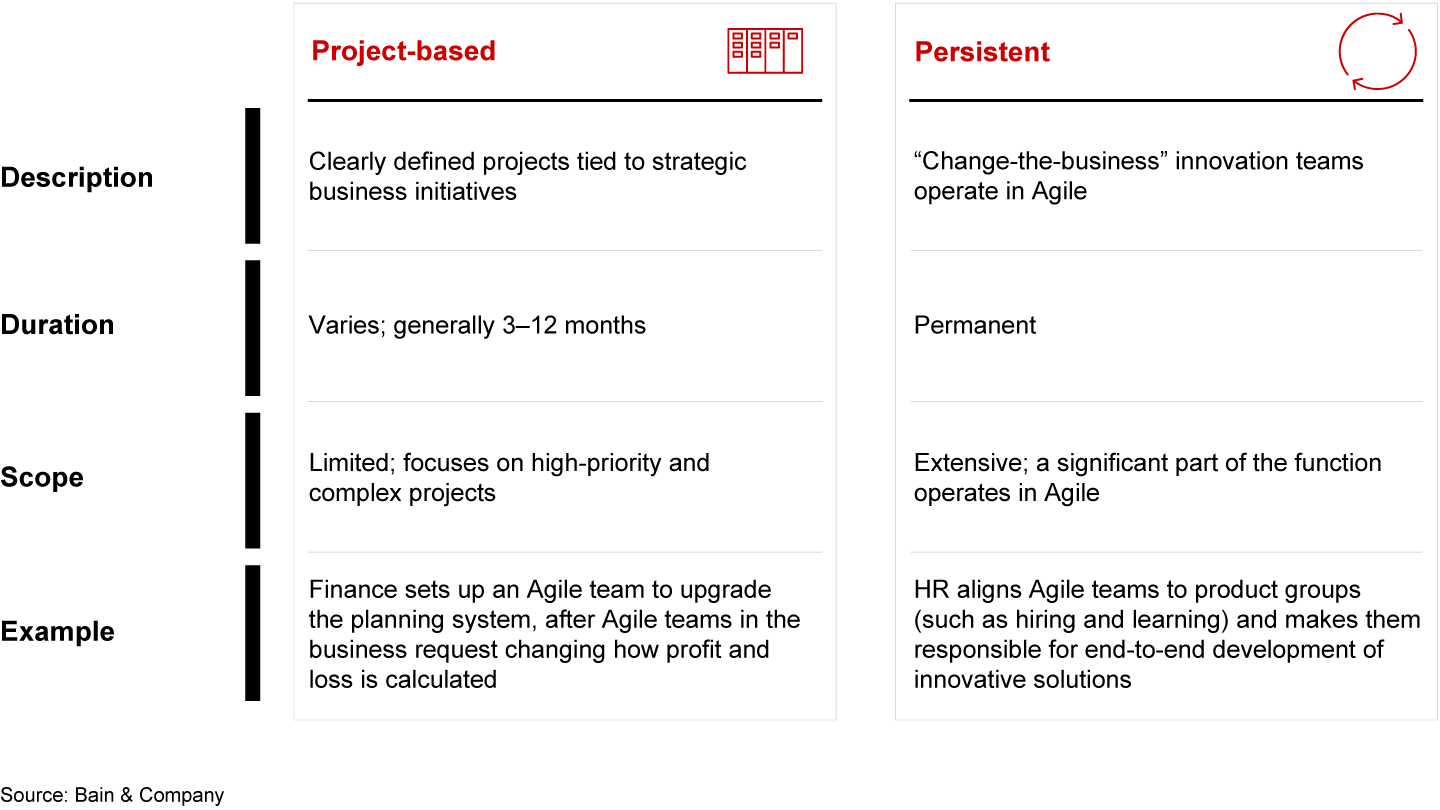

Project-based teams. The best way for any company experimenting with Agile to generate confidence with naysayers is to test the methodology and show results. The same is true for support and control functions. Today, there are multiple activities within support and control functions that can embrace Agile, including training, recruiting, forecasting and budgeting, and others. The challenges they take on may be tough. Financial planning, for example, is incredibly tough to get right. Perhaps because of this, the finance department has, over time, become home to many bureaucratic processes.
A global food and beverage company recently used a project-based approach to reinventing their financial planning processes, an important but time-consuming effort. An Agile team was created to increase both efficiency and accuracy. It began by exploring what users found difficult or painful about the annual financial planning process. It found that the bottom-up process was highly manual, required input from several hundred people around the world, and ate up three weeks out of every month. The estimates were calculated monthly, even though the business and the markets it participated in were highly stable. And they were not significantly more accurate than the company’s quarterly estimates.
The team designed a prototype of the new process and tested it with key stakeholders, including executive leadership, business unit general managers and finance leads, and the corporate controllers. Once fine-tuned based on the results of those early tests, the new process was further tested at a few business units in diverse places and types of markets. This approach worked. It produced the same results at a fraction of the time and people invested in the original system. A global rollout began soon after. The team’s work eventually led to an 80% decrease in transactional work, and became an example used to show other areas within the finance function how Agile can be deployed, allowing for broader scaling.
Persistent teams. Increasingly, companies are reorganizing parts of their support and control functions into fully dedicated, cross-functional Agile teams that constantly innovate and release new processes and services to the business. This structure ensures end-to-end ownership of experiences and capabilities and leads to improved results.
When a large retailer undertook an overhaul of its HR department, managers knew there were issues. Internal customer Net Promoter® scores were low, and service delivery was slow. To fix this, the department reorganized into persistent Agile teams focused on a set of capabilities including training, onboarding and rewards, among others.
These teams identified a number of issues. First, there was no end-to-end ownership of these processes, and no one was thinking collectively about an employee’s full experience. As these persistent teams began innovating and changing parts of the process, they began to see the process as an employee journey. Starting even before people join the company, the journey continues to the day they leave, with stops along the way at hiring, coming on board, training, and development for further advancement.
Using this approach, these teams were able to set priorities and stick to them. They stopped reactively responding to every separate request and creating bespoke solutions for each. Employees benefited, too. They now have a more connected set of experiences, and employee engagement scores have risen. The approach is spreading, with other Agile teams having now used it to more effectively promote important elements of the company’s education program, and get more employees to sign up. Finally, this Agile approach provides a much stronger mechanism for feedback when HR develops its offerings, resulting in programs that better match employee priorities.
Redesign support and control processes to improve organizational agility
In addition to collaborating with individual Agile teams, support and control functions play a critical role designing cross-functional processes that ultimately affect how all Agile teams operate. Their goal is to avoid forcing every decision or approval to go through support and control experts, so the experts take time to develop guidelines, checklists and templates that teams can use to make their own decisions within set guidelines. One example of this might be raising the spending thresholds for teams to make decisions without approval. Another might be allocating pools of funding that teams can shift among activities, stopping some things and starting others without outside approval, or it could be creating forms and templates for working with external partners that teams can use.
In the legal department, this may cover the requirements to launch a minimum viable product and overall compliance. In finance, it could focus on annual budgeting and planning (see the Bain Brief “How to Plan and Budget for Agile at Scale.”) In HR, hiring, performance management and career progression might be involved (see the article “Agile Is Not Enough.”)
In addition to cross-functional processes, support and control functions can also determine how much documentation Agile teams perform. In financial services, for example, Agile teams may be required to document every detail to satisfy regulators. Support and control functions can help strike the right balance between regulatory compliance and minimum viable documentation. As organizations mature in their Agile evolution, these processes will continue to change in order to promote even faster innovation.
Riot Games exemplifies how companies can take this approach to boost agility in support and control functions. The $1.6 billion developer of the wildly successful multiplayer online battle arena, League of Legends, Riot is taking support and control functions―facilities, finance, legal, internal communications, human resources and the like―that typically slow Agile teams, and turning them into an Agile platform upon which the entire company can innovate. They call it Product:Riot.
Product:Riot, like the rest of the company, aggressively focuses on serving its customers, but in this case its customers are Riot employees, or “Rioters.” All support and control procedures must be efficient, effective, and capable of keeping pace with rapid innovation. Sometimes traditional corporate software tools have had to be redeveloped from the ground up to serve Riot’s needs.
Rioters access Product:Riot resources through a flexible engagement model. Product:Riot team members can be embedded within a team or accessed through a shared service model where a single Product:Riot team member is the relationship manager for a set of Agile teams. All Product:Riot services come with Service Level Agreements with clear timelines for responsiveness, and the Product:Riot organization builds in buffer capacity to ensure it can meet spikes in demand and not be the bottleneck to innovation.
Product:Riot publishes philosophies and guidelines, but doesn’t publish strict rules unless they are really needed. For example, when the company’s engineering group wanted a unique set of talent analytics, Product:Riot gave them access to the data and engineering to independently build a dynamic funnel analysis that turned out to be so powerful it was then adopted across all of Product:Riot.
Not every business, such as highly regulated industries, can hand this much authority over to their teams. But Riot Games shows what is possible. Support and control functions can indeed be true partners in innovation, and organizations benefit when they are.
Net Promoter®, NPS®, NPS Prism®, and the NPS-related emoticons are registered trademarks, and Net Promoter Score℠, NPSx℠, and Net Promoter System℠ are service marks of Bain & Company, Inc., NICE Systems, Inc., and Fred Reichheld.
First published in 1月 2021