
Skip to Content
  • オフィス

    オフィス

    北米・南米
    • Atlanta
    • Austin
    • Bogota
    • Boston
    • Buenos Aires
    • Chicago
    • Dallas
    • Denver
    • Houston
    • Los Angeles
    • Mexico City
    • Minneapolis
    • Monterrey
    • Montreal
    • New York
    • Rio de Janeiro
    • San Francisco
    • Santiago
    • São Paulo
    • Seattle
    • Silicon Valley
    • Toronto
    • Washington, DC
    ヨーロッパ・中東・アフリカ
    • Amsterdam
    • Athens
    • Berlin
    • Brussels
    • Copenhagen
    • Doha
    • Dubai
    • Dusseldorf
    • Frankfurt
    • Helsinki
    • Istanbul
    • Johannesburg
    • Kyiv
    • Lisbon
    • London
    • Madrid
    • Milan
    • Munich
    • Oslo
    • Paris
    • Riyadh
    • Rome
    • Stockholm
    • Vienna
    • Warsaw
    • Zurich
    アジア・オーストラリア
    • Bangkok
    • Beijing
    • Bengaluru
    • Brisbane
    • Ho Chi Minh City
    • Hong Kong
    • Jakarta
    • Kuala Lumpur
    • Manila
    • Melbourne
    • Mumbai
    • New Delhi
    • Perth
    • Shanghai
    • Singapore
    • Sydney
    • Tokyo
    全てのオフィス
  • アルムナイ
  • メディア
  • お問い合わせ
  • 東京オフィス
  • Japan | 日本語

    地域と言語を選択

    グローバル
    • Global (English)
    北米・南米
    • Brazil (Português)
    • Argentina (Español)
    • Canada (Français)
    • Chile (Español)
    • Colombia (Español)
    ヨーロッパ・中東・アフリカ
    • France (Français)
    • DACH Region (Deutsch)
    • Italy (Italiano)
    • Spain (Español)
    • Greece (Elliniká)
    アジア・オーストラリア
    • China (中文版)
    • Korea (한국어)
    • Japan (日本語)
  • Saved items (0)
    Saved items (0)

    You have no saved items.

    後で閲読、共有できるようにするためにブックマークしてください

    Explore Bain Insights
  • 業界別プラクティス
    メインメニュー

    業界別プラクティス

    • 航空宇宙、防衛、政府関連
    • 農業
    • 化学製品
    • インフラ、建設
    • 消費財
    • 金融サービス
    • ヘルスケア
    • 産業機械、設備
    • メディア、エンターテインメント
    • 金属
    • 採掘・鉱業
    • 石油、ガス
    • 紙、パッケージ
    • プライベートエクイティ
    • 公共、社会セクター
    • 小売
    • テクノロジー
    • 通信
    • 交通
    • 観光産業
    • 公益事業、再生可能エネルギー
  • 機能別プラクティス
    メインメニュー

    機能別プラクティス

    • カスタマー・エクスペリエンス
    • サステイナビリティ、 社会貢献
    • Innovation
    • 企業買収、合併 (M&A)
    • オペレーション
    • 組織
    • プライベートエクイティ
    • マーケティング・営業
    • 戦略
    • アドバンスド・アナリティクス
    • Technology
    • フルポテンシャル・トランスフォーメーション
  • Digital
  • 知見/レポート
  • ベイン・アンド・カンパニーについて
    メインメニュー

    ベイン・アンド・カンパニーについて

    • ベインの信条
    • 活動内容
    • 社員とリーダーシップ
    • プレス・メディア情報
    • クライアントの結果
    • 受賞歴
    • パートナーシップを結んでいる団体
    Further: Our global responsibility
    • ダイバーシティ
    • 社会貢献
    • サステイナビリティへの取り組み
    • 世界経済フォーラム(WEF)
    Learn more about Further
  • キャリア
    メインメニュー

    キャリア

    • ベインで働く
      キャリア
      ベインで働く
      • Find Your Place
      • ベインで活躍する機会
      • ベインのチーム体制
      • 学生向けページ
      • インターンシップ
      • 採用イベント
    • ベインでの体験
      キャリア
      ベインでの体験
      • キャリアストーリー
      • 社員紹介
      • Where We Work
      • 成長を後押しするサポート体制
      • アフィニティ・グループ
      • 福利厚生
    • Impact Stories
    • 採用情報
      キャリア
      採用情報
      • 採用プロセス
      • 面接内容
    FIND JOBS
  • オフィス
    メインメニュー

    オフィス

    • 北米・南米
      オフィス
      北米・南米
      • Atlanta
      • Austin
      • Bogota
      • Boston
      • Buenos Aires
      • Chicago
      • Dallas
      • Denver
      • Houston
      • Los Angeles
      • Mexico City
      • Minneapolis
      • Monterrey
      • Montreal
      • New York
      • Rio de Janeiro
      • San Francisco
      • Santiago
      • São Paulo
      • Seattle
      • Silicon Valley
      • Toronto
      • Washington, DC
    • ヨーロッパ・中東・アフリカ
      オフィス
      ヨーロッパ・中東・アフリカ
      • Amsterdam
      • Athens
      • Berlin
      • Brussels
      • Copenhagen
      • Doha
      • Dubai
      • Dusseldorf
      • Frankfurt
      • Helsinki
      • Istanbul
      • Johannesburg
      • Kyiv
      • Lisbon
      • London
      • Madrid
      • Milan
      • Munich
      • Oslo
      • Paris
      • Riyadh
      • Rome
      • Stockholm
      • Vienna
      • Warsaw
      • Zurich
    • アジア・オーストラリア
      オフィス
      アジア・オーストラリア
      • Bangkok
      • Beijing
      • Bengaluru
      • Brisbane
      • Ho Chi Minh City
      • Hong Kong
      • Jakarta
      • Kuala Lumpur
      • Manila
      • Melbourne
      • Mumbai
      • New Delhi
      • Perth
      • Shanghai
      • Singapore
      • Sydney
      • Tokyo
    全てのオフィス
  • アルムナイ
  • メディア
  • お問い合わせ
  • 東京オフィス
  • Japan | 日本語
    メインメニュー

    地域と言語を選択

    • グローバル
      地域と言語を選択
      グローバル
      • Global (English)
    • 北米・南米
      地域と言語を選択
      北米・南米
      • Brazil (Português)
      • Argentina (Español)
      • Canada (Français)
      • Chile (Español)
      • Colombia (Español)
    • ヨーロッパ・中東・アフリカ
      地域と言語を選択
      ヨーロッパ・中東・アフリカ
      • France (Français)
      • DACH Region (Deutsch)
      • Italy (Italiano)
      • Spain (Español)
      • Greece (Elliniká)
    • アジア・オーストラリア
      地域と言語を選択
      アジア・オーストラリア
      • China (中文版)
      • Korea (한국어)
      • Japan (日本語)
  • Saved items  (0)
    メインメニュー
    Saved items (0)

    You have no saved items.

    後で閲読、共有できるようにするためにブックマークしてください

    Explore Bain Insights
  • 業界別プラクティス
    • 業界別プラクティス

      • 航空宇宙、防衛、政府関連
      • 農業
      • 化学製品
      • インフラ、建設
      • 消費財
      • 金融サービス
      • ヘルスケア
      • 産業機械、設備
      • メディア、エンターテインメント
      • 金属
      • 採掘・鉱業
      • 石油、ガス
      • 紙、パッケージ
      • プライベートエクイティ
      • 公共、社会セクター
      • 小売
      • テクノロジー
      • 通信
      • 交通
      • 観光産業
      • 公益事業、再生可能エネルギー
  • 機能別プラクティス
    • 機能別プラクティス

      • カスタマー・エクスペリエンス
      • サステイナビリティ、 社会貢献
      • Innovation
      • 企業買収、合併 (M&A)
      • オペレーション
      • 組織
      • プライベートエクイティ
      • マーケティング・営業
      • 戦略
      • アドバンスド・アナリティクス
      • Technology
      • フルポテンシャル・トランスフォーメーション
  • Digital
  • 知見/レポート
  • ベイン・アンド・カンパニーについて
    • ベイン・アンド・カンパニーについて

      • ベインの信条
      • 活動内容
      • 社員とリーダーシップ
      • プレス・メディア情報
      • クライアントの結果
      • 受賞歴
      • パートナーシップを結んでいる団体
      Further: Our global responsibility
      • ダイバーシティ
      • 社会貢献
      • サステイナビリティへの取り組み
      • 世界経済フォーラム(WEF)
      Learn more about Further
  • キャリア
    人気検索キーワード
    • デジタル
    • 戦略
    前回の検索
      最近訪れたページ

      Content added to saved items

      Saved items (0)

      Removed from saved items

      Saved items (0)

      論説

      The Chief Transformation Officer: Your Navigator for the Uncharted Waters Ahead

      The Chief Transformation Officer: Your Navigator for the Uncharted Waters Ahead

      In transformations that create sustainable results, the CTO plays five critical roles.

      著者:Raj Pherwani, Peter Slagt, Nathalie Lundqvist, and Amber Erskine

      • min read
      }

      論説

      The Chief Transformation Officer: Your Navigator for the Uncharted Waters Ahead
      en
      At a Glance
      • Large-scale change efforts achieve 24% more of their planned value when a dedicated CTO oversees them, Bain data shows.
      • There are five critical roles a CTO must play, often simultaneously: strategic architect, integrator, operator, coach, and controller.
      • Many CTOs are in the position for the first time and often don’t have a predecessor to lean on, making external coaching or peer mentoring highly valuable.

      To adapt to today’s pace of change, many companies must fundamentally transform how they work, behave, and perform. A growing body of evidence indicates that, to be successful, this kind of large-scale transformation needs a dedicated chief transformation officer (CTO) to partner with the CEO and help navigate change. Early data from Bain & Company’s ARCSM database of corporate transformations shows that large-scale change efforts achieve 24% more of their planned value when overseen by a dedicated CTO.

      Many CEOs are undertaking transformation on this scale for the first time and selecting their first CTO. It’s also common for the person filling the position to be a first-time CTO, pulled from within the organization to take on a challenging and exciting role with broad impact. Given this novelty, defining the role and selecting the right person to fill it should both start with an understanding of what a CTO does that makes such a difference.

      Based on input from more than 250 CTO attendees of Bain Full Potential Transformation Forums over the past five years and our work on more than 700 transformations, we’ve identified five critical roles a CTO must play: strategic architect, integrator, operator, coach, and controller. Each role will be important at different times (see Figure 1). Often, a CTO plays several at once.

      Figure 1
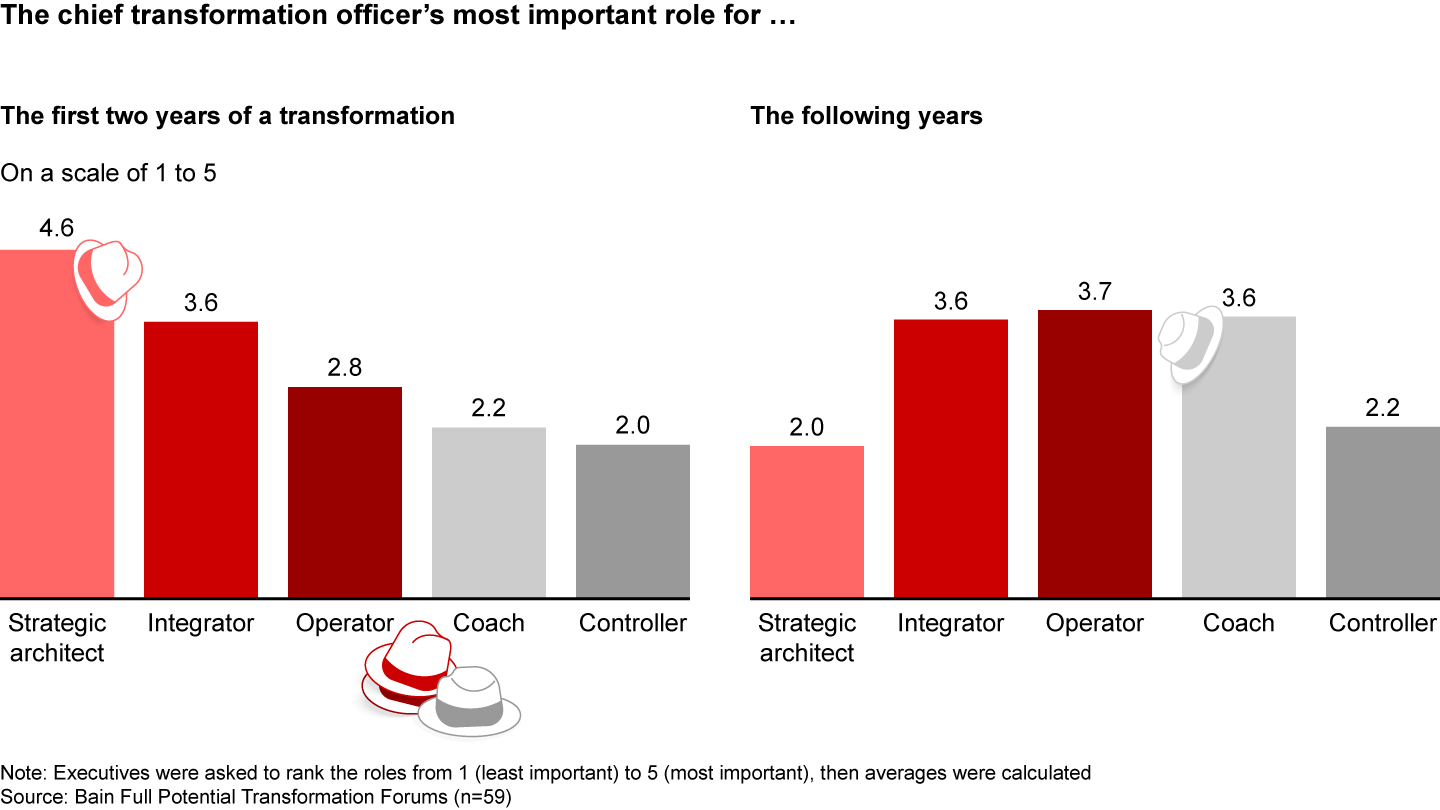
      The CTO wears many hats, often simultaneously

      The former CTO of a global technology company compares the job to using a Swiss Army knife: “There are multiple tools in the knife. You have to use them all at one point or another and be equally adept at all of them.”

      Read more about how we help CTOs

      Chief Transformation Officer Advisory

      With 700-plus transformations completed over the last decade and more than 250 CTOs having attended our transformation forums, we have built a community of coaches and a robust curriculum that can be tailored to the individual CTO and their needs.

      Evolution of the CTO’s role

      In the initial stages of the transformation, the strategic architect is the single most important role, according to the executives we surveyed.  

      As strategic architect, the CTO advises and aligns the CEO and the executive team on their shared ambition and what the transformation will involve. The CTO also shapes the portfolio of initiatives and ambition, articulates how all that work will be done, and identifies who among the company’s A-level players will be needed to lead the work.

      At this early stage, commitment from the top of the organization is key to building the momentum needed to get the transformation off the ground, as one major biotech company discovered. Facing the simultaneous expiration of valuable patents, the advent of several biosimilar drugs, and weak return on its R&D investments, the company wanted to expand its most strategically promising areas, financing that growth by reducing its cost structure and improving efficiency. In a series of full- and half-day workshops, the CEO and the executive leadership team, including the CTO, designed the transformation. Rather than pushing the executives in a certain direction, the CEO invited them to help set the course, seeding leadership buy-in that would, along with strong support from frontline managers, buoy the transformation over the next three years through the launch of more than a dozen initiatives.

      The integrator role, connecting the value expected from the transformation program to its delivery, is also critical from the beginning. As integrator, the CTO builds the organization’s capacity for change and cultivates new leadership behaviors that ensure sustainable results. This often requires simultaneously working on strategic initiatives designed to change the business while supporting the efficient running of everyday operations.

      In order to maximize return on investment, the CTO, as the one person who can see across the transformation, must identify, prioritize, and facilitate the funding of—with capital, people, and time—the highest-value initiatives. At the biotech, the transformation team carefully studied where the company derived value and where value was wasted. Savings from its efforts—more than $1 billion over three years—were split between shareholders and funding the transformation priorities. Instead of each functional group (IT, digital, etc.) reallocating its own funds, the company created one large investment budget and a marketplace of ideas to determine its allocation. Among the strategic priorities successfully funded in this manner was a three-year reduction in the time it took the company to develop a new drug.

      Integrating different parts of the organization and helping silos work together is necessary because the solution to many of the challenges that arise will require the involvement and leadership of various parts of the company. The CTO must at the same time manage the transformation team’s capacity, setting realistic expectations, or risk burnout. The most successful CTOs do this by avoiding politics, acting as diplomats between functions and levels of the organization while pragmatically focusing on its evolution.

      Delivery and implementation

      Later, as strategy and design become clearer, the operator, coach, and controller roles become more critical to the transformation program.

      In the operator role, CTOs plan and guide initiatives that bridge multiple functions and business units. They solve problems, manage conflicts that inevitably arise, and rally operational business leaders by identifying their concerns and helping address operational issues.

      As coach to the CEO and top executive team, CTOs support their journey of adoption by listening to their concerns and revising and adapting plans based on that input. To strengthen organizational capability, they also identify the limited number of key skills an organization needs to win market share, put the best people in those roles, and offer them training and coaching.

      At the biotech, the CTO selected early on a set of change agents (people in the line businesses who were highly credible and trusted) and assigned five or six of them to each initiative in the transformation. They helped the CTO spot when things were on track and when they were falling behind—with such success that, after two months, the company doubled the number of change agents. By the end of the program, as its scope increased, 300 people were in the role.

      Like any great coach, the CTO must also be a master communicator, the cheerleader providing encouragement and inspiration, celebrating progress and victories, and injecting energy and confidence into the organization.

      In the controller role, the CTO manages risks, ensuring a “red is good” mindset that values honest reporting and early warnings. This includes watching out for “watermelons”—initiatives that look like they are going well on the outside (green) but just below the surface are struggling (red). The CTO and their team track progress and help overcome roadblocks as they arise. When they are able to create a sense of urgency based on this experience, a CTO can help the transformation log early successes, giving the project energy and momentum.  

      Seeking mentorship

      CTOs can’t do all this alone. They must build a team of leaders with complementary skills and strengths. But even with a great team, the CTO role is a challenging and often lonely one. Most won’t have a predecessor to lean on for guidance or the opportunity to benefit from external coaching or mentoring by someone who’s filled the CTO position elsewhere.

      The CTO of a large technology company acted as a mentor for a newly appointed CTO at the biotech firm. The two met when the biotech’s CEO invited the tech CTO to company headquarters to share his company’s transformation journey with the executive team. After a full session and plenty of discussion of questions like “What is a transformation, really?” the biotech CEO, CTO, and executive team had confidence that they, too, could embark on their own transformation. The biotech CTO recalls how the tech executive helped him “understand the cross-currents that I had to negotiate early on in my CTO role,” and how later he continued to reach out periodically “when I needed to check my thinking or bounce something off of a trusted outside resource.”

      This kind of support is invaluable as CTOs learn to balance and rebalance the roles of strategic architect, integrator, operator, coach, and controller to fit the scope and focus of their own company’s transformation.

      著者
      • Headshot of Raj Pherwani
        Raj Pherwani
        パートナー, San Francisco
      • Headshot of Peter Slagt
        Peter Slagt
        パートナー, Madrid
      • Headshot of Nathalie Lundqvist
        Nathalie Lundqvist
        パートナー, Paris
      • Amber Erskine
        Practice Senior Manager, Atlanta
      関連するコンサルティングサービス
      • コスト・トランスフォーメーション
      • チェンジ・マネジメント
      • フルポテンシャル・トランスフォメーション
      チェンジ・マネジメント
      Business Transformation: Aim High

      Successful transformations call for ambition. Executives can maximize results by smartly managing launch, refinement, and execution.

      詳細
      チェンジ・マネジメント
      Building a Better Transformation

      These nine data-based practices can elevate any business transformation.

      詳細
      チェンジ・マネジメント
      There Are Two Ways to Manage Organizational Change: One Is Easy, the Other Is Better

      Today’s challenges are forcing leaders to rethink their approach to change management.

      詳細
      チェンジ・マネジメント
      Fighting the Battle for Energy: How to Reenergize Your Transformation for Its Second Half

      Every leadership team has its own dynamic, just as every CEO leads in his or her own way.

      詳細
      フルポテンシャル・トランスフォメーション
      Automotive Profitability: How OEM and Supplier Margins Are Faring

      The post-pandemic profit surge has reversed, as OEM margins have fallen more than 50% since 2023.

      詳細
      First published in 5月 2023
      Tags
      • コスト・トランスフォーメーション
      • チェンジ・マネジメント
      • フルポテンシャル・トランスフォメーション

      クライアント支援事例

      戦略 Virgin Australia: From Turbulence to Triumph

      ケーススタディを見る

      フルポテンシャル・トランスフォメーション An IT Distribution Company Champions Change But Stays True to its Customers

      ケーススタディを見る

      チェンジ・マネジメント Results360® Boosts a Pharmaceutical Company’s Stock Price 135%

      ケーススタディを見る

      お気軽にご連絡下さい

      私達は、グローバルに活躍する経営者が抱える最重要経営課題に対して、厳しい競争環境の中でも成長し続け、「結果」を出すために支援しています。

      ARC℠ is a service mark of Bain & Company, Inc.

      ベインの知見。競争が激化するグローバルビジネス環境で、日々直面するであろう問題について論じている知見を毎月お届けします。

      *プライバシーポリシーの内容を確認し、合意しました。

      プライバシーポリシーをご確認頂き、合意頂けますようお願い致します。
      Bain & Company
      お問い合わせ Sustainability Accessibility Terms of use Privacy Cookie Policy Sitemap Log In

      © 1996-2026 Bain & Company, Inc.

      お問い合わせ

      How can we help you?

      • ビジネスについて
      • プレス報道について
      • 採用について
      全てのオフィス