

論説
Executives at The Vanguard Group realized they had a problem.
Some of the big mutual-fund firm’s most important customers are brokers and advisors at large financial advisory firms—companies like Merrill Lynch, Edward Jones and Wells Fargo. These customers rely on Vanguard’s Financial Advisor Services division to handle their trades. But many of the advisors at these companies weren’t happy with one aspect of Vanguard’s operations. Whenever they submitted an order for a very large trade, they said, the order had to go through approvals designed as safeguards to protect shareholders against the potentially harmful effects of frequent trading and market timing. While clients understood that the caution was justified, the resulting uncertainty and delays often interfered with their ability to get the best price for their clients. Couldn’t something be done?
This wasn’t a problem that individual account reps at Vanguard could handle on their own. So the company assigned a team to come up with potential solutions, and it eventually implemented several process changes. For instance, Vanguard now has the ability to pre-verify certain trades so they can be executed quickly. Clients are happier, and the business runs more smoothly.
The “inner loop” of the Net Promoter SystemSM promotes individual learning. It lets frontline employees and teams hear both positive and constructive customer feedback directly and immediately. The inner loop enables them to implement whatever changes they can make on their own (see Figure 1). The “outer loop” is different: it supports improvements that go beyond the individual or team. Changes of this sort often involve new policies, processes, technology, pricing or even product features. They almost always cut across functions. Often, they require significant investment. They typically demand both detailed analysis and a decision to invest resources.
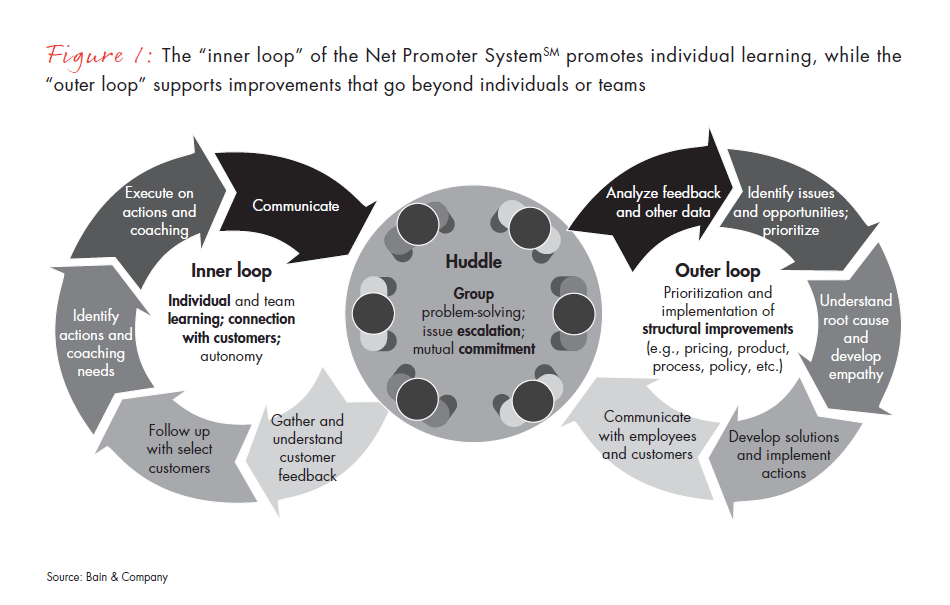
So the outer loop’s explicit purpose is to prioritize and support the kind of customer-friendly changes that employees and teams can’t make on their own. But there’s an implicit purpose as well. An effective outer loop makes employees feel supported. It gives them a voice in the firm’s priorities. It creates confidence that the company’s priorities support customer centricity—and that leadership is putting its money where its mouth is.
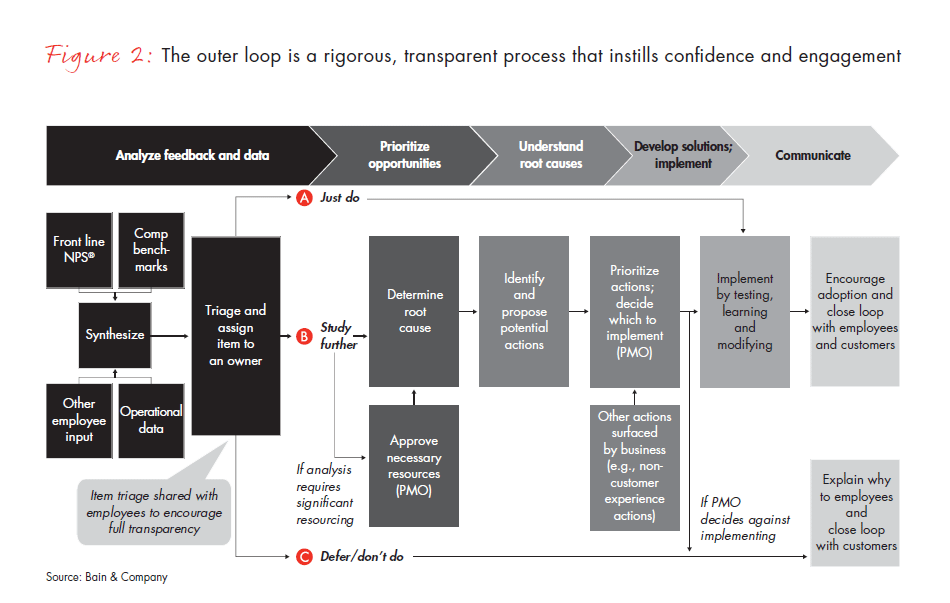
Structurally, an outer loop must employ a rigorous, well-defined process for addressing issues. A team—usually led by the customer advocacy office, or CAO—gathers input from a variety of sources. That team uses clear and explicit criteria to prioritize opportunities for improvement. The CAO makes recommendations to senior executives about which opportunities to address and who should be accountable for leading the charge against each one. The assigned team then investigates root causes and develops solutions. Throughout the process, the CAO makes sure that both customers and employees are informed about progress whenever doing so is relevant or required (see Figure 2).
All sorts of challenges arise, however, when a company creates this kind of mechanism. Companies often overlook valuable sources of data in identifying potential opportunities for improvement. They may fail to use adequate criteria when prioritizing opportunities. They may not work customer-focused improvements into the overall priorities of the business, resulting in competition for scarce resources. When it comes to addressing opportunities for change, many project teams leap too quickly to solutions, failing to fully identify true root causes first (see below, “Outer loop pitfalls and potholes”). Let’s look at what makes a good outer loop work.
Identifying issues: Sources of input
The data that feeds the outer loop begins with input from customers, but it doesn’t end there. In fact, there are four distinct sources of information the central team should review to identify issues:
- Data from the inner loop. This is the customer data. The team looks at all inner loop feedback. It identifies patterns, trends and changes in frequency. If a complaint crops up repeatedly, for instance—and if it can’t be addressed by frontline employees or teams—it’s grist for the outer loop mill. By the way, the feedback doesn’t have to come only from Net Promoter® requests. It can include feedback from customer complaint letters, customer research or any other source.
- Analysis of operational data. The outer loop team also digs into all the operational data that affects, or indicates opportunities in, the customer experience. Perhaps the company takes too long to process a new service order. Perhaps it gets too many repeat phone calls. American Express, for example, found that a large number of high-value card members had to call at least twice to get a lost card replaced, compared with only half as many for average-value card members.
- Employees. Frontline teams’ daily or weekly huddles often identify issues that can’t be resolved within the team. Frequently, employees throughout the organization share ideas for improving customer loyalty that are worthy of consideration. The annual employee survey often identifies issues that have their root in customer-facing capabilities or policies. Employees provide a rich source of opportunities for improvement.
- Marketplace insights. Competitors may have addressed an issue or opportunity in a way that merits consideration. Sometimes this comes to light through competitive benchmark Net Promoter research—for instance, a rival might get more positive feedback about fees and lateness policies from its customers, while your company gets more negative feedback. It can also come from other forms of competitive analysis. But direct competitors aren’t the only businesses worth looking at. A truly customer-centric management team has to scrutinize best practices from other industries as well. A bank can learn from Disney, a retailer from Apple, an insurance company from Amazon.
CAO teams that gather input from all these sources generally uncover far more opportunities than the company has resources to address. So the next task is to figure out which ones to take up first.
Rob Markey, a global leader in the Customer Strategy & Marketing practice, discusses why a robust, rigorous and transparent "outer loop" is essential to a solid Net Promoter System.
Prioritizing the opportunities
In the prioritization phase, the team creates a portfolio of initiatives with the most important ones at the top. The criteria for ranking them should be rigorous, explicit and transparent, so that everyone can understand what they are. For each initiative the team has to ask itself four critical questions—and then one more, an “X factor” that may shoot a seemingly secondary initiative to the top of the list:
- What will be the initiative’s impact? The team should assess the number of customers the change will affect, the number of employees involved and the magnitude of the impact on those customers or employees.
- How hard will it be to implement the initiative? This involves several subquestions. How many different functions, geographies and units are involved in the proposed initiative? Does it require complex technological changes? Does it need a large number of employees or customers to learn and adopt new behaviors? How big a step will it be to implement and scale up the changes?
- Is the organization ready to address the issue? Implementing a difficult or complicated change won’t work if a key department or functional group isn’t up to handling it. Perhaps a group is going through a system upgrade. Perhaps it has a new leader who isn’t yet comfortable in the job. Many such factors can compromise an initiative’s success.
- What is the timing of the economic impact? Companies can quantify the economic impact of a Net Promoter initiative if they understand the lifetime value of promoters as compared to passives and detractors. But some initiatives require a significant upfront investment while paying off over two or three years. If the company can’t easily absorb the short-term financial hit, the team may want to postpone expensive changes in favor of those with smaller total impact but greater benefit in the short term.
And then there’s the X factor, meaning the visibility and symbolic impact of the initiative on employees and customers. A given change might hit just a few customers a month and have a modest economic impact while resolving a longstanding irritant for a vocal subset of employees or customers. It might be largely meaningless to most employees but have a significant impact on the company’s reputation in the marketplace.
A CAO team that takes all these factors into account should be able to produce a carefully constructed portfolio of initiatives, one that is high in its impact yet entirely manageable and practical.
Addressing the opportunities
The process so far gives the CAO team a prioritized list of initiatives. It then must draw a cutoff line separating issues to be addressed now from those to be addressed later or discarded. It assigns every initiative above the line to an individual or group, and it ensures that those people have the authority and resources required to get the job done.
These groups then go to work. They identify the root causes of the issue they’re considering. They develop a broad set of potential solutions and select one. They create a business case to implement the solution. If the solution is approved, they test it out, scale it up and let the people who initially raised the issue know what the resolution was.
Right after one holiday season, for instance, Apple stores saw a drop in Net Promoter ScoresSM. Digging into the customer feedback, they saw an increase in complaints that the stores were understaffed, even though staffing levels hadn’t changed. Detailed root-cause investigation revealed that the drop in scores coincided with the week the sales reps had exchanged their bright holiday T-shirts for their signature Apple black T-shirts. So the team ran a controlled test in a set of stores, putting the colorful holiday shirts back on—and found that complaints about staffing levels dropped almost immediately. To this day, store employees wear distinctively colored T-shirts rather than the original stylish black ones.
Some of the issues that emerge from the outer loop process can be addressed in a single facility or functional group. Others are more complicated. The team needs to assign an appropriate level of resources and oversight to each one. Obviously, any project that makes its way onto the list requires a careful cost-benefit analysis. But the rigor behind the analysis should be commensurate with the resources required and the level of risk or uncertainty. Some wireless telecommunications companies, for instance, use Net Promoter and network data to create sophisticated economic models indicating the value of fixing dead zones in their mobile coverage networks. That’s a multimillion-dollar investment, and requires rather more rigor than a decision to change the T-shirts worn by store staff.
In all cases, however, it’s essential that the entire process be explicit and transparent. It should give confidence to frontline employees, middle management and others in the organization that persistent or systematic issues will be dealt with. You want people to think, Wow, they’re really taking this seriously. And you want employees to understand the reasoning behind decisions not to prioritize an issue they have raised. When someone says, “I believe the process was fair, even if I don’t agree with the decision,” you know she has faith in her organization and its customer centricity.
Rob Markey is a partner and director with Bain & Company’s New York office and leads the firm’s Global Customer Strategy & Marketing practice. He is coauthor of the best seller The Ultimate Question 2.0: How Net Promoter Companies Thrive in a Customer-Driven World.
Outer loop pitfalls and potholes
Companies often run into difficulty when setting up outer loop procedures. Among the most common traps are these:
- Incomplete sources of input. Outer loops based solely on market research or customer feedback are inadequate. Companies need to gather ideas from employees and peer practices as well.
- Insufficient rigor regarding prioritization. CAO teams often wind up with hundreds of ideas, far more than they can implement. But it’s hard to look someone in the eye and tell him that his idea is a low priority. So the list of initiatives just grows, and people wonder why things aren’t being done. It’s far better to create rigorous criteria for inclusion and then stick by the decision.
- Overly narrow scoping. Sometimes outer loop processes focus only on customer service. But the elements that create customer advocacy also include product, pricing, policy, promotion, process, technology and people—all the elements of the value proposition. So prioritization for the outer loop has to be integrated with the prioritization of any initiative in the business. It’s not a standalone process.
- Little project management oversight. The team gears up initiative after initiative, but nobody checks on these projects to see whether they are on track or off track. Lacking such oversight, people make up their own objectives and declare everything a success. Often, intervention by a senior executive at a couple of points along the way can make the difference between wild success and abject failure.
- Lack of sufficient transparency. Many management teams feel anxious about sharing the pipeline with employees and giving them regular updates. They’d prefer to keep their decisions private. Or, they simply don’t think it’s worth the time to communicate what’s going on. Either way, employees wonder what on earth happens to the ideas they submit. Eventually, they lose faith in the process.
Net Promoter® and NPS® are registered trademarks of Bain & Company, Inc., Fred Reichheld and Satmetrix Systems, Inc.
Net Promoter SystemSM and Net Promoter ScoreSM are trademarks of Bain & Company, Inc., Fred Reichheld and Satmetrix Systems, Inc.
First published in 6月 2015