

論説
In recent years, medical device manufacturers have embarked on an acquisition binge. We’ve seen a series of blockbuster deals—Medtronic’s acquisition of Covidien, Zimmer Holdings’ merger with Biomet and Johnson & Johnson’s purchase of Synthes, to name just a few— as well as numerous smaller transactions. This M&A bonanza has been sparked in part by the belief that absolute scale creates competitive advantage.
But does it? In many other industries, we find a clear correlation between overall scale and profitability. Classic strategy has long focused on building scale because larger companies tend to wield more influence with customers and have a greater ability to maintain pricing discipline. They also benefit from the most accumulated experience with driving down costs and can spread costs over the widest base of business.
Many healthcare trends would suggest that overall scale is essential for superior economics and indeed survival. Hospitals and other healthcare delivery systems have been consolidating. We’ve seen more sophisticated customer buying behaviors, both direct and via group purchasing organizations. Finally, new business models have emerged, including accountable care organizations and various payment reform initiatives. These trends add up to increased pricing pressure on medical device vendors and suggest that overall scale should produce superior economics.
Yet in medtech, the correlation between industry scale and profitability is quite weak. Instead, Bain research shows that profitability is more a function of category leadership than overall scale. Accumulating follower positions across categories creates aggregate scale but leads to poor economics. In short, medtech companies pursue breadth over depth at their peril (see Figure 1).
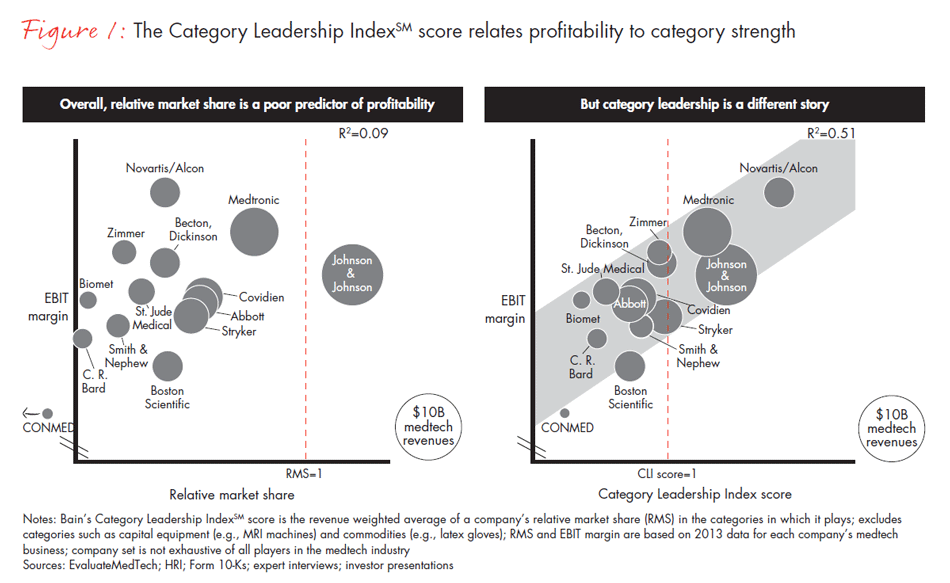
CONMED, for example, competes in multiple categories and is a distant follower in nearly all of them. In contrast, Medtronic (prior to acquiring Covidien) enjoyed industry-leading economics in part due to its commanding leadership in spine and cardiac rhythm products. This conclusion, which Bain recently also found to be true in the pharmaceutical industry (see the related Bain Brief), raises critical questions about how medtech companies should frame their portfolio, M&A and R&D prioritization strategies.
Why category leadership matters
Within a given category, leaders tend to enjoy a series of benefits that followers within that category cannot match:
- Feet on the street. With more feet on the street, better brand recognition, deeper clinical expertise and more relevant products, their sales, marketing and medical education teams can reach more physicians. Because of their depth, category leaders typically boast higher account densities per region and higher share of wallet within accounts.
- Deeper customer insights. Category leaders know more than category followers about the needs of the physicians who use their products. They also have privileged insight into the perspectives of other key stakeholders, including nurses, technicians, materials managers, procurement professionals and service line administrators. Category leaders know which products and features are in greatest demand, and how those products impact hospital economics. This knowledge helps them optimize their innovation efforts.
- Commercial clout. Category leaders have the customer knowledge and commercial clout to reshape the categories in which they compete, by introducing new business models such as value-added services and alternative pricing models. Compared with category leaders in consumer products or industrial goods, medtech leaders have been slower to embrace these innovations, but they are well positioned to lead the charge.
- Bidding power. Because category leaders have the most extensive category depth, they are also better positioned to compete for category-specific requests for proposal (RFPs) and tenders, which are increasingly limited to a few top players in each category.
- M&A advantage. Category leaders tend to have first rights when it comes to acquiring new, related assets. Leaders can pay a premium for these assets because they have more rapid and effective commercialization platforms, and category leaders have better insight into what new technologies will resonate with their customers.
- Bigger and better data. Category leaders will have a superior ability to aggregate data in support of efficacy claims, which is a nascent but growing customer need. As private and public payers increasingly seek data to prove clinical and economic outcomes, category leaders should benefit because they tend to have richer and longer data sets at their disposal. This happy state is likely a few years away in the US, but in certain markets (notably Europe) data analysis is already emerging as an important differentiator for medtech companies.
For all these reasons, category leadership should drive superior economics today and in the future. More important, few of these benefits accrue to companies with broad product portfolios across multiple categories in which no leadership positions are held. Some medtech companies, such as Medtronic, Stryker and Johnson & Johnson, have prospered by achieving leadership in multiple categories. Although many medtech companies have tried to create superior value by leveraging sales channels, physician relationships, R&D expertise and market intelligence across disparate categories, we have yet to find an example where a one-stop-shop offering beats the best of breed.
Category leadership does not preclude a company from adding new categories. Rather, it highlights the importance of entering those categories with a clear path to leadership in mind. This might require multiple M&A moves over time or a single well-placed acquisition. In 2010, for example, Stryker became a category leader in the neurovascular market by acquiring Boston Scientific’s neurovascular division.
Customers define categories
Category leadership starts with a deep understanding of the markets in which you compete. A category is not just a product or technology platform, nor is it a function of how companies happen to be organized. Rather, a category is a group of products that are bought using a common purchasing process managed by common stakeholders. These products serve a defined set of end users and often exist within a common competitive set.
There are important nuances to consider here. For instance, categories should not be so narrowly defined that they can only be served by one product. More often, competing treatment protocols and adjacent technologies exist for each individual product. Clinicians and administrators naturally tend to create sets of related products. However, it makes little sense to define categories so broadly that no customer could possibly make decisions across them. For example, hospitals buy hundreds of surgical instruments, ranging from power tools to handheld scalpels to trocars to surgical headlamps. Yet these products are purchased for different uses, through different processes and from different competitive sets. For all these reasons, the category “surgical instruments” is too broad to be meaningful in today’s healthcare environment. Rather, categories such as “wound closure” and “power tools” better capture the decision process and framework of individual buyers.
The Category Leadership IndexSM
In order to test the correlation between category leadership and profitability, we created the Category Leadership Index (CLI) score, which quantifies the degree of category leadership that a given company has achieved in all the markets where it competes. A company’s CLI score is the weighted average of the company’s relative market share in the categories in which it conducts business, weighted by the company’s percentage of total revenues in each category.
Profitability correlates far more strongly with category leadership than with overall size. For example, Zimmer, a maker of artificial hips and knees, sits in the middle of the pack in terms of its overall share of the medical instruments market. However, it leads several of the categories in which it competes and enjoys some of the highest EBIT margins in the industry as a result. In contrast, Smith & Nephew is about the same size as Zimmer, yet its category positions are comparatively weaker, which is reflected in its relatively lower margins.
There are some caveats to the analysis. First, some categories are inherently more profitable than others. For this reason, a company with a lagging position in a premium category can sometimes be as profitable as the leading company in a category with tighter margins. Second, the CLI scores in Figure 1 reflect global market shares. We know, however, that market shares can vary region to region; category leadership doesn’t necessarily travel. Certain medtech players can create attractive business models by leading in a region. While their global share of a given category might be low, their regional share is higher, giving them opportunities to enjoy higher returns.
Moreover, different regions have structurally different profit opportunities. A dollar of market share in one region will not have the same relationship to profit as a dollar of market share in the next. Despite these known issues, the correlation between global category leadership and profitability is quite strong (R²>0.5) and has critical implications for medtech companies.
Bain Partner Tim van Biesen, who leads the firm's Healthcare practice in the Americas, explains how medtech companies pursue breadth over depth at their own peril.
Implications for leadership teams
Understanding the CLI score and its individual components can be a powerful tool for medtech management teams. This perspective can inform portfolio strategy, R&D prioritization and, most readily, M&A choices.
On the portfolio strategy front, CLI scoring forces companies to acknowledge where they are strong and weak within properly defined categories. This can lead to important trade-offs and possible divestitures in markets where they have little chance of becoming leaders. CLI can also provide a useful framework to compare various portfolio moves, by assessing how each one might affect the overall CLI score. In 2014, for example, Johnson & Johnson sold its Ortho Clinical Diagnostics business to the Carlyle Group. This move increased Johnson & Johnson’s overall CLI score because it erased the company’s follower position in a market where it had limited opportunity to achieve leadership.
CLI can also help companies rationalize the dark art of setting R&D priorities. By assessing the components of their CLI score, companies can assess where they will get the biggest bang for their R&D dollar and where incremental spending will likely be wasted.
Finally, and perhaps most important, CLI scoring can help medtech players make the right M&A choices. Medical device companies have historically blended organic and inorganic growth, a trend that seems likely to persist. CLI scoring can help determine how well a target fits with an acquirer and how the proposed deal will enhance category leadership and profitability.
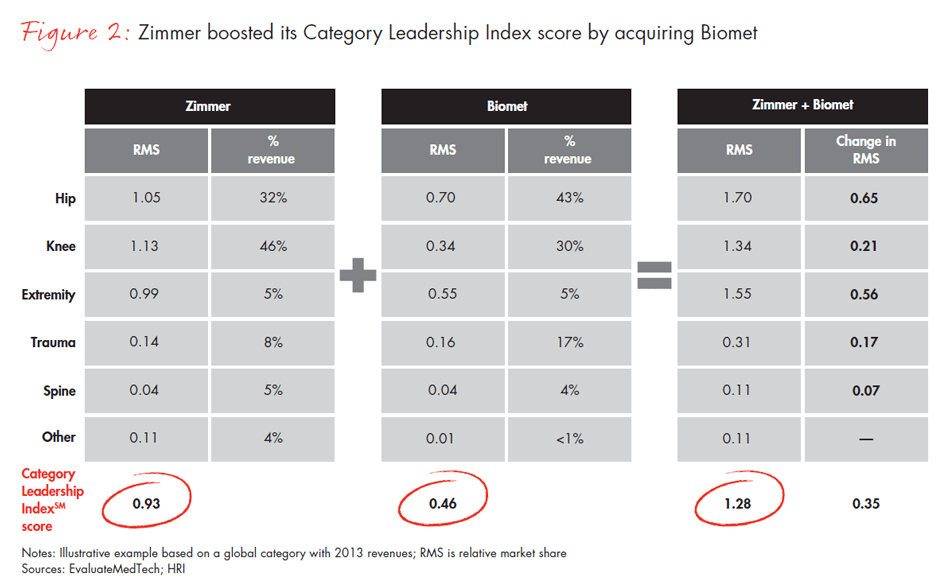
Consider Zimmer’s agreement to acquire rival Biomet for $13.4 billion in 2014. This deal boosted the combined company’s CLI score from 0.93 to 1.28 (see Figure 2). While it’s too early to estimate future profitability gains, the deal made Zimmer the largest player in the hip and knee category, and positions it well to compete in this market. Similarly, Johnson & Johnson’s acquisition of Synthes increased its overall CLI by transforming a relatively weak portfolio of trauma products into the category leader.
While bigger may be better in many industries, medtech is a different beast. Leadership teams can usefully view their growth strategies through the eyes of the customer. The core question then becomes, What do customer behaviors tell us about how best to meet their evolving needs? The customer perspective yields the conclusion that success in medtech is not about building the biggest company you can.
We recommend that leadership teams take a hard look at their businesses and ask the following questions:
- Have you clearly defined the categories in which you compete based on customer purchasing patterns?
- What is your current CLI score? Which categories and geographies have the biggest impact on it?
- Because of the link between profitability and category leadership, categories and geographies with stronger market positions should deliver higher profits. Do your internal targets take this into account? Are you managing the performance of each business consistent with its market position?
- What is the role of organic and inorganic growth in achieving your desired CLI position? In which categories and regions will you have to take action?
The takeaway: Depth, not breadth, is the key to success in medtech. Developing a leading market position within a category is a tremendously attractive path that can lead to superior alignment with customer needs and higher economic returns.
The authors are partners with Bain & Company. Tim van Biesen leads the firm’s Americas Healthcare practice from New York. Todd Johnson, also based in New York, is a member of the Global Healthcare practice. Patrick O’Hagan is a member of the Global Healthcare practice and works from Bain’s Boston office. Category Leadership IndexSM is a trademark of Bain & Company, Inc.
First published in 2月 2015