
Skip to Content
  • オフィス

    オフィス

    北米・南米
    • Atlanta
    • Austin
    • Bogota
    • Boston
    • Buenos Aires
    • Chicago
    • Dallas
    • Denver
    • Houston
    • Los Angeles
    • Mexico City
    • Minneapolis
    • Monterrey
    • Montreal
    • New York
    • Rio de Janeiro
    • San Francisco
    • Santiago
    • São Paulo
    • Seattle
    • Silicon Valley
    • Toronto
    • Washington, DC
    ヨーロッパ・中東・アフリカ
    • Amsterdam
    • Athens
    • Berlin
    • Brussels
    • Copenhagen
    • Doha
    • Dubai
    • Dusseldorf
    • Frankfurt
    • Helsinki
    • Istanbul
    • Johannesburg
    • Kyiv
    • Lisbon
    • London
    • Madrid
    • Milan
    • Munich
    • Oslo
    • Paris
    • Riyadh
    • Rome
    • Stockholm
    • Vienna
    • Warsaw
    • Zurich
    アジア・オーストラリア
    • Bangkok
    • Beijing
    • Bengaluru
    • Brisbane
    • Ho Chi Minh City
    • Hong Kong
    • Jakarta
    • Kuala Lumpur
    • Manila
    • Melbourne
    • Mumbai
    • New Delhi
    • Perth
    • Shanghai
    • Singapore
    • Sydney
    • Tokyo
    全てのオフィス
  • アルムナイ
  • メディア
  • お問い合わせ
  • 東京オフィス
  • Japan | 日本語

    地域と言語を選択

    グローバル
    • Global (English)
    北米・南米
    • Brazil (Português)
    • Argentina (Español)
    • Canada (Français)
    • Chile (Español)
    • Colombia (Español)
    ヨーロッパ・中東・アフリカ
    • France (Français)
    • DACH Region (Deutsch)
    • Italy (Italiano)
    • Spain (Español)
    • Greece (Elliniká)
    アジア・オーストラリア
    • China (中文版)
    • Korea (한국어)
    • Japan (日本語)
  • Saved items (0)
    Saved items (0)

    You have no saved items.

    後で閲読、共有できるようにするためにブックマークしてください

    Explore Bain Insights
  • 業界別プラクティス
    メインメニュー

    業界別プラクティス

    • 航空宇宙、防衛、政府関連
    • 農業
    • 化学製品
    • インフラ、建設
    • 消費財
    • 金融サービス
    • ヘルスケア
    • 産業機械、設備
    • メディア、エンターテインメント
    • 金属
    • 採掘・鉱業
    • 石油、ガス
    • 紙、パッケージ
    • プライベートエクイティ
    • 公共、社会セクター
    • 小売
    • テクノロジー
    • 通信
    • 交通
    • 観光産業
    • 公益事業、再生可能エネルギー
  • 機能別プラクティス
    メインメニュー

    機能別プラクティス

    • カスタマー・エクスペリエンス
    • サステイナビリティ、 社会貢献
    • Innovation
    • 企業買収、合併 (M&A)
    • オペレーション
    • 組織
    • プライベートエクイティ
    • マーケティング・営業
    • 戦略
    • アドバンスド・アナリティクス
    • Technology
    • フルポテンシャル・トランスフォーメーション
  • Digital
  • 知見/レポート
  • ベイン・アンド・カンパニーについて
    メインメニュー

    ベイン・アンド・カンパニーについて

    • ベインの信条
    • 活動内容
    • 社員とリーダーシップ
    • プレス・メディア情報
    • クライアントの結果
    • 受賞歴
    • パートナーシップを結んでいる団体
    Further: Our global responsibility
    • ダイバーシティ
    • 社会貢献
    • サステイナビリティへの取り組み
    • 世界経済フォーラム(WEF)
    Learn more about Further
  • キャリア
    メインメニュー

    キャリア

    • ベインで働く
      キャリア
      ベインで働く
      • Find Your Place
      • ベインで活躍する機会
      • ベインのチーム体制
      • 学生向けページ
      • インターンシップ
      • 採用イベント
    • ベインでの体験
      キャリア
      ベインでの体験
      • Blog: Inside Bain
      • キャリアストーリー
      • 社員紹介
      • Where We Work
      • 成長を後押しするサポート体制
      • アフィニティ・グループ
      • 福利厚生
    • Impact Stories
    • 採用情報
      キャリア
      採用情報
      • 採用プロセス
      • 面接内容
    FIND JOBS
  • オフィス
    メインメニュー

    オフィス

    • 北米・南米
      オフィス
      北米・南米
      • Atlanta
      • Austin
      • Bogota
      • Boston
      • Buenos Aires
      • Chicago
      • Dallas
      • Denver
      • Houston
      • Los Angeles
      • Mexico City
      • Minneapolis
      • Monterrey
      • Montreal
      • New York
      • Rio de Janeiro
      • San Francisco
      • Santiago
      • São Paulo
      • Seattle
      • Silicon Valley
      • Toronto
      • Washington, DC
    • ヨーロッパ・中東・アフリカ
      オフィス
      ヨーロッパ・中東・アフリカ
      • Amsterdam
      • Athens
      • Berlin
      • Brussels
      • Copenhagen
      • Doha
      • Dubai
      • Dusseldorf
      • Frankfurt
      • Helsinki
      • Istanbul
      • Johannesburg
      • Kyiv
      • Lisbon
      • London
      • Madrid
      • Milan
      • Munich
      • Oslo
      • Paris
      • Riyadh
      • Rome
      • Stockholm
      • Vienna
      • Warsaw
      • Zurich
    • アジア・オーストラリア
      オフィス
      アジア・オーストラリア
      • Bangkok
      • Beijing
      • Bengaluru
      • Brisbane
      • Ho Chi Minh City
      • Hong Kong
      • Jakarta
      • Kuala Lumpur
      • Manila
      • Melbourne
      • Mumbai
      • New Delhi
      • Perth
      • Shanghai
      • Singapore
      • Sydney
      • Tokyo
    全てのオフィス
  • アルムナイ
  • メディア
  • お問い合わせ
  • 東京オフィス
  • Japan | 日本語
    メインメニュー

    地域と言語を選択

    • グローバル
      地域と言語を選択
      グローバル
      • Global (English)
    • 北米・南米
      地域と言語を選択
      北米・南米
      • Brazil (Português)
      • Argentina (Español)
      • Canada (Français)
      • Chile (Español)
      • Colombia (Español)
    • ヨーロッパ・中東・アフリカ
      地域と言語を選択
      ヨーロッパ・中東・アフリカ
      • France (Français)
      • DACH Region (Deutsch)
      • Italy (Italiano)
      • Spain (Español)
      • Greece (Elliniká)
    • アジア・オーストラリア
      地域と言語を選択
      アジア・オーストラリア
      • China (中文版)
      • Korea (한국어)
      • Japan (日本語)
  • Saved items  (0)
    メインメニュー
    Saved items (0)

    You have no saved items.

    後で閲読、共有できるようにするためにブックマークしてください

    Explore Bain Insights
  • 業界別プラクティス
    • 業界別プラクティス

      • 航空宇宙、防衛、政府関連
      • 農業
      • 化学製品
      • インフラ、建設
      • 消費財
      • 金融サービス
      • ヘルスケア
      • 産業機械、設備
      • メディア、エンターテインメント
      • 金属
      • 採掘・鉱業
      • 石油、ガス
      • 紙、パッケージ
      • プライベートエクイティ
      • 公共、社会セクター
      • 小売
      • テクノロジー
      • 通信
      • 交通
      • 観光産業
      • 公益事業、再生可能エネルギー
  • 機能別プラクティス
    • 機能別プラクティス

      • カスタマー・エクスペリエンス
      • サステイナビリティ、 社会貢献
      • Innovation
      • 企業買収、合併 (M&A)
      • オペレーション
      • 組織
      • プライベートエクイティ
      • マーケティング・営業
      • 戦略
      • アドバンスド・アナリティクス
      • Technology
      • フルポテンシャル・トランスフォーメーション
  • Digital
  • 知見/レポート
  • ベイン・アンド・カンパニーについて
    • ベイン・アンド・カンパニーについて

      • ベインの信条
      • 活動内容
      • 社員とリーダーシップ
      • プレス・メディア情報
      • クライアントの結果
      • 受賞歴
      • パートナーシップを結んでいる団体
      Further: Our global responsibility
      • ダイバーシティ
      • 社会貢献
      • サステイナビリティへの取り組み
      • 世界経済フォーラム(WEF)
      Learn more about Further
  • キャリア
    人気検索キーワード
    • デジタル
    • 戦略
    前回の検索
      最近訪れたページ

      Content added to saved items

      Saved items (0)

      Removed from saved items

      Saved items (0)

      レポート

      Two Lessons the Chip Shortage Taught Us about Supply Chains

      Two Lessons the Chip Shortage Taught Us about Supply Chains

      Navigating future disruptions calls for a more holistic and proactive strategy involving closer collaboration between suppliers and customers.

      著者:Peter Hanbury and Anne Hoecker

      • min read
      }

      レポート

      Two Lessons the Chip Shortage Taught Us about Supply Chains
      en

      This article is part of Bain's 2021 Technology Report.

      Explore the report

      In 2021, if we didn’t open an article about the technology supply chain by talking about the semiconductor chip shortage, you’d wonder why.

      Technology executives are well aware that the shortage has made the already-pressing issue of increasing supply chain resiliency even more painfully acute. Indeed, technology companies have been dealing with increasingly disruptive supply chain shocks for years, so it was only a matter of time before one of this magnitude hit. While the breadth and depth of this shortage’s impact on the tech industry and the global economy is unprecedented, the reality is we’re going to see more of these disruptive events.

      The hard lessons of the chip shortage have made it clear that navigating future disruptions calls for a more holistic and proactive strategy, one that requires closer collaboration between suppliers and their customers than in the past. 

      Lesson 1: Major supply chain disruptions don’t have quick fixes.

      Despite massive investment announcements from semiconductor makers and pledges of government support, industry stakeholders have been struggling against a harsh reality: There are limited short-term solutions to the chip shortage (see Figure 1). It takes two to three years to build a new semiconductor factory, or fab. Most have been running at full production capacity since the third quarter of 2020, and even adding capacity to an existing fab can take more than a year. It’s also incredibly expensive. We estimate that adding just 5% to 10% capacity across existing nodes in the chip supply chain would cost about $40 billion.

      Figure 1
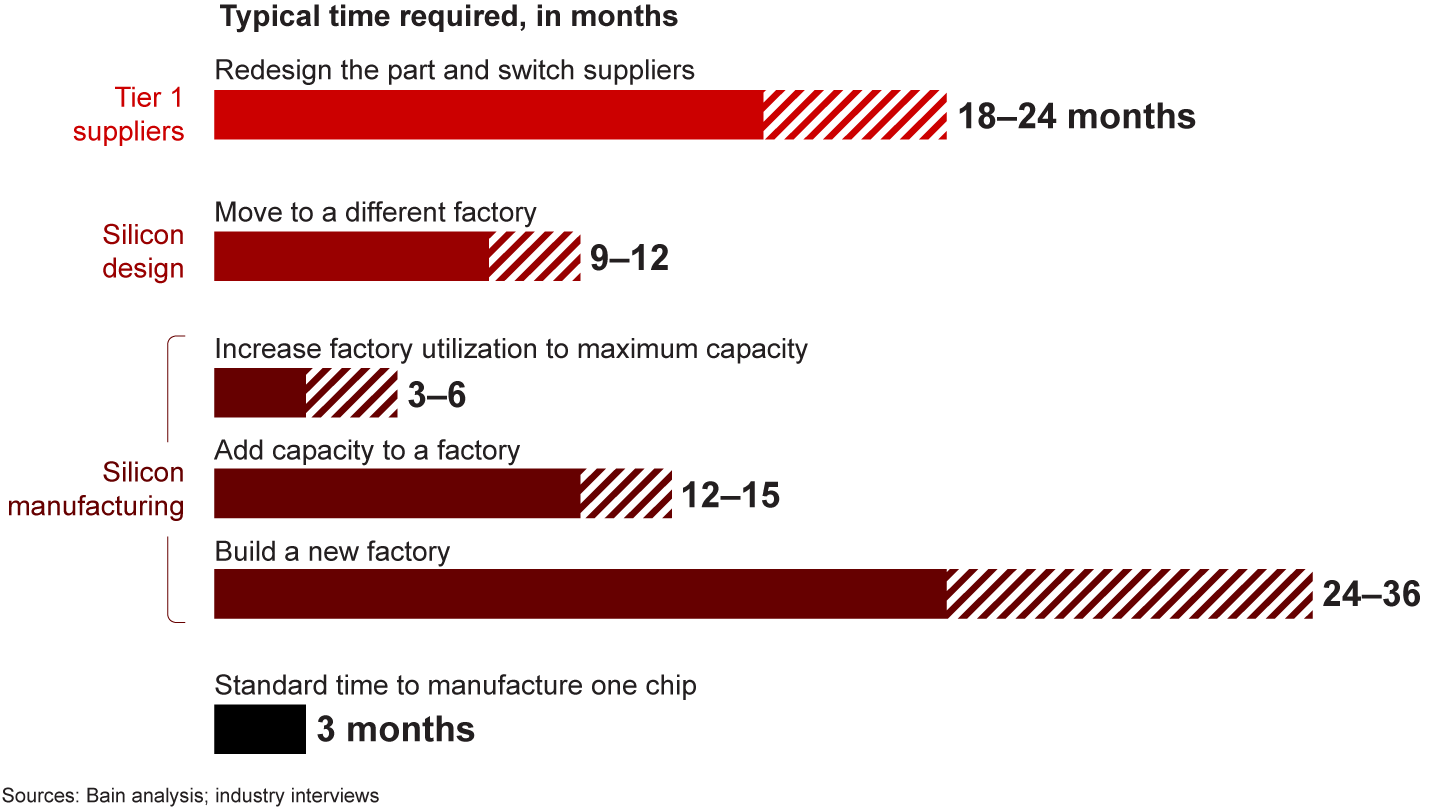
      Most solutions to the chip shortage have long lead times

      Although some of these dynamics are specific to front-end semiconductor manufacturing, the overarching principle holds for many steps of the tech supply chain. For example, the production of chip components such as substrates and silicon wafers faces similar lead times and disconnects between supply and demand. That’s dialing up the urgency for tech suppliers and their customers to prepare for the next big disruption. 

      Lesson 2: This is unlikely to be the last tech supply chain disruption that affects multiple industries, as more products across sectors rely on components that share the same manufacturing capacity.

      Automotive was the canary in the coal mine. But the impact of the chip shortfall soon spread to other sectors, even hitting blue-chip tech companies such as Apple, Nintendo, and Cisco. The crisis disrupted even the best-prepared companies that had been investing in supply chain resiliency for years.

      Why did the shortage spread? Most investments in semiconductor R&D and capital expenditures for new fabs go into the “bleeding-edge” technology needed to produce the advanced chips in smartphones, laptops, and servers. But "lagging-edge” chips have been the major pinch-point in the shortage. These chips, though based on technology developed more than a decade ago, play fundamental roles in automotive and industrial goods like cars and washing machines, as well as tech products such as laptops and smartphones (see Figure 2).

      Figure 2
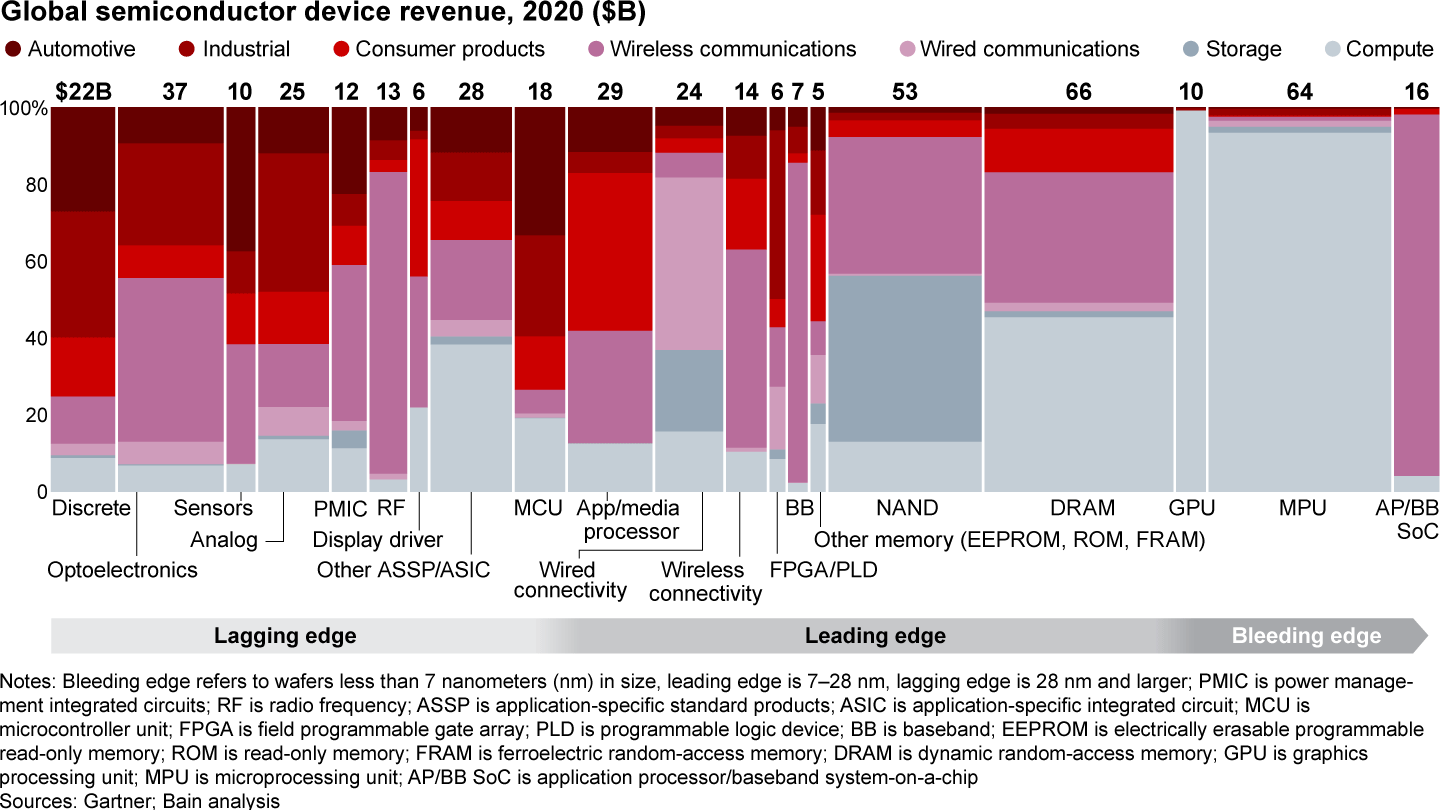
      Lagging-edge chips play key roles in products across automotive, industrial, consumer products, and other sectors

      However, chip makers have had limited incentive to invest in additional production capacity for these less-advanced chips, which typically sell for a dollar or two apiece, compared with $100 or more for higher-end semiconductors. Unlike their bleeding-edge cousins, the fabs that produce lagging-edge chips tend to be older and fully depreciated, and have historically been run at full capacity for maximum efficiency. When demand spiked last year, lagging-edge fabs had no excess capacity to give.

      Where might the next supply chain disruption hit? It’s possible that other components shared across industries could spark a similar event. For example, tech firms have been the largest consumers of lithium-ion batteries for years, but they’re quickly being overtaken by the automotive sector as it shifts to electric vehicles. In a battery shortage, tech vendors may find themselves the smaller, lower-priority customer losing access to a vital component.

      Governments are already bracing for the possibility of a battery shortage. The European Union and India this year announced subsidies for domestic battery production, and the US has also signaled increased support for the sector. 

      A holistic strategy

      As supply chain resilience has risen to the top of the CEO and board agenda, here are the investments leading companies are prioritizing.

      1. Developing a segmented strategy. Leading companies rank and prioritize components based on the probability of whether and how much they’ll be disrupted. Companies assess risk across several areas: lead time to add capacity; concentration of the supply base; geographic concentration (considering weather risk and geopolitical tensions); and multiple industries competing for supplies from the same producers.
      2. Instilling smart resilience. Companies are embedding more resilience in their supply chains through a custom blend of investments. They run numerous scenarios to pressure-test supply chain resilience and identify the relative return on investments in addressing weaknesses. The most effective strategies emphasize three capabilities:
        • Adaptability. Companies are revising their component qualification process to emphasize standardization of hardware where possible. Electric vehicle maker Tesla uses standard semiconductor hardware, but is developing the software running on those chips in-house. That has given the company more flexibility in the components to manufacture its cars.
        • Redundancy. For select areas, companies are building a supply buffer by buying up extra product inventory and, where possible, purchasing from multiple vendors.
        • Real-time feedback. Leading companies build a real-time market monitoring system with a dynamic heat map of potential supply chain failure points. For example, BMW is working with Amazon Web Services to use machine learning and blockchain technology to improve supply chain visibility.
      1. Deploying a cross-functional operating model. Efforts to boost supply chain resilience can’t be confined to the supply chain team alone. The most effective approaches involve all key stakeholders, including supply chain planning, engineering, procurement, and sales. This can head off supply chain disruptions or shift customer demand toward products with larger inventory. More companies are looping the supply chain team into the product design phase to highlight potential risks and trade-offs. Germany-based automotive parts maker Continental established an advanced buying process increasing the purchasing department’s role in the engineering of parts. This streamlined component use and reduced the number of parts in Continental’s end products, thereby cutting costs and limiting the company’s exposure to supply chain shocks.
      2. Collaborating up and down the supply chain. Companies increasingly recognize that complex, specialized supply chains, like those involving semiconductors, require strong collaboration between customers and suppliers. What does this look like?
        • More industrywide data sharing and negotiation for manufacturing capacity, both to improve transparency and avoid the bullwhip effect we saw with the chip shortage
        • Integrated planning teams to jointly assess the market situation and develop aligned strategies
        • Teaming up to appeal for government subsidies to locate manufacturing in home countries or diversify production capacity

      The current chip shortage will pass eventually. The companies that act decisively now to build supply chain resilience will be best positioned to weather the next storm, wherever it comes from.

      More from the report

      • Welcome to the New Tech Economy

      • Tech-tonic Equity Shifts

      • The Case for Big Tech M&A

      • Tech Venture Capital Surges

      • SaaS Spurs Software Superperformance

      • Bringing Order to the Hybrid Cloud

      • Winning Europe’s Cloud Market

      • Shifting Semiconductor Equilibrium

      • Leading AI’s Next Era

      • US, China, and the Decoupling Push

      • The Tech Talent War Expands

      • Scaling DevOps

      • The Go-to-Market Orchestra

      • Chip Shortage Lessons

      Read our 2021 Technology Report

      Download the PDF Explore the report
      著者
      • Headshot of Peter Hanbury
        Peter Hanbury
        パートナー, San Francisco
      • Headshot of Anne Hoecker
        Anne Hoecker
        パートナー, Silicon Valley
      関連業種
      • IT Services
      • Semiconductors
      • Software
      • テクノロジー
      関連するコンサルティングサービス
      • Customer Experience
      • サプライチェーン
      テクノロジー
      When Will the Chip Shortage End?

      Even with recent investments and signs of improvement, the recovery will be uneven and depend on such wild cards as general economic activity, geopolitical tensions, and shortages of “bleeding-edge” chipmaking equipment.

      詳細
      テクノロジー
      Despite Tech Layoffs, Competition for Talent Remains Fierce

      Tech workers increasingly value career development opportunities and remote or hybrid work options, while compensation has soared.

      詳細
      Customer Experience
      How to Master the Art of Selling Sustainability

      Our survey of 500 B2B buyers and sellers shows a widening chasm on sustainability. A new industrial sales model is needed to close this buy-sell gap.

      詳細
      テクノロジー
      Using Hardware to Scale the Industrial Internet of Things

      Bain partners discuss the opportunity for hardware vendors to help companies develop their IoT pilots.

      詳細
      Customer Experience
      Accelerating Performance Despite Inflation

      Turbulent times shouldn’t stop companies from pursuing full potential and business resiliency.

      詳細
      First published in 9月 2021
      Tags
      • Customer Experience
      • IT Services
      • Semiconductors
      • Software
      • サプライチェーン
      • テクノロジー

      クライアント支援事例

      サステイナビリティ、社会貢献 Can Microchips Turbocharge Sustainability Improvement?

      ケーススタディを見る

      Helping a Midsize ERP Player Compete against the Giants

      ケーススタディを見る

      業績改善 Aggressively growing an IT service provider with a high-performance culture

      ケーススタディを見る

      お気軽にご連絡下さい

      私達は、グローバルに活躍する経営者が抱える最重要経営課題に対して、厳しい競争環境の中でも成長し続け、「結果」を出すために支援しています。

      ベインの知見。競争が激化するグローバルビジネス環境で、日々直面するであろう問題について論じている知見を毎月お届けします。

      *プライバシーポリシーの内容を確認し、合意しました。

      プライバシーポリシーをご確認頂き、合意頂けますようお願い致します。
      Bain & Company
      お問い合わせ Sustainability Accessibility Terms of use Privacy Cookie Policy Sitemap Log In

      © 1996-2026 Bain & Company, Inc.

      お問い合わせ

      How can we help you?

      • ビジネスについて
      • プレス報道について
      • 採用について
      全てのオフィス