

論説

There’s a revolution brewing in finance departments. Activist investors are pressuring companies on costs just as digital disruption and mounting complexity take their toll. These forces are causing companies to call on their finance teams to move beyond their traditional roles as number crunchers.
The timing couldn’t be better for CFOs to deliver on this mandate. Automation has drastically streamlined manual processes, giving CFOs more time and money to invest in what matters most, while advanced analytics, artificial intelligence and other developments enable them to make speedier, better-informed decisions. The stage is set for a CFO to become a company’s internal challenger and proactively identify new opportunities.
But it isn’t happening often enough. CFOs get high marks for using technology and top talent to satisfy business units with better-than-agreed-upon service level metrics for key transaction and accounting processes. They produce thousands of reports faster as they gain access to real-time data. The trouble is, too many CFOs know they’re not creating as much value for the company as they could. For example, while the financial planning and analysis (FP&A) function is facilitating the budgeting process, CFOs are not really challenging those plans.
When finance functions fail to fully deliver on their potential, it’s often a fundamental matter of their inability to divert focus away from areas that are not boosting value—reconciling reports and closing the books, for example. By overinvesting their time and energy in those areas, CFOs have little left to devote to more important activities, based on the company’s chosen strategic priorities, such as supporting performance management, business planning or M&A.

Plot Your Path to Financial Excellence
Answer these questions to assess how your company’s financial performance matches up to its strategic goals.
When Bain & Company interviewed nearly 100 CFOs in 2015, they readily admitted that they still struggle to align their energies to strategic priorities. We learned that 41% would like to spend more time in strategic planning (see Figure 1 and the sidebar, “What do CFOs say?”).
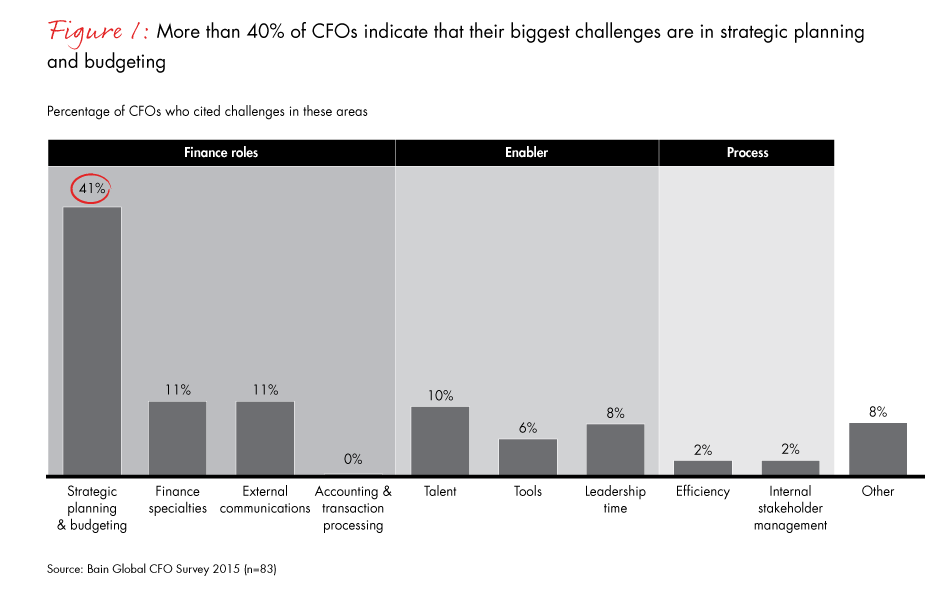
Not surprisingly, many continue to struggle as they attempt to evolve the role of finance with two often-conflicting objectives: save money and have more efficient finance departments while helping the business make more fact-based and effective decisions. But CFOs can change course by adopting an owner mindset and then making clear choices to become more efficient in routine activities, generating savings that can be plowed into carefully selected higher-value endeavors.
Based on our experience, CFOs face three major challenges when they set out to boost their role in a company. We’ll look at them one by one.
Challenge #1: Knowing where (and where not) to excel. Does the industry you operate in require you to excel more in strategic planning or in risk management? Does your company strategy require you to outperform competitors in M&A or in treasury? Does your organization need more support in budgeting or in performance management? The truth is that some finance roles generate more strategic value than others and are more critical for helping a company outpace competitors.
Knowing where to invest begins with understanding the industry, strategic priorities and organizational needs—and then evaluating the finance function with fresh eyes, stepping back to rigorously assess the changes that need to be made. (see Bain’s Financial Excellence Diagnostic). The best companies start by evaluating the characteristics of their industry and company—the speed of change in the market, or the capital intensity of the business, or the degree of regulation, for example. Next, they consider the company’s competitive strategy. Does it differentiate on quality/innovation or on price? Does it view M&A as a priority? And then there are the company’s capabilities and culture to evaluate. Are business units stronger in planning or in execution? How value-oriented or risk-oriented are the company’s executives?
Consider the example of a global consumer goods company whose CFO made several clear choices to maximize the value of his department. The company operates in a rapidly changing market environment and maintains ambitious growth targets, aiming to win a few points of market share from its main competitors. The CFO opted to build a world-class M&A team to help make scale a competitive advantage. The company wants to reduce its tax burden and is operating across many countries with a complex legal structure, so he improved his tax management capabilities. On the other hand, the company determined that there would be no strategic advantage for the company or value to be created in accounting and transaction processing. The CFO decided that those finance subfunctions could just be good enough and superefficient, freeing up cash in the process.
Challenge #2: Understanding where you stand. After determining where and where not to excel, you need to assess how much potential for improvement exists and how much in the way of new capabilities you need to build. Are you a cost leader in account and transaction processing? Underperforming in cash and capital management? Learning how well your finance capabilities stack up requires a detailed assessment of both quality and cost for each role, including benchmarks to compare your position with that of relevant peers.
The consumer goods company mentioned above held a management team workshop, conducted extensive internal interviews and performed deep benchmarking in a few areas. The effort helped it see that half of its existing initiatives were not critical to meeting its strategic objectives. It also identified a 20% reduction in annual finance costs that could be reinvested in strategic capabilities that would be important for the future. Those findings served as the starting point for reducing the percentage of the finance budget devoted to auditing and increasing the percentage going to M&A. The findings also showed how the company could up its game in forecasting accuracy to help manage growth by installing new digital tools for predictive analytics.
A technology company wanted to implement new robotic tools to speed accounting and transaction processing, reduce human error and lower costs. But it first needed to determine which of its many existing IT systems would be priorities for being updated. As an important initial move, it surveyed nearly 400 users of those existing systems to assess the level of satisfaction and efficiency, identifying more than 50 pain points. By comparing expected benefits with costs, it was able to prioritize the gaps that needed to be closed and 13 feasible high-value initiatives that would be required. Ultimately, the company developed guidelines to help improve its systems, generate savings and free up resources to devote to strategic priorities.

Unleashing Finance's Full Potential
Many CFOs want to spend more time on strategy. Here's how they can take their finance departments to the next level.
Challenge #3: Closing the gap. Once you have a clear picture of where you want to be best in class, what that looks like and what you need to get there, the next stage involves building a solid case for the changes that will make finance more strategic, and designing a concrete roadmap of the initiatives to roll out in a multiyear process. Success requires unwavering support from top management. It also requires an early risk assessment to identify the barriers to change—and a plan for mitigating those risks.
A diagnostic helped a diversified industrial company determine that its finance department was highly effective but also burdened by high costs, as well as complicated and cumbersome processes. It then used a zero-based redesign to address the main pain points in its finance function, from planning to transactional activities. As part of the overhaul, it defined a set of initiatives and developed a five-year plan for achieving a 60% cost reduction target that would bring finance spending in line with industry benchmarks and free up funds to invest in its most value-added activities.
Better-quality, less-costly accounting and transaction processing paved the way for the industrial company’s finance department to have the time and resources necessary to influence decisions and identify value creation opportunities. Now that members of the finance department are spending less time generating and reading reports, they are able to spend more time advising the business.
That’s the ultimate goal. Companies hoping to replicate such success systematically tackle the three challenges that keep finance from reaching its full potential as a strategic partner in business. Only after you determine where to excel, understand your starting point and lay plans for closing the gap can the finance function be the strategic partner it needs to be.
Henrik Poppe, a partner with Bain’s Corporate Finance practice, shares several steps CFOs can take to transform the finance function.
What do CFOs say?
With the finance department gaining strategic importance, we interviewed nearly 100 CFOs about their roles and challenges, and how they spend their time. Among the key findings: CFOs still struggle to align their energies to strategic priorities. Fully 40% say their company’s strategy is not the primary factor in its resource allocation.
CFOs spend 35% of their time on direct strategy support such as strategy creation, business planning, target setting, resource allocation and performance tracking. Overwhelmingly, they say they want to spend more time on this. They estimate they devote about 30% of their time to stakeholder—external stakeholders, executives and the board—management, and generally feel comfortable with this time allocation. Another 20% of their time goes to specific finance responsibilities such as balance sheet management, audit and compliance, while a final 15% is spent managing the finance organization. Overall CFOs say they’re spending insufficient time in the areas of strategic planning and budgeting and talent management.
When asked to discuss their challenges, CFOs reported that the biggest one they face involves managing their internal organization, specifically the need to improve such capabilities as performance management and advanced analytics while boosting the effectiveness of their organization. The next-biggest challenges: finding sources of growth and allocating resources effectively, as well as managing external stakeholders. What legacy do CFOs want? Among those surveyed, 45% want their legacy to be commercial success as measured by growth, shareholder returns or the quality of the business, or in their strategic advice to the CEO—all evidence of the movement in which CFOs are becoming more of a business partner. Another 25% want to be known for building the organization’s capabilities.
Laura Miles is a Bain & Company partner based in Atlanta. She leads Bain’s global Mergers & Acquisitions and Corporate Finance practices. Henrik Poppe is a partner in Bain & Company’s Oslo office and global Corporate Finance leader. He is also an expert in Bain’s Mergers & Acquisitions and Private Equity practices.
First published in 6月 2017