
Skip to Content
  • オフィス

    オフィス

    北米・南米
    • Atlanta
    • Austin
    • Bogota
    • Boston
    • Buenos Aires
    • Chicago
    • Dallas
    • Denver
    • Houston
    • Los Angeles
    • Mexico City
    • Minneapolis
    • Monterrey
    • Montreal
    • New York
    • Rio de Janeiro
    • San Francisco
    • Santiago
    • São Paulo
    • Seattle
    • Silicon Valley
    • Toronto
    • Washington, DC
    ヨーロッパ・中東・アフリカ
    • Amsterdam
    • Athens
    • Berlin
    • Brussels
    • Copenhagen
    • Doha
    • Dubai
    • Dusseldorf
    • Frankfurt
    • Helsinki
    • Istanbul
    • Johannesburg
    • Kyiv
    • Lisbon
    • London
    • Madrid
    • Milan
    • Munich
    • Oslo
    • Paris
    • Riyadh
    • Rome
    • Stockholm
    • Vienna
    • Warsaw
    • Zurich
    アジア・オーストラリア
    • Bangkok
    • Beijing
    • Bengaluru
    • Brisbane
    • Ho Chi Minh City
    • Hong Kong
    • Jakarta
    • Kuala Lumpur
    • Manila
    • Melbourne
    • Mumbai
    • New Delhi
    • Perth
    • Shanghai
    • Singapore
    • Sydney
    • Tokyo
    全てのオフィス
  • アルムナイ
  • メディア
  • お問い合わせ
  • 東京オフィス
  • Japan | 日本語

    地域と言語を選択

    グローバル
    • Global (English)
    北米・南米
    • Brazil (Português)
    • Argentina (Español)
    • Canada (Français)
    • Chile (Español)
    • Colombia (Español)
    ヨーロッパ・中東・アフリカ
    • France (Français)
    • DACH Region (Deutsch)
    • Italy (Italiano)
    • Spain (Español)
    • Greece (Elliniká)
    アジア・オーストラリア
    • China (中文版)
    • Korea (한국어)
    • Japan (日本語)
  • Saved items (0)
    Saved items (0)

    You have no saved items.

    後で閲読、共有できるようにするためにブックマークしてください

    Explore Bain Insights
  • 業界別プラクティス
    メインメニュー

    業界別プラクティス

    • 航空宇宙、防衛、政府関連
    • 農業
    • 化学製品
    • インフラ、建設
    • 消費財
    • 金融サービス
    • ヘルスケア
    • 産業機械、設備
    • メディア、エンターテインメント
    • 金属
    • 採掘・鉱業
    • 石油、ガス
    • 紙、パッケージ
    • プライベートエクイティ
    • 公共、社会セクター
    • 小売
    • テクノロジー
    • 通信
    • 交通
    • 観光産業
    • 公益事業、再生可能エネルギー
  • 機能別プラクティス
    メインメニュー

    機能別プラクティス

    • カスタマー・エクスペリエンス
    • サステイナビリティ、 社会貢献
    • Innovation
    • 企業買収、合併 (M&A)
    • オペレーション
    • 組織
    • プライベートエクイティ
    • マーケティング・営業
    • 戦略
    • アドバンスド・アナリティクス
    • Technology
    • フルポテンシャル・トランスフォーメーション
  • Digital
  • 知見/レポート
  • ベイン・アンド・カンパニーについて
    メインメニュー

    ベイン・アンド・カンパニーについて

    • ベインの信条
    • 活動内容
    • 社員とリーダーシップ
    • プレス・メディア情報
    • クライアントの結果
    • 受賞歴
    • パートナーシップを結んでいる団体
    Further: Our global responsibility
    • ダイバーシティ
    • 社会貢献
    • サステイナビリティへの取り組み
    • 世界経済フォーラム(WEF)
    Learn more about Further
  • キャリア
    メインメニュー

    キャリア

    • ベインで働く
      キャリア
      ベインで働く
      • Find Your Place
      • ベインで活躍する機会
      • ベインのチーム体制
      • 学生向けページ
      • インターンシップ
      • 採用イベント
    • ベインでの体験
      キャリア
      ベインでの体験
      • キャリアストーリー
      • 社員紹介
      • Where We Work
      • 成長を後押しするサポート体制
      • アフィニティ・グループ
      • 福利厚生
    • Impact Stories
    • 採用情報
      キャリア
      採用情報
      • 採用プロセス
      • 面接内容
    FIND JOBS
  • オフィス
    メインメニュー

    オフィス

    • 北米・南米
      オフィス
      北米・南米
      • Atlanta
      • Austin
      • Bogota
      • Boston
      • Buenos Aires
      • Chicago
      • Dallas
      • Denver
      • Houston
      • Los Angeles
      • Mexico City
      • Minneapolis
      • Monterrey
      • Montreal
      • New York
      • Rio de Janeiro
      • San Francisco
      • Santiago
      • São Paulo
      • Seattle
      • Silicon Valley
      • Toronto
      • Washington, DC
    • ヨーロッパ・中東・アフリカ
      オフィス
      ヨーロッパ・中東・アフリカ
      • Amsterdam
      • Athens
      • Berlin
      • Brussels
      • Copenhagen
      • Doha
      • Dubai
      • Dusseldorf
      • Frankfurt
      • Helsinki
      • Istanbul
      • Johannesburg
      • Kyiv
      • Lisbon
      • London
      • Madrid
      • Milan
      • Munich
      • Oslo
      • Paris
      • Riyadh
      • Rome
      • Stockholm
      • Vienna
      • Warsaw
      • Zurich
    • アジア・オーストラリア
      オフィス
      アジア・オーストラリア
      • Bangkok
      • Beijing
      • Bengaluru
      • Brisbane
      • Ho Chi Minh City
      • Hong Kong
      • Jakarta
      • Kuala Lumpur
      • Manila
      • Melbourne
      • Mumbai
      • New Delhi
      • Perth
      • Shanghai
      • Singapore
      • Sydney
      • Tokyo
    全てのオフィス
  • アルムナイ
  • メディア
  • お問い合わせ
  • 東京オフィス
  • Japan | 日本語
    メインメニュー

    地域と言語を選択

    • グローバル
      地域と言語を選択
      グローバル
      • Global (English)
    • 北米・南米
      地域と言語を選択
      北米・南米
      • Brazil (Português)
      • Argentina (Español)
      • Canada (Français)
      • Chile (Español)
      • Colombia (Español)
    • ヨーロッパ・中東・アフリカ
      地域と言語を選択
      ヨーロッパ・中東・アフリカ
      • France (Français)
      • DACH Region (Deutsch)
      • Italy (Italiano)
      • Spain (Español)
      • Greece (Elliniká)
    • アジア・オーストラリア
      地域と言語を選択
      アジア・オーストラリア
      • China (中文版)
      • Korea (한국어)
      • Japan (日本語)
  • Saved items  (0)
    メインメニュー
    Saved items (0)

    You have no saved items.

    後で閲読、共有できるようにするためにブックマークしてください

    Explore Bain Insights
  • 業界別プラクティス
    • 業界別プラクティス

      • 航空宇宙、防衛、政府関連
      • 農業
      • 化学製品
      • インフラ、建設
      • 消費財
      • 金融サービス
      • ヘルスケア
      • 産業機械、設備
      • メディア、エンターテインメント
      • 金属
      • 採掘・鉱業
      • 石油、ガス
      • 紙、パッケージ
      • プライベートエクイティ
      • 公共、社会セクター
      • 小売
      • テクノロジー
      • 通信
      • 交通
      • 観光産業
      • 公益事業、再生可能エネルギー
  • 機能別プラクティス
    • 機能別プラクティス

      • カスタマー・エクスペリエンス
      • サステイナビリティ、 社会貢献
      • Innovation
      • 企業買収、合併 (M&A)
      • オペレーション
      • 組織
      • プライベートエクイティ
      • マーケティング・営業
      • 戦略
      • アドバンスド・アナリティクス
      • Technology
      • フルポテンシャル・トランスフォーメーション
  • Digital
  • 知見/レポート
  • ベイン・アンド・カンパニーについて
    • ベイン・アンド・カンパニーについて

      • ベインの信条
      • 活動内容
      • 社員とリーダーシップ
      • プレス・メディア情報
      • クライアントの結果
      • 受賞歴
      • パートナーシップを結んでいる団体
      Further: Our global responsibility
      • ダイバーシティ
      • 社会貢献
      • サステイナビリティへの取り組み
      • 世界経済フォーラム(WEF)
      Learn more about Further
  • キャリア
    人気検索キーワード
    • デジタル
    • 戦略
    前回の検索
      最近訪れたページ

      Content added to saved items

      Saved items (0)

      Removed from saved items

      Saved items (0)

      論説

      Why Asset Class Expansion Is Harder Than It Seems

      Why Asset Class Expansion Is Harder Than It Seems

      Moving into a new private equity asset class can’t be that difficult, right? Think again.

      著者:Hugh MacArthur, Or Skolnik, Brenda Rainey, Graham Rose, and Alexander De Mol

      • min read
      }

      論説

      Why Asset Class Expansion Is Harder Than It Seems
      en

      The vast majority of private equity firms have a growth imperative.

      Steady expansion of assets under management (AUM) is the best way for any firm to generate a predictable stream of fees. For single-focus firms, diversification into strategies that are less cyclical, or countercyclical, can increase stability. Striking out in a new direction may be the key to expanding share of wallet with limited partners (LPs) looking for exposure elsewhere on the risk/reward spectrum. For maturing firms, expansion is often about talent; it can be critical for retaining or attracting the best people.

      The number and variety of growth strategies have exploded in recent years as firms look for alternatives beyond their core (see Figure 1). One of the most popular, however, is also among the riskiest: asset class expansion. In practice, too many of these asset class adjacency moves end up as small side businesses that aren’t particularly strategic or profitable. In the worst cases, firms cut their losses and exit the business altogether. A Bain & Company analysis shows that over 60% of the firms that pursue asset class expansion will retrench from at least one of those pursuits over time.

      Figure 1
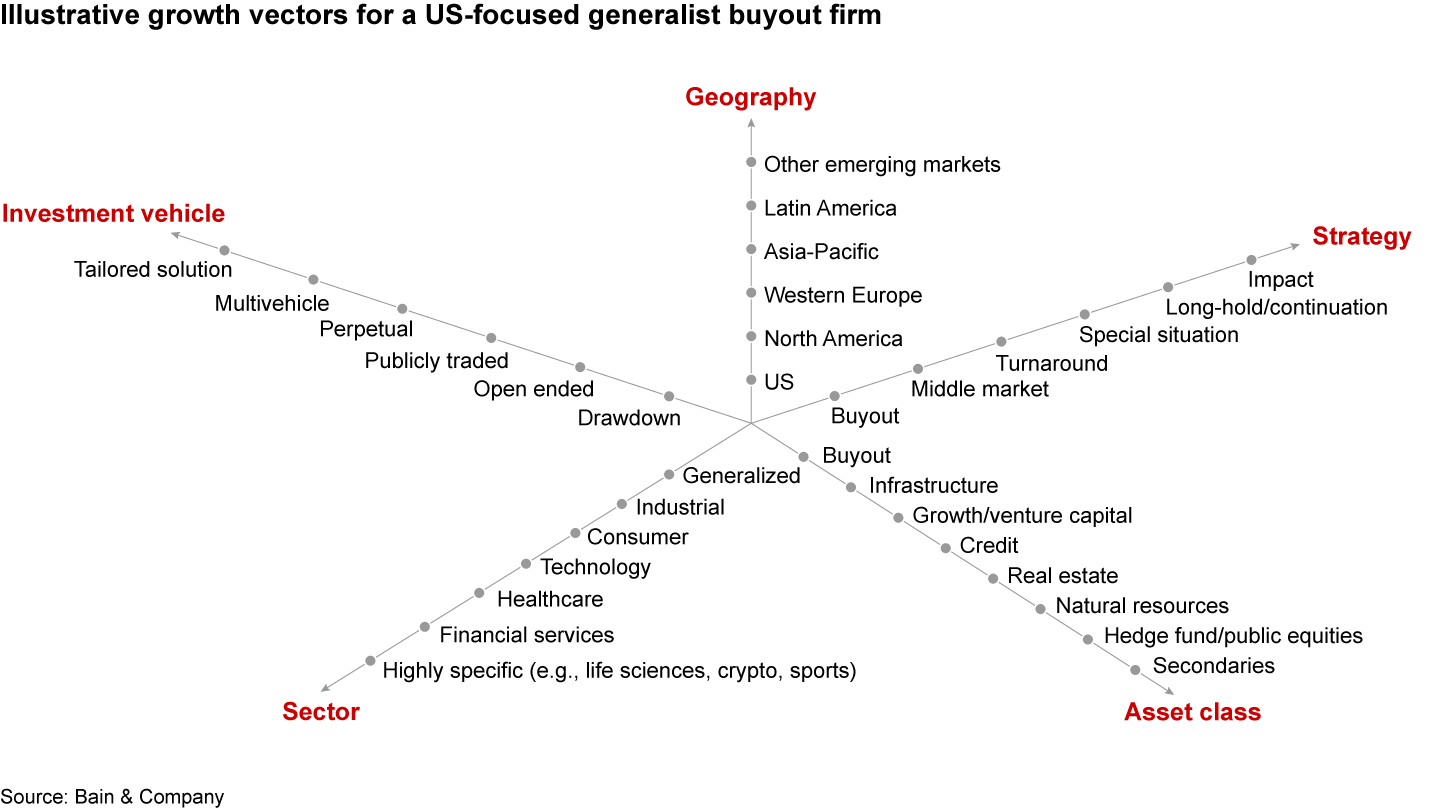
      New approaches and products have proliferated as private equity firms seek additional ways to grow

      What goes wrong?

      While many firms assume that success in the buyout world will translate smoothly to, say, credit investing or infrastructure, that’s often not the case. Despite the common umbrella of “private capital,” synergies across most asset classes are relatively minor. Different asset classes often require sharply different capabilities across the investment value chain—from sourcing and underwriting to deal structuring, value creation, and exit. Each class has a unique ecosystem requiring a distinct set of relationships. And though there may be some overlap among sources of capital across funds, the decision makers responsible for each class tend not to be the same.

      The basis of competition also varies widely across asset classes. While a small to midsize buyout firm can thrive in a lucrative niche, asset classes like liquid credit or core real estate are driven by massive scale. Expanding into these areas demands a clear-eyed assessment of what sort of investment it would take to establish critical mass and, importantly, whether the firm is prepared to make that kind of commitment. Asset classes like growth equity and venture capital may share more with buyout in terms of capabilities and business model, but, increasingly, they require deep, specialized expertise in technology and the ability to make deals at a much faster pace. Success in underwriting infrastructure risk, meanwhile, may turn on how well the firm understands specific government regulations or local political realities.  

      If the firm lacks the requisite capabilities, networks, or experience to break into a new business, it will have to add new talent. That raises the buy or build dilemma and sparks tricky questions at the operating level about how to set up the new team for success. Private equity is a people business, and integrating new talent always presents risks that have to be managed carefully. Transforming what amounts to a single-line business into a multiline organization means allocating resources and economics in ways that may be unfamiliar or disruptive.

      A strong buyout fund, for instance, generates strong economics for the firm. By nature, that’s less true of other asset classes like infrastructure or natural resources. When adding one to the other, how do you share firmwide economics in a way that feels good to everybody? And how do you allocate resources: Does the fund-raising organization cover both businesses, or do you need to build a new one?

      While the tendency is to assume these details are easily solvable, they aren’t. In fact, they can have major consequences for the firm; the complexity of integration can easily overwhelm the organization.

      None of this is to say that asset class expansion is a bad idea. But the firms getting it right work hard to confirm that it is a good idea for their firm and investors. That involves a thorough two-part analysis: Is the asset class really as attractive as it might seem? And if it is, do we actually have a right to win based on our talent, resources, and appetite for taking on a new business (see Figure 2)?

      Figure 2
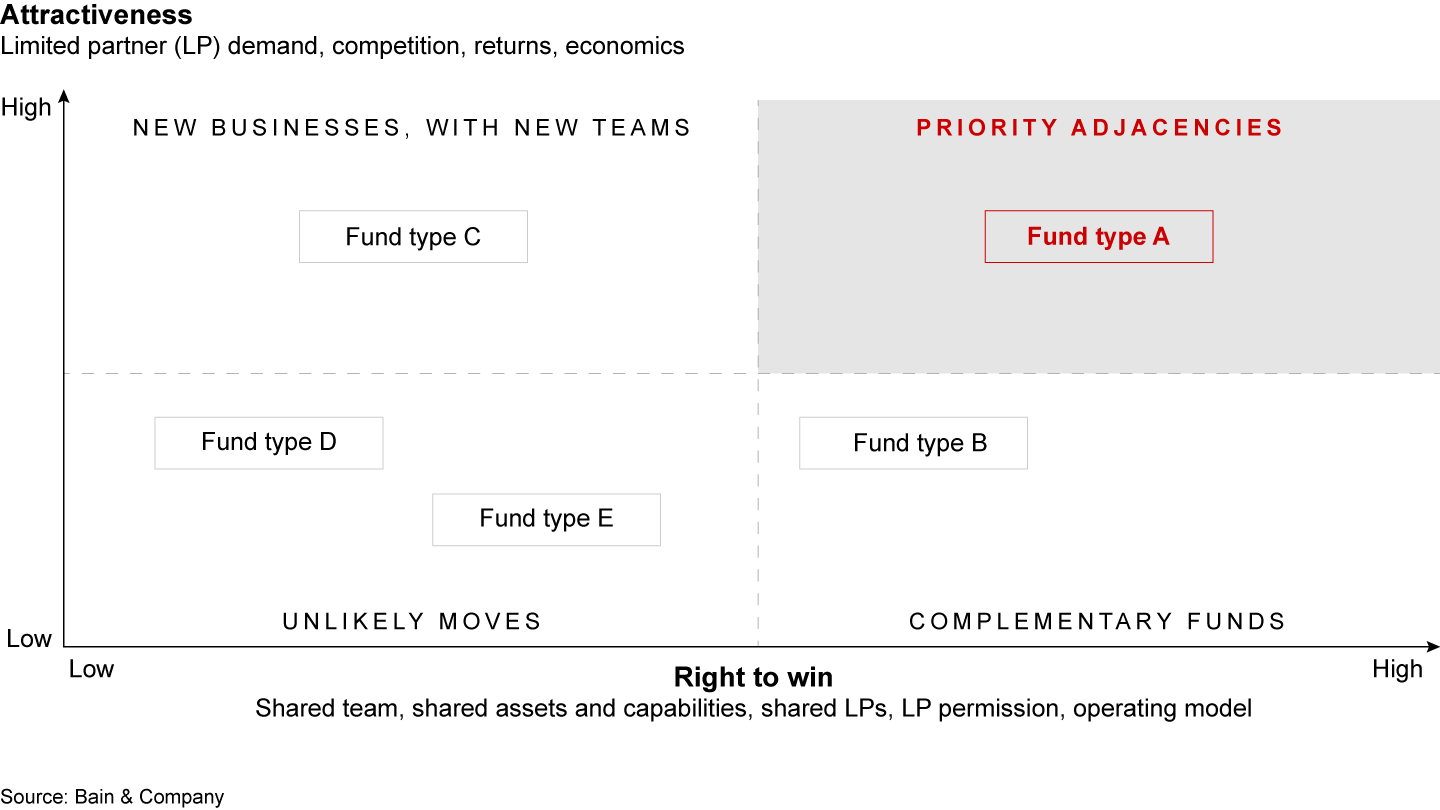
      Successful asset class expansion starts with two questions: Is the class attractive, and do we have a right to win?

      These questions lead to several practical considerations that can help frame the issues.

      Attractiveness

      • LP demand: Is this an area that has attracted the interest of a large number of investors and significant capital?
      • Competition: Who is competing in the space now? How good are they, and is there room for new entrants?
      • Returns: How high are typical returns for this asset class? Are returns similar to or better than what we offer our investors today?
      • Economics: What is the typical fee structure for this asset class? What is a realistic size for Fund I, and what scale is required to compete? Can we achieve that size in a reasonable time frame with a workable investment?

      Right to win

      • Shared team: Can our existing team (investment professionals and others) succeed within this new adjacency? If not, how much new talent will we need to add, and are attractive candidates or acquisition targets available? What will it take to integrate the new team with our unique culture?
      • Shared assets and capabilities: To what extent will our differentiated assets and capabilities help us win in this adjacency (sourcing networks, operational expertise, sector knowledge, etc.)? How much capability building (or buying) is required?
      • Shared LPs: Will our existing LPs invest with us in this strategy, and are they enthusiastic about placing capital there?
      • LP permission: How will LPs perceive our expansion? Will they see it as complementary or as a distraction? Could this perception harm future fund-raising?
      • Operating model: Will this move take advantage of our existing infrastructure and operations, or will it involve some level of transformation? Is it culturally aligned with the current team and style of investing? Will the economics work to everyone’s advantage?

      The most important message here is that a growth imperative isn’t enough. It has to be matched with a differentiation imperative that gets just as much attention from leadership. More than anything else, LPs want to know that a general partner can reliably outperform the average in whatever asset class its funds invest in. Growth in AUM comes from demonstrating a clear, competitive advantage and the ability to deliver results.

      This has never been more true than in today’s fund-raising environment, where new capital is suddenly harder to come by. Growth for growth’s sake won’t play. The imperative is to demonstrate how your firm is going to win.

      著者
      • Headshot of Hugh MacArthur
        Hugh MacArthur
        パートナー, Boston
      • Headshot of Or Skolnik
        Or Skolnik
        パートナー, New York
      • Headshot of Brenda Rainey
        Brenda Rainey
        Executive Vice President, Boston
      • Headshot of Graham Rose
        Graham Rose
        パートナー, Boston
      • Headshot of Alexander De Mol
        Alexander De Mol
        パートナー, London
      関連業種
      • プライベートエクイティ
      コンサルティングサービス
      • Firm Strategy & Operations
      プライベートエクイティ
      This Time It’s Different: The Strategic Imperative in Private Equity

      Structural changes are already altering the competitive landscape in alternatives. Do you have a plan to stay ahead over the coming decade?

      詳細
      プライベートエクイティ
      What Kind of AI Cycle Are We Actually In?

      The question for investors is not whether AI will boom or bust, but who may be unwittingly subsidizing the buildout.

      詳細
      プライベートエクイティ
      Macro Update: What Could Derail 2026?

      Bain’s leading macroeconomic expert examines the cracks beneath the surface of the US market and how investors should prepare for post-globalization realities.

      詳細
      Firm Strategy & Operations
      Sustainable Aviation Fuel: The Supply Race Is On

      European production is projected to fall nearly 20% short of mandate-driven demand by 2030, a big opportunity for global feedstock suppliers and refiners that invest now.

      詳細
      プライベートエクイティ
      New Models of Value Creation for Physician Groups

      Investors are retooling their physician group approach, building performance-driven platforms for the long term and positioning assets for strategic exits.

      詳細
      First published in 8月 2022
      Tags
      • Firm Strategy & Operations
      • プライベートエクイティ

      クライアント支援事例

      A Strategic Vision Inspires a Strategic Acquisition

      ケーススタディを見る

      Rapid Tech Due Diligence Helped a Private Equity Firm Invest with Confidence

      ケーススタディを見る

      An Asian Sovereign Wealth Fund Expands Its Tech Investing

      ケーススタディを見る

      お気軽にご連絡下さい

      私達は、グローバルに活躍する経営者が抱える最重要経営課題に対して、厳しい競争環境の中でも成長し続け、「結果」を出すために支援しています。

      ベインの知見。競争が激化するグローバルビジネス環境で、日々直面するであろう問題について論じている知見を毎月お届けします。

      *プライバシーポリシーの内容を確認し、合意しました。

      プライバシーポリシーをご確認頂き、合意頂けますようお願い致します。
      Bain & Company
      お問い合わせ Sustainability Accessibility Terms of use Privacy Cookie Policy Sitemap Log In

      © 1996-2026 Bain & Company, Inc.

      お問い合わせ

      How can we help you?

      • ビジネスについて
      • プレス報道について
      • 採用について
      全てのオフィス