

論説
Media companies once had to read the tea leaves in focus groups, TV ratings and chart rankings to help guide their investment decisions, but no longer. They are now awash in data. Across devices and media types, they can track clicks, views and shares—all containing information that, when properly sifted and understood, can improve the odds of their programming bets.
Of course, nearly every industry is looking for ways to add value through analytics. And media companies may have better opportunities than most, as the very act of consuming content provides incredible amounts of data that can inform every aspect of content generation, packaging and distribution. The challenge in media, then, is not to generate data, but to integrate multiple data flows—new digital data along with more traditional sources of information—into their operations. Media companies must seize the opportunities this new data presents—or watch their pure digital competitors extend their lead in consumer intimacy.
Our work with media companies across the value chain, including content creators, aggregators and distributors, leaves us with no doubt that the opportunity to serve audiences better is immense, and the companies that are able to capitalize on this opportunity are likely to produce tremendous new value. But our work also suggests that even the media companies with the most sophisticated approaches are not ready for this challenge. Many are just beginning to take a systematic approach to building and managing their analytics capabilities.
Media companies are awash in data but many lack the capabilities to integrate this information into their operations, says Partner Charlie Kim, head of Bain & Company's Media practice in the Americas. In this brief video, he explains what leading media companies can do to harness this data and increase growth.
Bigger bets on new products: Tapping data insights
Every year brings more data and with it, more chances to help media companies understand their customers better, so they can create and deliver more compelling products and services. Armed with those insights, media executives can approach the analytics challenge with goals of improving their existing products or creating new products that add value to their companies’ portfolios.
Improve existing products. In media, value comes from understanding and predicting the content (movies, video, music, books and games) audiences want. Data and analytics firepower can increase a media company’s odds of getting it right. When the producers of House of Cards were shopping the series to various distributors, Netflix and the other networks bidding for it all knew that political dramas, David Fincher films and Kevin Spacey in a sinister role were highly bankable properties. But Netflix brought superior data to the bidding, based on its in-depth and fine-grained analysis of viewers’ habits over many millions of viewings of shows. Netflix executives not only knew these qualities were likely to make the show popular; they also knew how long viewers had stuck with similar programs, through seasons and individual shows, and which characters had drawn the strongest interest. That confidence allowed Netflix to make a bolder bid and win the show as well as three Emmy awards.
Similarly, Disney is experimenting with ways to use data to improve a different kind of entertainment and customer experience: the theme park. Disney’s MagicBand bracelets use wireless technology to track visitors’ movements through its Orlando theme parks and resorts. Guests can use them to get into Disney’s parks, check in at FastPass entrances and even unlock their hotel rooms. On the back end, Disney will be able to gather volumes of data about where guests go and what they do at its parks, which Disney can use to optimize its customers’ experience.
Develop new products. The success of House of Cards shows how data helped one company acquire a better product to improve an existing business. The Weather Channel, recently rebranded as The Weather Company, is using its data to create a new product. The company has been known primarily for its cable TV channel featuring weather news. Now it is also building up its capabilities to sell weather data and insights as new services. Its non-media customers include energy farms and insurance companies that, for example, can text their customers if they know there’s a strong likelihood of hail in the customers’ area. One of the company’s most interesting and potentially lucrative new businesses is WeatherFX, a marketplace service that allows advertisers to correlate their display ads with weather events, based on what products are most likely to move in that weather.
Twitter’s recently announced deal with 300 Entertainment is another example of how a company’s data stream can create value in an adjacent business. Twitter users referenced music in more than a billion tweets in 2013— bits of commentary that can help music promoters learn what fans are saying and identify music that is generating excitement. Twitter will share that information (along with proprietary data about where those tweets originated) with 300, which will help Twitter organize the data and develop software that could be used by the music industry. Twitter says the goal is to connect artists and labels; 300 will be able to use the information to track early trends.
Organizing for advanced analytics
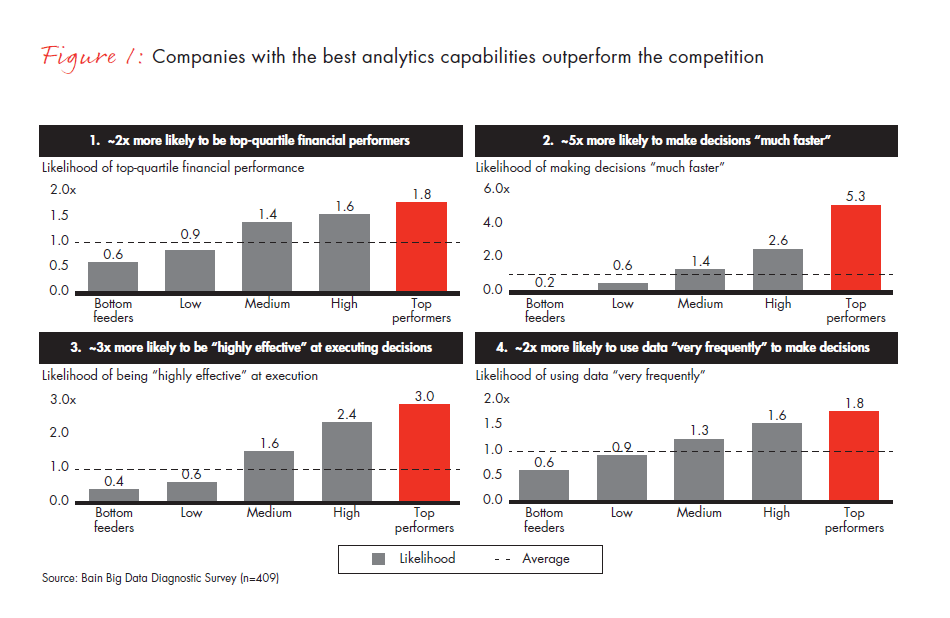
Having data isn’t the same as knowing what to do with it. To make the most of these opportunities, media companies will have to reset their organizations around building their analytics capabilities. Our 2013 survey on Big Data found that leaders in analytics share some organizational traits, and they are outperforming their less data-driven competitors on many levels (see Figure 1). The leaders in our study were:
- Twice as likely to be in the top quartile of financial performance within their industries
- Five times as likely to make decisions much faster than their market peers
- Three times as likely to execute decisions as intended
- Twice as likely to use data very frequently when making decisions
To build their data capabilities, companies like Google, Facebook and Twitter have invested heavily in analytics talent and infused data-driven approaches into their marketing, programming and creative processes. Media companies that lack competitive advanced analytics skills will increasingly find themselves outpaced by the better-informed, quicker business moves of those that excel in analytics.
The table stakes for getting started include a focus on three areas:
Ambition. Leading companies clearly define their intention and describe how improving their analytics capabilities will improve their business performance. Appointing a chief data officer is a strong sign that a company wants to do more than simply organize its analytics efforts; it wants to find new value using them. Yahoo’s appointment of Usama Fayyad is one such example.
Capabilities. With ambition defined, media executives need to create the will and the skill to use data throughout the organization. Organizations don’t change easily, and the value of analytics may not be apparent to everyone. Leaders define clear owners of analytics initiatives. They provide incentives to ensure decisions are based on data. They create targets for operational or financial improvements and trace the impact of analytics when those targets are achieved.
Organizational home. Models vary from having centers of excellence to hosting the analytics function in the most relevant parts of the company. But rarely, if ever, do we see analytics capabilities delegated to the IT department. Because it’s so critical to a business’s success, leading companies seat the analytics function closer to their business leaders.
As they build new analytics capabilities, media companies will need to remain focused on their business outcomes and understand what data will help them achieve those outcomes. We hear executives asking, “What can we do with all this data?” when they should be asking, “What data do we need to understand to build our business?” Cable companies, for example, gather terabytes of consumer data about customer start dates, the end of their promotional periods and service complaints. This data is most valuable when it helps cable companies understand the risk of a customer leaving. As the scope and volume of captured data keep growing, so do the analytics challenges.
Ramping up
Consumers’ media habits are changing rapidly, but media companies will need time to build up their operational capabilities in ways that allow them to make the most of the insights from incoming data. A network may be able to see, for example, how long viewers stick with the programs they’re watching. But those observations are fairly useless until media companies can scale up their abilities to act on them.
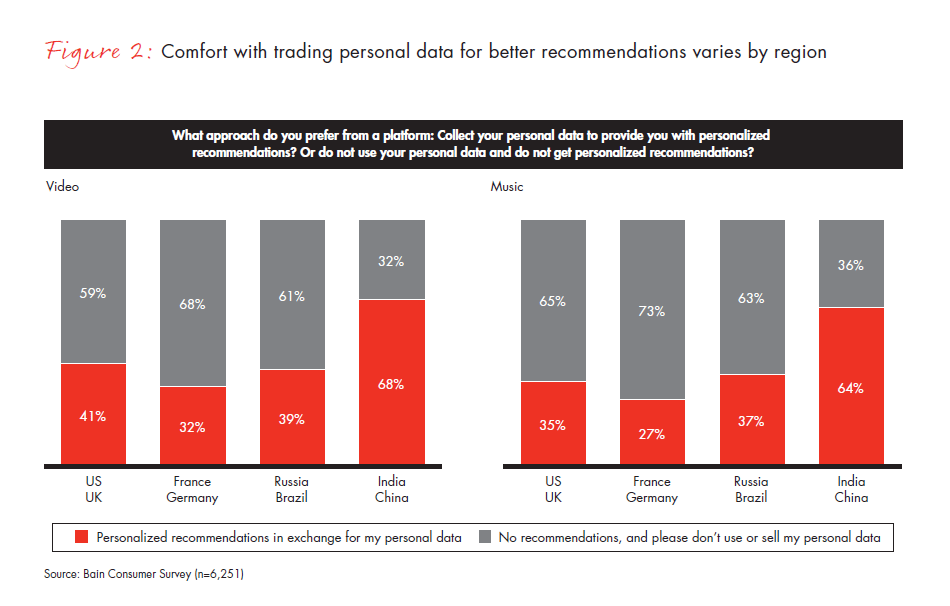
They will also need to pay attention to sensitivities around privacy and acknowledge regional differences in consumers’ sentiments. Our 2013 consumer survey across eight major media markets found significant differences in consumers’ willingness to allow companies to use their personal data in exchange for better content recommendations. Most of the consumers we surveyed in France and Germany are ready to do away with personalized recommendations in order to keep their personal data confidential. On the other hand, Indian and Chinese consumers are either less aware or less concerned about privacy issues: More than 60% would like personalized recommendations even if it means relinquishing some personal data (see Figure 2).
Media companies will have to invest in noninvasive, “opt-in” viral marketing techniques to share recommendations via social networks, rather than mine the data consumers may have inadvertently left open to marketing uses. As they tread new ground, publishers will have to manage these new sensitivities carefully, working with consumers and regulators to find the right balance between personalized services and privacy.
Finally, we expect media companies will continue indefinitely to balance traditional techniques with more data-driven methods of marketing and content generation. Advanced analytics may not be the silver bullet, but it is quickly becoming a powerful capability that can give media companies a competitive edge. Amazon’s recommendation engine may be highly refined and able to suggest obscure books and movies to every unique visitor based on his or her patterns of consumption and other indicators, but even Amazon can still move product with a large splash screen. It’s important for media companies to strike the right balance between well-established business practices and the use of new approaches based on analytics.
Laurent Colombani is a partner with Bain & Company’s Paris office. Andre James is a Bain partner in Los Angeles, and Charles Kim is a partner with Bain’s New York office. Rasmus Wegener is a Bain partner in Atlanta. All four work with Bain’s Global Media practice.
First published in 5月 2014