Skip to Content
  • オフィス

    オフィス

    北米・南米
    • Atlanta
    • Austin
    • Bogota
    • Boston
    • Buenos Aires
    • Chicago
    • Dallas
    • Denver
    • Houston
    • Los Angeles
    • Mexico City
    • Minneapolis
    • Monterrey
    • Montreal
    • New York
    • Rio de Janeiro
    • San Francisco
    • Santiago
    • São Paulo
    • Seattle
    • Silicon Valley
    • Toronto
    • Washington, DC
    ヨーロッパ・中東・アフリカ
    • Amsterdam
    • Athens
    • Berlin
    • Brussels
    • Copenhagen
    • Doha
    • Dubai
    • Dusseldorf
    • Frankfurt
    • Helsinki
    • Istanbul
    • Johannesburg
    • Kyiv
    • Lisbon
    • London
    • Madrid
    • Milan
    • Munich
    • Oslo
    • Paris
    • Riyadh
    • Rome
    • Stockholm
    • Vienna
    • Warsaw
    • Zurich
    アジア・オーストラリア
    • Bangkok
    • Beijing
    • Bengaluru
    • Brisbane
    • Ho Chi Minh City
    • Hong Kong
    • Jakarta
    • Kuala Lumpur
    • Manila
    • Melbourne
    • Mumbai
    • New Delhi
    • Perth
    • Shanghai
    • Singapore
    • Sydney
    • Tokyo
    全てのオフィス
  • アルムナイ
  • メディア
  • お問い合わせ
  • 東京オフィス
  • Japan | 日本語

    地域と言語を選択

    グローバル
    • Global (English)
    北米・南米
    • Brazil (Português)
    • Argentina (Español)
    • Canada (Français)
    • Chile (Español)
    • Colombia (Español)
    ヨーロッパ・中東・アフリカ
    • France (Français)
    • DACH Region (Deutsch)
    • Italy (Italiano)
    • Spain (Español)
    • Greece (Elliniká)
    アジア・オーストラリア
    • China (中文版)
    • Korea (한국어)
    • Japan (日本語)
  • Saved items (0)
    Saved items (0)

    You have no saved items.

    後で閲読、共有できるようにするためにブックマークしてください

    Explore Bain Insights
  • 業界別プラクティス
    メインメニュー

    業界別プラクティス

    • 航空宇宙、防衛、政府関連
    • 農業
    • 化学製品
    • インフラ、建設
    • 消費財
    • 金融サービス
    • ヘルスケア
    • 産業機械、設備
    • メディア、エンターテインメント
    • 金属
    • 採掘・鉱業
    • 石油、ガス
    • 紙、パッケージ
    • プライベートエクイティ
    • 公共、社会セクター
    • 小売
    • テクノロジー
    • 通信
    • 交通
    • 観光産業
    • 公益事業、再生可能エネルギー
  • 機能別プラクティス
    メインメニュー

    機能別プラクティス

    • カスタマー・エクスペリエンス
    • サステイナビリティ、 社会貢献
    • Innovation
    • 企業買収、合併 (M&A)
    • オペレーション
    • 組織
    • プライベートエクイティ
    • マーケティング・営業
    • 戦略
    • アドバンスド・アナリティクス
    • Technology
    • フルポテンシャル・トランスフォーメーション
  • Digital
  • 知見/レポート
  • ベイン・アンド・カンパニーについて
    メインメニュー

    ベイン・アンド・カンパニーについて

    • ベインの信条
    • 活動内容
    • 社員とリーダーシップ
    • プレス・メディア情報
    • クライアントの結果
    • 受賞歴
    • パートナーシップを結んでいる団体
    Further: Our global responsibility
    • ダイバーシティ
    • 社会貢献
    • サステイナビリティへの取り組み
    • 世界経済フォーラム(WEF)
    Learn more about Further
  • キャリア
    メインメニュー

    キャリア

    • ベインで働く
      キャリア
      ベインで働く
      • Find Your Place
      • ベインで活躍する機会
      • ベインのチーム体制
      • 学生向けページ
      • インターンシップ
      • 採用イベント
    • ベインでの体験
      キャリア
      ベインでの体験
      • Blog: Inside Bain
      • キャリアストーリー
      • 社員紹介
      • Where We Work
      • 成長を後押しするサポート体制
      • アフィニティ・グループ
      • 福利厚生
    • Impact Stories
    • 採用情報
      キャリア
      採用情報
      • 採用プロセス
      • 面接内容
    FIND JOBS
  • オフィス
    メインメニュー

    オフィス

    • 北米・南米
      オフィス
      北米・南米
      • Atlanta
      • Austin
      • Bogota
      • Boston
      • Buenos Aires
      • Chicago
      • Dallas
      • Denver
      • Houston
      • Los Angeles
      • Mexico City
      • Minneapolis
      • Monterrey
      • Montreal
      • New York
      • Rio de Janeiro
      • San Francisco
      • Santiago
      • São Paulo
      • Seattle
      • Silicon Valley
      • Toronto
      • Washington, DC
    • ヨーロッパ・中東・アフリカ
      オフィス
      ヨーロッパ・中東・アフリカ
      • Amsterdam
      • Athens
      • Berlin
      • Brussels
      • Copenhagen
      • Doha
      • Dubai
      • Dusseldorf
      • Frankfurt
      • Helsinki
      • Istanbul
      • Johannesburg
      • Kyiv
      • Lisbon
      • London
      • Madrid
      • Milan
      • Munich
      • Oslo
      • Paris
      • Riyadh
      • Rome
      • Stockholm
      • Vienna
      • Warsaw
      • Zurich
    • アジア・オーストラリア
      オフィス
      アジア・オーストラリア
      • Bangkok
      • Beijing
      • Bengaluru
      • Brisbane
      • Ho Chi Minh City
      • Hong Kong
      • Jakarta
      • Kuala Lumpur
      • Manila
      • Melbourne
      • Mumbai
      • New Delhi
      • Perth
      • Shanghai
      • Singapore
      • Sydney
      • Tokyo
    全てのオフィス
  • アルムナイ
  • メディア
  • お問い合わせ
  • 東京オフィス
  • Japan | 日本語
    メインメニュー

    地域と言語を選択

    • グローバル
      地域と言語を選択
      グローバル
      • Global (English)
    • 北米・南米
      地域と言語を選択
      北米・南米
      • Brazil (Português)
      • Argentina (Español)
      • Canada (Français)
      • Chile (Español)
      • Colombia (Español)
    • ヨーロッパ・中東・アフリカ
      地域と言語を選択
      ヨーロッパ・中東・アフリカ
      • France (Français)
      • DACH Region (Deutsch)
      • Italy (Italiano)
      • Spain (Español)
      • Greece (Elliniká)
    • アジア・オーストラリア
      地域と言語を選択
      アジア・オーストラリア
      • China (中文版)
      • Korea (한국어)
      • Japan (日本語)
  • Saved items  (0)
    メインメニュー
    Saved items (0)

    You have no saved items.

    後で閲読、共有できるようにするためにブックマークしてください

    Explore Bain Insights
  • 業界別プラクティス
    • 業界別プラクティス

      • 航空宇宙、防衛、政府関連
      • 農業
      • 化学製品
      • インフラ、建設
      • 消費財
      • 金融サービス
      • ヘルスケア
      • 産業機械、設備
      • メディア、エンターテインメント
      • 金属
      • 採掘・鉱業
      • 石油、ガス
      • 紙、パッケージ
      • プライベートエクイティ
      • 公共、社会セクター
      • 小売
      • テクノロジー
      • 通信
      • 交通
      • 観光産業
      • 公益事業、再生可能エネルギー
  • 機能別プラクティス
    • 機能別プラクティス

      • カスタマー・エクスペリエンス
      • サステイナビリティ、 社会貢献
      • Innovation
      • 企業買収、合併 (M&A)
      • オペレーション
      • 組織
      • プライベートエクイティ
      • マーケティング・営業
      • 戦略
      • アドバンスド・アナリティクス
      • Technology
      • フルポテンシャル・トランスフォーメーション
  • Digital
  • 知見/レポート
  • ベイン・アンド・カンパニーについて
    • ベイン・アンド・カンパニーについて

      • ベインの信条
      • 活動内容
      • 社員とリーダーシップ
      • プレス・メディア情報
      • クライアントの結果
      • 受賞歴
      • パートナーシップを結んでいる団体
      Further: Our global responsibility
      • ダイバーシティ
      • 社会貢献
      • サステイナビリティへの取り組み
      • 世界経済フォーラム(WEF)
      Learn more about Further
  • キャリア
    人気検索キーワード
    • デジタル
    • 戦略
    前回の検索
      最近訪れたページ

      Content added to saved items

      Saved items (0)

      Removed from saved items

      Saved items (0)

      論説

      Beyond Trade Wars, the Real Reason You Need to Reinvent Your Supply Chain

      Beyond Trade Wars, the Real Reason You Need to Reinvent Your Supply Chain

      Rapidly changing customer expectations make the case for greater flexibility.

      著者:Jared Lapin, Gerry Mattios, Raymond Tsang, and Jason Lee

      • min read
      }

      論説

      Beyond Trade Wars, the Real Reason You Need to Reinvent Your Supply Chain
      en
      概要
      • Broad macroeconomic shifts have made far-flung supply chains more costly and cumbersome.
      • Although productivity rates in some Chinese industries have risen by as much as 10 times since 1992, wage levels in China are 20 times higher.
      • Leading companies are shifting production of customized products closer to market demand.
      • Digital solutions can help offset the costs of local production and increase margins.

      The US-China trade dispute has been a wake-up call in boardrooms around the world. As companies scramble to avert short-term cost pressures from a trade war, many are now considering a bigger opportunity—the chance to redesign their supply chains for the future. Building a more flexible operations network can help companies adapt to rapidly shifting customer expectations and protect against future geopolitical risk. 

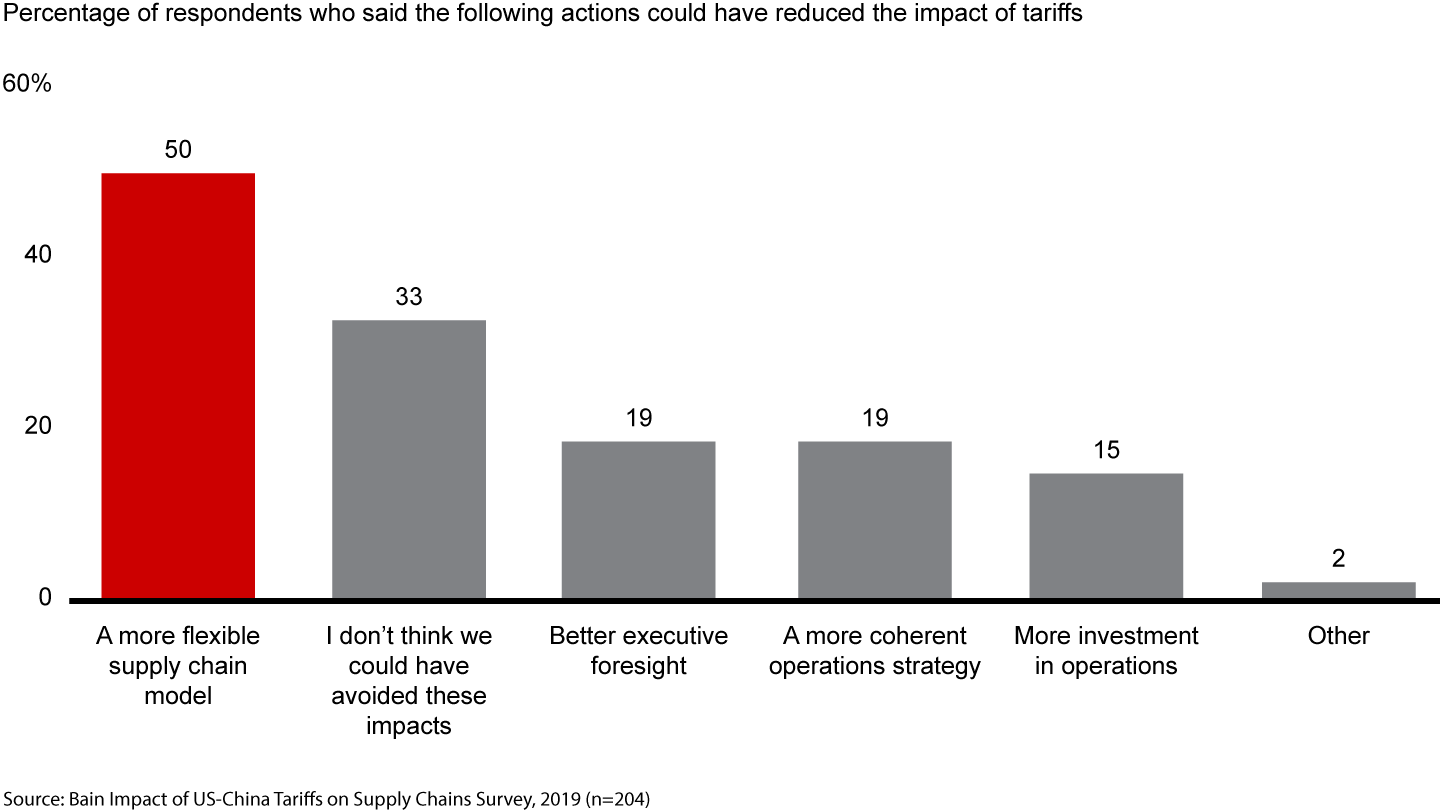
      The impact of tariffs is a serious concern, of course—some $70 billion in added cost for Chinese imports to the US and $20 billion in higher costs for US imports to China. Electronics products account for a quarter of the goods affected by tariffs, and industrial manufacturers make up 20%. A recent Bain survey shows 60% of US multinationals with suppliers or operations in China expect a negative impact from tariffs. Of those, nearly 40% anticipate a cost increase of more than 5%, and another 40% expect a rise of 3% to 4%. Importantly, 50% of all respondents said a more flexible supply chain could have helped mitigate the impact of the tariffs (see Figures 1 & 2). 

      Figure 1
      Forty percent of the US multinationals that anticipate a negative impact from China tariffs expect cost increases of 5% or more
      Forty percent of the US multinationals that anticipate a negative impact from China tariffs expect cost increases of 5% or more
      Forty percent of the US multinationals that anticipate a negative impact from China tariffs expect cost increases of 5% or more
      Figure 2
      Half of executives surveyed said a more flexible supply chain could have helped mitigate tariffs’ impact on their operations
      Half of executives surveyed said a more flexible supply chain could have helped mitigate tariffs’ impact on their operations
      Half of executives surveyed said a more flexible supply chain could have helped mitigate tariffs’ impact on their operations

      Short-term tactical moves can help limit potential damage. Leadership teams can seek new raw material suppliers and hedge those costs, shift contract manufacturing to a different region or rebalance manufacturing around the world. In a recent Bain survey, 25% of corporate executives said they were redirecting investments out of China and 42% said they expect to get materials from a different region in the next year. Among those moving some or all of their production from China to other regions: camera-maker Olympus and toy company Hasbro.

      But the long-term strategic challenge is getting supply chains right for the future. That’s a complicated balancing act. Wage levels in China today are 20 times higher than they were in 1992, pushing low-cost manufacturing to other developing countries and making automated assembly lines more compelling than in the past. China is also starting to manufacture higher value products and services, and its labor productivity has increased by 16% annually over the last 10 years.

      At the same time, rapid changes in consumer preferences are making far-flung supply chains costly, cumbersome and vulnerable to a growing number of risks. Consumers want more customized products, and more variations. Those preferences are increasing product portfolios. Global manufacturers are starting to realize that producing customized products closer to market demand is smarter and can be more cost effective. Importantly, it allows them to allocate production in tandem with shifting demand, instead of months in advance.

      Broad macroeconomic shifts also are transforming global markets. Manufacturing cost is still important, but agility and speed to market are becoming increasingly vital to competitiveness. Companies that fail to adapt to rapid changes in market demand risk producing the wrong products.

      インフォグラフィック

      Now Is the Time to Reinvent Your Supply Chain

      Trade wars, long-term trends offer an opportunity to build a supply chain for the future

      Supply chain of the future

      Leading manufacturers are using new technologies to reinvent their supply chains for an era of faster change and uncertainty. The digital technology that powers Industry 4.0, for example, helps companies produce far more efficiently through intelligent, digital supply chains. Workstations fitted with augmented reality software to instruct workers are increasing productivity rates and enabling more complex workflows. If a worker picks up the wrong bolt, the system immediately recognizes the mistake and tells the worker which one to use.

      As these advances make the workforce in the US and other high-wage markets more efficient, low wage rates are becoming less important than they were two decades ago, when companies rushed to invest in China. Take the case of a global consumer products company that recently began rethinking its decades-old strategy of consolidating facilities in a few low-cost regions. The company’s leadership team realized its far-flung supply chain limited flexibility and slowed the introduction of new innovations to market. Senior executives also worried about geopolitical fallout including increased tariffs and other potential taxes. 

      To increase the company’s responsiveness to changing market demand and develop more locally customized products, they started shifting some production closer to key markets. The company’s new production sites are smaller but have a more flexible layout. The good news: Digital solutions helped offset the costs of local production and increase margins by more than 6%.

      By negotiating contracts with suppliers that offer capacity in multiple countries, companies can shift sourcing or production as geopolitical risk or other factors threaten to crimp supply. One global technology company has increased the resiliency in its supply chain by working with its parts suppliers and contract manufacturers to build capacity outside of China. At the same time, the leadership team is looking for opportunities in its existing network to rebalance manufacturing and take advantage of free trade zones.

      Made in China 2025

      In 2015, the Chinese government launched a policy initiative called Made in China 2025 to achieve dominance in global high-tech manufacturing. For Chinese manufacturing companies, the initiative means increased complexity and a greater focus on intellectual property. That shift, together with the US-China trade dispute, has prompted many to start rethinking their supply chains.

      One Chinese technology company has begun redesigning its global supply chain network strategy to make it more agile and less vulnerable to geopolitical risks. To quickly offset rising costs, it’s shifting some of the east-coast production inland, where wages are lower. As part of an effort to build a supply chain of the future, the leadership team is conducting a strategic review of demand and supply chain capabilities in emerging markets including Southeast Asia, Eastern Europe and Latin America.

      Monday 8 AM 

      Many global companies have taken short-term actions to shield their businesses from higher costs and supply interruption linked to the US-China trade dispute. But industry leaders are taking full advantage of the trade crisis to reimagine their supply chains for the future.  

      Three critical steps help them zero in on the issues that matter most as they start to design flexible and efficient networks for 2025 and beyond. First, senior executives meet with marketing and sales teams to understand customer expectations for the next three to five years. In particular, they determine how critical speed to market will be for customers and for the industry. Next, they sit down with operations heads to project what investments will be needed to deliver on customer expectations. Finally, these companies choose supply chain technologies, networks and partnerships to underpin a more flexible and agile global network.

      Leadership teams starting down this path determine their next steps by assessing the importance of several key capabilities:

      • the use of supply chain data to more accurately predict local demand;
      • sourcing goods from diverse geographical areas;
      • the flexibility to outsource production of products;
      • digital manufacturing and warehousing; and
      • artificial intelligence-enabled route optimization and pick-and-pack technology. 

      Stepping back, companies also need to evaluate geopolitical risks that could threaten supply chains and determine where to build redundancy into critical capabilities. Each leadership team will confront a different mix of challenges and come up with its own set of answers. But successful companies have one thing in common: They are not waiting for the next crisis to start the journey. 

      Jared Lapin is an expert principal in Bain & Company’s Performance Improvement practice and is based in the firm’s Chicago office. Gerry Mattios is an expert vice president in Bain’s Performance Improvement and Advanced Manufacturing & Services practices and is based in the Singapore office. Raymond Tsang is a partner in Bain’s Performance Improvement practice and is based in Shanghai. Jason Lee is an expert principal in Bain’s Global Advanced Analytics group and is based is the Los Angeles office.

      著者
      • Headshot of Jared Lapin
        Jared Lapin
        Former Partner, Chicago
      • Headshot of Gerry Mattios
        Gerry Mattios
        パートナー, Singapore
      • Headshot of Raymond Tsang
        Raymond Tsang
        パートナー, Hong Kong
      • Headshot of Jason Lee
        Jason Lee
        Vice President, Data Science, Los Angeles
      関連業種
      • 産業財、サービス
      関連するコンサルティングサービス
      • サプライチェーン
      産業財、サービス
      It’s Time to Rethink Every Link in Your Supply Chain

      A function that once got little attention is now becoming a key differentiator.

      詳細
      産業財、サービス
      Technology in Building Products: Turn Cost into Value

      Bain experts reveal how companies in the building products industry are unlocking growth with bold tech investments.

      詳細
      サプライチェーン
      How AI Is Starting to Transform Circular Packaging

      There are 15 AI use cases companies across the value chain can use today to accelerate circularity.

      詳細
      産業財、サービス
      Defense M&A

      Bold moves will determine the winners as a continent rearms.

      詳細
      産業財、サービス
      Building Products M&A

      Why more companies are acquiring for scope.

      詳細
      First published in 8月 2019
      Tags
      • サプライチェーン
      • 産業財、サービス

      クライアント支援事例

      Supply Chain Security Mitigates a Sovereign Wealth Fund’s Construction Disruptions

      ケーススタディを見る

      購買・調達 How an Airline Used a Global Stall to Give Procurement a Lift

      ケーススタディを見る

      戦略 An auctioneer makes a winning online bid

      ケーススタディを見る

      お気軽にご連絡下さい

      私達は、グローバルに活躍する経営者が抱える最重要経営課題に対して、厳しい競争環境の中でも成長し続け、「結果」を出すために支援しています。

      ベインの知見。競争が激化するグローバルビジネス環境で、日々直面するであろう問題について論じている知見を毎月お届けします。

      *プライバシーポリシーの内容を確認し、合意しました。

      プライバシーポリシーをご確認頂き、合意頂けますようお願い致します。
      Bain & Company
      お問い合わせ Sustainability Accessibility Terms of use Privacy Cookie Policy Sitemap Log In

      © 1996-2026 Bain & Company, Inc.

      お問い合わせ

      How can we help you?

      • ビジネスについて
      • プレス報道について
      • 採用について
      全てのオフィス