

論説

概要
- Only a taxpayer-funded bailout saved RBS from going broke in 2008, after wrongheaded acquisitions and a period of across-the-board cost-cutting.
- Under new leadership, RBS fashioned a radically different strategy around understanding and addressing customers’ needs. The bank shifted its operating model from products and distribution to the customer journey (all the activities required to fill a particular need) and service.
- To change ways of working, RBS set up cross-functional teams responsible for individual journeys; greatly simplified its products; removed bonuses tied to sales; and designed an easy-to-use, convenient mobile app and website.
- While it’s premature to declare victory, RBS has made substantial progress: The balance sheet is strong, and the cost-income ratio has improved. New accounts and new mortgage lending have expanded. These add up to a restoration of customers’ loyalty and trust.
Recovering from the biggest loss in British corporate history as “the bank that almost broke Britain” during the 2008 financial crisis is a tall order. Rebuilding a reputation tarnished from years of “greed, arrogance, hubris and light-touch regulation,” as one prominent newspaper put it, would seem next to impossible.
Yet a decade on, the Royal Bank of Scotland has managed not only to recover its financial footing thanks to a taxpayer-funded bailout and more prudent risk-taking, but also to start restoring the trust and loyalty of many individual customers who were buffeted by the financial crisis. RBS has re-forged the strongest bonds with retail customers of its NatWest subsidiary (and it plans to rebrand the entire group as NatWest).
RBS’s resurgence remains a work in progress, with ample scope to improve. To thrive in an increasingly competitive market, the bank needs to improve customers’ experience, continue to simplify and evolve its legacy IT, accelerate growth in a difficult economic environment and deliver more digital innovations. Advancing on these fronts will help restore the bank’s reputation, which still suffers in many regions of the UK where it shuttered branches and laid off staff.
By many measures, though, RBS has already orchestrated a remarkable turnaround by focusing intensely on customers’ priorities—much of which has occurred quietly behind the headline restructuring moves. Training its resources on making customers’ lives easier stands in contrast to a culture that prized unbridled sales growth and sprawling M&A, which resulted in a dubious assessment of risk leading up to the financial crisis.
Among the many indicators of renewal are market-leading Net Promoter® scores at NatWest from customers taking out a new mortgage; one of the most well-regarded mobile platforms in the market, which almost three-quarters of customers now use (see Figure 1); and a steadily growing share of the UK market for personal banking.
Figure 1
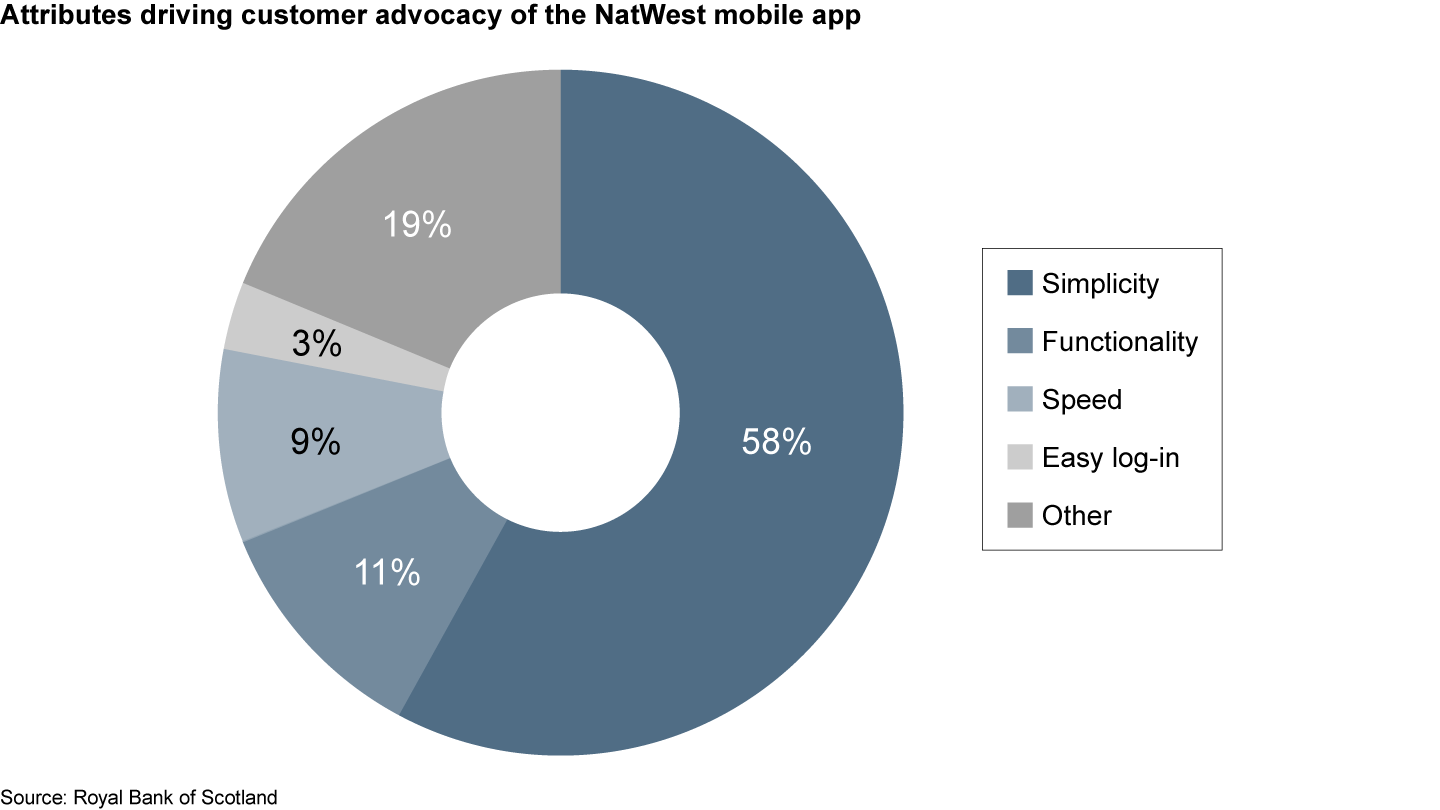

Emerging from the rubble of the financial crisis
This slow and steady resurgence has taken place in relative obscurity compared with the flamboyant tale of woe that played out on a global stage (see Figure 2). That story featured the 2007 takeover-too-far of ABN AMRO (jointly with Fortis and Santander), which lacked a strategic rationale. It grew out of a culture of fear and ruthless cost-cutting under CEO Fred Goodwin.
Figure 2
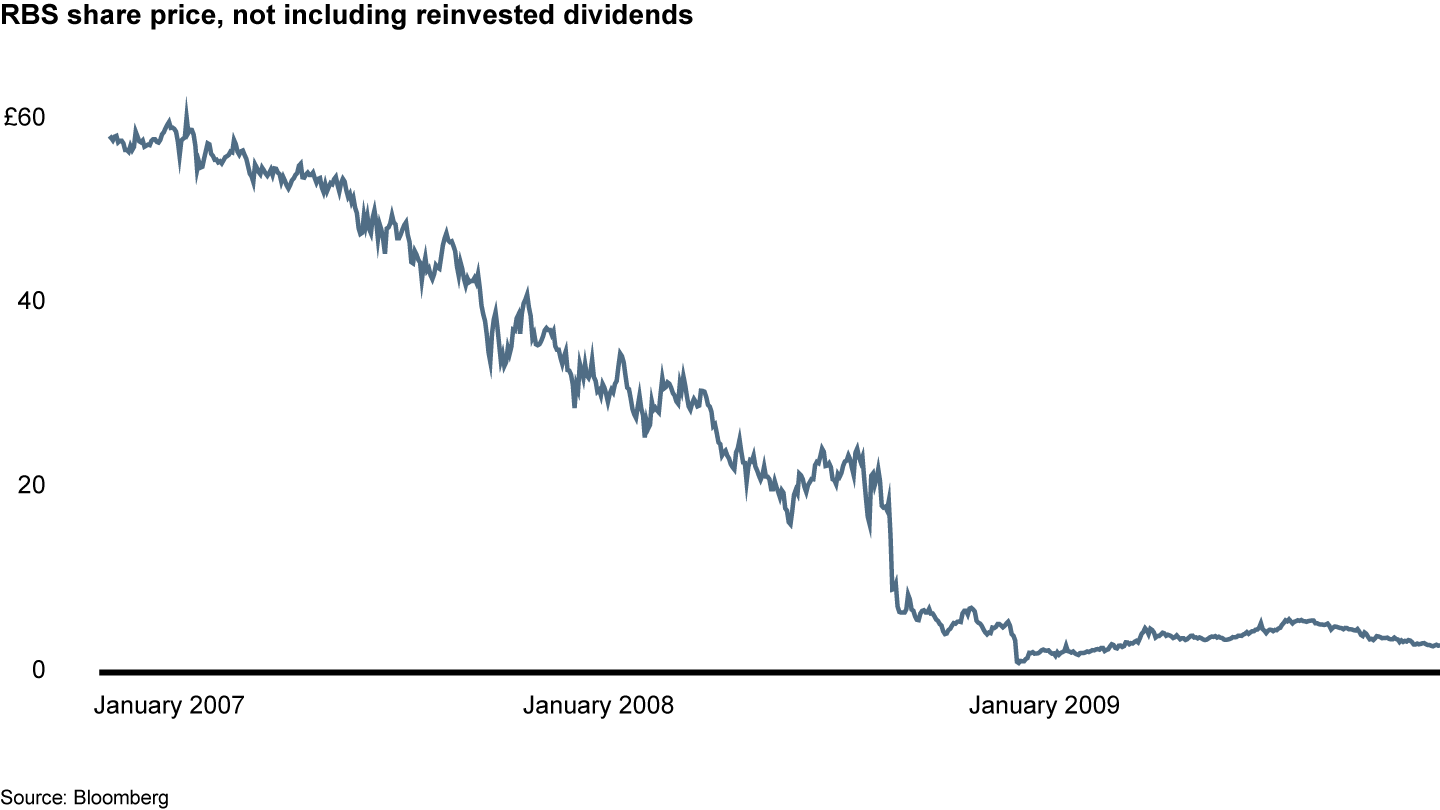

Less well known is how RBS emerged from the rubble. After the financial meltdown, RBS went back to basics to stabilize the bank and make it safe again. A narrow focus on commercial growth in a low-risk manner would reassure regulators and meet the bank’s government commitment to expand lending.
Once the bank had stabilized and reinstilled a discipline of healthy commercial growth, Ross McEwan, named CEO in 2013, led development of a strategy to withdraw from 20 countries, radically scale back the investment bank and focus on the UK.
As part of that reorientation, certain senior executives, such as the new CEO of personal banking, Les Matheson, championed a broader brief. They felt that in the next phase, the organization should aim to help meet customers’ goals at all the varied stages of life. This kicked off a quiet revolution backed with significant resources to understand and address customers’ needs, so that the bank could successfully meet customers’ expectations for a convenient, responsive, digitally enabled experience.
RBS’s retail group came out with a new mission statement: “Effortless every day, brilliant when it matters.” Like other mission statements, this was a broad notion that could easily have fizzled without a coherent strategy and an operational plan sustained over many years. Fortunately, RBS has delivered both.
McEwan embodied the mission when meeting staff and exhorting them, “What have you done to help the customer today?” His regular assurance that the customer mattered, along with irrefutable feedback from real customers about chronic pain points in dealing with RBS, gradually empowered employees to speak up about dysfunctional processes. Sure, some people resisted, noted one RBS executive, because “people tend to cling to what works and what they know.”
What many managers and executives did not know was what it felt like to deal with RBS as a customer—information that Net Promoter System feedback now brought to life.
Take the process of opening a checking account for the first time. The process was massively bureaucratic, forcing customers to mail or take to a branch the original documentation for proof of identity and address. Only after Net Promoter Score feedback prompted executives to go through the process themselves did they realize how risk aversion had created a monster.
Les Matheson on the Customer-Centric Bank
RBS’s long overhaul also involved designing simpler, clearer, fairer products. One obvious step, though painful in the short term, was eliminating “bad profits”—hidden fees, fee income from credit card teaser offers and different prices or rates in different channels. This decision in 2014 demonstrated to staff that senior management was serious about customer service.
McEwan and Matheson backed this up with an even tougher call in 2015: removing incentives for frontline employees such as the standard bonus at the branch or regional level for hitting monthly sales quotas. They eliminated variable compensation completely for customer-facing employees and introduced Net Promoter Score feedback for individual performance evaluations, though not linked to compensation. “Prior to the financial crisis, we would celebrate sales performance,” recalls Matheson. “As we changed the culture, the people we really valued were those who’d done fantastic, heroic things for customers.”
73% of RBS’s active personal checking account customers used mobile or online channels in 2019, and the bank saw 34% growth in mobile payments.
Shifting perspective from product to customer journey
No single decision or activity defines how RBS has been transforming its operating model. Instead, the transformation entails a persistent, painstaking process of flagging and eliminating small annoyances for customers and creating a series of small things that help customers—all without tripping up with regulators over issues such as how to accommodate customers in vulnerable situations.
One notable decision, however, was shifting the central unit of management from the product to the customer journey. A journey consists of all the activities required to fill a customer need, such as buying and maintaining a home or making regular payments or saving for the future. In contrast to the narrow, bank-centered product view, a journey perspective offers a holistic way of understanding and meeting customers’ priorities. This perspective has relevance for any financial institution contending with new competition from major technology companies and smaller fintechs that offer attractive digital experiences and different business models.
This was a major change, as most banks still organize around distributing products. Even some banks that purport to organize around customer journeys do so as a marketing overlay.
Beyond the Branch: Customer Journeys in Banking
At RBS, the heads of product and distribution moved on, leaving room for executives responsible for the customer journey to pursue new ways of working. Product experts became part of teams assigned to specific customer journeys. Distribution experts joined service teams that helped customers use self-service channels or provided staff assistance when customers want it, departing from the old mindset of branch staff “owning” their customers.
RBS trained tellers and other frontline staff on how to assess customers’ needs and advise them during conversations, and on how to listen to customer feedback through Net Promoter scores, then act on the feedback. New tools such as recorded customer conversations, and script prompts based on analysis of past successes, supported the new behaviors.
Resource allocation shifted accordingly to journeys. The changes also hinged on self-funding by removing bad costs, simplifying overly complex processes and relying more on digital self-service and automation of back-end processes.
As a result, RBS saw steady improvements in cost. Customer calls declined because RBS was resolving more queries at the first contact. The bank’s cost-income ratio dropped from 76% in 2015 to 65% in 2019. Meanwhile, a redesigned mobile app attracted more mobile payments, digital sales and basic transactions—a digital migration coaxed along by 850 “TechXperts” in branches.
RBS’s cost-income ratio has improved from 76% in 2015 to 65% in 2019.
Beyond changing incentives and ways of working, RBS revised how it holds senior executives accountable. Where accountability once divided along narrow products and functions—one executive for mortgages, another for distribution, and so on—the bank now defines accountability for an end-to-end customer journey. Taking that end-to-end perspective allows the journey team to create more value for the customer and the bank. Matheson calls it “breaking silos at scale.”
This model incorporates the customer perspective, and also integrates technology staff with business staff. For example, 1,600 technology and business employees, all working on teams devoted to specific customer journeys, co-located in Edinburgh over the course of one weekend.
Helping people own a home, not just selling them a mortgage
The nitty-gritty details of RBS’s customer-centered transformation come to life in the metamorphosis of its mortgage business. Mortgages are a crucial part of a retail bank’s economics, as well as a way to deepen relationships with customers.
By 2016, new, tech-savvy competitors were springing up with relatively convenient mortgage offers. Matheson and team realized that RBS could better serve customer by reimagining the traditional business of selling the mortgage product—with its focus on price, promotions and features—as a business built around helping people through all stages of home buying and ownership.
To get there, however, several things would need to change, especially the rigid ways of working that involved different departments operating in silos not in concert. The bank set up a small, cross-functional team, including people from various departments in the business and IT, to revamp the entire home ownership journey.
Human-centered design, informed by regular customer feedback, guided activities such as the mortgage application. Now a customer could complete the application on a smartphone or computer in less than an hour. A follow-up conversation could take place on the phone rather than in person, and the bank could give a decision in a few days rather than weeks.
The team also simplified related processes. RBS would no longer require a survey of a property if it could make a proper valuation from other data. And it would not ask for the applicant’s income and spending history if it could quickly obtain that from one of the credit bureaus.
In 2017, NatWest launched the UK’s first paperless mortgage application; now 93% of all its applications are paperless. The average application-to-offer time has shrunk from 23 days to 11. Customers have responded well to these innovations: NatWest has reached a market-leading Net Promoter Score of 39 from customers taking out a new mortgage, tied for the highest score in the market in 2019.
With NatWest launching the UK’s first paperless mortgage application, 93% of all its mortgage applications are paperless. NatWest ties for the highest Net Promoter Score in the UK mortgage market.
Rising consumer expectations mean that RBS must continually improve its proposition or else cede ground to digital native insurgents. NatWest responded with an offering that allows customers to tap an ecosystem of partners for online assistance that ranges from shopping for a new property, to tracking and borrowing against equity, to planning and funding renovations.
Deploying a team that incorporated skills related to customer insights, software development and third-party partnering, RBS was able to develop and launch the first version of this offering in four months. A solution of this complexity and quality would have taken at least three times as long under previous ways of working—if it could have been successfully developed at all.
A glass half full
With McEwan’s departure to become CEO of National Australia Bank in late 2019, RBS is positioned to prosper under new CEO Alison Rose, who has reaffirmed the bank’s commitment to putting customers first. The balance sheet is strong, with a core equity tier one ratio of 16.2%. RBS returned to profitability in 2017, having racked up losses totaling almost £60 billion since 2008, and started to deliver dividends in 2018. RBS also returned £2.7 billion to shareholders in 2019.
Other indicators also give confidence that the bank’s proposition is once again resonating with customers. New accounts opened exceed accounts closed. New mortgage lending has steadily expanded, rising 8% in 2019. Digital innovations, such as allowing customers to open an account by providing a selfie and photo of their passport via smartphone, or launching biometric credit cards, have become quite popular.
Steady progress with customers motivates employees as well. RBS’s employee engagement score has risen from 78% in early 2015 to 87% by 2019, vs. a global average of 82. The retail bank, with the largest number of employees, is powering this trend with a score of 91% in 2019.
Progress with customers motivates employees as well. RBS’s employee engagement score has risen from 78% in early 2015 to 87% in 2019, vs. a global average of 82.
Yet it would be premature to declare victory after the tough restructuring. The customer goodwill that RBS has worked so hard to earn hinges on continued progress in several areas: making end-to-end journeys simpler and more digital, delivering more value to customers, moving faster than competitors—and doing all these thing without major missteps. This is a tall order, but feasible now that the bank considers serving customers as a core purpose.
Herman Spruit and Eduardo Roma are partners with Bain & Company’s Financial Services practice. They are based in London.
Net Promoter®, Net Promoter System®, Net Promoter Score® and NPS® are registered trademarks of Bain & Company, Inc., Fred Reichheld and Satmetrix Systems, Inc.
First published in 3月 2020