

論説

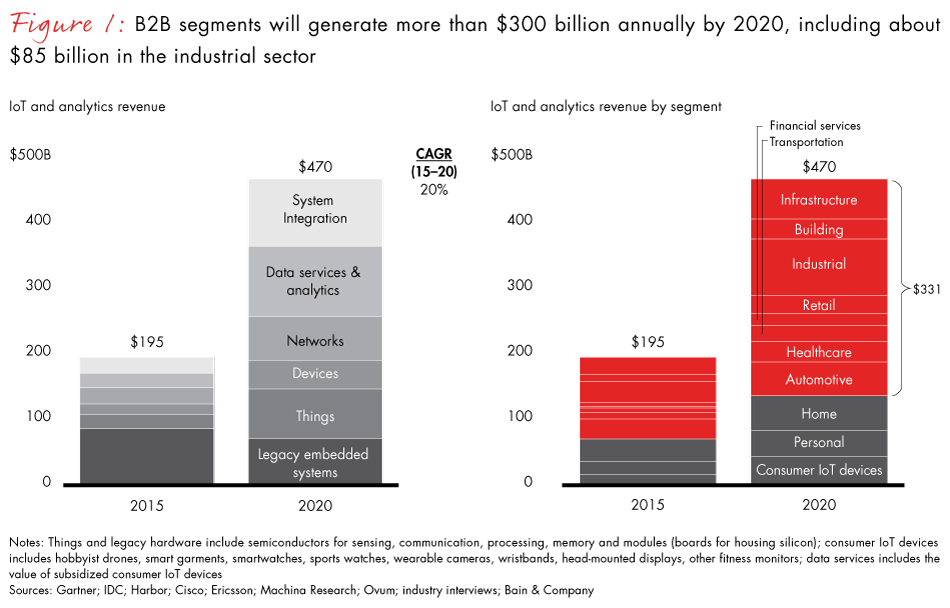
Connected consumer devices and wearables have captured the attention of the media, but the biggest battlegrounds in the Internet of Things (IoT) will be the enterprise and industrial sectors. Consumer applications will generate $150 billion by 2020, but business-to-business (B2B) applications will be worth twice that amount, with more than $300 billion in anticipated revenues (see Figure 1). Globally, enthusiasm for the Internet of Things has fueled more than $80 billion in merger and acquisition (M&A) investments by major vendors and more than $30 billion in venture capital, according to Bain’s estimates.
Within the industrial and enterprise markets, however, decisions about where and how to invest in IoT applications are complicated by fragmentation in industry subsectors and the mission-critical requirements of the technology. Some of the largest industrial firms are investing billions in their IoT platforms, including GE’s Predix, Siemens’s Mindsphere and Schneider Electric’s EcoStruxure. Although technologies such as sensors, connectivity, processing, cloud services and analytics applications are mostly ready and available, many executives still struggle to make the case for investment and to focus their organization’s resources around an IoT platform. Industrial companies are still hindered by concerns about how technologies will integrate with their existing environment, how they will manage security and how they will evolve over time.
For IoT technology providers, the equation is just as complex, but several imperatives are emerging.
• Partnerships are essential, and industrial device and equipment makers are forging relationships with analytics leaders and cloud service providers that will be critical to success. Most are also investing in their own analytics capabilities, in part to work better with these partners.
• Specialization across the industrial landscape will further complicate decisions about where to invest. Each industry has a distinct ecosystem structure: Some are more fragmented than others, while some are more global than local. Understanding the unique characteristics will be key to commercial and technological efforts.
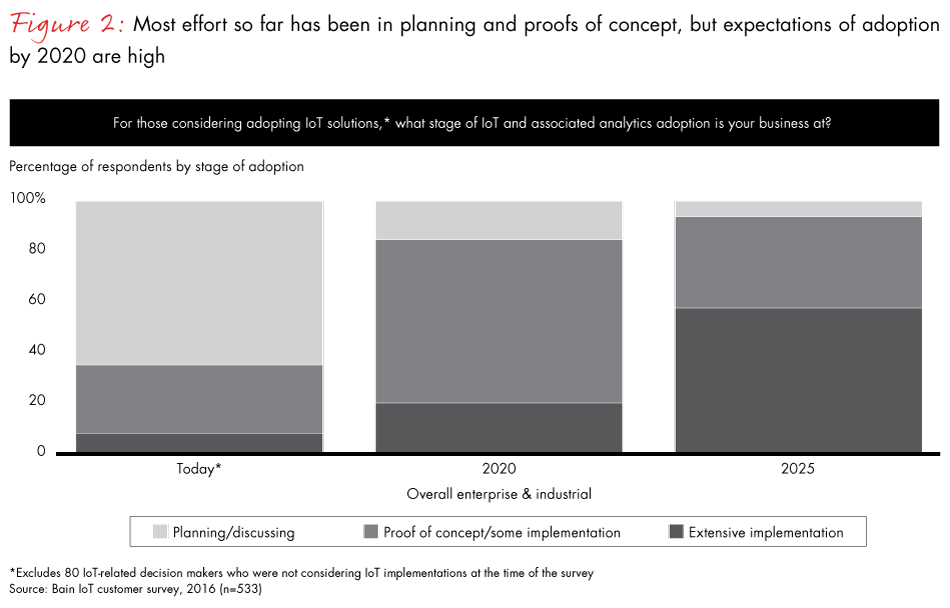
• Long replacement cycles for legacy equipment and embedded software make the transitions difficult, but proofs of concept are under way (see Figure 2).
• Use case requirements in operational technology are complex, and failure incurs greater risk than in consumer applications. Many industrial applications operate large physical devices with low latency, often at very high speeds—think robotic arms in an automotive factory—or operate critical functions in a production process, like valves in an oil refinery, and cannot simply stop operating without serious safety consequences. So the operations technology needs to operate in real time, be deterministic and include a fail-safe mode (to stop the movement of a robotic arm or open a pressure-relief valve) that prevent catastrophic failures from happening. “Blue screens” are just not acceptable in operational technology.
• Safety and data security are paramount, as breaches could have catastrophic consequences. The 2010 attack on Iran’s nuclear facilities by the Stuxnet worm, which infiltrates and compromises industrial control systems, demonstrated the potential damage that malware can cause to industrial systems. Worms like Stuxnet, which was programmed to attack the logic controller of the centrifuges, are a particularly dangerous risk for mission-critical operations.

B2B Opportunities for Vendors in the Internet of Things
Explore the most attractive business-to-business opportunities for vendors in the Internet of Things.
Building momentum and scale in the industrial IoT
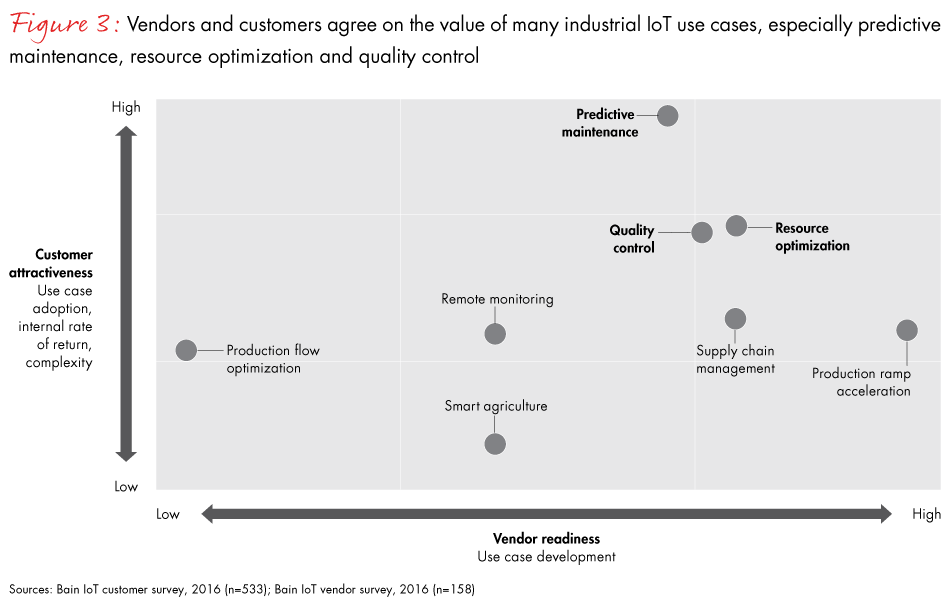
To gain a better idea of how this complexity plays out, consider the industrial and technology vendors that are constructing the industrial Internet of Things. Their initial efforts build on established industrial use cases like predictive maintenance, resource optimization and quality control (see Figure 3). By applying IoT and advanced analytics technologies they can add new services and capabilities to these existing services. They’re also listening to customers and building end-to-end solutions with the help of partners to fill in the gaps, including cloud service providers and app developers. (For more details on who customers trust most and what barriers they see to their adoption of IoT technologies, see the Bain Brief “How Providers Can Succeed in the Internet of Things.”)
As they build momentum off these proofs of concept, the question becomes how to scale. Options include adding other connected devices to their IoT service or expanding the solution to more business units. Either way, as you scale, the solution begins to take on more of the characteristics of a platform, even if it remains an internal solution for one organization. Opening the platform to others—suppliers, system integrators and other third parties—increases the value of the solution. Providing access to the data and exposing the application programming interfaces (APIs) may raise some security risks, but with the right protections in place, it also attracts external developers who will contribute valuable applications to the platform.
Platforms will play an essential role in the development of the industrial and enterprise IoT as they provide an integrated suite of services for participants, including
- connecting and authenticating devices and sensors;
- ensuring security;
- aggregating data and running analytics; and
- providing access to internal and external developers.
Leading platform providers are evolving in different ways depending on their ambitions and traditional strengths (see Figure 4). For example, leading cloud and analytics providers are developing tools and infrastructure that enable their customers to gather data from sensors at the edge of the network and aggregate it into their cloud ecosystems. At Amazon Web Services (AWS), clients get access to tools and building blocks that help them easily develop applications that make use of all the sensor data. Dynamic pricing models let them pay for only the computing resources they need, and in return they get access to a broad developer base. This level of convenience has enabled AWS, Microsoft Azure and a handful of others to become the data-center back end for most apps that we have on our smartphones. When apps or services gain traction, the cloud provider wins, too. For these firms, IoT and the data it will generate is the next growth driver.
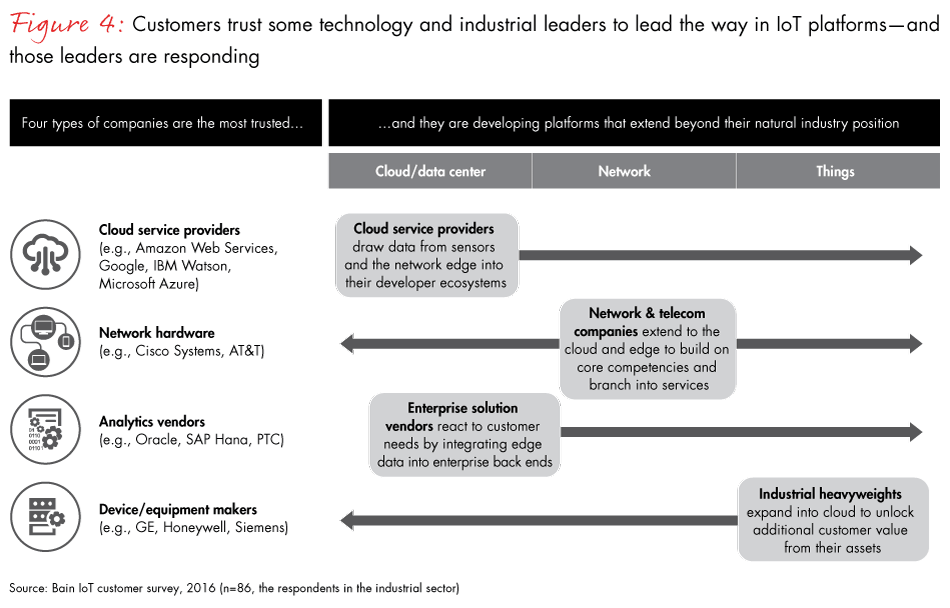
Enterprise solution vendors like SAP and Oracle are developing platforms to make it easier to integrate IoT data into their existing enterprise resource planning (ERP), supply chain and other traditional software solutions. They are getting ahead of the demand of their customers who see digitalization expand from the office to the factory floor or retail outlet. (See the sidebar, “Four questions about data.’’)
Telcos are developing platforms that capitalize on their life-cycle management capabilities. Telcos have the deep experience necessary to connect and manage millions of devices, including maintenance, upgrades and decommissioning. With life-cycle management as a baseline, telcos will then extend their platforms to offer vertical solutions to industrial and commercial businesses. (For more on telcos and the IoT, read the Bain Brief “Close to the Core: Telcos’ Competitive Advantage in the Internet of Things.”) Network equipment vendors such as Cisco are adding functions like authentication, security and analytics to their appliances to improve their value proposition.
Industrial giants such as GE, Siemens and Bosch are moving from the equipment layer up into software and analytics, aiming to build platforms that become the standard operating systems for industrial systems.
Bosch’s IoT platform, for example, gathers and analyzes metrics that help measure quality and optimize production in real time. Compared with IoT platforms that are emerging from traditional software vendors or cloud service providers, platforms evolving from industrial ecosystems are more likely to have the real-time capabilities and a fail-safe mode built in from the start. Their roots lie in mission-critical industrial systems that can pose significant risks and physical danger if they fail.
Peter Bowen, a partner with Bain's Technology practice, outlines three important concepts that will help companies compete in the industrial IoT.
Three ways to advance on platforms
Based on the opportunities available and the direction set by market leaders, industrial technology providers have at least three clear options for choosing platforms, depending on their starting point, ambition and capabilities.
-
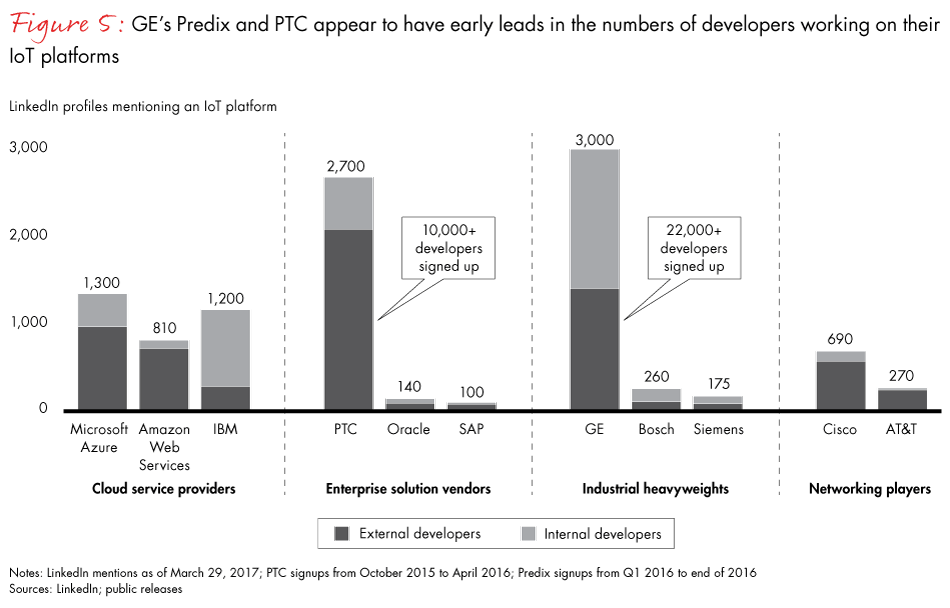
Build your own platform. Large industrial vendors are already investing billions in this, the most expensive and long-term option. Success depends not only on committing to years of investment before seeing any returns, but also on starting from a position of competitive advantage or unique customer base. One way to do this, as the enterprise software developer PTC has shown, is by acquiring and integrating existing platforms. PTC’s acquisitions of Axeda and ThingWorx allowed it to grow their developer base rapidly and gain traction in select industries such as healthcare (see Figure 5). Even without a large ecosystem, vendors with a strong market share in a narrow domain can build platforms that achieve scale within their customer base and beyond. The German machine tool manufacturer Trumpf, for example, is developing its Axoom platform to help its small and medium-size customers control their equipment linked to the IoT.
Regardless of size, the traditional platform battle playbook remains essential: solve a critical issue, bring market influencers on board as partners, race to scale by pricing correctly and attracting developers, and erect barriers to competition. Among the questions executives should ask themselves as they head down this path:
- Do we have the financial capacity, skills and stamina to build this?
- How long will it take, and can we get there early enough to obtain some competitive advantage?
- Can my use case and my industry generate the necessary returns?
-
Partner with an existing platform. This path requires much less investment and can also offer a leap forward, capitalizing on the effort of the platform provider and partners. Partners that join early may have the ability to shape or redefine the platform for their industry if they enter at the right time and with the appropriate level of momentum and investment. For example, Schindler has partnered with GE as the premier elevator and escalator provider on the Predix platform. Schindler gets access to an established IoT platform and a broad developer base, along with the ability to shape the front end for its industry. GE benefits by bringing an industry leader on board to extend Predix, tapping Schindler’s domain knowledge. Partnerships like this one benefit the platform provider and the customer, with sharing of expertise, revenue and mobilization effort. Of course, not all partners need to be at the scale of GE: Start-ups with platforms aimed at very specific use cases may prove to be the most effective partners, and industrial companies should not rule out candidates based on company size. Executives should ask:
- How do we find the right partners and secure the right contracts?
- How do we share the incentives in ways that keep both parties motivated?
-
Develop a point application with common tools from cloud service providers. This is the most cost effective way to get access to a platform, such as Amazon Web Service’s Greengrass, and its developer base. Companies that take this route use the tools and infrastructure provided by AWS to build their own IoT solution, but they have much less ability to shape the platform or its tools. They hit the ground running, but may find themselves locked in to the terms and development path of a market-leading cloud provider. Among the right questions to get started:
- Can AWS Greengrass or Microsoft Azure deliver what we want to do, in terms of analytics, capabilities and other features?
- Do we feel comfortable implementing the solution on our own and building the necessary skills using online tools?
- How can we ensure that this approach differentiates us from the competition, can scale to other use cases and is generally future proof?
Getting started
While these are still early days for the Internet of Things, companies are already launching proofs of concept, industrial leaders are investing billions building their platforms and industry-shaping partnerships are forming. As executives shape their industrial strategy, here are three important concepts they should keep in mind.
First, it helps to have a clear picture of the desired end state, including the business case for the investment. Even though a successful start usually depends on a single use case with a limited investment, a roadmap to scale, with a clear destination, guides decisions and reinforces the point that this is not a one-off investment. A key element of these considerations should be the monetization model, which can focus on converting use cases into commercial results or capturing licensing fees from leveraging the IoT platform beyond the current customer base and domain. Having the end state in mind also mobilizes senior executive–level commitment and accountability, which is critical for sustained execution.
Second, build in security from the start, mapping it from edge to cloud. Everyone is talking about IoT security, but almost no one is providing reliable end-to-end security solutions today. Be prepared to work with two or three firms to meet your needs, from device security to the cloud and across the entire system.
Finally, enter the game with a strong bias in favor of partnerships, including start-ups that may be below your radar for typical enterprise relationships. If you require a specialized use case to get started, it may come from a small start-up focused on that niche. As you scale, these partnerships deepen over time, often with equity stakes or a path to acquisition.
It may take years to develop and scale a platform, but now is the time to make investment decisions and choose the right partners, as industrial companies define their digital strategy and their ambitions for the Internet of Things.
Four questions about data
Customers look to platform owners and technology providers to deliver end-to-end solutions, and to help them understand the potential of their data. By answering a few simple questions, customers can begin to define their capabilities and needs—a significant step toward choosing the right solution.
- What data do we create? Is the data aggregated from a central repository or distributed points, moving or fixed? Do we generate the data, or are we consumers of it—and what new data should we create?
- What is the value of the data? How does the data accrue to us and our customers? Which uses produce the most valuable data? How do we link the value to our competitive advantage?
- How do we harvest the data? Is it easy? Is it secure? Which end points are already enabled, and which need to be? Are we harvesting it ourselves or with partners?
- How do we analyze the data? Which analyses will create the most value for us and our customers? What tools do we have or need? How do we integrate these insights into our digital strategy?
Peter Bowen is a partner with Bain & Company in Chicago. Asit Goel and Michael Schallehn are partners in Bain’s Silicon Valley office. Michael Schertler is a partner in Bain’s Munich office. All four work with Bain’s Global Telecommunications, Media and Technology practice.
First published in 9月 2017