

論説

We love the equipment. We’re struggling with the instruction manual.
That was the essence of feedback from an automaker that had bought equipment from a plant-engineering company. The equipment installed in one factory had been assembled by three of the engineering company’s departments, and each department’s technical documentation used different standards. That made it complicated to feed the documentation into the automaker’s IT system. So despite the upfront expense, the engineering company moved to one documentation standard—a step toward making life easier for the customer.
Technology and engineering once defined the field of competition for companies in business-to-business markets. Now there’s an equally critical ingredient: the strength of the customer’s experience.
The shift to understand and incorporate the customer’s perspective stems largely from the fact that B2B companies in many markets are searching for ways to set themselves apart from competitors. As a result, firms that traditionally prized only technical expertise now pay more attention to customers’ broader needs and priorities.
Companies with customers who perceive them as arrogant, unresponsive and slow clearly will benefit from a more customer-centered approach. So will market leaders that lack good sensors on customers’ perceptions. Younger, insurgent companies also can set themselves apart from established competitors by designing a better experience for customers.
Leading firms in a variety of B2B industries find that a more systematic approach to the experience helps to earn stronger customer loyalty. Customers who become promoters tend to buy more with the supplier, stay longer, be less sensitive to price, cost less to serve, and recommend the supplier to others. The payoff: Promoters have a lifetime value that can reach two to seven times that of customers who are detractors, depending on the industry.
Although companies can achieve some quick gains, creating an experience that truly delights customers requires a sustained effort. Executives who are serious about building a compelling customer experience should answer these five questions (see Figure 1).
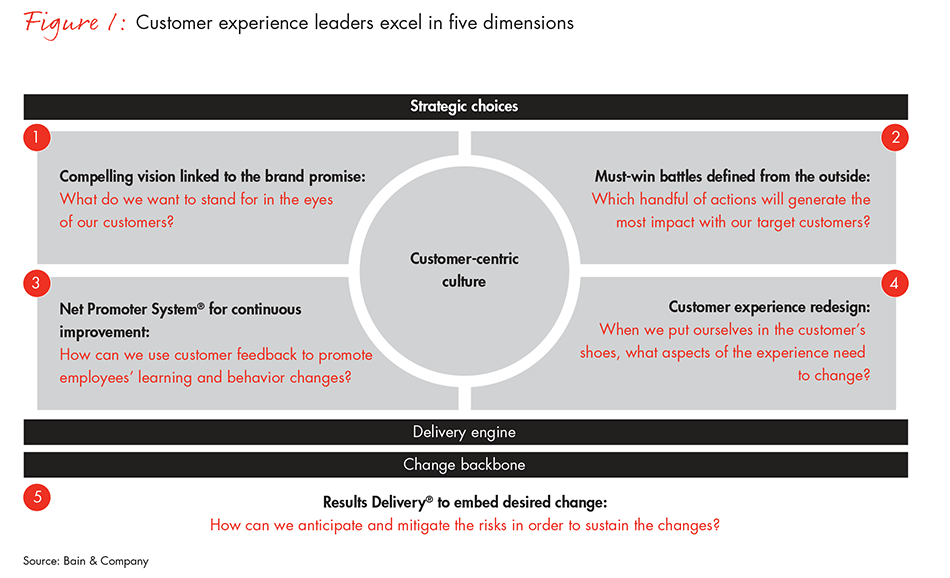
1. What do we want to stand for in the eyes of our customers?
The first task is to articulate the distinctive value proposition that the company will offer to customers, and then transmit that proposition to people throughout the organization. Senior leaders might understand what they need to do to improve the customer experience, but they often fail to mobilize people at the front line.
Beyond a slogan or slide deck, then, leaders need to paint a compelling picture of the destination—what the company should and should not stand for—so that employees know what the initiative means for them and how their behavior and approach should change.
A compelling vision defines specific milestones for meeting customers’ needs and priorities, and how the company will achieve those goals. It also determines how those goals will translate into operational metrics to attain consistent delivery across all channels.
One electrical components company, for example, distilled its vision to being “the easiest manufacturer to conduct business with and the first choice for electrical products.” Based on feedback from distributors and end customers, the company worked on various improvements to put that vision into practice, including better demand forecasting to assure product availability, a more user-friendly interface on its website and better communication with distributors.
2. Which handful of actions will generate the most impact with our target customers?
Plans to improve the customer experience often comprise hundreds of uncoordinated initiatives that emerged with good intent from different parts of the organization, with little clarity about which will add the most value for customers. A glut of initiatives rarely adds up to a powerful whole because each one receives too little attention or funding.
Companies should sift through early initiatives to identify those that work well, reinforce the vision and deserve more resources. These insights come from analyzing customer feedback, combined with data from market research, social media scans and other external sources.
A major truck company in Europe, aware that competitors had caught up on technical performance, realized it needed to raise its game in such areas as service in order to justify its higher prices. It ran an annual survey of customers, but the survey couldn’t determine which aspects of the overall experience should be improved, and what were root causes of the problems. So the company gathered feedback from customers at select retail sites to determine their Net Promoter Score® (a key metric for customer loyalty) through one or two simple questions: Would you recommend company X? Why? It turned out that customers who gave low scores were most concerned about repair time and repair quality, citing repeat visits and staff that didn’t listen to them (see Figure 2).
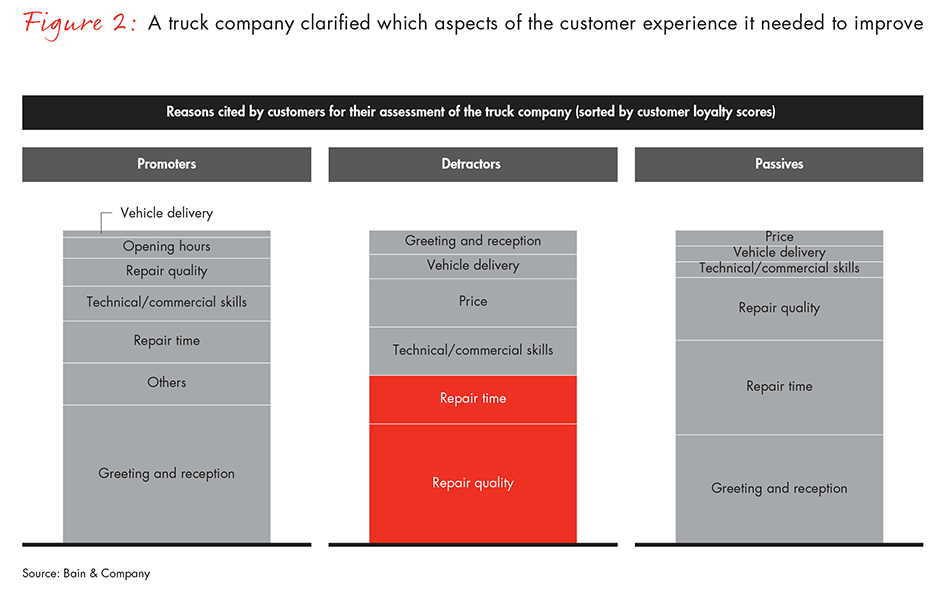
Service repairs thus became a must-win battle for the truck company. It launched training for reception staff on how to systematically listen to the customer and take time to review the list of repairs. It changed repair scheduling to spread out the workload and reduce delays, and when delays did occur, it provided staff with better tools to quickly communicate the delays to customers. These actions paid off: The number of lower-scoring customers shrank from 30% of the total to 5% over three months.
3. How can we use customer feedback to help employees learn and change their behavior?
To truly understand what annoys or delights customers about their experience, and then mobilize and harness employees’ energy to make changes, companies can continually deploy two types of feedback loops as part of the Net Promoter System (see Figure 3).
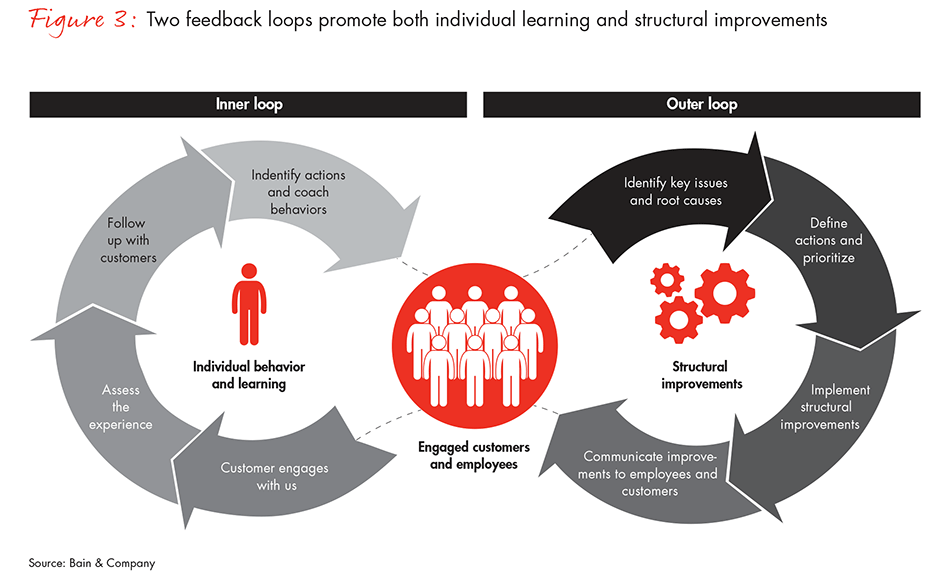
An inner loop collects customer feedback such as that gathered by the truck company in Europe. This feedback goes quickly to the relevant employees and supervisors so that they can learn what does and does not work, change behaviors accordingly and follow up with customers. At regular huddles, teams can discuss customers’ perceptions and feedback, share what they learned, escalate to more senior managers issues that cannot be resolved locally, and follow up with select customers.
The richness of customer feedback, distilled the right way, will also fuel an outer loop to identify major issues and root causes of problems and strengths, which typically involve multiple functions and departments. Management can deploy resources to address these systemic issues and make structural improvements that benefit the overall customer experience, and must clearly communicate these changes to employees. The Net Promoter System thus serves as an engine for continuous improvement, by systematically engaging the front line.
A major construction materials company used these feedback loops on a range of customer episodes, including sales. It learned that several customers ascribed low value to visits by sales representatives, because the reps had no relevant market intelligence. Based on that feedback, the company developed a more targeted approach that equipped reps with substantial market intelligence for certain top-tier customers, whereas other customers received fewer visits requiring less preparation.
4. When we put ourselves in the customer’s shoes, what aspects of the experience need to change?
With technology and competitive dynamics moving so quickly these days, leading companies don’t hesitate to completely rethink customer experiences by, for example, incorporating new digital channels and features. Effective experience design works outside-in from the customer’s perspective, not inside-out from an engineering standpoint. Leading companies generally start with a clean sheet and redesign important episodes, or even the entire experience, to fix shortcomings and seize opportunities for “wow” moments.
These moments might require cultural, not just technical, skills. An engineering company learned that lesson during the sales process, when its engineers met with the customer teams from a country with a very different culture. Besides the quality of the company’s engineering, aspects that mattered to the customer teams included awareness of and respect for their home culture. After some stumbles on the cultural front, the engineering company quickly set up specific training for the employees involved in that process.
5. How can we anticipate and mitigate the risks, in order to sustain the changes?
Senior leaders committed to building a superior customer experience will need a plan that they can achieve while carrying on with day-to-day business. Companies that fall short of their expectations usually fail to bring their people through the change, largely due to two blind spots. First, they push initiatives without articulating the behaviors they expect from their people (and themselves). Second, the mere prospect of change can be unsettling; employees worry about their own roles, resist the change and get distracted from their work.
Just as devising a winning experience starts with the customer’s priorities, an achievable plan shows empathy for employees and assesses the organization’s state of readiness by identifying which groups are the most critical in carrying out the changes, equipping them for success and providing coaching support.
Once companies set about improving their customer experience, they often realize a secondary benefit of lower costs. Simplifying processes, resolving customer complaints faster and more effectively, promoting customer self-service where appropriate—all these changes not only make customers’ lives easier, but tend to decrease the costs of complexity, errors and redoing work. Increasingly in industrial settings, a customer-centered culture that delivers exceptional experiences at reduced cost, time after time, will create lasting competitive differentiation.
Michael Staebe is a partner with Bain & Company’s Customer Strategy & Marketing practice, and Andreas Dullweber leads the practice in Europe, the Middle East and Africa. They are both based in Munich.
Net Promoter System® and Net Promoter Score® are registered trademarks of Bain & Company, Inc., Fred Reichheld and Satmetrix Systems, Inc.
Results Delivery® is a registered trademark of Bain & Company, Inc.
First published in 8月 2016