
Skip to Content
  • オフィス

    オフィス

    北米・南米
    • Atlanta
    • Austin
    • Bogota
    • Boston
    • Buenos Aires
    • Chicago
    • Dallas
    • Denver
    • Houston
    • Los Angeles
    • Mexico City
    • Minneapolis
    • Monterrey
    • Montreal
    • New York
    • Rio de Janeiro
    • San Francisco
    • Santiago
    • São Paulo
    • Seattle
    • Silicon Valley
    • Toronto
    • Washington, DC
    ヨーロッパ・中東・アフリカ
    • Amsterdam
    • Athens
    • Berlin
    • Brussels
    • Copenhagen
    • Doha
    • Dubai
    • Dusseldorf
    • Frankfurt
    • Helsinki
    • Istanbul
    • Johannesburg
    • Kyiv
    • Lisbon
    • London
    • Madrid
    • Milan
    • Munich
    • Oslo
    • Paris
    • Riyadh
    • Rome
    • Stockholm
    • Vienna
    • Warsaw
    • Zurich
    アジア・オーストラリア
    • Bangkok
    • Beijing
    • Bengaluru
    • Brisbane
    • Ho Chi Minh City
    • Hong Kong
    • Jakarta
    • Kuala Lumpur
    • Manila
    • Melbourne
    • Mumbai
    • New Delhi
    • Perth
    • Shanghai
    • Singapore
    • Sydney
    • Tokyo
    全てのオフィス
  • アルムナイ
  • メディア
  • お問い合わせ
  • 東京オフィス
  • Japan | 日本語

    地域と言語を選択

    グローバル
    • Global (English)
    北米・南米
    • Brazil (Português)
    • Argentina (Español)
    • Canada (Français)
    • Chile (Español)
    • Colombia (Español)
    ヨーロッパ・中東・アフリカ
    • France (Français)
    • DACH Region (Deutsch)
    • Italy (Italiano)
    • Spain (Español)
    • Greece (Elliniká)
    アジア・オーストラリア
    • China (中文版)
    • Korea (한국어)
    • Japan (日本語)
  • Saved items (0)
    Saved items (0)

    You have no saved items.

    後で閲読、共有できるようにするためにブックマークしてください

    Explore Bain Insights
  • 業界別プラクティス
    メインメニュー

    業界別プラクティス

    • 航空宇宙、防衛、政府関連
    • 農業
    • 化学製品
    • インフラ、建設
    • 消費財
    • 金融サービス
    • ヘルスケア
    • 産業機械、設備
    • メディア、エンターテインメント
    • 金属
    • 採掘・鉱業
    • 石油、ガス
    • 紙、パッケージ
    • プライベートエクイティ
    • 公共、社会セクター
    • 小売
    • テクノロジー
    • 通信
    • 交通
    • 観光産業
    • 公益事業、再生可能エネルギー
  • 機能別プラクティス
    メインメニュー

    機能別プラクティス

    • カスタマー・エクスペリエンス
    • サステイナビリティ、 社会貢献
    • Innovation
    • 企業買収、合併 (M&A)
    • オペレーション
    • 組織
    • プライベートエクイティ
    • マーケティング・営業
    • 戦略
    • アドバンスド・アナリティクス
    • Technology
    • フルポテンシャル・トランスフォーメーション
  • Digital
  • 知見/レポート
  • ベイン・アンド・カンパニーについて
    メインメニュー

    ベイン・アンド・カンパニーについて

    • ベインの信条
    • 活動内容
    • 社員とリーダーシップ
    • プレス・メディア情報
    • クライアントの結果
    • 受賞歴
    • パートナーシップを結んでいる団体
    Further: Our global responsibility
    • ダイバーシティ
    • 社会貢献
    • サステイナビリティへの取り組み
    • 世界経済フォーラム(WEF)
    Learn more about Further
  • キャリア
    メインメニュー

    キャリア

    • ベインで働く
      キャリア
      ベインで働く
      • Find Your Place
      • ベインで活躍する機会
      • ベインのチーム体制
      • 学生向けページ
      • インターンシップ
      • 採用イベント
    • ベインでの体験
      キャリア
      ベインでの体験
      • キャリアストーリー
      • 社員紹介
      • Where We Work
      • 成長を後押しするサポート体制
      • アフィニティ・グループ
      • 福利厚生
    • Impact Stories
    • 採用情報
      キャリア
      採用情報
      • 採用プロセス
      • 面接内容
    FIND JOBS
  • オフィス
    メインメニュー

    オフィス

    • 北米・南米
      オフィス
      北米・南米
      • Atlanta
      • Austin
      • Bogota
      • Boston
      • Buenos Aires
      • Chicago
      • Dallas
      • Denver
      • Houston
      • Los Angeles
      • Mexico City
      • Minneapolis
      • Monterrey
      • Montreal
      • New York
      • Rio de Janeiro
      • San Francisco
      • Santiago
      • São Paulo
      • Seattle
      • Silicon Valley
      • Toronto
      • Washington, DC
    • ヨーロッパ・中東・アフリカ
      オフィス
      ヨーロッパ・中東・アフリカ
      • Amsterdam
      • Athens
      • Berlin
      • Brussels
      • Copenhagen
      • Doha
      • Dubai
      • Dusseldorf
      • Frankfurt
      • Helsinki
      • Istanbul
      • Johannesburg
      • Kyiv
      • Lisbon
      • London
      • Madrid
      • Milan
      • Munich
      • Oslo
      • Paris
      • Riyadh
      • Rome
      • Stockholm
      • Vienna
      • Warsaw
      • Zurich
    • アジア・オーストラリア
      オフィス
      アジア・オーストラリア
      • Bangkok
      • Beijing
      • Bengaluru
      • Brisbane
      • Ho Chi Minh City
      • Hong Kong
      • Jakarta
      • Kuala Lumpur
      • Manila
      • Melbourne
      • Mumbai
      • New Delhi
      • Perth
      • Shanghai
      • Singapore
      • Sydney
      • Tokyo
    全てのオフィス
  • アルムナイ
  • メディア
  • お問い合わせ
  • 東京オフィス
  • Japan | 日本語
    メインメニュー

    地域と言語を選択

    • グローバル
      地域と言語を選択
      グローバル
      • Global (English)
    • 北米・南米
      地域と言語を選択
      北米・南米
      • Brazil (Português)
      • Argentina (Español)
      • Canada (Français)
      • Chile (Español)
      • Colombia (Español)
    • ヨーロッパ・中東・アフリカ
      地域と言語を選択
      ヨーロッパ・中東・アフリカ
      • France (Français)
      • DACH Region (Deutsch)
      • Italy (Italiano)
      • Spain (Español)
      • Greece (Elliniká)
    • アジア・オーストラリア
      地域と言語を選択
      アジア・オーストラリア
      • China (中文版)
      • Korea (한국어)
      • Japan (日本語)
  • Saved items  (0)
    メインメニュー
    Saved items (0)

    You have no saved items.

    後で閲読、共有できるようにするためにブックマークしてください

    Explore Bain Insights
  • 業界別プラクティス
    • 業界別プラクティス

      • 航空宇宙、防衛、政府関連
      • 農業
      • 化学製品
      • インフラ、建設
      • 消費財
      • 金融サービス
      • ヘルスケア
      • 産業機械、設備
      • メディア、エンターテインメント
      • 金属
      • 採掘・鉱業
      • 石油、ガス
      • 紙、パッケージ
      • プライベートエクイティ
      • 公共、社会セクター
      • 小売
      • テクノロジー
      • 通信
      • 交通
      • 観光産業
      • 公益事業、再生可能エネルギー
  • 機能別プラクティス
    • 機能別プラクティス

      • カスタマー・エクスペリエンス
      • サステイナビリティ、 社会貢献
      • Innovation
      • 企業買収、合併 (M&A)
      • オペレーション
      • 組織
      • プライベートエクイティ
      • マーケティング・営業
      • 戦略
      • アドバンスド・アナリティクス
      • Technology
      • フルポテンシャル・トランスフォーメーション
  • Digital
  • 知見/レポート
  • ベイン・アンド・カンパニーについて
    • ベイン・アンド・カンパニーについて

      • ベインの信条
      • 活動内容
      • 社員とリーダーシップ
      • プレス・メディア情報
      • クライアントの結果
      • 受賞歴
      • パートナーシップを結んでいる団体
      Further: Our global responsibility
      • ダイバーシティ
      • 社会貢献
      • サステイナビリティへの取り組み
      • 世界経済フォーラム(WEF)
      Learn more about Further
  • キャリア
    人気検索キーワード
    • デジタル
    • 戦略
    前回の検索
      最近訪れたページ

      Content added to saved items

      Saved items (0)

      Removed from saved items

      Saved items (0)

      Paper & Packaging Report

      Don’t Underestimate the Cost of Overcapacity

      Don’t Underestimate the Cost of Overcapacity

      Overcapacity is endemic to the paper and packaging industry, but these actions can help you maintain margins.

      著者:Ilkka Leppävuori, Joshua Hinkel, and Michael Tonelli

      • First published in 1月 2026
      • min read
      }

      レポート

      Don’t Underestimate the Cost of Overcapacity
      en
      概要
      • Most companies aim to grow their profits at four times the rate of the market, but only 7% of industrial companies achieve this goal.
      • To manage overcapacity, leading paper and packaging companies focus on improving their cost advantage.
      • AI can help by transforming sales and operations planning into a continuous process, with insights constantly updated, reprioritized, and aligned across functions.

      This article is part of Bain's 2026 Paper & Packaging Report.

      Explore the report

      Managing overcapacity and the low profit margins that follow is a well-known headache for paper and packaging executives. A new multiyear study by Bain & Company shows why overcapacity persists across industries: Executives are overly optimistic when they make their strategic plan.

      Most companies aim to grow their revenues at twice the rate of the underlying market and profits at four times the rate of the market. In reality, only 7% of industrial companies achieve this goal. Furthermore, in capital-intense industries like paper and packaging, these optimistic plans often lead to significant capital spending and persistent overcapacity. Recent geopolitical uncertainty and tariffs have only added further complexity to the overcapacity conundrum.

      In paper and packaging, leading companies do not bet on competitors scaling down or disappearing; instead, they focus on improving their own cost advantage, as overcapacity could reoccur. This might mean proactively closing capacity when necessary and avoiding the scenario in which supply so outstrips demand that players keep undercutting each other on price, until only a few can make money. For example, leading producers of graphic paper like UPM, Domtar (formerly Paper Excellence Group), Stora Enso, and Nippon Paper have all closed meaningful capacity in recent years as demand declined.

      Three steps to manage overcapacity

      1. Understand your risk and exposure. Successful companies begin by analyzing their current and expected supply and demand balance in the grades they produce, both in the short term and the long term. They also look at their competitive position in terms of their fully landed cash cost per ton to determine: Do we have a competitive advantage, and are we also able to make money across market cycles? How sustainable is that advantage? What are our breakeven points by mill and grade, in terms of volume and price? They evaluate where a given mill or the company itself stands in the market (see Figure 1). Specifically, understanding the true end-to-end profitability of different products—and not just the contribution margin—is critical.

      Figure 1
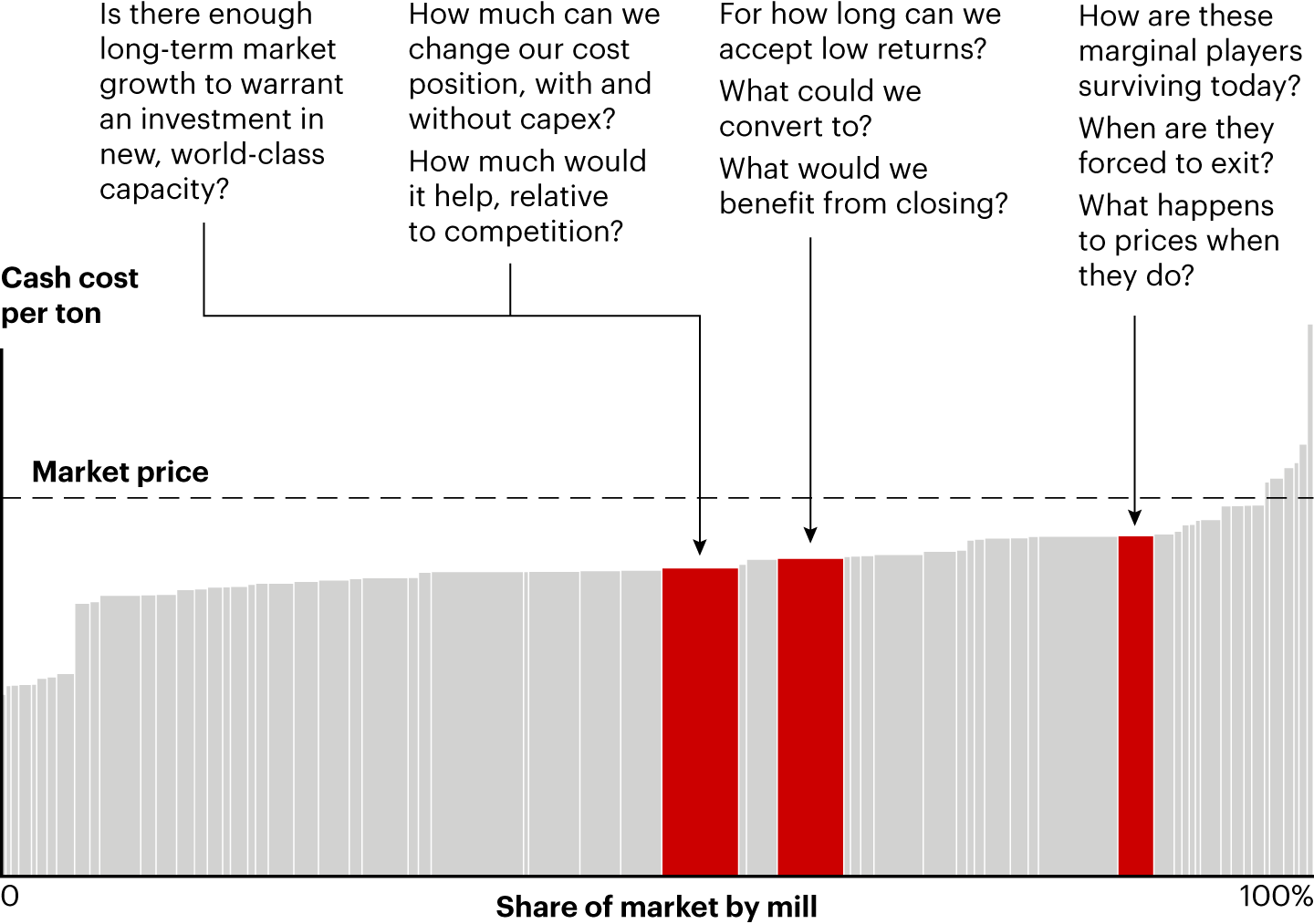
      The questions to ask depend on each mill’s position in the overall market
      出所 Fastmarkets

      2. Map your strategic options, offensive and defensive. While growing scale can improve one’s position in certain industries, it’s usually not effective in creating long-term durability in paper and packaging. Instead, the cash cost position (i.e., the cost to produce a ton of board or paper) is typically what matters most. Understanding your true cost position relative to peers is hard work and requires more than relying on external secondary sources. A company’s relative cost position, for example, can change depending on the geography where it sells, as transport costs will vary, and the relative position of an individual mill is not easily understood.

      In times of overcapacity, companies have a range of strategic options to weigh (see Figure 2).

      Figure 2
      There are many strategic options to consider in a market overcapacity situation
      出所 Bain & Company

      Investing in capacity, efficiency, and converting to new grades. Companies that are capable of making investments often do so in competitive new capacity, such as investing in new mills or new technologies. New assets perform significantly better than aging assets, and it’s usually not possible to close that gap even by spending substantially to maintain older assets. Latin American pulp producer Suzano, for example, has invested in new assets during times of pulp overcapacity and low prices, trusting that its superior cash cost position will enable profits regardless of cycle.

      Successful companies also improve their cost position by investing in efficiency. They do not necessarily add capacity but continuously push to produce every ton at a lower price. They do so by improving energy and variable cost efficiency or by using automation to lower labor costs.

      Finally, they often convert to another grade where there is more room to grow than in the existing grade. They take into account the technical limitations of current assets as well as which products they could produce with reasonable investments.

      Closing capacity and optimizing existing mills. Along with the high-performing mills in its portfolio, every paper and packaging company likely also has mills that are struggling. For these mills, the best option may be to close uncompetitive capacity. Closing mills usually comes with high costs and strong social considerations, making it one of the hardest decisions for paper and packaging executives.  

      What about mothballing, or shutting down facilities for a period to save on operational costs while maintaining equipment, so it’s possible to reopen capacity better and faster than peers when conditions change? While mothballing capacity for longer periods of time can be effective in other industries, it is relatively rare in paper and packaging. In certain segments, however, such as graphic paper and nonintegrated mills, turning production on and off is common, as it helps companies adjust to demand fluctuations and can be used to optimize electricity costs, for example.

      Leading companies also focus on day-to-day operations and make their existing mill operations as cost efficient as possible without major additional investments. Still, without expending significant capital to modernize operations, even a very systematic operational excellence program will likely yield only a 7%–10% cost reduction per ton, according to Bain studies over several years. Such cost reductions are meaningful but not game-changing considering that, across most grades, top-quartile producers have 20%–40% lower costs than bottom-quartile ones.

      Finally, M&A can be a useful additional tool to provide scale and to create networks of mills. With a larger footprint, closing capacity will be less challenging, as the proportionate hit of closing one mill is absorbed more easily. Lately we have seen significant consolidation in the industry, such as International Paper’s acquisition of DS Smith and Smurfit Kappa’s merger with WestRock.

      3. Improve your operational flexibility with scenario planning. Leading companies are moving away from thinking about sales and operations planning (S&OP) as a traditional deterministic process for allocating demand to particular mills. Instead, they consider the different scenarios that could play out in their markets and their relevant end customer markets and ask what signposts could alert them to those scenarios. This can inform how and when they act and how they respond to competitors.  

      AI can also be a powerful tool in the S&OP process. Specifically, it can help transform planning into a continuous process—where insights are constantly updated, reprioritized, and aligned across functions. Generative AI, meanwhile, can deliver richer insights, increasing forecast accuracy and enabling faster, smarter decisions.

      In one example, a global packaging company enhanced its forecasting system by integrating both traditional structured data—like order book information and historical sales—and unstructured or external inputs, which were previously too messy or time-consuming to use. This data included economic indicators, competitor behavior, and domain-specific signals such as industry trends and even commodity movements. Gen AI was able to parse and contextualize the unstructured inputs, transforming them into predictive features the model could use. As a result, the model improved its ability to detect early inflection points—especially in volatile sectors—before they were visible in the internal data.

      The AI-enabled forecast model enhanced predictive accuracy, reducing the error rate by over 10%. That kind of precision has a direct, measurable impact on the business; it decreases overproduction, tightens inventory control, and results in fewer stockouts and better alignment with upstream suppliers.

      More important, the team moved from being reactive to proactive. Planners were no longer spending their time debating the validity of the baseline forecast—they were scenario testing, stress testing key variables, and collaborating with sales and ops teams to align on risk-adjusted decisions.

      While this example focuses on demand, the architecture applies just as easily to supply planning and capacity modeling in the paper and packaging industry. With the right data foundation, these models can simulate lead time volatility, factory throughput, or component availability—empowering planners with an end-to-end probabilistic view.

      History would suggest that overcapacity is not going anywhere soon. To thrive despite overcapacity, well-run companies allocate more volume to the most profitable customers, products, and geographies. They consider M&A as an option to expand network coverage and improve the efficiency of their asset base. They map the options for each production site, accounting for the system-wide implications of possible closures and conversions.

      In addition to understanding their own business in laser detail, leading companies understand how they fit into the larger competitive landscape. Successful paper and packaging executives employ a chess-like mentality as they plot out their own strategy, forecast different moves that competitors may make, and plan their responses in those situations as scenarios continue to evolve.

      Read our 2026 Paper & Packaging Report

      Download the PDF Explore the report

      Read the Next Chapter

      Transforming Maintenance with Artificial Intelligence

      Resilience and Efficiency

      • Don’t Underestimate the Cost of Overcapacity

      • Transforming Maintenance with Artificial Intelligence

      • It’s Time to Rethink Every Link in Your Supply Chain

      Customer-Led Growth

      • Luxury Packaging: Resolving the Tension Between Creativity and Impact

      • To Make Money, Follow the Money

      • M&A in Paper and Packaging: Bigger but Fewer Deals

      • Battle of the Substrates

      • Sustainability: Less Talk and More Action

      • Chemical Recycling: Plastics Firms Must Move Now or Miss Out

      著者
      • Headshot of Ilkka Leppävuori
        Ilkka Leppävuori
        パートナー, Helsinki
      • Headshot of Joshua Hinkel
        Joshua Hinkel
        パートナー, Dallas
      • Headshot of Michael Tonelli
        Michael Tonelli
        パートナー, Boston
      関連業種
      • 産業財、サービス
      • 林産品(林業)、紙、パッケージ
      関連するコンサルティングサービス
      • Manufacturing
      • オペレーション
      • コスト・トランスフォーメーション
      • サプライチェーン
      • 業績改善
      • 戦略
      業績改善
      Tariff Response: What You Need to Know

      Bain's Karen Harris and Hernan Saenz discuss the lasting impact of tariffs, what leading companies are doing to adapt, and the strategic moves to make for success.

      詳細
      Paper & Packaging Report
      Transforming Maintenance with Artificial Intelligence

      With little to no capex, companies can turn maintenance into an engine of cash flow.

      詳細
      Paper & Packaging Report
      Sustainability: Less Talk and More Action

      Despite elusive targets, the business case is stronger than ever.

      詳細
      Paper & Packaging Report
      Navigating Turbulence in Paper and Packaging

      Scenario planning can create a dynamic, future-proof strategy.

      詳細
      産業財、サービス
      How Sustainability Is Creating B2B Growth

      Our survey of B2B buyers and sellers finds growth leaders using sustainability to create commercial value while laggards focus on compliance.

      詳細
      Tags
      • Manufacturing
      • Paper & Packaging Report
      • オペレーション
      • コスト・トランスフォーメーション
      • サプライチェーン
      • 業績改善
      • 産業財、サービス
      • 戦略
      • 林産品(林業)、紙、パッケージ

      クライアント支援事例

      Supply Chain Security Mitigates a Sovereign Wealth Fund’s Construction Disruptions

      ケーススタディを見る

      A Packaging Company Unboxes a New Go-to-Market Strategy

      ケーススタディを見る

      Manufacturing A Paper Company Optimizes Its Industrial Footprint

      ケーススタディを見る

      お気軽にご連絡下さい

      私達は、グローバルに活躍する経営者が抱える最重要経営課題に対して、厳しい競争環境の中でも成長し続け、「結果」を出すために支援しています。

      ベインの知見。競争が激化するグローバルビジネス環境で、日々直面するであろう問題について論じている知見を毎月お届けします。

      *プライバシーポリシーの内容を確認し、合意しました。

      プライバシーポリシーをご確認頂き、合意頂けますようお願い致します。
      Bain & Company
      お問い合わせ Sustainability Accessibility Terms of use Privacy Cookie Policy Sitemap Log In

      © 1996-2026 Bain & Company, Inc.

      お問い合わせ

      How can we help you?

      • ビジネスについて
      • プレス報道について
      • 採用について
      全てのオフィス