

論説

Insurers today find it increasingly challenging to differentiate themselves in the eyes of their customers. Helped by aggregator websites that make comparison shopping easy, consumers tend to make buying decisions based largely on price. Insurers eager to distinguish themselves from their competitors can promote quicker response times, friendlier call center agents and easier-to-use apps and websites, but only a handful of companies manage to do these things well enough to really wow their customers. Insurance customers are hard to impress in part because they are so difficult to engage; many interact with their insurers less than once a year.
Companies are using digital tools—including websites, email and mobile apps—to connect with their customers more often. But digital efforts alone can only get them so far. A Bain & Company survey of more than 172,000 retail insurance customers in 20 countries shows that insurers are making progress in delighting customers through digital, but customers using only digital channels still give their insurers lower loyalty scores than those using both digital and traditional channels. (For more on consumer sentiment in insurance, see Customer Behavior and Loyalty in Insurance: Global Edition 2017.)
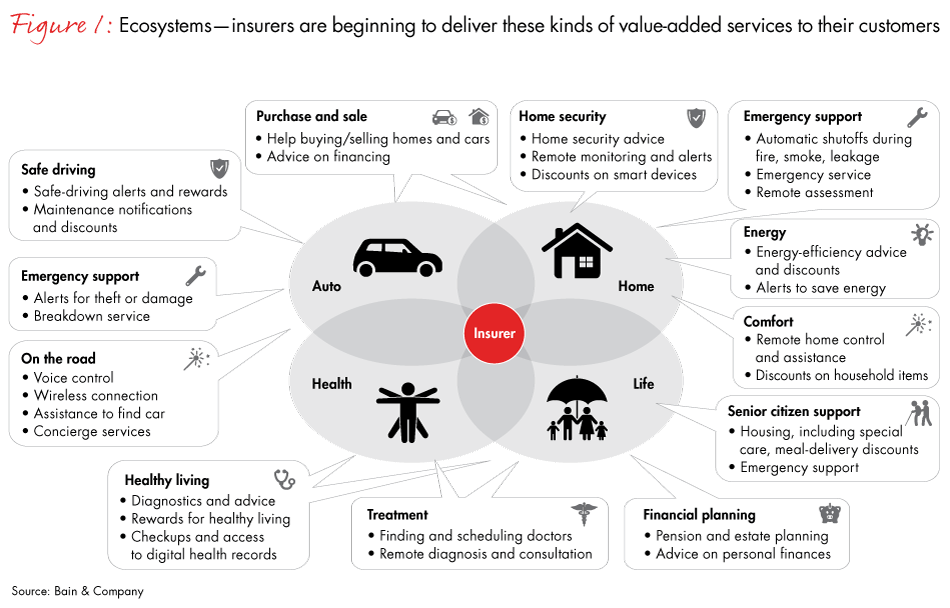
Forward-looking insurers are adopting a radically new approach. Taking their cues from companies in other commoditizing industries, these insurers are looking beyond their standard insurance products and offering value-added services that address broader consumer and business partner needs. They’re positioning themselves at the center of an ecosystem of interconnected services that includes noninsurance offerings such as smoke, intrusion and leakage monitors for the home; telematic sensors for vehicles that can be used to reward good driving or trigger maintenance alerts; health diagnostics and advice; and financial planning (see Figure 1).
Why are some insurers stretching the boundaries of their business? By developing an ecosystem of services beyond insurance, they can reinvent customer relationships, increase revenues and reduce costs. The Bain loyalty survey shows that, by offering ecosystem services, insurers are able to boost loyalty among existing customers, attract new customers and reduce price sensitivity across their customer base (see Figure 2).
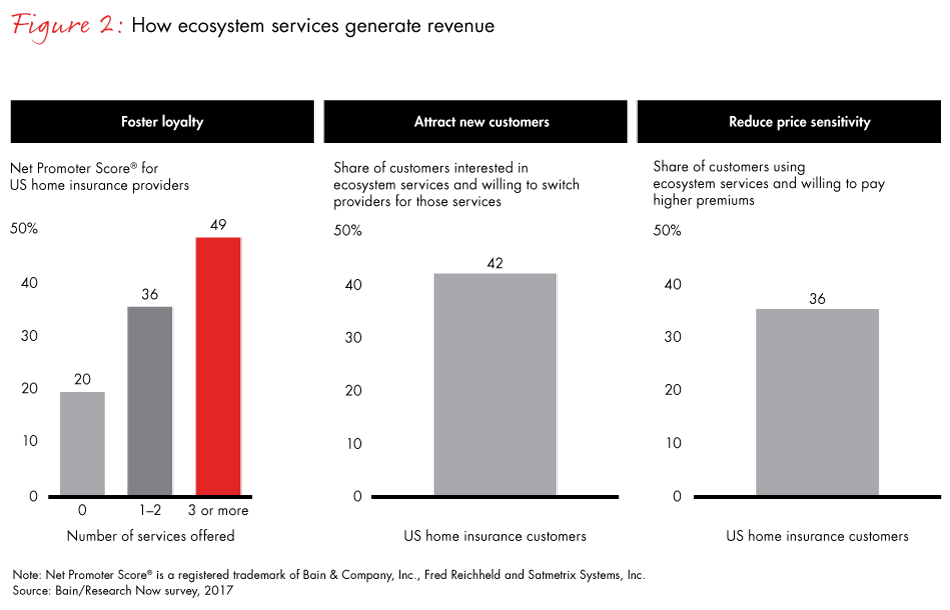
Around the world, across the four product groups (auto, home, health and life), insurance customers who use ecosystem services and have a positive experience give their carriers high loyalty scores—significantly higher than customers who use no ecosystem services at all. In major markets, a majority of customers interested in ecosystem services say they’re prepared to switch to an insurer that offers them—an indication that these services have the power to pull in new customers. And the Bain survey shows that policyholders are willing to pay higher premiums to insurers that offer ecosystem services—a strong sign that companies can use an ecosystem strategy to break free from the commoditization trap.
There are also knock-on effects that boost profitability. Many of these ecosystem services help people live healthier and safer lives, which, not coincidentally, can lead to fewer insurance claims. When insurers provide non-insurance services, they can gather new kinds of data and glean fresh insights into customer behavior. They can then use those insights to refine their offerings and increase the efficiency of their operations. In addition, insurers can collect commissions when they refer customers to other providers in their ecosystem, and they can receive fees for helping other companies develop their own ecosystem platforms.
The ecosystem approach may not be right, or necessary, for all insurers. Low-cost providers may choose to continue to compete on price. These companies can remain pure insurance players and focus on providing low-cost underwriting, efficient policy administration and a flawless claims experience. Any role these firms play in an ecosystem will be on the periphery, as suppliers. In this scenario, other ecosystem participants will control the customer interface and play an important role in channeling customers to the insurer.
A pure-play strategy can be effective, particularly when the insurer has powerful partners. Shanghai-based online insurer Zhong An, which is backed by Chinese tech giants Alibaba and Tencent and traditional insurer Ping An, has attracted more than 400 million customers since it was founded in 2013. Last year, Zhong An received close to 90% of its premiums from partner platforms.
When it comes to forming ecosystems, insurers face intense competition from noninsurers. Companies are vying for control of customer interactions. In automotive ecosystems, for example, Volkswagen, Tesla and other manufacturers offer insurance to car buyers, meaning the auto company, not the insurer, has command of the customer interface.
The Bain survey shows that insurers can resist these incursions by capitalizing on their customers’ enthusiasm for ecosystem services. In major markets, more than 80% of insurance customers are interested in, or open to, such services, and, in most countries, a majority of interested customers are open to having their insurer be the ecosystem’s central provider. Insurers that choose to play a leading role in an ecosystem can differentiate themselves from the competition—if they have a well-conceived strategy and are prepared to move quickly.
Henrik Naujoks, who leads Bain's Financial Services practice in Europe, the Middle East and Africa, states that although insurance can be a low-touch industry, ecosystem services can boost customer loyalty, increase revenues and reduce costs.
What customers want
Insurance customers around the world have clear, and strikingly similar, preferences when it comes to ecosystem services. The Bain survey indicates that they’re looking for safety, prevention, convenience and rewards for good behavior. Auto insurance customers rank breakdown and repair support, sensors and alarms that help deter theft and vandalism and locate stolen cars, and devices that monitor driving behavior as their most desired services.
Home insurance customers want systems that monitor their residences when they’re away, send alerts when there’s been damage or intrusion, and automatically take remediation steps, such as shutting off the water system in the case of a leaky pipe. Health and life insurance customers are looking for wellness exams, preventative tests, and expert guidance during treatment and recovery. While there are commonalities in consumer preferences across larger markets, insurers have to carefully select the services that best fit their target customer segments and have the greatest potential to generate meaningful benefits.
The ecosystem concept in insurance is still in its infancy. Across the 20 markets Bain surveyed, fewer than 10% of customers have used more than three ecosystem services, on average. Nonetheless, there are some note-worthy examples of insurers who have embraced the ecosystem approach.
In Brazil, Porto Seguro, the multiyear loyalty leader in property and casualty insurance, has created a constellation of more than 20 companies that offer customers roadside assistance, residential repairs, vehicle loans, consumer financing, credit and investment advice, and many other services. Porto Seguro has been able to steadily gain market share without competing aggressively on price. In 2016, global insurer AXA announced a groupwide plan to transform itself from “payer to partner,” by expanding services in areas such as vehicle sensors, home monitoring devices and digital health tools.
Building an ecosystem
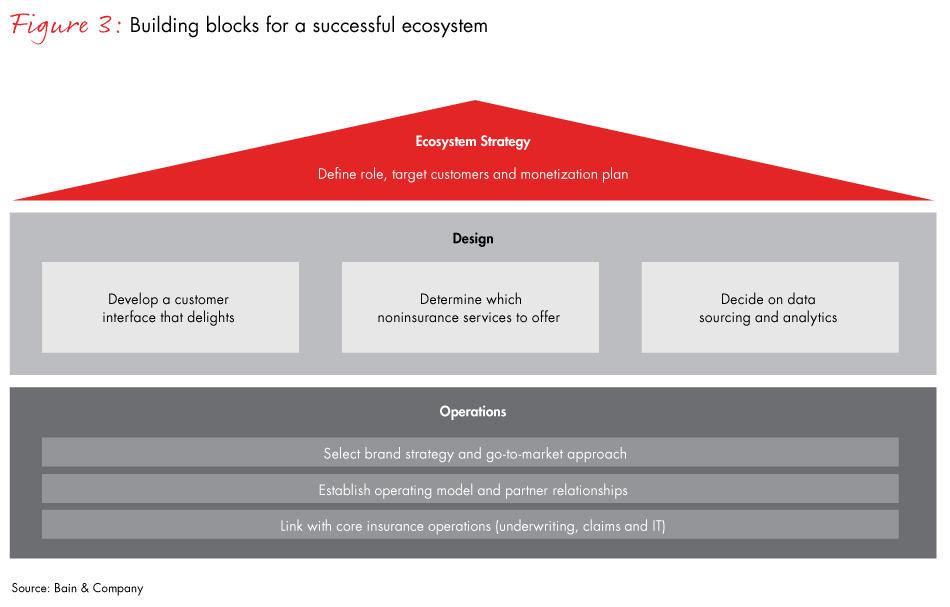
As they get ready to venture into an ecosystem, insurers will face a series of critical, and often challenging, decisions. Bain’s experience shows that these strategic choices are best tackled early on. Once this key preparatory work has been done, companies can move swiftly to matters of design and operations (see Figure 3). But it all begins with a three-pronged strategic approach:
-
Define your role in the ecosystem. Given your specific position in the market, what are the opportunities to establish an ecosystem? Do you want to be a sole owner or a co-owner of the system, or would it make more sense to be a supplier, with no ownership stake? Would partnering with a technology company, retailer or Big Data provider bring benefits such as a new pool of customers or fresh data and insights?
-
Select your target customers. Do you want to focus on your base of existing policyholders, or do you open your services and ecosystem fully or partially to prospects that are currently not, and may never be, policyholders?
-
Clarify how to make money. Do you expect ecosystem offerings to cover their costs? Do you want them to generate a separate revenue stream? Determine what the economics of the ecosystem should look like for your company, customers and partners—at the outset and over time.
The keys to success
Companies that are successful in an ecosystem understand the importance of delivering a differentiated and disruptive value proposition. They build customer engagement through innovative and personalized offerings that are regularly updated and refreshed. They provide incentives to attract customers to ecosystem services and keep them engaged over time. And they make it easy for customers to move seamlessly between insurance and noninsurance services.
Smart insurers drive for scale quickly. They target markets where they have commanding name recognition and a critical mass of customers. They create a strong branding taxonomy for the new services, and they promote the ecosystem aggressively. They pick their partners with care, leveraging the benefits specialized providers can bring, including a new customer pool, talent, IT and analytics.
Successful ecosystem providers recognize that they need to carve out clear routes to profitability. They negotiate contracts with partners that are good for customers, while also boosting profits. For example, offering discounts at wellness providers is a benefit for policyholders, but it also can generate new revenue, in the form of referral commissions.
Every step of the way, leading ecosystem players embrace the power of data. They tap the wealth of information that customers routinely provide about themselves. They use artificial intelligence to personalize interactions with customers and further refine their offerings. They also use the deep insights they gather from the ecosystem to help make their core insurance functions, especially under-writing and claims, more effective and efficient.
Insurers can get data in various ways. One relatively inexpensive method is to ask customers to self-report their daily activities, such as how often they exercise, but that approach is neither thorough nor reliable. More complete, and also more costly, approaches include garnering data from devices such as smartphones or wearables, or buying it from companies such as vehicle manufacturers.
Insurers building ecosystems can learn from insurtechs. That means understanding the urgency of developing a superior customer experience, and moving quickly, adopting an Agile operating model and a test-and-learn approach. Companies that deploy these techniques tend to collide with the reality of their often complex, costly and inflexible legacy IT architecture. If needed, they can take a staged approach to upgrading their IT, perhaps by starting with ecosystem applications and linking them selectively to existing technology, including the all-important customer relationship management system. Next, they can develop application program interfaces that connect the ecosystem to the broader application landscape. In the end, however, it is imperative for insurers to modernize their overall IT architecture in order to be ready for the future.
Ecosystems may not be a good fit for every insurer, particularly for low-cost carriers that can compete effectively on price. However, for insurers that do want to become the central player in an ecosystem, the time to move is now, fast and decisively—before competitors, both from within and outside the industry, lure away their customers. With a carefully crafted ecosystem strategy, insurers can expand their offerings, differentiate themselves in the eyes of their customers, build and sustain loyalty, and successfully fend off the threat of commoditization.
Henrik Naujoks is a partner in Bain & Company’s Zurich office and leads the firm’s Financial Services practice in Europe, the Middle East and Africa. Florian Mueller, Darci Darnell and Harshveer Singh are Financial Services partners based in Munich, Chicago and Singapore, respectively.
Net Promoter® , Net Promoter System® , Net Promoter Score® and NPS® are registered trademarks of Bain & Company, Inc., Fred Reichheld and Satmetrix Systems, Inc.
First published in 9月 2017