

The Visionary CEO’s Guide to Sustainability

概要
- Today’s CEOs speak less about sustainability but increasingly link it to business value (costs, customers, and capital).
- Twenty-five percent of industrial emissions can be cut with ROI-positive levers in reach today.
- Inflection points in sustainable technologies are coming fast, increasingly driven by industrial policy in fast-growing countries.
- CEOs must balance efficiency with robustness to withstand growing disruption.
This article is part of Bain's 2025 CEO Sustainability Guide
This time last year, sustainability was in a “trough of disillusionment.” After sweeping commitments and aspirational goal setting in 2021 and 2022, sustainability moved down the list of CEO priorities, and the challenges to deliver became real. Today, while sustainability remains below peak hype levels, our latest CEO data shows that the decline is bottoming out. Sustainability is slowly increasing as a CEO priority (see Figure 1).
Figure 1
Note: Based on aggregation of publicly available CEO surveys
Sources: IBM; Gartner; PwC; KPMG; Bain analysisHow can this be when there are constant headlines declaring that sustainability is dead?
While CEOs speak less about sustainability, they continue to act—a phenomenon we call the “do-say gap.” Analyzing over 35,000 statements made by 150 leading companies’ CEOs in 2018, 2022, and 2024, Bain’s AI-powered Sustainability Pulse tool identified a clear evolution in rhetoric. In 2018, most CEO comments focused on compliance and doing good for society. Today’s CEOs have moved from moral value to business value, aligning sustainability with core business risks and operational realities such as costs, customers, commercial motions, and capital investments. One case in point: Salespeople are incorporating sustainability into their pitches. The “quiet CEO” speaks less about sustainability, but when they do, they frame it as a concrete lever of business value (see Figure 2).
Figure 2
Note: The selected CEOs lead the top 50 companies by market capitalization in each of the Americas, EMEA, and Asia-Pacific regions, totaling 150 CEOs
Source: Roughly 2,000 audio/video files across major conferences, earnings calls, podcasts, etc.Despite this evolution in public rhetoric, there’s ample evidence of companies’ continued commitment and action. Companies are making their targets more, not less, ambitious. Between 2022 and 2025, 10% of companies increased their Science-Based Targets initiative (SBTi) ambitions, while only 4% scaled back. Two-thirds of companies are on track to achieve their Scope 1 and Scope 2 emissions targets.
Significant challenges remain. About half of companies are behind on their Scope 3 targets. This is not surprising. One of their key suppliers—energy executives—are recalibrating their net-zero outlook, according to Bain’s 2025 Energy Executive Agenda. Today, only 32% of these executives expect to reach net zero by 2050—down from nearly 40% last year. Some 44% project net zero won’t be reached until 2070 or later, up from less than one-third in 2024. This tension between the pace of change of upstream energy suppliers and the ambitions of their downstream customers is likely to continue.
And customers aren’t waiting. In our annual survey of B2B companies, half of buyers said they already assign more business to sustainable suppliers—an increase from last year. Like CEOs, leading B2B sellers recognize sustainability as a strategic driver of growth, a creator of value, and a competitive differentiator. Our annual survey of more than 14,000 consumers in eight countries finds consumers overloaded, worried about geopolitics, economic pressure, and many things beyond sustainability. Yet four out of five care deeply about the issue and reward companies that make innovative, affordable, and sustainable products.
Navigating this turbulent environment demands clarity and decisive action. In conversations with hundreds of companies and executives, it became clear that there are three questions every CEO must ask and answer to set the right ambition and define a practical, successful path forward.
1. How can we accelerate where sustainable impact and business value already align?
In just five years—the span of a typical CEO planning cycle—2030 sustainability targets will come due. The good news: Many of the levers required to meet those targets are already available and deliver business value.
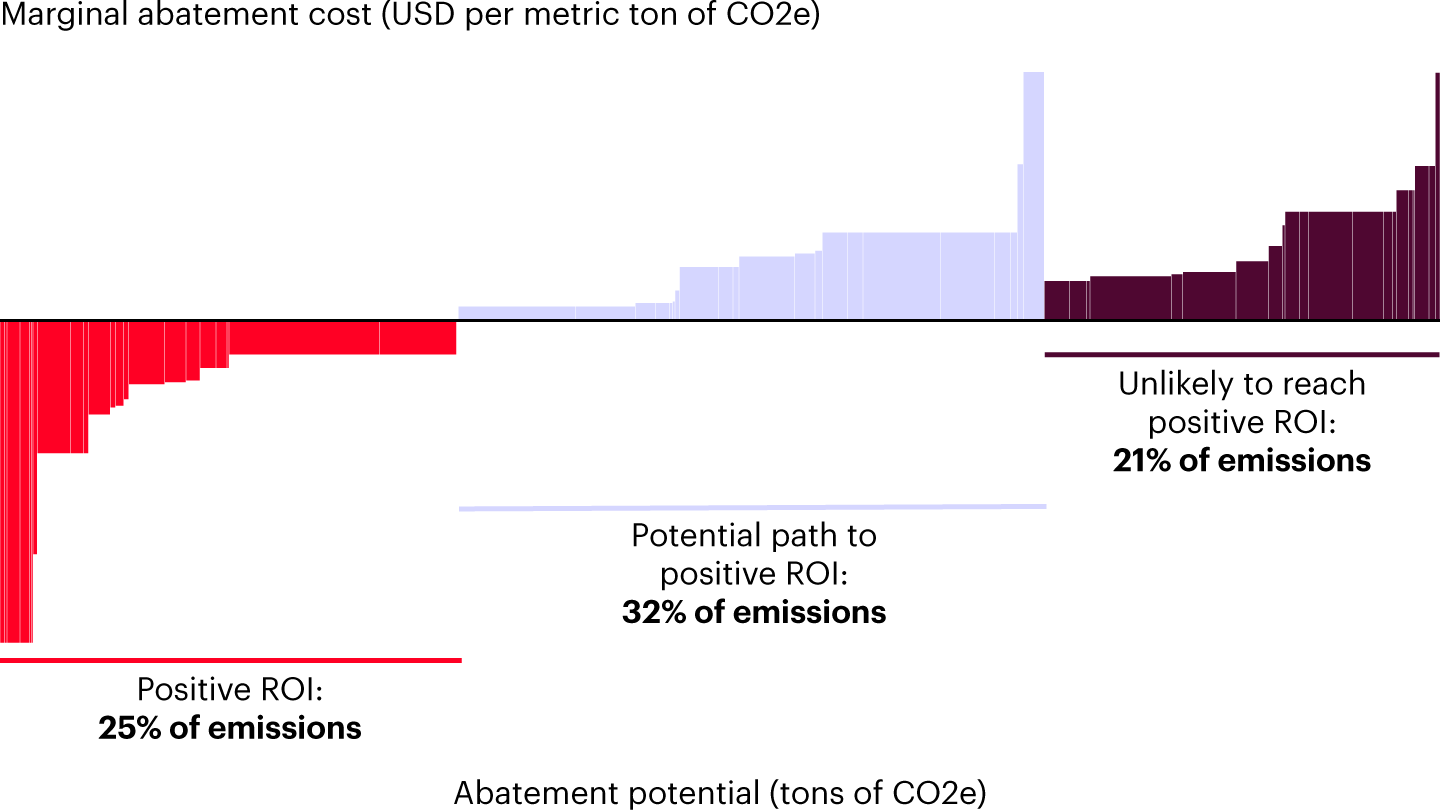
To quantify the share of global emissions that can be profitably abated, and the cost required, we used Bain’s proprietary Decarbonization Lever Library. We analyzed levers across 14 industries representing two-thirds of global emissions. Based on this analysis, levers that are already ROI-positive today can abate 25% of global CO₂ emissions (see Figure 3).
Figure 3

Note: Remaining emissions not covered by Bain Decarbonization Lever Library
Sources: Bain analysis; Bain Decarbonization Lever LibraryEach industry and company has opportunities. Most organizations have a good sense of the initiatives that deliver both sustainability and financial results. Some improve energy efficiency, while others build circular design or support supply chain localization. Companies should scale and accelerate these high-ROI levers and make them part of their business-as-usual decision making.
Consider a European agricultural company with big sustainability ambitions. It had identified ROI-positive levers to cut farm emissions by more than 30%, but due to farmers’ heavy workload, manual processes, limited farmer tools, and cultural resistance, only about a third of that potential had been undertaken. To address this, the company launched a clear incentive structure and a digital platform. By prioritizing initiatives and automating or prepopulating 80% of the more than 200 data points farmers needed to track, the platform enabled traceable progress. The result: reduced friction, marketable transparency, and new revenue from premium products, which the company reinvested into farms to further drive sustained impact and farmer buy-in.
2. How do we anticipate the next disruption in policy, technology, and customer behavior?
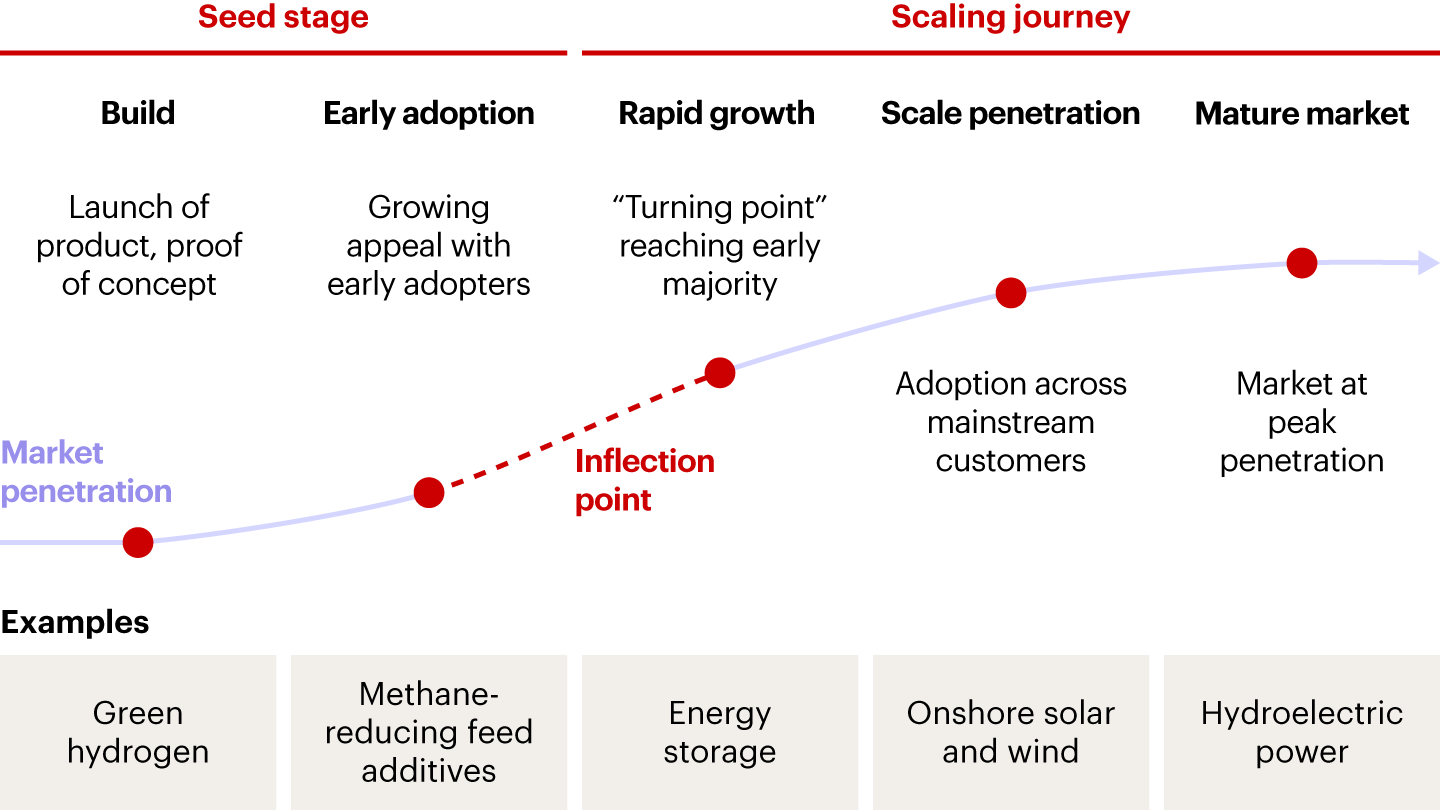
Deploying ROI-positive levers will not be enough. Companies must anticipate what’s next. By our calculation, an additional 32% of emissions can be abated with levers that have the potential to be ROI positive in the medium term. The rate at which these levers progress will be shaped by three forces: policy, technology, and customer behavior. The interplay of these forces creates inflection points—moments that mark a step change in the market’s trajectory, reshaping competition, profit pools, and growth (see Figure 4).
Figure 4

Note: In examples, maturity indicated is that of the most advanced geography and can differ by region
出所 Bain analysisThis year, of the three levers, diverging regional policies have had the greatest effect on progress. The US is rolling back the Inflation Reduction Act, including key environmental provisions. The EU is easing sustainability regulations with the Omnibus deal. By contrast, some of the world’s fast-growing economies are increasingly using transition-oriented industries as a cornerstone of industrial policy. These countries invest in sustainable industries in order to grow their economies, increase energy security, and build geopolitical power. Through regulatory guidelines, tightly controlled supply chains, and access to critical raw materials, these countries accelerate technological development and inflection points.
Aided by supportive policies, a number of sustainable technologies are already moving toward their inflection point. These include batteries in China and green hydrogen in the Middle East. More are coming.
Two of China’s key political objectives are self-reliance—reducing the need for energy imports—and green development, in part to improve air quality. When Beijing identified battery costs as the chokepoint to electric mobility, it moved on three fronts. First, promoting R&D investments through the Made in China 2025 mandate. Next, national champions CATL and BYD scaled rapidly on the back of supportive industrial policy, which also secured access to critical raw material supply and refining capacity. (China now refines 70% of global battery-grade lithium and 90% of battery-grade graphite.) Finally, falling prices, high product quality, and dense charging infrastructure combined to drive faster EV adoption than in the West (see Figure 5). Today, China has a scale and cost advantage in both electric vehicles and grid storage.
Figure 5


注 Battery costs are based on battery pack and cells for volume vehicles (60kWh battery pack size) with high safety standards; assumes three-year average prices for lithium; 2025 and 2030 bars are projections
Sources: Bain & Company; analyst reports; IHS Markit/S&P Mobility (Jan 2024)To anticipate and capitalize on these new inflection points, leaders prioritize future-sensing, early signal detection, and swift scaling. They are prepared to move quickly as dynamics change, cost curves shift, and new profit pools emerge. Remaining flexible is important because technology costs rarely fall in a straight line. The levelized cost of utility-scale solar, for example, has plummeted since 2010, much faster than any forecast. As a result, adoption has been faster than expected, disrupting the sector and surprising many companies.
3. How do we build a robust (eco)system that bends but doesn’t break?
The remaining levers—covering close to 50% of emissions—are likely to remain ROI-negative beyond 2050. This means pragmatic CEOs must prepare their organization for a world of accelerating disruption—from climate change to geopolitical realignments and technological leaps. To succeed, companies must become more resilient and robust.
The concept of robustness, borrowed from biology, offers a compelling blueprint. As French scientist Olivier Hamant notes, natural systems thrive in uncertain environments not through optimization, but through redundancy, diversity, and adaptability. These so-called “inefficiencies” serve as shock absorbers and enable long-term resilience.
This stands in sharp contrast to the prevailing corporate model, in which optimization often strips out slack. Hyper-efficient systems and streamlined supply chains, though valuable in stable environments, are often brittle in volatile ones.
The challenge for today’s CEOs is to balance the needs of short-term cost efficiency with longer-term robustness. Robust organizations make resilience a design principle. They build supply redundancy to limit their exposure to extreme conditions in specific regions. They master real-time sensing systems to anticipate and quickly respond to changing conditions. And they maintain a broad portfolio of climate levers, even those not yet ROI-positive, and are ready to activate them as conditions change.
These actions will not just impact individual companies. The choices of anchor firms—large influential companies that have an impact far beyond their own four walls—will influence the broader ecosystem, including customers, value chains, and regulators. Leading CEOs focus not only on building robust companies, but also on strengthening the ecosystems around them.
These are some of the lessons that have been taken to heart by leading banks as they look to become more robust in a volatile climate and regulatory landscape. Some have begun integrating climate risk into their lending decisions—mapping high-risk sectors and stress-testing borrowers against future climate scenarios. Recognizing that resilience can’t be built alone, executives are partnering with borrowers and insurers to reduce and spread the risk. The result: more robust portfolios, reduced exposure to hidden vulnerabilities, and more adaptive internal systems.
Looking forward
With 2030 targets now visible on the horizon, sustainability has shifted from aspiration to execution. Accelerate what works. Anticipate what’s coming. Build strength and flexibility. And bring these three questions to your next boardroom conversation. They’re a starting point for action that’s both strategic and sustainable.
Read our 2025 CEO Sustainability Guide
More from the report
First published in 9月 2025